
Loose batteries are easy to misplace, mix up, or leave in a drawer where their terminals can contact metal objects. The best battery organizer cases for beginners make it simpler to sort common sizes, check charge, and keep spare cells protected.
This roundup compares 10 options, from compact holders for everyday household use to larger cases designed for extensive battery collections. Look for the capacity, portability, tester, and safety features that fit your routine.
Best 10 Battery Organizer Cases for Beginners Picks for 2026
Best High-Capacity Pick
Ontel Battery Daddy 180-Battery Case

- Stores up to 180 batteries across six common types
- Includes a battery tester
- Clear locking lid and portable handle
Best For: Large households and emergency kits
Best Compact Pick
Dial Industries Battery Storage Case
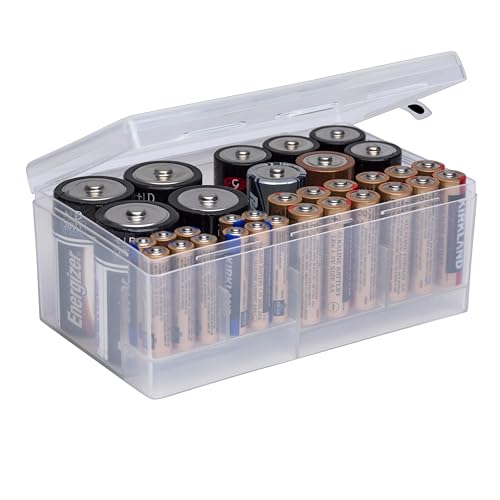
- Organizes AAA, AA, C, and D batteries
- Clear snap lid for quick visibility
- Compact size suits small storage spaces
Best For: Small collections and everyday household storage
Best Wall-Mountable Pick
Amazon Basics 110-Battery Case

- Holds up to 110 batteries
- Includes a 1.5V and 9V battery tester
- Supports wall mounting or carrying
Best For: Organized storage in garages, utility rooms, and workshops
Best Extra-Large Pick
Molutsody 260-Battery Organizer

- Stores up to 260 mixed battery types
- Includes a built-in battery tester
- Locking lid and handle support secure portability
Best For: Large, mixed battery collections and workshops
Simple Starter Set

- Four clear boxes for AA and AAA batteries
- Up to 48 batteries per box
- Movable dividers and locking latches
Best For: Beginners organizing mostly AA and AAA batteries
Best for Everyday Use

- Holds up to 150 mixed-size batteries
- Includes a built-in battery tester
- Double-sided case with clear cover and handle
Best For: Households storing several battery types in one case
Maximum Protection Choice
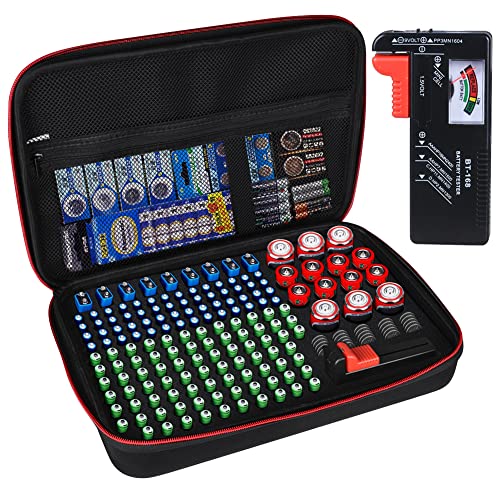
- Holds more than 200 mixed-size batteries
- Fireproof and waterproof construction
- Foam slots and included BT-168 tester
Best For: Large collections needing protective, portable storage
Clear Compact Pick
Beginner Battery Organizer Case

- Clear cover for quick battery identification
- Holds up to 61 common-size batteries
- Includes tester and hard protective shell
Best For: Households needing compact, visible battery storage
High-Capacity Starter

- Organizes up to 200 AA and AAA batteries
- Foam slots separate battery contacts
- Includes tester and six extra pockets
Best For: Large household battery collections and tool boxes
All-Size Portable Pick
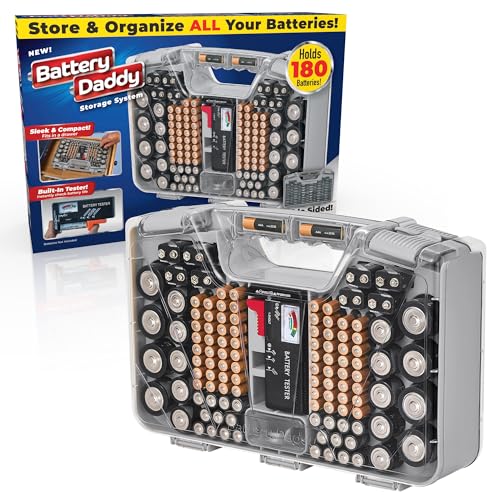
- Stores up to 180 batteries in six sizes
- Clear locking lid and carrying handle
- Includes tester for single-use and rechargeable batteries
Best For: Mixed-size battery storage and emergency kits
Best High-Capacity Pick – Ontel Battery Daddy 180-Battery Case
For beginners looking for battery organizer cases for beginners, the Ontel Battery Daddy offers a straightforward way to sort common battery sizes in one portable case. Its double-sided layout, clear cover, locking latches, and included tester make household battery storage easy to manage.
Best For: Households, emergency kits, and users who need to store many battery types.
Pros:
- Stores up to 180 batteries, including AA, AAA, C, D, 9-volt, and coin cells.
- Includes a tester for checking single-use and rechargeable batteries.
- Clear locking lid, secure latches, and carrying handle support portable storage.
Cons:
- Batteries are not included.
- At 2.2 pounds, it is heavier than smaller organizers.
The large capacity is useful if your battery collection is spread across drawers and shelves. Beginners should appreciate the visible compartments and tester, though the case may be more storage than needed for a small collection.
Best Compact Pick – Dial Industries Battery Storage Case
If you are new to battery organization, the Dial Industries case keeps the setup simple by assigning compartments to AAA, AA, C, and D batteries. Its compact footprint makes it a practical choice among battery organizer cases for beginners who want a small, easy-to-carry solution.
Best For: Small battery collections in kitchens, utility rooms, garages, or travel bags.
Pros:
- Dedicated compartments keep four battery sizes separated.
- Clear snap lid makes the contents easy to see.
- Compact design measures approximately 2.75 by 6.5 by 3.75 inches.
- Backed by a one-year manufacturer’s defect warranty.
Cons:
- Does not list storage for 9-volt or coin-cell batteries.
- Holds fewer batteries than the larger cases in this roundup.
This is a sensible starter organizer when you mainly use standard household batteries and do not need a tester. Its smaller capacity is also its advantage for beginners with limited storage space.
Best Wall-Mountable Pick – Amazon Basics 110-Battery Case
The Amazon Basics case gives beginners a flexible way to organize batteries on a shelf, in a drawer, or on a wall. For anyone comparing battery organizer cases for beginners, its transparent cover, carrying handle, and included tester provide useful visibility and basic battery checks.
Best For: Users who want medium-capacity storage with wall-mounting flexibility.
Pros:
- Holds up to 110 batteries, including AA, AAA, C, D, 9V, and coin cells.
- Includes a tester for 1.5V and 9V batteries.
- Can be carried or wall mounted.
- Transparent cover allows the contents to be viewed without opening.
Cons:
- It is not water resistant.
- The lift-off lid may be less secure than a locking-latch design.
This model balances capacity and accessibility without being as large as the highest-capacity option. Its wall-mountable design can help keep batteries visible and off crowded work surfaces.
Best Extra-Large Pick – Molutsody 260-Battery Organizer
Beginners with a varied or growing battery collection may prefer the Molutsody organizer for its large capacity and broad compatibility. It combines molded compartments, a tester, and a double-layer locking lid in a case designed for home, garage, RV, or workshop storage.
Best For: Users who need maximum capacity for mixed standard, rechargeable, and button-cell batteries.
Pros:
- Holds up to 260 batteries in AA, AAA, C, D, 9V, button-cell, and rechargeable formats.
- Built-in tester helps identify remaining battery power.
- Clear double-layer locking lid helps protect contents from dust, moisture, and accidental opening.
- Built-in handle supports portability.
Cons:
- Batteries are not included.
- Its 1.17-kilogram weight and large capacity may be excessive for small collections.
The Molutsody is aimed at comprehensive battery management rather than minimal storage. Its broad compatibility makes sorting easier, but beginners should consider whether they have enough batteries to justify this larger case.
Simple Starter Set – Clear AA/AAA Battery Boxes
For beginners building a battery routine, the GlossyEnd set offers a straightforward way to sort AA and AAA cells. Four clear boxes, movable dividers, locking latches, and an included tester make this a practical pick among battery organizer cases for beginners.
Best For: Beginners who mainly use AA and AAA batteries and want separate, portable cases.
Pros:
- Four boxes provide dedicated AA and AAA storage.
- Each box holds up to 48 batteries.
- Movable dividers can create smaller sections or separate live and dead batteries.
- Clear, high-impact plastic and locking latches make contents easy to see and secure.
Cons:
- Does not accommodate the broad range of battery sizes listed for some larger organizers.
- Batteries are not included.
- The cases are not water resistant.
This set is a sensible entry point if your household mostly relies on AA and AAA cells. Its multiple cases make sorting simple, though users with C, D, 9V, or button batteries will need additional storage.
Best for Everyday Use – Ontel Battery Daddy Organizer
The Ontel Battery Daddy is designed for beginners who want one portable case for a broad household battery collection. Its double-sided layout, clear cover, carrying handle, heavy-duty latches, and included tester make it an approachable choice among battery organizer cases for beginners.
Best For: Households that use multiple battery sizes and want high capacity in one compact organizer.
Pros:
- Stores up to 150 batteries, including AA, AAA, C, D, 9V, and button cells.
- Double-sided design uses space efficiently and fits in drawers or on shelves.
- Clear cover provides an at-a-glance view of the collection.
- Built-in tester checks single-use and rechargeable batteries.
Cons:
- Its listed capacity is lower than the larger 200-plus-battery case.
- The product has no warranty listed.
- Batteries are not included.
Choose this organizer when convenience and broad compatibility matter more than maximum capacity. The tester and carrying handle are especially useful for beginners managing batteries throughout the home.
Maximum Protection Choice – Fireproof Battery Vault
Beginners who want extensive storage and added protection can use this fireproof battery vault to organize more than 200 batteries. Individual foam slots, a tester, a zipper closure, and a durable carrying design make it a feature-rich option among battery organizer cases for beginners.
Best For: Users with large, mixed battery collections who prioritize protective construction and portability.
Pros:
- Stores more than 200 AA, AAA, C, D, 9V, and button batteries.
- Fireproof, waterproof, shockproof, and dustproof materials are designed for added protection.
- Pre-cut foam slots keep batteries separated and secure.
- Includes a BT-168 tester and a durable handle.
Cons:
- Its larger capacity and protective construction may be more than a small collection needs.
- Individual slots may take longer to load than open compartments.
- Batteries are not included.
This is the strongest fit for a growing collection or for users who want a protective case for storage and travel. Its capacity and protective features are useful, but a smaller box may be simpler for basic AA/AAA needs.
Clear Compact Pick – Beginner Battery Organizer Case
For beginners comparing battery organizer cases for beginners, this compact EVA case offers an uncomplicated way to keep common battery sizes together. Its clear cover makes the contents easy to identify, while the included tester helps check remaining power before use.
Best For: Households that want a compact, portable organizer for frequently used AA, AAA, 9V, C, and D batteries.
Pros:
- Clear cover provides quick visibility without opening the case.
- Holds up to 61 batteries across several common sizes.
- Hard shell helps protect batteries from impacts and drops.
- Includes a battery tester for checking remaining power.
Cons:
- Its single-compartment design may offer less separation than multi-compartment cases.
- Batteries are not included.
This is a straightforward starter option when visibility, portability, and a basic tester matter more than maximum capacity or highly customized storage.
High-Capacity Starter – Tenergy 200-Battery Organizer
Among battery organizer cases for beginners, the Tenergy is a practical choice for users who want a clearly structured storage system from the start. Foam slots organize up to 100 AA and 100 AAA batteries, while extra pockets accommodate loose or specialty batteries.
Best For: Larger households, hobbyists, and tool-box users who regularly keep substantial AA and AAA supplies on hand.
Pros:
- Stores up to 200 batteries, including 100 AA and 100 AAA.
- Foam slots help keep battery contacts from touching.
- Six extra pockets hold loose batteries, shrink-wrapped packs, and button cells.
- Includes a tester compatible with alkaline, NiMH, and NiCd batteries.
Cons:
- Its 11.5-by-9.6-by-3.5-inch size requires more storage space.
- The case is not water resistant.
- Batteries are not included.
The Tenergy favors capacity and organization over minimal size, making it a sensible beginner case for anyone building a larger, orderly battery supply.
All-Size Portable Pick – Ontel Battery Daddy Organizer
For beginners seeking battery organizer cases for beginners that cover many battery types, the Ontel Battery Daddy provides labeled capacity across two sides. Its clear locking lid, carrying handle, and included tester make it easy to store and check batteries for household devices or emergency kits.
Best For: Users who need portable storage for mixed-size batteries, including AA, AAA, 9V, C, D, and coin cells.
Pros:
- Holds up to 180 batteries across six battery types.
- Clear cover allows the contents to be viewed at a glance.
- Locking lid, latches, and built-in handle support portable storage.
- Tester checks both single-use and rechargeable batteries.
Cons:
- Its 13.27-inch length may be less convenient for smaller drawers.
- It is not water resistant.
- Batteries are not included.
This is the most versatile choice of the three for mixed battery collections, especially when portability and broad size coverage are more important than a slim profile.
How We Picked These Battery Organizer Cases for Beginners
We focused on the features that matter most to first-time buyers: battery capacity, compatibility with common AA and AAA cells, support for C and D batteries where applicable, portability, visibility, and included testing tools. We also considered whether each case suits a drawer, shelf, wall, emergency kit, or larger household collection.
Capacity claims can vary by battery size and arrangement, so treat stated maximums as guidelines rather than guarantees. A case that holds fewer batteries may be more useful if it is easier to carry, label, and access.
Quick Comparison
| Best For | What to Look For |
|---|---|
| Small household supply | Compact case with clearly separated AA and AAA slots |
| Large collections | Double-sided or high-capacity organizer with a secure closure |
| Emergency storage | Protective construction, tester, and a portable handle |
| Wall or shelf organization | Wall-mounting capability or a stable, easy-to-read layout |
| Mixed battery sizes | Dedicated spaces for AA, AAA, C, D, and 9V batteries |
Key Buying Factors for Battery Organizer Cases for Beginners
Capacity and Battery Compatibility
Start by counting the batteries you currently own and allow room for a small backup supply. Most households primarily use AA and AAA cells, while C, D, and 9V batteries require differently shaped compartments. Avoid paying for oversized storage if you only need a compact organizer for a few devices.
Tester and Battery Visibility
An integrated tester can help identify weak batteries before you install them in a remote, flashlight, toy, or controller. Clear lids and labeled slots make it easier to see what you have without emptying the case. Remember that a basic tester indicates condition at the time of testing; it does not replace a charger or a detailed battery analyzer.
Protection and Portability
Choose a secure lid, protected terminals, and sturdy construction to reduce accidental contact, damage, and clutter. A handle is useful for moving supplies between rooms or storing them in an emergency kit. If you need specialized fireproof, waterproof, or explosion-resistant protection, check the manufacturer’s exact specifications and certifications rather than relying only on marketing language.
Placement and Organization
Wall-mounted designs save drawer space, while slim cases work well in cabinets. Separate rechargeable and disposable batteries, keep new and used cells apart, and store batteries in a cool, dry location away from loose metal objects.
Who Should Buy Which Battery Organizer Cases for Beginners?
Choose a compact multi-size case if you are organizing a modest household supply or want a simple starter option. A large double-sided organizer is better for families, workshops, or homes that keep batteries for many devices. Select a case with a handle for emergency preparedness or frequent transport, and consider a wall-mountable model when quick visibility matters more than maximum portability.
For beginners, the best choice is usually the smallest case that fits your current battery collection while leaving enough room to sort cells by size and condition. That approach keeps the organizer manageable and makes it easier to maintain over time.