
If you need a large-room air cleaner with H13 HEPA filtration, odor control, and a quiet nighttime setting, this Hepa 235 CFM air purifier review covers the important trade-offs.
Its strongest fit is a household that wants automatic monitoring and broad contaminant coverage without giving up bedroom-friendly controls.
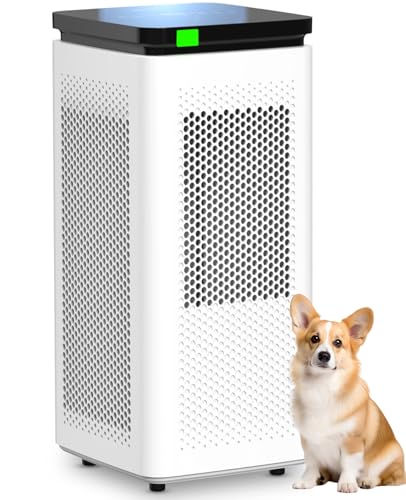
Hepa Air Purifier Review Summary
The Hepa 235 CFM H13 True HEPA Air Purifier is designed for homes that need more than a small desktop cleaner.
Its 235 CFM CADR, dual-sided airflow, H13 True HEPA filter, and activated carbon layer give it a sensible feature set for large living rooms, open areas, basements, offices, and homes with pets or cooking odors.
The listing says it can clean 500 square feet in 15 minutes and cover up to 3,500 square feet; those figures are manufacturer-provided coverage claims, so room layout, ceiling height, doors, and operating speed will affect real-world results.
This purifier makes the most sense for buyers who want one floor-standing unit with automatic fan control, visible PM2.5 feedback, and a dedicated sleep mode. It is less compelling for someone who needs a compact travel unit, wants a documented set of detailed specifications beyond the listing, or prefers not to plan for periodic filter replacement.
Review Scorecard
| Category | Score | Buyer assessment |
|---|---|---|
| Large-room airflow | 9/10 | The listed 235 CFM CADR and dual-inlet design are strong on paper for spacious rooms and open areas. |
| Particle filtration | 9/10 | H13 True HEPA is specified at 0.1 micrometers and 99.97% filtration, according to the listing. |
| Odor and smoke control | 8/10 | The activated carbon filter is intended for smoke, VOCs, and everyday odors, though odor results depend on source and filter condition. |
| Bedroom usability | 9/10 | A listed 30 dB Sleep Mode, panel dimmer, and timer make overnight use a clear strength. |
| Automatic monitoring | 8/10 | The PM2.5 display and Auto Mode add useful feedback and hands-off operation. |
| Maintenance clarity | 8/10 | A replacement indicator helps, with replacement suggested every three to four months based on use and air conditions. |
| Safety and efficiency features | 8/10 | The listing names child lock, ENERGY STAR certification, and certifications including CARB, DOE, EPA, and UL. |
Key Features and Specifications of Hepa Air Purifier
The central specification is a 235 CFM CADR paired with dual-sided airflow.
That combination is aimed at moving a substantial amount of room air through the filter system, rather than relying on a low-output fan suitable only for a small personal space.
The stated application range reaches from bedrooms and offices to large living rooms, basements, open-concept homes, and pet activity areas.
The filtration system combines two jobs.
The H13 True HEPA layer is listed as capturing 99.97% of particles at 0.1 micrometers, while the activated carbon filter is intended to reduce odors, smoke, VOCs, and other gaseous household smells.
That makes the design relevant to homes dealing with dust, pollen, pet dander, pet hair, cigarette smoke, wildfire smoke, and cooking-related odors.
The evidence supports describing these as the contaminants the filter is designed to address; it does not establish that every source will disappear immediately or completely.
The purifier also includes a built-in air-quality monitor with a digital PM2.5 display.
In Auto Mode, the fan adjusts according to detected air quality, which can reduce the need to change speeds manually as conditions shift.
This is particularly useful around cooking, pets, or dusty everyday activity, when a fixed fan setting may be either unnecessarily loud or too conservative.
For nighttime use, the listed Sleep Mode reduces noise to 30 dB.
A panel dimmer lets you reduce the brightness of the controls, and the timer adds another way to limit operation to a chosen period.
Child Lock is intended to prevent unwanted control changes in shared spaces, while the floor-standing format keeps the unit positioned as a whole-room appliance rather than a tabletop accessory.
Energy and compliance claims are also part of the product pitch.
The listing identifies the purifier as ENERGY STAR certified and gives consumption of as little as 0.66 kWh per day based on ENERGY STAR test data.
It also names CARB, DOE, EPA, and UL certifications.
These claims may provide useful reassurance, but buyers who need certification documentation for a specific installation should verify the applicable paperwork and exact product identity before purchase.
Maintenance is relatively straightforward.
A filter replacement indicator is intended to signal when service is due, and the listing recommends replacing the filter every three to four months depending on usage and air conditions.
The recommended replacement options are genuine SIESEAN filters, searchable on Amazon by B0FVFQQXDR or B0GWLKWCGS.
Ongoing filter cost and availability should therefore be included in the ownership decision, especially in smoky, dusty, or pet-heavy environments.
Pros and Cons of Hepa Air Purifier
Pros
- Strong stated airflow for large spaces: The 235 CFM CADR and dual-sided intake are well matched to the product’s large-room positioning.
- Broad filtration target: H13 True HEPA addresses particles, while activated carbon is included for smoke, VOCs, and odors.
- Useful nighttime controls: 30 dB Sleep Mode, a dimmer, and a timer support bedroom use and light sleepers.
- Helpful automation: PM2.5 feedback and Auto Mode make it easier to respond to changing indoor conditions.
- Family-oriented controls: Child Lock and a floor-standing design suit shared living areas.
- Maintenance reminder: The replacement indicator reduces guesswork about filter changes.
Cons
- Large-room claims are conditional: The stated 3,500-square-foot coverage will depend heavily on room configuration and operating speed.
- Filter upkeep is recurring: Replacement every three to four months may be frequent for heavily used or polluted spaces.
- No detailed independent test results are supplied here: The available evidence is listing information, not hands-on or laboratory verification.
- A floor-standing unit needs dedicated space: It may be excessive for a desk, small nursery, or single-person office.
- Carbon performance is use-dependent: Activated carbon can help with odors and smoke, but severe or continuous sources may require source control and ventilation as well.
Who Should Buy Hepa Air Purifier?
This is a good match for pet owners who want a unit aimed at dander, pet hair, dust, and everyday odors.
It also suits households with smokers or occasional smoke concerns because the listing specifically combines carbon filtration with HEPA particle filtration.
The Auto Mode and PM2.5 display are useful for people who would rather let the purifier respond to changing conditions than adjust the fan repeatedly.
It is also a sensible candidate for a bedroom, child’s room, living room, basement, or office where overnight noise and display brightness matter.
The 30 dB Sleep Mode, dimmer, timer, and Child Lock give it a more complete daily-use control set than a basic fan-and-filter appliance.
Skip it if your main need is a very small purifier for a desk or compact room.
You may also want another option if you cannot accommodate regular filter replacements, if you need verified performance for a specialized environment, or if your room has a persistent pollution source that requires ventilation or professional remediation in addition to filtration.
Large-Room Air Purifier Buying Analysis
CADR Versus Coverage Claims
The most useful way to interpret the product is to start with its 235 CFM CADR rather than the maximum square-foot number alone.
CADR describes the purifier’s listed clean-air output, while the advertised coverage is a broader use-case claim.
A closed 500-square-foot room may behave differently from a 3,500-square-foot open floor plan with high ceilings and multiple air paths.
HEPA and Carbon Do Different Jobs
The H13 layer is the particle-focused component for dust, pollen, dander, and smoke particles.
The carbon layer is aimed at odors, VOCs, and other gaseous compounds.
Buyers should value the combination, but should not treat the purifier as a substitute for removing mold, fixing a leak, stopping smoke at its source, or improving ventilation.
Auto Mode Versus Manual Control
Auto Mode is convenient when indoor conditions vary throughout the day, while Sleep Mode is more appropriate when quiet operation is the priority.
The PM2.5 display gives the user a visible reason for fan changes, but the display should be viewed as an operating aid rather than a complete measurement of every indoor pollutant.
Filter Replacement as a Budget Item
The indicator and stated three-to-four-month interval simplify maintenance, but they also make consumables part of the long-term cost.
Before buying, check that the recommended SIESEAN replacement filters remain available and that their timing fits your expected usage.
Alternatives to Hepa Air Purifier
If you want to compare similar categories on Amazon, consider these credible alternatives:
- Coway Airmega air purifiers are worth comparing if you prioritize an established large-room purifier line with automatic operation.
- Levoit Core air purifiers offer a broad range of room sizes and are useful for buyers who want to compare compact and whole-room formats.
- Winix air purifiers are another established option for shoppers comparing HEPA-and-carbon filtration with automated air-quality features.
- Blueair Blue Pure air purifiers may appeal to buyers focused on a different approach to high-volume room air cleaning and a simple control experience.
Is Hepa Air Purifier Worth It?
The Hepa 235 CFM H13 True HEPA Air Purifier is worth considering when your priorities are large-room airflow, particle filtration, odor coverage, quiet sleep operation, and automatic monitoring in one floor-standing unit.
Its strongest evidence-based advantages are the listed 235 CFM CADR, H13 HEPA plus activated carbon design, 30 dB Sleep Mode, PM2.5 display, Auto Mode, Child Lock, and filter reminder.
The main caution is to keep the coverage claim in context.
This is a promising fit for large rooms and households with pets, smoke, dust, or odors, but actual results depend on room layout, pollutant source, fan setting, and timely filter replacement.
Buy it if those controls and the broad filtration package match your home; choose a smaller or more specialized purifier if your space, maintenance needs, or verification requirements point elsewhere.