
The best 360-degree cameras make it easy to capture an entire scene, then choose the framing later. That flexibility is useful for action sports, travel, real estate, meetings, and immersive content.
We selected 10 cameras spanning premium 8K models, compact action cameras, professional capture tools, and meeting-focused webcams. Use the guide below to match resolution, stabilization, durability, and workflow to your needs.
Best 10 360-Degree Cameras Picks for 2026
Best Low-Light Pick

- 8K/30fps capture with dual 1/1.28-inch sensors
- AI processing for improved low-light footage
- Waterproof design with replaceable lenses
Best For: Adventure creators and low-light filming
Best for Meetings
j5create 360 Degree Meeting Webcam
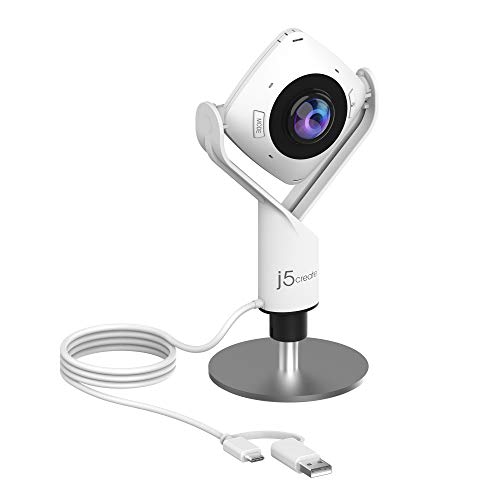
- 360-degree coverage with six display modes
- 1080p video at 30 Hz
- Built-in omnidirectional microphone
Best For: Conference rooms and group video calls
Best Value Action Pick

- 5.7K 360-degree Active HDR video
- 4K single-lens shooting mode
- Waterproof body with stabilization and Horizon Lock
Best For: Action sports, travel, and vlogging
Best Built-In Storage Combo

- 8K/30fps video and 120MP 360-degree photos
- 105GB built-in storage with up to 190 minutes of recording
- Includes invisible selfie stick and extra battery
Best For: Travel and action creators needing long recording capacity
Lightweight 8K Pick
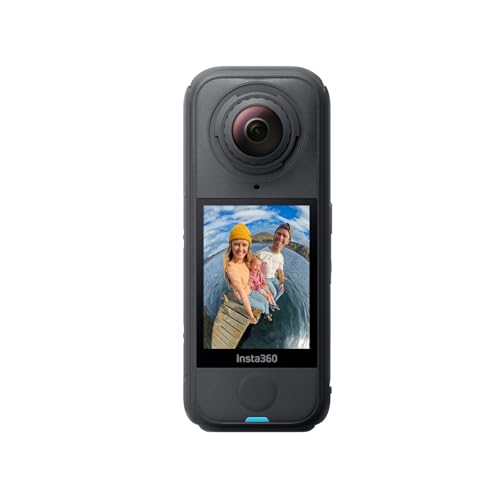
- 165g compact design
- 8K30fps 360 video
- Replaceable lenses and FlowState stabilization
Best For: Portable travel and family 360-degree footage
Best for Everyday Use
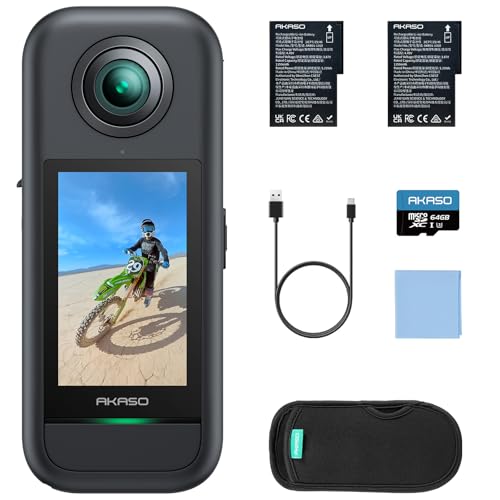
- 5.7K 360 video
- 72MP 360-degree photos
- AI tracking with 64GB card included
Best For: Action recording and high-resolution 360 photos
Low-Light Adventure Pick

- 8K30fps with large dual sensors
- Waterproof to 49 feet
- Up to 208 minutes of battery life
Best For: Low-light, underwater, and extended action recording
Professional Detail

- 11K stills up to 60MP
- 5.7K video with stabilization
- RAW, GPS, touchscreen, and expandable storage
Best For: Professional photography, mapping, and virtual tours
Pocket Adventure Pick
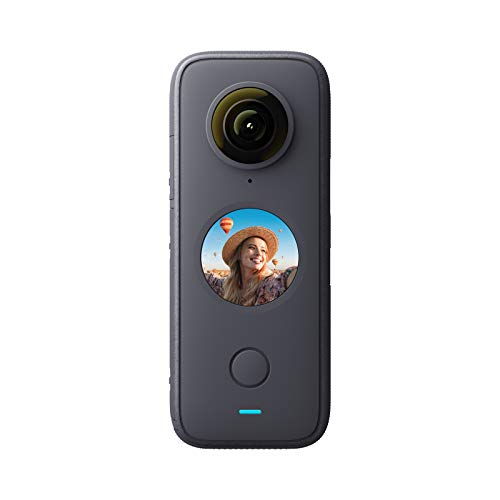
- 5.7K 360 video capture
- FlowState stabilization and horizon leveling
- 10-meter waterproof design
Best For: Travel, action sports, and stabilized handheld footage
Action Editing Choice

- 5.6K30 spherical video
- Quik app reframing and object tracking
- 360 and single-lens HERO modes
Best For: Action sports, POV footage, and flexible social-video creation
Best Low-Light Pick – Insta360 X5
The Insta360 X5 is a premium choice among 360-degree cameras for creators who want highly detailed footage in changing light. Its dual 1/1.28-inch sensors support 8K/30fps recording, while stabilization, replaceable lenses, and waterproof construction suit demanding action and travel use.
Best For: Adventure videographers, vloggers, and night or low-light shooting.
Pros:
- 8K/30fps 360-degree video from dual large sensors.
- Triple AI chip design improves low-light processing.
- FlowState stabilization and 360-degree Horizon Lock help keep footage smooth and level.
- Waterproof body, replaceable lenses, and approximately 208-minute battery life.
Cons:
- Its advanced feature set may be more than casual users need.
- MicroSD storage is required for recording.
The X5 stands out when image quality, ruggedness, and reframing flexibility matter most. InstaFrame mode also provides a quicker flat-video workflow when you do not want to edit the full 360-degree capture.
Best for Meetings – j5create 360 Degree Meeting Webcam
The j5create 360 Degree All Around Meeting Webcam is a practical option among 360-degree cameras for meetings, online classes, and group collaboration. It combines Full HD 1080p video with an omnidirectional microphone and six display modes, all through a USB plug-and-play setup.
Best For: Conference rooms, remote classes, and team calls with multiple participants.
Pros:
- 360-degree video coverage with six viewing and display modes.
- Full HD 1080p video at 30 Hz.
- Built-in omnidirectional microphone for meeting audio.
- Works with Zoom, Microsoft Teams, Google Meet, Skype, and other listed platforms.
Cons:
- It is not water resistant.
- Fixed focus and no image stabilization limit its use for moving subjects.
- App permissions or a firmware update may be needed for optimal operation.
This webcam is designed for communication rather than action capture. Its broad coverage and selectable layouts make it useful when several people need to appear in the same call without repositioning the camera.
Best Value Action Pick – Insta360 X3
The Insta360 X3 remains a versatile entry in the 360-degree cameras category, pairing 5.7K 360-degree Active HDR video with a 4K single-lens mode. Its waterproof body, FlowState stabilization, and AI-assisted reframing make it suitable for action footage, travel, and vlogging.
Best For: Motorcycle riders, winter-sports users, travelers, and vloggers seeking flexible capture modes.
Pros:
- 5.7K 360-degree Active HDR recording with post-capture reframing.
- 4K30fps wide-angle mode and 2.7K60fps 170-degree MaxView option.
- Waterproof design with FlowState stabilization and Horizon Lock.
- 2.29-inch touchscreen supports on-camera control.
Cons:
- Its maximum 360-degree resolution is lower than newer 8K models.
- Battery and storage details may require additional planning for longer shoots.
The X3 is a balanced choice for creators who want both immersive 360-degree footage and conventional wide-angle video. It offers strong stabilization and straightforward reframing without requiring a separate action camera.
Best Built-In Storage Combo – DJI Osmo 360
The DJI Osmo 360 Essential Combo is a feature-rich option among 360-degree cameras, offering 8K/30fps video, a 1-inch 360-degree imaging system, and 120MP 360-degree photos. Its included 1.2-meter invisible selfie stick, extra battery, and 105GB of built-in storage make it well suited to extended travel and action shoots.
Best For: Travelers and action creators who want high resolution, included accessories, and internal storage.
Pros:
- 8K/30fps 360-degree video and 120MP 360-degree still photos.
- 1-inch imaging supports sharper low-light footage.
- 105GB built-in storage and up to 190 minutes of recording.
- Includes a 1.2-meter invisible selfie stick and an extra battery.
Cons:
- The DJI Mimo app must be downloaded from the official DJI website because it is unavailable on Google Play.
- Fixed focus may be less flexible for certain close-up subjects.
The Osmo 360 is particularly appealing for users who want to start shooting immediately without relying solely on a memory card. Its magnetic quick-release system and single-lens mode also support fast transitions between 360-degree capture and vlogging.
Lightweight 8K Pick – Insta360 X4 Air
The Insta360 X4 Air is a strong choice for shoppers who want lightweight 360-degree cameras without giving up 8K video. At 165g, it is easy to carry, while shoot-first, frame-later capture and AI editing simplify the process of finding shareable angles after recording.
Best For: Travelers, families, and creators who prioritize portability, 8K capture, and flexible reframing.
Pros:
- Lightweight 165g design is convenient for travel and everyday use.
- 8K30fps 360 video captures detailed footage from every angle.
- FlowState stabilization and 360-degree Horizon Lock help keep footage smooth and level.
- Replaceable lenses can reduce the need to replace the entire camera after lens damage.
Cons:
- It is not water resistant, so wet-weather use requires caution.
- The invisible selfie stick is sold separately.
- High-resolution 8K recording may require substantial microSD storage.
The X4 Air stands out when weight and creative flexibility matter most. Its 8K recording, stabilization, and app-based reframing make it approachable for beginners, though its lack of water resistance limits some action-oriented use.
Best for Everyday Use – AKASO 360
The AKASO 360 is one of the more feature-packed 360-degree cameras for action users who want 5.7K video and high-resolution stills. Its digital stabilization, Horizon Steady, and AI subject tracking are designed to make moving footage easier to capture and edit.
Best For: Budget-conscious adventurers who want 360 video, 72MP photos, and a 64GB card included in the standard combo.
Pros:
- 5.7K 360 video provides immersive footage with useful detail.
- Dual 1/2-inch 48MP sensors support sharp images and 72MP 360-degree photos.
- AI subject tracking and shoot-first, frame-later capture simplify recording action.
- Water-resistant design and approximately 60-minute battery life suit shorter outings.
Cons:
- The included battery is rated for about 60 minutes of average use.
- The invisible selfie stick effect requires a separately purchased selfie stick.
- Digital stabilization may be less versatile than a hybrid stabilization system.
The AKASO 360 offers a compelling mix of resolution and creative tools, especially for buyers who want strong photo specifications and bundled storage. Its shorter stated battery life is the main consideration for extended adventures.
Low-Light Adventure Pick – Insta360 X5 Essentials Bundle
The Insta360 X5 Essentials Bundle is built for demanding outdoor use among 360-degree cameras, combining 8K30fps recording with dual 1/1.28-inch sensors and enhanced low-light processing. It also includes an invisible selfie stick, carry case, lens guards, and a fast-charge case.
Best For: Adventure creators who need waterproofing, improved low-light performance, long battery life, and included shooting accessories.
Pros:
- 8K30fps video and large dual sensors support detailed footage with improved dynamic range.
- Triple AI chip processing is designed to reduce noise in dim or nighttime scenes.
- Waterproof to 49 feet and rated for up to 208 minutes of battery life.
- Replaceable lenses, built-in wind reduction, and included selfie stick add practical value.
Cons:
- The microSD card is sold separately.
- Its listed 1.42 kg weight is substantially higher than the X4 Air.
- The waterproof rating is specified to 49 feet, so deeper diving requires additional protection.
The X5 is the most capable pick here for wet, extended, or low-light adventures. Its Essentials Bundle is particularly convenient because it includes key accessories, while the heavier design and separate memory-card requirement are worth factoring into the purchase.
Professional Detail – Ricoh Theta X 360° Camera
The Ricoh Theta X is a strong choice for creators who want high-resolution 360-degree cameras footage and still images. Its 11K, 60-megapixel still capture, 5.7K video, RAW support, built-in GPS, and large touchscreen make it suited to detailed travel, property, mapping, and professional content workflows.
Best For: Professional photographers, virtual-tour creators, and users who need high-resolution files, GPS data, and extended shooting flexibility.
Pros:
- Captures 11K 360-degree still images up to 60 megapixels.
- Records 5.7K 360-degree video at 30 fps with image stabilization.
- Supports HDR-DNG RAW recording for extensive editing.
- Includes built-in GPS, an OLED touchscreen, interchangeable battery, and external memory.
Cons:
- Its professional feature set may be more than casual users need.
- Some high-resolution video modes have operating restrictions when wireless LAN is active or when using certain power configurations.
The Theta X stands out among 360-degree cameras for its exceptional still-image resolution and more advanced capture options. Choose it when image detail, RAW editing, GPS data, and flexible storage matter more than having the smallest action-camera design.
Pocket Adventure Pick – Insta360 ONE X2 360 Camera
The Insta360 ONE X2 is a compact option for users who want versatile 360-degree cameras footage on the move. It combines 5.7K 360 capture with FlowState stabilization, a touchscreen, AI editing tools, voice control, and IPX8 waterproofing for active outdoor use.
Best For: Travelers, action-sports users, vloggers, and anyone who wants stabilized 360 footage without carrying a gimbal.
Pros:
- Records 5.7K 360-degree video at up to 30 fps.
- FlowState stabilization and horizon leveling help keep footage steady.
- Waterproof to 10 meters without a case.
- Supports live streaming, webcam use, voice control, and AI-assisted editing.
Cons:
- Battery life is listed at approximately 80 minutes.
- Still-image resolution is 18 megapixels, below the Ricoh Theta X’s stated resolution.
The ONE X2 is a practical all-rounder for spontaneous shooting, especially when stabilization and weather resistance are priorities. Its compact body and editing features make it easier to capture and share reframed clips from travel or action footage.
Action Editing Choice – GoPro MAX 360 Camera
The GoPro MAX is built for action-focused creators who want 360-degree cameras footage alongside traditional single-lens shooting. It records 5.6K30 spherical video, supports 3K60 slow motion, offers waterproof construction and stabilization, and works with the GoPro Quik app for reframing and object tracking.
Best For: Action sports, family activities, POV recording, and users who want 360 and conventional video modes in one camera.
Pros:
- Captures 5.6K30 spherical video without requiring precise framing.
- GoPro Quik supports reframing, object tracking, photo grabs, and transitions.
- Offers single-lens HERO mode for standard video, photos, and time lapse.
- Includes waterproofing, stabilization, an Enduro battery, and stealth mounting support.
Cons:
- Single-lens video is limited to 1080p or 1440p modes.
- At 13.12 ounces, it is heavier than the Insta360 ONE X2 listed here.
- The supplied specifications list a 2-inch screen with a maximum display resolution of 2K.
The GoPro MAX makes sense for users who value flexible reframing and the option to switch between spherical and traditional action-camera footage. Its Quik app workflow and included mounting accessories add convenience for fast-moving, shareable content.
How We Picked the Best 360-Degree Cameras
We compared the selected models by image quality, video resolution, stabilization, waterproofing, battery design, portability, controls, software features, and intended use. We also considered practical differences between true 360-degree capture, traditional single-lens shooting, webcam functionality, and professional still-image applications.
Specifications such as 8K recording or high-resolution stills matter, but they are not the only deciding factors. Lens protection, replacement options, editing tools, battery life, and how easily footage can be reframed may have a greater effect on everyday satisfaction.
Quick Comparison
| Best For | Look For | Notable Options |
|---|---|---|
| Premium action video | 8K capture, stabilization, rugged construction | Insta360 X5, DJI Osmo 360 |
| Lightweight travel | Low weight, compact body, simple reframing | Insta360 X4 Air, Insta360 X3 |
| Value-focused recording | Core 360 capture and accessible pricing | AKASO 360, GoPro MAX |
| Virtual tours and professional stills | High-resolution photos, GPS, touchscreen controls | Ricoh Theta X |
| Meetings and remote collaboration | All-around room coverage and webcam compatibility | j5create 360 Degree All Around Meeting Webcam |
Key Buying Factors for 360-Degree Cameras
Resolution and Reframing
Because a 360 camera spreads its image around the entire sphere, higher resolution generally preserves more detail after you crop or reframe. 8K models are particularly useful for outputting sharp perspective video, while 5.7K cameras can be a sensible balance of quality, storage, and price.
Stabilization and Lens Protection
For biking, hiking, skiing, or handheld movement, electronic stabilization helps keep footage watchable. Dual exposed lenses can be vulnerable, so replaceable lens systems and included guards are valuable for frequent outdoor use.
Waterproofing, Battery, and Storage
Check the camera’s waterproof rating, whether a case is required, expected recording time, and battery-swapping options. High-resolution video consumes storage quickly, making fast, high-capacity memory cards and a convenient transfer workflow important.
Editing and Connectivity
Look for mobile and desktop apps that support automatic reframing, subject tracking, invisible selfie-stick effects, live streaming, and exports in your preferred format. A touchscreen, voice control, or webcam mode can also make setup faster.
Who Should Buy Which 360-Degree Cameras?
Choose a premium Insta360 or DJI model if you want the strongest combination of resolution, stabilization, action durability, and creative reframing. These are the best fit for creators and active travelers who regularly edit footage.
Choose the Insta360 X3, X4 Air, AKASO 360, GoPro MAX, or ONE X2 if you want a more approachable entry point, a lighter setup, or a balance between 360 capture and conventional video. Match the model to your preferred app, waterproofing needs, and required resolution.
Choose the Ricoh Theta X for high-detail still images, property documentation, virtual tours, and professional workflows. Choose the j5create webcam for conference rooms and remote meetings rather than outdoor action recording.