
If you’re looking to enhance your firing experience, you’ll want to explore the best digital kiln controllers of 2025. These advanced tools provide precise temperature control, user-friendly designs, and essential safety features. Whether you’re a hobbyist or a professional, finding the right controller can profoundly impact your results. Let’s take a closer look at the top models that are making waves in the market this year.
PID Temperature Controller Kit with SSR Solid State Relay and Thermocouple Sensor
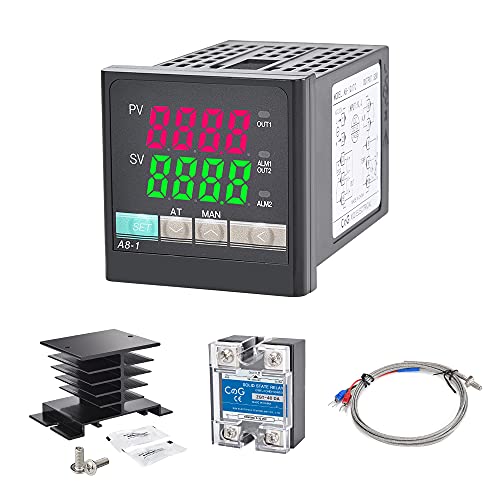
If you’re looking for precise temperature control in your projects, the PID Temperature Controller Kit with SSR Solid State Relay and Thermocouple Sensor is an excellent choice. Operating on AC 100~240V, it includes a reliable SSR 40DA, a K Type Thermocouple, and a black heat sink. This compact kit features an LCD that displays both Celsius and Fahrenheit, making it user-friendly. Many users appreciate its performance in applications like cigar humidors and electric smokers. However, be mindful of potential temperature inaccuracies and setup challenges; accessing certain settings may require additional resources like YouTube for clearer guidance.
Best For: This product is best for hobbyists and professionals seeking precise temperature control for applications like cigar humidors and electric smokers.
Pros:
- Easy-to-read LCD display supports both Celsius and Fahrenheit.
- Includes a reliable SSR 40DA and K Type Thermocouple for effective temperature management.
- Compact design makes it suitable for various projects and installations.
Cons:
- Users have reported significant temperature inaccuracies, particularly at higher temperatures.
- Setup instructions can be unclear, with some settings requiring external resources like YouTube for guidance.
- Some units were reported as defective, leading to customer returns.
K-Type Thermocouple Block Ceramic Kiln Insulator Sensor Probe

The K-Type Thermocouple Block Ceramic Kiln Insulator Sensor Probe stands out as an essential tool for artists and manufacturers working in high-temperature environments, ensuring accurate temperature readings up to 2372 °F (1300 °C). Made from durable ceramic, it features an 8-gauge thermocouple for reliable measurements. The 3.3 ft wire extension keeps the measuring device safely outside the heat zone. It connects easily to digital thermometers or temperature controllers, making it versatile for kilns, furnaces, and more. Although user experiences vary, its ease of installation and performance make it a valuable choice for precise temperature monitoring in your projects.
Best For: Artists and manufacturers working in high-temperature environments who require accurate temperature monitoring.
Pros:
- Durable ceramic construction ensures longevity in high-heat applications.
- 3.3 ft wire extension allows the measuring device to remain outside the heat zone for safety.
- Compatible with digital thermometers and temperature controllers for versatile usage.
Cons:
- Some users report inconsistencies in temperature readings across different units.
- Varied user experiences, with ratings ranging from poor to highly recommended.
- Installation may be challenging for those unfamiliar with thermocouple setups.
Coiliiot PID Temperature Controller with LCD Display
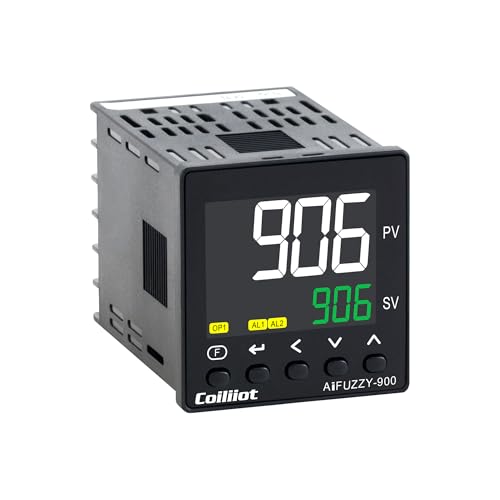
For those seeking precision in temperature control, the Coiliiot PID Temperature Controller with LCD Display stands out as an excellent choice in the domain of digital kiln controllers. Designed for versatile applications, it supports both relay and SSR output, handling up to 5A resistive load without extra components. The clear LCD screen allows you to switch between °C and °F easily, while the dual alarms protect against overheating. Operating at temperatures up to 1800°C, it’s compatible with various thermocouples and RTDs. Although setup can be tricky, its reliability in performance makes it a favorite among users.
Best For: The Coiliiot PID Temperature Controller is best for hobbyists and professionals needing precise temperature control in applications like kilns, brewing, and reptile habitats.
Pros:
- Versatile Output: Supports relay and SSR output, making it suitable for various heating devices.
- High Temperature Range: Operates effectively at temperatures up to 1800°C, accommodating a wide range of applications.
- User-Friendly Display: Clear LCD with °C/°F switching and dual alarms for user convenience and safety.
Cons:
- Initial Setup Difficulty: Users may find the setup process challenging, requiring adjustments for optimal performance.
- Limited Instructions: Some users report a lack of detailed guidance for installation and troubleshooting.
- Weight: At 5.3 ounces, it may be considered slightly heavier compared to other similar devices, which could affect mounting options.
KT8230 Digital Temperature Controller Thermostat Regulator

Looking for a reliable way to manage temperature in your home or hobbyist environment? The KT8230 Digital Temperature Controller Thermostat Regulator could be your perfect solution. Operating at 120VAC with a 30A capacity, it covers a wide temperature range from -22℉ to 572℉. You’ll appreciate its 1°F accuracy and customizable differential settings for precise control. Plus, the delay start feature lets you tailor heating or cooling operations. With built-in alarms and user-friendly design, the KT8230 guarantees safe and effective temperature management. Enjoy the flexibility of the 2m NTC sensor for all your temperature needs!
Best For: Hobbyists and homeowners looking for an accurate and reliable temperature management solution for various applications such as incubators, greenhouses, and reptiles.
Pros:
- Wide temperature range of -22℉ to 572℉, suitable for diverse environments.
- 1°F accuracy with customizable differential settings for precise control.
- User-friendly design with built-in alarms for safety and a flexible 2m NTC sensor.
Cons:
- Requires a 120VAC power source, which may limit placement options.
- Initial setup may require calibration for optimal performance, depending on user needs.
- Relay system may have wear over time, potentially affecting long-term reliability.
AGPtek Universal Digital PID Temperature Controller
Designed for both hobbyists and professionals, the AGPtek Universal Digital PID Temperature Controller offers exceptional precision with its dual display that shows both Fahrenheit and Celsius readings. This versatile controller has a measurement range from -1999 to 9999, depending on the input signal. Its main output features a relay with a capacity of AC 250V/3A and DC 30V/3A, ensuring reliable performance. Plus, with PID cooling and heating control, you can customize your firing process effortlessly. The software-selectable alarm output includes two lines and seven alarm modes, giving you peace of mind during your projects. Enjoy enhanced control and accuracy with AGPtek!
Best For: The AGPtek Universal Digital PID Temperature Controller is best for hobbyists and professionals seeking precise temperature control in various applications.
Pros:
- Dual display allows for easy reading of temperatures in both Fahrenheit and Celsius.
- Wide measurement range from -1999 to 9999 accommodates various input signals.
- Customizable control with PID cooling/heating and multiple alarm modes enhances project reliability.
Cons:
- Relay output limitations (AC 250V/3A and DC 30V/3A) may not be suitable for high-power applications.
- Complexity of setup and configuration may be challenging for beginners.
- Limited documentation could hinder troubleshooting and user understanding of advanced features.
PID Temperature Controller, Digital Display K Type
The PID Temperature Controller, Digital Display K Type, MC901, stands out as an ideal choice for professionals in industries requiring precise temperature management, such as powder coating and food processing. It features a built-in chip that enhances sensitivity and accuracy, allowing you to monitor temperatures with a resolution of 0.1℃/0.1℉. With both relay and SSR output options, you can adapt it to your specific needs. Compact and durable, its flame-retardant housing is waterproof and dustproof, making it reliable in various conditions. Customers praise its ease of programming and consistent performance, earning it a 4.8 out of 5-star rating.
Best For: Professionals in industries requiring precise temperature control, such as powder coating and food processing.
Pros:
- Built-in chip enhances sensitivity and accuracy for optimal temperature management.
- Compact and durable design with waterproof and dustproof features for reliability in various conditions.
- High customer satisfaction with a 4.8 out of 5-star rating, highlighting ease of programming and consistent performance.
Cons:
- Some users have noted that the casing is lightweight, which may raise concerns about durability.
- Requires appropriate knowledge for installation and programming, which may not be suitable for all users.
- Limited to K Type PT100 sensors, which may restrict flexibility for users with different sensor requirements.
Jaybva PID Temperature Controller for Industrial Automation

For professionals in industries like ceramics or food and beverage, the Jaybva PID Temperature Controller stands out with its capability to support a wide range of thermocouples, guaranteeing precise temperature readings across various applications. Operating between 100V to 240V, it features a dual LED display, allowing you to easily read temperatures in both Fahrenheit and Celsius. With built-in autotuning and a read range of -199°C to 1800°C, it optimizes PID results effectively. Its seven output combinations enhance versatility, making it perfect for devices like kilns and incubators. The power-off memory function guarantees your settings are preserved, adding to its convenience.
Best For: Professionals in the ceramics, food and beverage, and industrial automation sectors seeking reliable temperature control solutions.
Pros:
- Highly Versatile: Supports multiple thermocouple types (K, J, E, and Pt100) for a wide range of applications.
- User-Friendly: Dual LED display for easy temperature reading in both Fahrenheit and Celsius.
- Efficient Control: Built-in autotuning feature optimizes PID results for precise temperature regulation.
Cons:
- Limited Read Range: Maximum temperature limit of 1800°C may not be suitable for all high-temperature applications.
- Size Constraints: Compact mounting size may pose challenges in installations with limited space.
- Dual Output Complexity: While versatile, managing multiple output options may require additional configuration knowledge.
VEVOR Electric Kiln for Wax Casting and Pottery

If you’re an artist seeking a reliable and efficient kiln for wax casting and pottery, the VEVOR Electric Kiln stands out with its professional design and portability. With a powerful 1500W heating element, it reaches a maximum temperature of 2192℉, perfect for melting metals and glazing pottery. The PID digital control system allows precise temperature monitoring and customization for your projects. Weighing 38.6 pounds, it’s easy to move. While it has a solid rating of 4.1 stars, be aware of potential customer service issues and calculate power costs based on your local electricity rates before purchasing.
Best For: Artists and hobbyists looking for a portable and efficient kiln for wax casting, pottery glazing, and metal tempering.
Pros:
- High-performance 1500W heating element allows for quick melting of materials.
- Convenient PID digital control system for precise temperature management.
- Compact and portable design suitable for tabletop use.
Cons:
- Lacks programmable temperature ramping, limiting advanced temperature control.
- Some users report concerns regarding heating efficiency.
- Customer service experiences may vary, with potential responsiveness issues.
Inkbird All-Purpose Digital Temperature Controller (ITC-1000)

Versatile and user-friendly, the Inkbird All-Purpose Digital Temperature Controller (ITC-1000) is perfect for hobbyists and professionals alike who need precise temperature control in their kilns. You can easily switch between Fahrenheit and Celsius, ensuring it meets your preferences. Set your desired temperature and difference value for accurate readings, thanks to its temperature calibrating feature. With two relays, you can effortlessly toggle between cooling and heating modes. Plus, built-in alarms alert you when temperatures exceed set limits or if there’s a sensor error. The delay protection enhances safety, making the ITC-1000 a reliable choice for your firing needs.
Best For: Hobbyists and professionals who require precise temperature control in their kilns.
Pros:
- Versatile display options with Fahrenheit and Celsius settings.
- Accurate temperature control with calibration and adjustable difference values.
- Safety features including alarms for temperature limits and sensor errors.
Cons:
- May require a learning curve for users unfamiliar with digital controllers.
- Limited to two relays, which may not be sufficient for complex setups.
- Initial setup might be time-consuming for those who prefer plug-and-play devices.
Bayite Temperature Controller BTC211 for Heating and Cooling
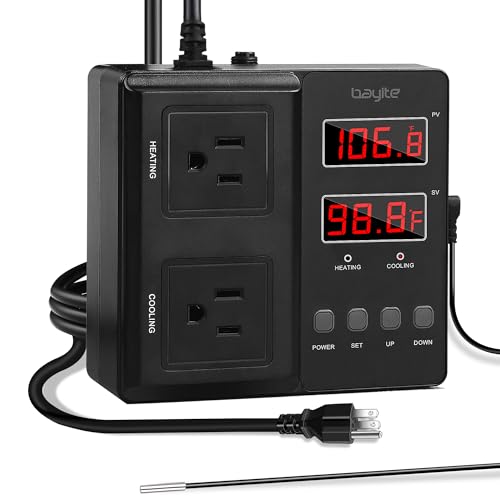
The Bayite Temperature Controller BTC211 stands out as an ideal choice for those who require precise temperature management in both heating and cooling applications. With a 1650W capacity and dual relay output, you can control both heating and cooling equipment seamlessly. Its user-friendly design allows for easy plug-and-play operation, displaying temperatures in °C or °F. The waterproof probe sensor provides accurate readings within 0.1°F, ensuring stability. Plus, you’ll appreciate the high and low temperature alarms and compressor delay protection that prevent rapid cycling. With a one-year warranty and responsive customer service, it’s a reliable investment for your temperature control needs.
Best For: The Bayite Temperature Controller BTC211 is best for individuals seeking precise temperature control for both heating and cooling systems in various applications.
Pros:
- Reliable performance with accurate temperature readings often within 0.1°F.
- User-friendly design allows for easy plug-and-play operation and dual temperature display.
- Compressor delay protection prevents rapid cycling, enhancing the longevity of connected equipment.
Cons:
- Some users report initial inaccuracies in temperature readings, particularly in the morning.
- Adjustments may be needed for AC unit thermistors to optimize performance.
- Power failure recovery may raise concerns, though the unit generally resumes expected function after outages.
Factors to Consider When Choosing a Digital Kiln Controller
When choosing a digital kiln controller, you’ll want to take into account several key factors. Think about the temperature range capabilities and control features that suit your specific needs. Additionally, assess the controller’s compatibility with thermocouples, user interface design, and safety systems to guarantee a smooth and secure operation.
Temperature Range Capabilities
Choosing a digital kiln controller involves considering multiple factors, and one of the most vital is its temperature range capabilities. The range dictates what materials you can process, with common limits from 32°F to 2372°F (0°C to 1300°C), and advanced models reaching up to 1800°C. A wider range offers versatility for various applications, like metal tempering and pottery glazing, which require different heat settings. Accurate control within this range, often with a resolution of 0.1°C/0.1°F, guarantees successful results. Additionally, stability and consistency are essential to prevent thermal shock or uneven firing, which can compromise your final product. So, consider these factors carefully to enhance your firing experience.
Control Features and Functions
As you navigate the selection of a digital kiln controller, it is vital to evaluate the control features and functions that will best suit your needs. First, consider the temperature range; opt for controllers that cover from 32°F to 2372°F (0°C to 1300°C) for high-heat applications. Look for models with dual output options, like relay and SSR, to enhance versatility for different heating elements. An autotuning function is significant, as it adjusts PID settings automatically for peak control. Safety features, such as built-in alarms for temperature limits or sensor errors, can prevent equipment damage and guarantee your safety. Finally, a user-friendly interface with a clear LCD display that allows easy switching between Celsius and Fahrenheit enhances usability.
Compatibility With Thermocouples
To guarantee accurate temperature management in your kiln, it is crucial to select a digital kiln controller that supports the specific type of thermocouples you’ll be using, such as K, E, J, N, or PT100. Compatibility with thermocouples directly impacts the controller’s ability to monitor and manage temperatures effectively across various applications, including kilns and furnaces. Consider controllers that offer dual sensor compatibility, as this enhances versatility, allowing you to switch thermocouple types based on your needs. Also, check the measurement range supported by the controller; some can operate up to 2372°F (1300°C). Finally, verify the controller features autotuning and calibration options for the thermocouple, maintaining precise temperature control and addressing any discrepancies in readings.
User Interface Design
When it comes to selecting a digital kiln controller, the user interface design greatly impacts your experience and efficiency. A user-friendly interface with a clear LCD display lets you easily monitor temperatures and make adjustments in both Celsius and Fahrenheit. Intuitive navigation menus help you set parameters without needing extensive technical knowledge. Multi-function buttons streamline operations, giving you quick access to features like alarm settings and calibration. Visual feedback, such as color-coded indicators, enhances your experience by immediately showing system status or temperature deviations. Plus, customizable settings allow you to tailor the interface to your specific needs, resulting in improved usability and efficiency during operation. Choose wisely to optimize your kiln firing process!
Safety and Alarm Systems
Choosing the right digital kiln controller involves more than just user-friendly features; safety and alarm systems are essential elements that can protect both you and your equipment. Look for controllers with built-in alarms that activate if temperature limits are exceeded or sensor errors occur, enhancing your safety. Delay start functions are also valuable, allowing you to set a specific time before heating begins, minimizing the risk of overheating. Controllers with dual alarms can prevent overheating or device failure, ensuring safe operation. Additionally, the ability to set low and high temperature limits helps you manage operational parameters effectively. Visual or audible alarm outputs provide immediate alerts for any issues, allowing you to respond quickly and maintain a safe firing environment.