
A good leather burnishing machine can make edge finishing faster and more consistent, especially when you work through multiple pieces or need to sand before polishing. But a compact handheld kit and a bench-mounted grinder solve different problems.
These 10 options cover variable-speed polishers, rosewood-wheel machines, and sanding-focused kits. Use the guide below to match the machine to your leather, workspace, and finishing routine.
Best 10 Leather Burnishing Machine Picks for 2026
Best for Standard Sleeves
Variable-Speed Rosewood Burnisher

- 0–8,000 RPM speed dial
- Standard 2-by-2-inch sanding sleeves
- 12 sleeves across three grits
Best For: Small leather goods and easy sleeve replacement
Best for Veg-Tan Edges
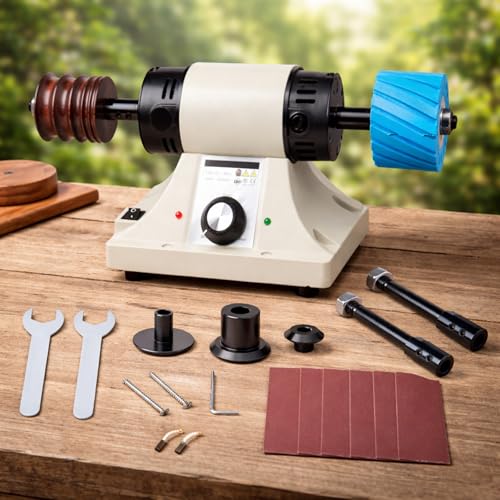
- Adjustable 0–8,000 RPM speed
- Rosewood head and six sanding belts
- Includes setup hardware and spare brushes
Best For: Vegetable-tanned leather edge finishing
Best for Finer Included Grits

- 350W motor with adjustable speed
- 12 sleeves in 120, 180, and 320 grits
- Compact, movable bench design
Best For: Small projects needing finer sanding steps
Best Handheld Kit
Compact Burnisher with 10 Ebony Heads

- Ten ebony heads for varied edges
- 16-ounce handheld design
- Storage case included
Best For: Corners, slots, holes, and compact storage
Best for Adjustable Angles
4-in-1 Leather Polishing Machine

- Four polishing heads
- Adjustable swivel head
- 1,500–6,000 RPM
Best For: Makers polishing varied leather edges, surfaces, and holes
High-Speed Edge Pick
350W Electric Leather Edge Burnisher

- Adjustable speed up to 8,000 RPM
- 350W corded motor
- Compact listed footprint
Best For: Burnishing vegetable-tanned leather edges
Best Sanding Kit

- Six belts in 120, 180, and 320 grits
- Wood burnishing wheel included
- Stepless control up to 8,000 RPM
Best For: Sanding and burnishing leather edges with one kit
Best All-in-One Kit
Variable-Speed Burnisher with Sanding Drum

- 0–8,000 RPM adjustable speed
- Rosewood wheel plus sanding drum
- Includes 12 assorted-grit sleeves
Best For: Sanding and finishing small leather goods
Most Flexible Positioning
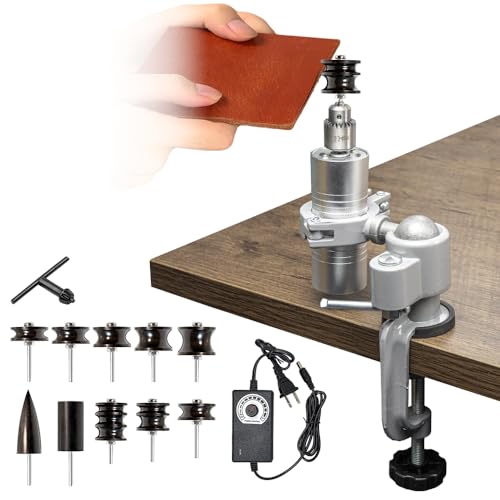
- Stated 0–24,000 RPM range
- Ten ebony-wood slicker bits
- Tabletop clamp or handheld use
Best For: Varied edge profiles and adjustable working angles
Best for Vegetable-Tanned Edges

- Adjustable speed up to 8,000 RPM
- Rosewood head and six sanding belts
- Includes spare brushes and wrenches
Best For: Shaping and smoothing vegetable-tanned edges
Best for Standard Sleeves – Variable-Speed Rosewood Burnisher
This leather burnishing machine combines a 0–8,000 RPM speed dial with a rosewood wheel and a 2-inch sanding drum. Its standard 2-by-2-inch sleeves are a practical advantage when you need replacements.
Best For: Bench-based edge sanding and burnishing on small leather goods, especially if standard replacement sleeves matter.
Pros:
- Variable speed lets you adjust for sanding, shaping, or burnishing.
- Includes 12 sleeves in 80, 120, and 240 grits.
- Compact design includes mounting holes and corner brackets for stability.
Cons:
- Requires a 110V outlet and bench space.
- Included sleeves stop at 240 grit.
This is a well-equipped bench option if you want multiple grits in the box and straightforward sleeve replacement.
Best for Veg-Tan Edges – Podoy 8,000 RPM Edge Polisher
The Podoy leather burnishing machine offers adjustable speed from 0 to 8,000 RPM for sanding and polishing vegetable-tanned leather edges. Its kit pairs sanding sleeves with a rosewood head for a two-step edge-finishing workflow.
Best For: Makers working mainly with vegetable-tanned leather who want a corded sanding-and-burnishing setup.
Pros:
- Adjustable speed supports different edge-finishing steps.
- Includes a rosewood grinding head and six sanding belts.
- Package includes connecting rods, clamps, wrenches, and spare carbon brushes.
Cons:
- Specified for 110V corded use.
- Includes fewer sanding consumables than the 12-sleeve kits in this roundup.
Choose this one for its included hardware and veg-tan focus; check the listed accessories against the setup you plan to use.
Best for Finer Included Grits – Compact 350W Burnisher
This leather burnishing machine combines a 350W motor, 0–8,000 RPM adjustment, and 12 sanding sleeves in 120, 180, and 320 grits. Its compact form suits a crowded workbench or a tool you need to move between tasks.
Best For: Small leather projects that benefit from several included sanding grits before hardwood-wheel burnishing.
Pros:
- Includes 12 sleeves, with a finer 320-grit option.
- Adjustable speed covers sanding and edge polishing.
- Compact body can be lifted with one hand; a one-year warranty is listed.
Cons:
- Requires a 110V power source.
- Sleeve changes may require following the provided instructions or video.
The grit selection makes this a useful pick if you want to refine small edges before switching to the included hardwood wheel.
Best Handheld Kit – Compact Burnisher with 10 Ebony Heads
Unlike the bench machines above, this leather burnishing machine is a corded handheld tool with 10 ebony heads. The assortment of head sizes and groove widths helps you work on straight edges, corners, slots, and holes.
Best For: Crafters who want a lightweight, storable tool for varied edge shapes rather than a bench-mounted sanding setup.
Pros:
- Ten ebony heads provide options for different edge profiles.
- Weighs 16 ounces and includes a storage case.
- Kit includes the tool, power cord, heads, and manual.
Cons:
- No sanding drum or sleeves are listed among the included components.
- Requires corded power.
Its appeal is access and head variety, particularly for details a bench wheel may be less convenient to reach. Plan on a separate sanding method if your edges need shaping first.
Best for Adjustable Angles – 4-in-1 Leather Polishing Machine
This leather burnishing machine suits makers who need to reach different edges, surfaces, and holes. Its swivel head changes the working angle, while four polishing heads and a 1,500–6,000 RPM speed range give you options for different leatherwork.
Best For: Leatherworkers who want adjustable positioning and multiple polishing heads in one corded tool.
Pros:
- Four heads cover edges, surfaces, and holes.
- Adjustable swivel head helps position the tool for different parts.
- Variable speed runs from 1,500 to 6,000 RPM.
- Beech storage base helps keep the heads together.
Cons:
- Requires a 120V power outlet.
- Its listed speed range does not extend below 1,500 RPM.
Choose this model if head selection and working angle matter more to you than a very low starting speed. The included storage base is a useful addition when switching attachments.
High-Speed Edge Pick – 350W Electric Leather Edge Burnisher
If you mainly finish vegetable-tanned leather edges, this leather burnishing machine offers a 350W motor and adjustable speed up to 8,000 RPM. Its compact listed dimensions make it worth considering for a workbench where space is limited.
Best For: Makers seeking a straightforward, corded edge burnisher for vegetable-tanned leather.
Pros:
- 350W motor with adjustable speed up to 8,000 RPM.
- Compact 5.12 × 4.96 × 5.12-inch listed dimensions.
- Designed for use on vegetable-tanned leather products.
Cons:
- The mahogany grinding head can be damaged by overtightening its nut or exposure to high heat.
- Requires a 110V power outlet.
This is the more focused option of the three: it prioritizes powered edge burnishing without a listed assortment of sanding belts. Follow the installation caution to protect the grinding head.
Best Sanding Kit – 350W Leather Edge Burnisher
This leather burnishing machine combines a wood burnishing wheel with a sanding-belt attachment, making it useful when a project calls for both edge preparation and polishing. The kit includes six belts across 120, 180, and 320 grits, and its 350W motor has adjustable speed up to 8,000 RPM.
Best For: Leatherworkers who want sanding and burnishing accessories together for edges on wallets, bags, and belts.
Pros:
- Includes six sanding belts in three grit options.
- Wood burnishing wheel and sanding-belt wheel are included.
- Stepless speed control reaches up to 8,000 RPM.
- Independent power switch and overload/over-voltage protection are listed.
Cons:
- Corded operation requires access to an outlet.
- At about 7.3 pounds, it is heavier than a handheld burnishing tool.
Pick this kit if your workflow includes smoothing before burnishing. Its included belts add versatility, though it takes more setup than a burnisher used with a single head.
Best All-in-One Kit – Variable-Speed Burnisher with Sanding Drum
This leather burnishing machine combines a rosewood wheel and sanding drum for shaping and finishing edges. Its adjustable 0–8,000 RPM range lets you choose a speed for different leather projects.
Best For: Crafters who want sanding and burnishing tools together for wallets, belts, and small leather goods.
Pros:
- Includes 12 assorted-grit, ready-to-fit 2 × 2-inch sanding sleeves.
- Pure-copper motor is described as running with low noise and vibration.
- Compact body has corner brackets and mounting holes for added stability.
Cons:
- Requires a 110V outlet.
- Its 0–8,000 RPM range is lower than the BAUSATZ model’s stated maximum.
Choose this kit if you want the sanding-to-burnishing workflow in one bench setup rather than a bit-focused polisher.
Most Flexible Positioning – BAUSATZ Swivel-Head Burnisher
This leather burnishing machine stands out for its adjustable chuck position and ten ebony-wood slicker bits in different shapes and groove widths. Its stated speed range is 0–24,000 RPM for tailoring polishing and grinding to a project.
Best For: Leatherworkers who want multiple edge profiles and an adjustable working angle.
Pros:
- Universal swivel allows the chuck position to be adjusted.
- Ten ebony-wood bits cover different shapes and groove widths.
- Can be clamped to a tabletop or detached for handheld use.
Cons:
- Uses DC power at a stated 3–24V, unlike the listed 110V corded models.
- Supplied components list burnisher bits, not a sanding drum or sleeves.
This is the more adaptable pick for changing edge profiles and tool position; check whether its DC setup suits your workspace.
Best for Vegetable-Tanned Edges – Futchoy 110V Burnishing Kit
This leather burnishing machine is aimed at vegetable-tanned leather edges: use the included sanding sleeves to shape an edge, then the rosewood head to smooth it. The corded 110V unit has an adjustable speed with a stated 8,000 RPM maximum.
Best For: Crafters finishing vegetable-tanned leather who want sanding and burnishing in one kit.
Pros:
- Includes a rosewood grinding head and six sanding belts.
- Adjustable speed reaches a stated maximum of 8,000 RPM.
- Package includes spare carbon brushes, clamps, and wrenches.
Cons:
- Requires a 110V outlet.
- Supplied description specifically highlights vegetable-tanned leather; suitability for other leathers is not detailed.
The included edge-shaping and smoothing accessories make this a practical choice when vegetable-tanned leather is your main material.
How We Picked These Leather Burnishing Machines
We organized the 10 selected products by the features most likely to affect daily use: handheld versus bench-style design, stated speed range, included burnishing heads, sanding accessories, and power requirements. We also looked for practical differences, such as whether a machine offers adjustable speed or combines sanding and polishing functions. Product titles do not establish build quality or long-term reliability, so confirm specifications, included parts, and warranty terms on the current listing before buying.
Quick Comparison: Which Style Fits Your Work?
- Compact handheld kit: Suits occasional touch-ups, small projects, and limited bench space. It may require a steadier hand for long, uniform edges.
- Variable-speed bench machine: A practical choice for repeatable edge work and switching between materials or finishing steps. Check its footprint and mounting requirements.
- Sanding-and-burnishing setup: Worth considering if you need to level edges before polishing. Compare the supplied sleeves or belts and the availability of replacements.
- Rosewood-wheel setup: Appeals to makers who want a shaped wooden burnishing wheel; check that its grooves suit the thicknesses you use.
Key Buying Factors for a Leather Burnishing Machine
Speed and Control
Adjustable speed gives you room to experiment with different leathers, edge treatments, and attachments. A high advertised maximum RPM is not automatically better: too much speed or pressure can heat an edge and make control harder. Look for a usable adjustment range, not just a peak number.
Wheels, Sanding Media, and Edge Sizes
Match wheel grooves to your usual leather thickness and finished edge shape. If you plan to sand and burnish on one machine, check what comes in the box and whether compatible sleeves, belts, or wheels are easy to replace. Included accessory counts are useful only when the pieces fit your actual workflow.
Workspace and Electrical Compatibility
Bench machines need a stable surface and clearance around spinning parts; handheld tools trade some stability for portability. Verify the listing’s voltage and plug before ordering, particularly for products described as 110V. Factor in noise, dust control, eye protection, and safe handling of loose clothing around rotating wheels.
Who Should Buy Which Leather Burnishing Machine?
New or occasional leatherworkers may prefer a compact kit if storage and cost matter more than production speed. Makers finishing many similar edges should prioritize a stable, adjustable-speed bench unit with a wheel profile that matches their work. Anyone routinely correcting uneven edges should consider a model with suitable sanding accessories rather than buying on polishing attachments alone. If you work across several leather thicknesses, favor replaceable or varied heads and verify their sizes before choosing a Leather Burnishing Machine.