
If you’re serious about photography, having the right tools can make all the difference. Light meters are essential for achieving perfect exposure, but with so many options available, choosing the right one can be tricky. From compact models to advanced features, each light meter offers unique advantages tailored to your needs. Discover which of the top 10 light meters can elevate your photography and help you capture those stunning shots every time.
Light Meter Digital Illuminance Meter
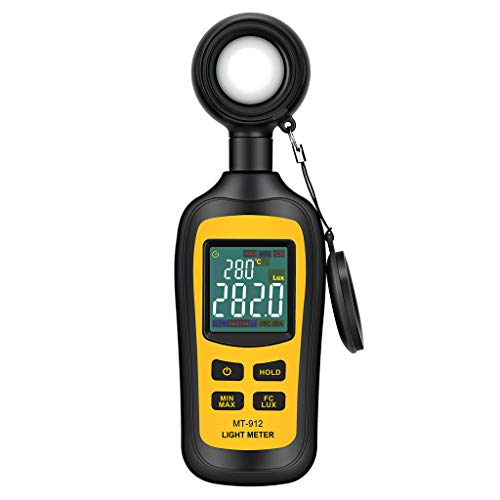
The Light Meter Digital Illuminance Meter is perfect for photography enthusiasts who need precise lighting measurements for their projects. It measures luminosity from 0 to 200,000 Lux, ensuring you get accurate readings every time. With an impressive accuracy of ±3% for lower Lux levels, you can trust its reliability. The 4-digit color LCD screen displays MIN/Max readings and features data hold, making it easy to track changes. Plus, it’s lightweight and compact, ideal for on-the-go shooting. With a two-year warranty, you can feel confident in your investment, whether you’re designing sets or capturing moments at home or in the office.
Best For: Photography enthusiasts and professionals who require accurate lighting measurements for their projects.
Pros:
- High accuracy of ±3% for readings under 10,000 Lux, ensuring reliable measurements.
- 4-digit color LCD screen with MIN/Max readings and data hold for easy tracking of light changes.
- Lightweight and compact design makes it convenient for portable use.
Cons:
- Limited to a maximum measurement of 200,000 Lux, which may not cover extremely bright environments.
- Battery life may require attention due to the auto power-off feature.
- May be less suitable for users who need advanced features or connectivity options.
Digital Illuminance Lux Meter with Rotating Sensor
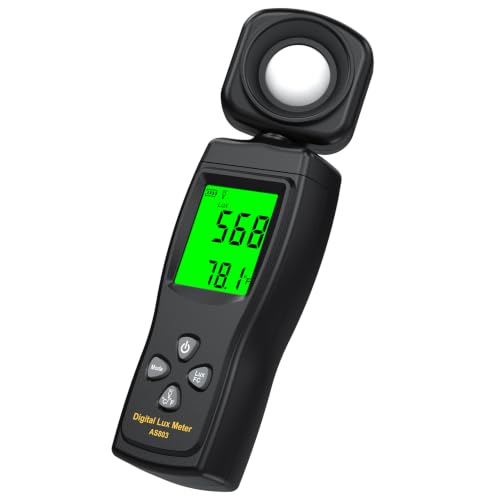
For photography enthusiasts aiming to achieve perfect lighting, the Digital Illuminance Lux Meter with Rotating Sensor stands out as an essential tool. Measuring light from 0 to 200,000 Lux with ±4% accuracy, it’s perfect for various environments. The 180° rotating sensor allows you to capture angles effortlessly, while the backlight LCD guarantees visibility even in low light. With a rapid 0.5-second sampling rate, you’ll get real-time data during shoots. This versatile meter tracks common light sources and even monitors temperature, making it invaluable for preventing over- or under-exposure. Lightweight and portable, it’s a must-have for any photographer.
Best For: Photographers and plant enthusiasts seeking to optimize lighting conditions for their specific environments.
Pros:
- Accurate measurement of light levels from 0 to 200,000 Lux with ±4% accuracy.
- 180° rotating sensor allows for flexible and convenient angle measurements.
- Lightweight and portable design makes it easy to carry for on-the-go usage.
Cons:
- May require calibration for utmost precision in specific lighting conditions.
- Limited to measuring light and temperature, lacking additional environmental metrics.
- Battery life may vary based on usage frequency and settings.
Light Meter Digital Illuminance Meter with LCD Screen
With its high accuracy of ±3% for readings under 10,000 Lux, the Light Meter Digital Illuminance Meter is perfect for photography enthusiasts seeking precise lighting measurements. It measures luminosity from 0 to 200,000 Lux and even tracks ambient temperature. The 4-digit color LCD screen displays MIN/Max readings, making it easy for you to analyze your lighting conditions. With features like data hold, auto power off, and low battery indication, it’s user-friendly. Its lightweight and compact design guarantees portability, whether you’re on a set, in an office, or at home. Plus, it comes backed by a 2-year warranty.
Best For: Photography enthusiasts and professionals needing accurate lighting measurements for various environments.
Pros:
- High accuracy with a margin of ±3% for readings under 10,000 Lux.
- User-friendly features such as MIN/Max readings, data hold, and auto power off.
- Lightweight and compact design makes it portable for on-the-go use.
Cons:
- May not be as effective in extremely high light conditions exceeding 200,000 Lux.
- Requires regular battery checks due to low battery indication feature.
- Limited to measuring ambient temperature, not suitable for other environmental measurements.
Pro Handheld EML Light Meter Sensor for Architecture Interior Lighting Design

Designed specifically for architects and lighting designers, the Pro Handheld EML Light Meter offers unparalleled precision in measuring light’s impact on health and sleep. With its 6-in-1 capabilities, you can effortlessly measure illuminance, CCT, EML, visual contrast, and more. The compact design makes it easy to carry, fitting right in your pocket or bag. Plus, its smart connectivity with the In. Licht pro app allows for real-time data analysis on your mobile device. While some users wish for better instructions, the accurate readings and user-friendly interface make it a must-have for anyone serious about lighting design.
Best For: Architects, lighting designers, and horticulturists seeking precision in light measurement for health and design applications.
Pros:
- Accurate readings for multiple lighting metrics including EML and CCT.
- Compact and portable design, making it easy to carry and use on the go.
- Smart connectivity with the In. Licht pro app for real-time data analysis.
Cons:
- Some users report fluctuating readings for lumens and color temperature.
- Lack of a comprehensive user manual and quick-start guide.
- Users express a need for better protective cases for transport.
LATNEX Light Meter LM-50KL for Measuring Lux/Fc
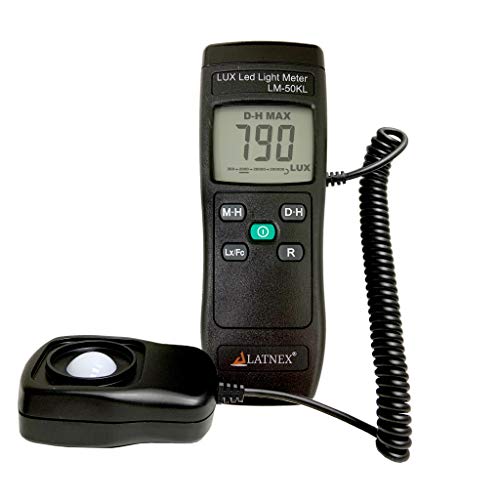
The LATNEX Light Meter LM-50KL stands out for photography enthusiasts who need accurate measurements of light intensity. Measuring from 200 to 200,000 lux or foot-candles, it’s perfect for various settings, including galleries and studios. The large LCD screen and data hold function make readings easy to view, while the 1.5-meter sensor wire offers flexible positioning. With about 200 hours of battery life and overload indicators, this device is reliable for extended use. Plus, you’ll appreciate the included carrying case and 1-year warranty, ensuring you have support for your lighting needs. Capture perfect shots every time with the LATNEX LM-50KL!
Best For: Photography enthusiasts and professionals seeking precise light intensity measurements in various settings such as galleries and studios.
Pros:
- Large LCD screen with a data hold function for easy viewing of measurements.
- Flexible positioning with 1.5 meters of sensor wiring for versatile use in different environments.
- Long battery life of approximately 200 hours, ensuring reliable performance for extended periods.
Cons:
- May be considered overkill for casual users who only need basic light measurements.
- The sensitivity range might be too wide for specific low-light scenarios, leading to less accurate readings.
- Carrying case might add extra bulk for those looking for a more compact solution.
Sekonic LiteMaster Pro L-478D-U Light Meter (401-474)
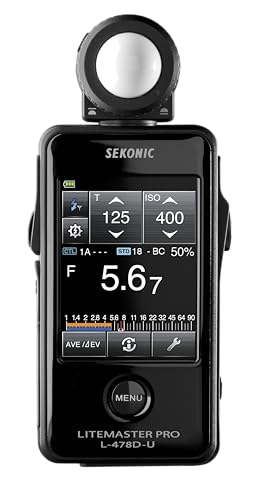
For photographers seeking precise control over their lighting, the Sekonic LiteMaster Pro L-478D-U light meter stands out with its intuitive touch-screen interface and versatile measurement modes. This compact device features a 2.7-inch LCD that displays ambient, flash, and cine information, making it user-friendly. You’ll appreciate the full ambient-flash modes, especially the T-F mode for mixing light sources. Its DTS Exposure Profiling guarantees accurate exposure matching with your camera, enhancing your shooting efficiency. While some users noted minor calibration issues, the overall feedback highlights its effectiveness in mixed lighting scenarios, making it a valuable tool for serious photographers.
Best For: Serious photographers seeking precise control over lighting and improved shooting efficiency.
Pros:
- Intuitive touch-screen interface for easy operation.
- Versatile measurement modes including ambient, flash, and cine.
- DTS Exposure Profiling ensures accurate exposure matching with your camera.
Cons:
- Some users experienced minor calibration issues.
- Occasional inaccuracies in readings reported by users.
- Button size may be considered too small by some users.
LightMate AirPro Light Meter for Photography

Capturing the perfect shot relies heavily on accurate exposure, and the LightMate AirPro Light Meter excels in providing just that, making it an ideal tool for film photographers. Weighing just 5 ounces and featuring a durable black metal shell, it’s both lightweight and sturdy. With ±0.1EV accuracy and a variety of modes, including Aperture Auto and Manual Mode, you can easily adjust settings for any lighting condition. The OLED display guarantees readability, while customizable exposure indicators keep you informed. If you’re looking for reliability and precision, the LightMate AirPro is a fantastic choice for enhancing your photography experience.
Best For: The LightMate AirPro Light Meter is best for film photographers seeking precise exposure settings for their manual cameras.
Pros:
- Durable black metal shell ensures longevity and resistance to wear.
- ±0.1EV accuracy with multiple modes for versatile shooting conditions.
- Tactile dials with audible feedback enhance user experience and ease of adjustments.
Cons:
- The metal shoe may short modern camera hot shoes, causing compatibility issues.
- Small size of the OLED display might be challenging for some users to read in bright conditions.
- Limited to ISO1~ISO3200, which may not meet the needs of all photographers.
UNI-T UT383 Light Meter for Brightness Measurement

Measuring light intensity accurately is essential for photographers aiming to achieve the perfect exposure. The UNI-T UT383 Light Meter is a fantastic choice, measuring light in Lux (0-199,900) and Foot Candles (0-18,500) with a high accuracy of ±(4% + 8). Its large 4-digit LCD screen features a backlight for easy reading, even in low light. With a quick 0.5-second sampling time, it provides reliable results. You’ll appreciate the overload indication, Max/Min data hold, and low battery indicator. Plus, the portable value pack includes everything you need, along with 24/7 customer support for any questions.
Best For: The UNI-T UT383 Light Meter is best for photographers and lighting professionals who need precise light intensity measurements for optimal exposure settings.
Pros:
- High accuracy with a measurement range suitable for various lighting conditions.
- Large backlit LCD screen for easy readability in low-light environments.
- Includes useful features like overload indication and Max/Min data hold for tracking light variations.
Cons:
- Limited to a specific measurement range, which may not suffice for extreme lighting conditions.
- Some users may find the sampling time of 0.5 seconds slower compared to other high-end models.
- Requires batteries, which may need to be replaced periodically, adding to maintenance.
Sekonic Speedmaster L-858D-U Light Meter (401-858)
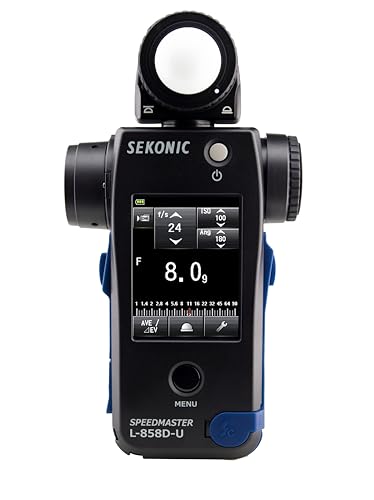
Photographers seeking precision in their light measurements will find the Sekonic Speedmaster L-858D-U Light Meter (401-858) an invaluable tool. Its flash measurement capabilities, including flash duration measurements and HSS flash measurements, let you capture fast-moving subjects and overpower sunlight effortlessly. The innovative flash analyzing function measures both ambient and flash light, showing their percentage in total exposure. With increased light sensitivity, it captures readings down to 0.1 lx. Plus, the wireless triggering features enhance compatibility with Elinchrom Skyport and Phottix Strato II/Ares II. This groundbreaking meter is essential for anyone serious about mastering light in their photography.
Best For: Photographers who require precise light measurements for both ambient and flash photography, especially in challenging lighting conditions.
Pros:
- Flash measurement capabilities allow for accurate readings in fast-paced environments and bright conditions.
- Increased light sensitivity enables readings in very low light situations, capturing details that other meters may miss.
- Wireless triggering features provide enhanced compatibility with popular flash systems, streamlining workflow.
Cons:
- Higher price point may not be suitable for casual photographers or hobbyists.
- Learning curve associated with advanced features might be daunting for beginners.
- Size and portability may be less convenient compared to simpler light meter models.
LightMate Area 2S Light Meter for Photography & OV-X1 Retro Viewfinder

For those seeking precision in their photography, the LightMate Area 2S Light Meter paired with the OV-X1 Retro Viewfinder is an exceptional choice. This ultra-compact meter features a 0.96-inch OLED screen, perfect for clear visibility, and boasts over 20 hours of battery life. With adjustable aperture and shutter speed step values, you can easily customize your settings for every shot. The OV-X1 viewfinder helps frame your compositions, whether attached or detached. Highly rated for its accurate readings and portability, this combination is ideal for vintage camera enthusiasts and serious photographers alike, offering great value for money.
Best For: The LightMate Area 2S Light Meter is best for vintage camera enthusiasts and serious photographers seeking precision and portability in their photography equipment.
Pros:
- Compact design makes it easy to carry in a pocket.
- Rechargeable battery offers over 20 hours of life and 6 months of standby.
- Versatile metering modes and adjustable settings cater to various shooting preferences.
Cons:
- Limited to specific camera types, which may not suit all users.
- Small OLED screen may be difficult to read in bright sunlight.
- Initial learning curve for those unfamiliar with manual metering techniques.
Factors to Consider When Choosing a Light Meter for Photography
When you’re choosing a light meter, you’ll want to contemplate several key factors. Measurement accuracy is essential, but don’t overlook display features, portability, and battery life. Think about how versatile you need the meter to be for your photography style.
Measurement Accuracy Importance
Choosing the right light meter hinges on measurement accuracy, as it directly impacts your exposure settings and, ultimately, the quality of your photographs. A high accuracy rating, typically expressed as a percentage like ±3% or ±4%, guarantees reliable readings in various lighting conditions. If you’re serious about photography, you’ll want a meter with low accuracy margins, since even slight variations can lead to underexposure or overexposure. Pay attention to how a meter performs at different luminosity levels, especially below and above 10,000 Lux. Accurate light measurements are essential for consistent results, particularly when dealing with mixed lighting sources or complex environments. Prioritize accuracy to elevate your photography to the next level.
Display Features Evaluation
A well-designed display can greatly enhance your experience with a light meter, especially in challenging lighting conditions. Look for light meters with a large, backlit LCD screen that makes reading measurements easier in low light. Models featuring a MIN/Max data hold function are beneficial, as they allow you to capture peak light levels for precise exposure settings. A 4-digit display provides detailed readings, helping you understand subtle differences in light intensity. Additionally, consider meters with auto power-off features to conserve battery life, ensuring your meter is ready when you need it. Finally, low battery indicators are essential for monitoring battery status, preventing interruptions during important shoots. These features can markedly improve your efficiency and effectiveness in capturing perfect shots.
Portability and Design
While considering a light meter, portability and design play significant roles in your overall photography experience. You’ll want a lightweight and compact model that’s easy to carry around, especially during outdoor shoots. Look for durable construction materials like metal or robust plastic to guarantee your meter withstands the rigors of travel. A user-friendly design with tactile dials and easy-to-read displays will help you access essential data quickly. Additionally, consider models with versatile mounting options, like cold shoe mounts, which enhance usability in various photography setups. With these factors in mind, you can find a light meter that not only fits seamlessly into your gear but also elevates your photography game.
Battery Life Considerations
Portability and design aren’t the only factors to contemplate when selecting a light meter; battery life plays an essential role in ensuring you can capture every moment without interruption. Some light meters can operate continuously for up to 200 hours, making them ideal for extended shoots. If you don’t use the device daily, look for models with rechargeable batteries and standby times exceeding six months. Charging methods vary, with some using convenient USB-C while others rely on standard batteries. To avoid unexpected shutdowns during critical moments, choose a light meter with a low battery indicator. Additionally, consider power-saving features, like auto shutdown, to maximize battery longevity when you’re busy capturing your best shots.
Versatile Applications Scope
When choosing a light meter for photography, understanding its versatile applications can greatly enhance your shooting experience. Light meters can measure various light sources, including LED, fluorescent, and halogen, making them ideal for studios, offices, and indoor gardens. Look for models with multiple measurement modes like data hold and max/min value recording, enhancing usability in diverse settings. If you’re focused on photography, opt for meters that provide essential metrics like exposure settings to avoid over- or under-exposure. The ability to measure both ambient light and flash intensity is vital for achieving precise lighting. Finally, consider portability; lightweight and compact meters allow for quick and convenient measurements wherever you go.
User-Friendly Interface
A light meter’s versatility in measuring different light sources is only part of the equation; its user-friendly interface plays a significant role in enhancing your shooting experience. Look for a clear LCD screen that displays readings and settings in an easily readable format, especially in varying light conditions. Touchscreen controls or intuitive dials let you adjust ISO, shutter speed, and aperture quickly, helping you achieve the perfect exposure. Features like data hold and max/min value recording make it easier to capture critical measurements without constant adjustments. Additionally, a lightweight, compact design guarantees portability, allowing you to carry the meter effortlessly. Don’t forget to check user feedback and ratings to verify the interface meets your practical needs.