
A mini table saw can make repeatable cuts in small craft materials without taking over your workbench. But similar-looking machines can differ substantially in cutting capacity, adjustments, accessories, and guarding.
This roundup covers 10 listings for hobby and model-making projects. Use the buying guide below to narrow your choice by material, cut size, and the features you will actually use.
Best 10 Mini Table Saw for Hobbyists Picks for 2026
Best for Accessory Variety

- Four included blade types
- Adjustable cutting angle; 16 mm depth
- Flexible shaft for detail work
Best For: Model making and mixed-material crafts
Best for Compact Precision

- Adjustable 0–15 mm blade height
- Seven adapter settings
- Includes miter gauge and multiple discs
Best For: Miniatures and shallow cuts in a tight workspace
Best for Two-Blade Cutting

- Steel and diamond blades included
- Two miter slots and miter gauge
- 15 mm maximum depth at 90°
Best For: Small projects using different blade types
Best for Cutting and Grinding
MXBAOHENG 96W Mini Precision Table Saw

- Adjustable 0–14 mm blade height
- Blades and grinding disc included
- Blade guard not included
Best For: Miniature crafts needing cutting and grinding
Best for Larger Craft Pieces

- Approximately 8.5-by-6.5-inch tabletop
- 80–85 mm blades; up to 25 mm cutting height
- Seven speeds and separate cutting/finishing motors
Best For: Model makers needing more tabletop space and multiple functions
Best for Small Workspaces

- 7.1-by-5.5-inch footprint; weighs 3.25 lb
- Four included 2.5-inch blade types
- Up to 0.59-inch cutting depth
Best For: Crafters working on small parts in limited space
Best for Quick Blade Swaps

- Two-screw access for blade changes
- Four 63 mm blade types included
- Seven speeds; up to 15 mm cutting depth
Best For: Hobbyists switching blades between small craft materials
Compact All-Rounder
MIMYTH Mini Table Saw for Crafts

- Independent dual motors
- Four material-specific blades
- 0.59-inch maximum cutting depth
Best For: Model making and varied small craft tasks
Accessory-Rich Pick

- Independently switched motors
- Over 100 small parts included
- 0–16 mm blade-height adjustment
Best For: Hobbyists who cut and do frequent detail work
Light-Material Specialist
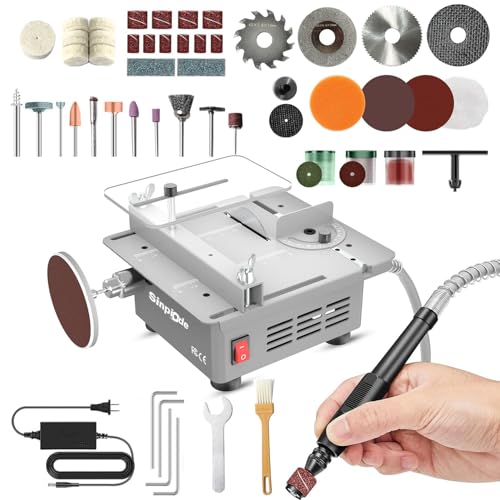
- Seven speed settings
- Four blades for thin materials
- Remove blade for sanding-only use
Best For: Delicate craft cuts in thin stock
Best for Accessory Variety – Saker Mini Table Saw
If you want a mini table saw for hobbyists that can do more than make straight cuts, the Saker pairs a compact cutting table with assorted blades and a flexible shaft for small-detail work.
Best For: Model makers who want one compact tool for cutting and occasional sanding or engraving.
Pros:
- Includes four blade types for materials such as thin wood, plastic, PCB, and tubing.
- Offers an adjustable cutting angle and a stated 16 mm cutting depth.
- Marked tabletop, transparent debris baffles, and rubber feet support controlled work.
Cons:
- The 16 mm depth limits it to relatively thin stock.
- The listing conflicts on speed settings and motor wattage, so confirm those specifications before buying.
This is the versatile pick for a small craft bench, especially if you will use the included attachments. Choose a larger saw for thicker woodworking stock.
Best for Compact Precision – MXBAOHENG S3 Mini Table Saw
The MXBAOHENG S3 is a mini table saw for hobbyists working with narrow wood pieces, model materials, acrylic, or PCB. Its adjustable blade height and seven-setting power adapter give you useful control in a small workspace.
Best For: Miniature builders who need adjustable cut depth and a compact tabletop footprint.
Pros:
- Blade height adjusts from 0 to 15 mm for shallow cuts.
- Seven adapter settings range from 12V to 24V.
- Includes a miter gauge, transparent board, dust tube, and multiple cutting discs.
Cons:
- Its 15 mm maximum cut depth is not suited to thick lumber.
- The small table calls for careful workpiece support on longer pieces.
The S3 makes sense when depth control matters more than cutting capacity. It is geared toward small craft components, not full-size woodworking.
Best for Two-Blade Cutting – 4-Inch 60W Mini Table Saw
This 60W benchtop model is a mini table saw for hobbyists who want a small station for varied materials. It comes with a manganese-steel blade and a diamond blade, plus two miter slots for guided cuts.
Best For: Small workshop projects that call for two included blade types and miter-gauge guidance.
Pros:
- Includes approximately 4-inch steel and diamond blades.
- Two miter slots, a miter gauge, blade guard, and clear eye guard are listed.
- Stated maximum cut depth is 15 mm at 90 degrees.
Cons:
- The 15 mm depth restricts the thickness of workpieces.
- Check that the included blade suits your material before cutting; the listing does not specify performance by material.
Consider this saw if the two-blade setup matches your projects. Its modest cutting depth keeps it firmly in the small-parts category.
Best for Cutting and Grinding – MXBAOHENG 96W Mini Precision Table Saw
For a mini table saw for hobbyists who also want light grinding capability, this MXBAOHENG model includes several blades, a grinding disc, and a chuck. Its seven-setting power adapter and adjustable blade height suit small model-making tasks.
Best For: Crafters cutting thin wood, plastic, acrylic, or PCB who also want the included grinding accessories.
Pros:
- Blade height adjusts from 0 to 14 mm.
- Seven adapter settings span 12V to 24V.
- Includes multiple blade types, a grinding disc, miter gauge, and dust tube.
Cons:
- A blade guard is not included, though the panel has mounting holes for one.
- The 14 mm maximum cut depth limits thicker stock.
The accessory set adds flexibility for miniature projects, but the missing guard is an important consideration. Check the setup and plan for appropriate guarding before use.
Best for Larger Craft Pieces – Dual-Motor Mini Table Saw
If you need a mini table saw for hobbyists that can handle slightly larger craft pieces, this model pairs an approximately 8.5-by-6.5-inch tabletop with 80–85 mm blades. It also offers separate motors for cutting and finishing tasks.
Best For: Model makers who want a larger work surface and several functions in one benchtop tool.
Pros:
- Seven speed settings and adjustable blade height up to 25 mm.
- Four blade types for materials including wood, acrylic, PCB, and soft metals.
- Two-screw blade access, a dust outlet, and accessories for grinding, polishing, drilling, and engraving.
Cons:
- Its 25 mm maximum cutting height limits thicker stock.
- Corded power requires an outlet.
The larger table and blade set distinguish it from smaller craft saws, but it remains a tool for appropriately sized materials rather than thick lumber.
Best for Small Workspaces – MIMYTH Portable Craft Saw
For a mini table saw for hobbyists with limited bench space, the MIMYTH measures 7.1 by 5.5 by 2.5 inches and weighs 3.25 pounds. Its included blades and finishing accessories support small model-making and craft projects.
Best For: Crafters who prioritize compact storage and work with thin wood, plastic, PCB, or small metal pieces.
Pros:
- Compact, lightweight design is easy to move and store.
- Four 2.5-inch blade types cover different craft materials.
- Includes a transparent guard, marked scale, miter gauge, and accessories for sanding, drilling, and engraving.
Cons:
- Maximum listed cutting depth is 0.59 inches, so it is not suited to thick stock.
- Small footprint provides limited support for larger workpieces.
Choose this one when portability matters more than cutting capacity; its stated depth and compact table make the most sense for small parts.
Best for Quick Blade Swaps – Dual-795 Craft Table Saw
This mini table saw for hobbyists is worth considering if projects call for frequent blade changes. Its access window lets you reach the blade by removing two screws, while the supplied blade types cover several common craft materials.
Best For: Hobbyists who alternate between small wood, plastic, PCB, and soft-metal cutting jobs.
Pros:
- Four included blade types and a two-screw blade-access design.
- Seven speed settings, adjustable blade height, and angle settings from 0° to 90°.
- Separate motors and switches for cutting versus grinding and polishing, plus a dust outlet.
Cons:
- Maximum stated cutting depth is 15 mm, limiting material thickness.
- Its 63 mm blades are smaller than those on some other mini saws.
The quick-access blade compartment is the main practical draw. Check your material thickness before buying, since this model is designed around shallow craft cuts.
Compact All-Rounder – MIMYTH Mini Table Saw for Crafts
If you want a mini table saw for hobbyists that can also handle small finishing tasks, this MIMYTH model combines cutting with sanding, engraving, and drilling accessories. Its 7.1 x 5.5-inch footprint suits a crowded craft bench.
Best For: Model makers working with thin wood, PCB, plastic, and small metal tubing.
Pros:
- Independent dual motors separate saw operation from the accessory functions.
- Four 2.5-inch blades cover different craft materials.
- Adjustable blade height up to 0.59 inches and a 0°–90° cutting-angle range.
Cons:
- The 0.59-inch maximum cutting depth limits thicker stock.
- Choosing the right blade and accessory adds setup steps.
Choose this one if you value a compact, multi-function workstation over the capacity of a full-size saw. Its guard, marked scale, and rubber feet are useful details for small-project work.
Accessory-Rich Pick – Dual-Motor Mini Table Saw
This mini table saw for hobbyists is worth considering if your projects alternate between cutting and detail work. It pairs independently switched motors with a sanding disc, drill chuck, and flexible shaft, plus a set of more than 100 small parts.
Best For: Craft benches where cutting, polishing, drilling, and engraving all come up regularly.
Pros:
- Independent switches let the cutting and grinding/polishing motors run separately.
- Blade height adjusts through a 0–16 mm range, with a 0°–90° cutting-angle range.
- Four blade types and an aluminum-alloy tabletop support varied light-material projects.
Cons:
- The 16 mm blade-height range limits the thickness of stock it can accommodate.
- The many accessories may be unnecessary if you only need to make cuts.
The separate motor controls are the main distinction here: you can select the function you need without starting both. Check that its small cutting capacity fits your materials before choosing it for furniture-related projects.
Light-Material Specialist – 100W Mini Table Saw
For a mini table saw for hobbyists focused on delicate materials, this 100W model offers seven speed settings and four blades for tasks involving balsa, plastic sheets, PCBs, and thin soft metal. It is explicitly intended for small crafts rather than heavy-duty woodworking.
Best For: Light-duty craft cuts where adjustable speed matters more than cutting capacity.
Pros:
- Seven-level speed control helps match the setting to the material.
- Four specialized blades cover a range of thin craft materials.
- Includes a cast-alloy tabletop, etched scale, transparent guard, and shock-absorbing pads.
Cons:
- Maximum cutting thickness is 0.59 inches; thick wood and ferrous metals are outside its intended use.
- Saw and sanding functions activate simultaneously, so the blade must be removed for sanding-only use.
The speed options make this a practical choice for varied thin stock, but the linked saw-and-sander operation deserves attention. Follow the supplied blade-removal warning whenever you switch to sanding alone.
How We Picked the Best Mini Table Saw for Hobbyists
We focused on compact, benchtop saw listings aimed at crafts and model building, then compared the details buyers can check before ordering: stated power, speed settings, blade size, cutting-angle and depth adjustments, included accessories, and table layout. These are listing-level comparisons, not hands-on performance or safety test results. Two entries use the same MIMYTH product name, and several generic listings have closely similar names; check the seller, model details, and included components before assuming they are different machines.
Quick Comparison: Match the Saw to the Job
The Saker listing emphasizes seven speed levels, angle adjustment, and a large accessory bundle. The MXBAOHENG S3 is presented as a portable precision craft saw, while the separate MXBAOHENG 96W listing specifies seven speeds. One basic 4-inch listing specifies a 60W motor and two blades. The dual-motor listings advertise added grinding or engraving functions; decide whether those functions justify extra controls and accessories for your projects. For listings with sparse specifications, confirm the blade dimensions and usable cutting capacity rather than relying on “multifunctional” in the name.
Key Buying Factors for a Mini Table Saw for Hobbyists
Material and Cutting Capacity
Start with the thickest and widest stock you plan to cut. Check the stated maximum cutting depth at both 90 degrees and your intended bevel angle, plus the distance between blade and fence. A small saw suited to thin model parts may not accommodate thicker hardwood or larger panels. Verify that the supplied blade is rated for your material; do not assume a woodworking blade is suitable for metal or plastic.
Adjustments and Repeatability
A usable fence, readable angle scale, and stable blade-height or tilt adjustment matter more than a long accessory list if you make matching parts. Look for clear photos of the fence and miter guide, and check whether the stated speed control offers settings appropriate to your materials. Seven speeds alone do not establish accuracy or cutting power.
Safety, Workspace, and Consumables
Confirm what guarding, blade enclosure, and work-holding options are supplied. Small workpieces need controlled feeding and secure support; keep fingers away from the blade, wear eye protection, and follow the maker’s instructions. Check the saw’s footprint, power requirements, noise expectations, and availability of correctly sized replacement blades before buying. Product names may omit these details, so consult the current manual and listing.
Who Should Buy Which Mini Table Saw for Hobbyists?
For occasional straight cuts in thin craft stock, begin with a simpler model whose capacity and blade compatibility are clearly specified. If you routinely switch materials or make angled model parts, compare the Saker and MXBAOHENG adjustable-speed listings, prioritizing fence quality and the adjustments you need. Consider a dual-motor or all-in-one machine only if you will use its sanding, grinding, or engraving functions and have room to operate them safely. If a listing cannot document its cutting capacity, included guards, or replacement blades, choose one that can.