
Working with resin, solder, or other hobby materials can release fumes you do not want lingering in your workspace. The right setup helps keep the air clearer and the job more comfortable.
Below, we compare 10 options designed to capture smoke and odor at the source, with choices for compact benches, enclosed printers, and heavier-duty extraction needs.
Best 10 Resin Fume Extractor Fan Picks for 2026
Best for Strong Suction
100W Solder Fume Extractor, 250m³/h HEPA

- 250m³/h airflow for stronger smoke capture
- H13 HEPA and carbon filtration for particles and odors
- Compact, low-noise design fits bench setups
Best For: Makers who need a compact, high-suction extractor for soldering, resin printing, and light engraving.
Best for Easy Setup
3D Printer Enclosure Ventilation Kit
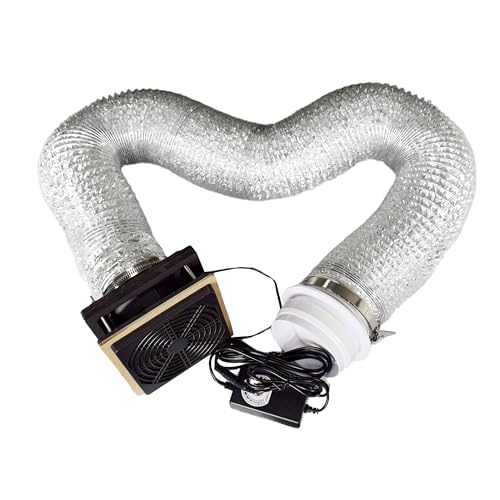
- All-in-one kit with fan, duct, sealed port, and adapters
- 180 CFM airflow with adjustable speed control
- 3m duct and wall/window mounting options for flexible installs
Best For: Makers who want a ready-to-install enclosure exhaust solution for resin or FDM printers.
Best for Multi-Use Workshops

- 3-stage filter helps reduce solder smoke and odors
- Compact, portable ABS build for tight desks
- 115 CFM airflow with 45 dB noise level
Best For: Makers and hobbyists who need a compact extractor for soldering, wood burning, and similar bench work.
Best for Adjustable Coverage
YIHUA 948DQ-I Solder Fume Extractor Fan

- Tiltable 30° stand for better aiming
- Dual filtration adsorbers help reduce fumes and odors
- Includes 8 extra replacement filters
Best For: Makers who need an adjustable bench-top extractor for soldering, wood burning, or light hobby work.
Best for DIY Ventilation Kits

- Up to 141 CFM airflow for small exhaust jobs
- PWM speed control for tuning airflow
- Includes adapter, mesh guards, and screws
Best For: DIY makers building a compact venting setup for resin, soldering, or craft fumes.
Best for Soldering Bench Flexibility
YIHUA 948DQ-I Solder Fume Extractor

- Dual filtration helps reduce fumes and odor
- Tiltable stand improves intake positioning
- Includes detachable helping hands and extra filters
Best For: Hobbyists and repair users who need a compact extractor with adjustable positioning.
Best for Small Soldering Setups
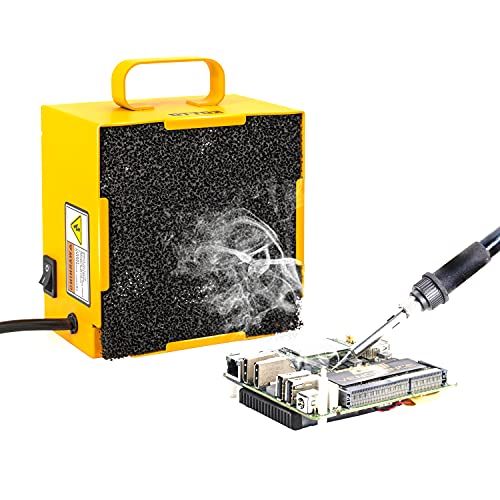
- 3000 RPM suction for close-range smoke capture
- Activated carbon filter helps trap flux and solder fumes
- Compact, portable design with rubber feet and handle
Best For: DIY soldering benches, small electronics repairs, and compact workspaces.
Best for Extra Filters
Valtcan Solder Fume Extractor Fan

- 3 included activated carbon filters
- Adjustable tilt for targeted capture
- Low-noise ESD-safe desktop design
Best For: Makers who want a simple bench-top extractor with extra filters for soldering and light resin work.
Best for Compact Soldering Stations
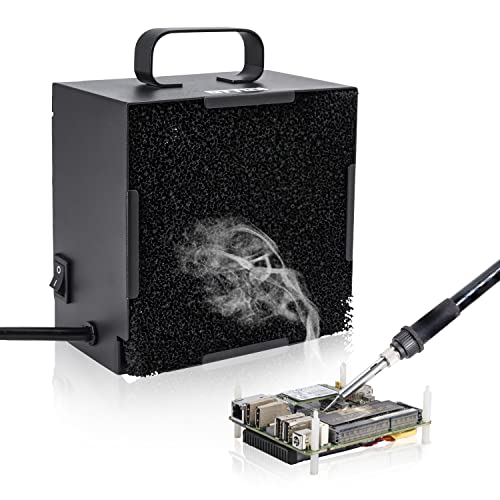
- Activated carbon filter captures solder and flux fumes
- 3000 RPM fan targets close-range smoke removal
- Portable design with non-slip feet and carry handle
Best For: DIY soldering and small bench setups that need basic fume control.
Best for Strong Suction – 100W Solder Fume Extractor, 250m³/h HEPA
If you want a resin fume extractor fan that can pull smoke and odors close to the source, this model stands out for its strong airflow, multi-stage filtration, and compact bench-friendly design. It’s built for hobbyists who work in soldering, resin 3D printing, or light laser engraving and want cleaner air without a noisy setup.
Best For: Makers who need a compact, high-suction extractor for soldering, resin printing, and other small workshop tasks.
Pros:
- 100W motor with 250m³/h airflow for stronger smoke capture
- H13 HEPA plus activated carbon helps reduce fine particles and odors
- Low-noise operation and compact size suit desktop workspaces
- Flexible 360° tube makes it easier to position near the work area
Cons:
- Better suited to small-to-medium benches than large shop environments
- Filter replacements will add to long-term maintenance cost
- Not intended for high-power laser use beyond light engraving
Overall, this resin fume extractor fan is a practical pick if you want a stronger-than-basic unit that balances suction, filtration, and footprint. It’s especially appealing for users who need one extractor that can handle solder smoke and resin odors in the same workspace.
Best for Easy Setup – 3D Printer Enclosure Ventilation Kit
If you need a practical resin fume extractor fan for a closed printer setup, this kit is built to move air out of an enclosure without forcing you to piece together separate parts. It combines the fan, ducting, sealed port, backdraft valve, and mounting adapters into one package, which makes it a strong fit for non-ventilated resin, FDM, or laser workspaces.
Best For: Makers who want an all-in-one enclosure exhaust kit with simple installation and flexible wall or window venting.
Pros:
- Includes the main parts needed for a complete enclosure ventilation setup
- 180 CFM output with speed control helps match airflow to different enclosure sizes
- 3m duct and multiple adapters make placement easier in real-world setups
- Sealed port and backdraft valve help reduce leaks and keep airflow directional
Cons:
- Designed for enclosures, so it is not a standalone room air purifier
- Best results depend on a reasonably sealed enclosure
- May be more hardware than casual users need for very small builds
Overall, this resin fume extractor fan is a smart buy if you want a venting solution that is ready to install and tuned for enclosed printing. Its value comes from convenience, adjustable airflow, and a more complete hardware bundle than many basic exhaust kits.
Best for Multi-Use Workshops – MUIN Solder Fume Extractor
If you need a practical resin fume extractor fan for a small bench, the MUIN Solder Fume Extractor is built to pull smoke, flux odor, and light chemical fumes away from your workspace with a 3-stage filter and compact footprint.
Best For: Makers who want a portable, low-noise extractor for soldering, wood burning, and other hobby work where fumes build up quickly.
Pros:
- 3-stage filtration helps capture solder smoke, flux fumes, and odors.
- Compact ABS design saves desk space and is easy to move around.
- 115 CFM airflow and 45 dB noise level suit close-range bench use.
- Works across soldering, pyrography, 3D printing, jewelry, and crafting.
Cons:
- Best for localized capture, not larger room ventilation.
- Single-unit design may be less powerful than bigger dual-fan extractors.
Overall, this is a solid pick if you want a versatile resin fume extractor fan that fits neatly on a crowded workstation and handles more than just soldering tasks.
Best for Adjustable Airflow – Wathai 120mm 12V Fume Extractor Fan Kit
If you want a flexible resin fume extractor fan for soldering, 3D printing, or a small paint booth, this Wathai kit is built to be easy to tune and easy to set up. The included speed controller lets you balance airflow and noise, while the 4-inch duct parts and filters make it simple to adapt to different DIY ventilation jobs.
Best For: Makers who need a compact, adjustable fan kit for fumes, odors, and light-duty workspace ventilation.
Pros:
- Speed controller adjusts airflow from 4V to 12V for better noise control
- Dual ball bearings and 5,000-hour rating suit continuous use
- Includes fan, controller, duct connector, filter, guard, and screws for a more complete setup
- Works well for soldering, resin work, 3D printing, and small spray or paint stations
Cons:
- Standard 4-inch hose is not included
- Best suited to small-to-medium DIY setups rather than large shop ventilation
- AC-powered control setup may be less convenient than a simple plug-and-play fan
For buyers who want control over airflow rather than just raw power, this is a practical resin fume extractor fan kit with enough included parts to get a custom extraction setup running quickly.
Best for Adjustable Coverage – YIHUA 948DQ-I Solder Fume Extractor Fan
If you want a resin fume extractor fan that can be aimed more precisely at your work area, the YIHUA 948DQ-I is a practical option. Its tiltable stand, dual-sided fenders, and replaceable filters make it a solid pick for soldering, wood burning, and other small bench tasks where controlling fumes matters.
Best For: Makers who need adjustable airflow coverage and a simple bench-top extractor for soldering or light hobby work.
Pros:
- 30° tilting stand helps direct extraction closer to the source
- Dual filtration adsorbers help catch particles and reduce odors
- Includes 8 extra filters for longer usable life
- Fenders help limit airflow disruption around the work zone
Cons:
- Designed for a relatively close extraction distance
- 110-127V US plug limits use outside compatible regions
- Best suited for light-duty bench setups, not heavy industrial fumes
For buyers comparing a resin fume extractor fan, the YIHUA 948DQ-I stands out more for adjustability and included replacements than raw power. It’s a good fit if you want a compact, straightforward extractor that makes it easier to keep fumes under control during detailed bench work.
Best for DIY Ventilation Kits – 4" DC12V Axial Exhaust Fan
If you need a practical resin fume extractor fan for a small bench, booth, or hobby enclosure, this 4-inch DC12V axial fan offers strong airflow in a compact DIY-ready package. It is designed for soldering, 3D printing, laser work, and light paint or resin venting, with included adapters and a variable-speed controller so you can tune airflow to the task.
Best For: Hobbyists who want a customizable fan kit for small resin, soldering, or craft ventilation setups.
Pros:
- Up to 141 CFM airflow for focused extraction in compact spaces
- PWM dimmer lets you adjust fan speed from low to full output
- Includes power adapter, duct adapters, mesh guards, and screws
- Quiet DC motor and dual ball bearings suit longer DIY sessions
Cons:
- Requires self-assembly, so it is not a plug-and-play unit
- Best suited to small setups rather than whole-room filtration
- Not compatible with CPUs, so it is limited to ventilation use
As a resin fume extractor fan, this model makes the most sense when you want a simple, flexible exhaust solution you can mount into a custom box or duct. It is less polished than a dedicated desktop purifier, but the included hardware and speed control make it a solid value for DIY venting projects.
Best for Soldering Bench Flexibility – YIHUA 948DQ-I Solder Fume Extractor
If you want a practical resin fume extractor fan for soldering and small bench work, the YIHUA 948DQ-I adds useful extras beyond basic smoke removal. It combines dual filtration with adjustable positioning and helping hands, making it a good fit for detail work where you need airflow control and object support at the same time.
Best For: Hobbyists and repair users who want a compact fume extractor with adjustable angle control and built-in helping hands.
Pros:
- Dual-filter design helps capture fumes and reduce odor at the source
- 30° tiltable stand makes it easier to aim intake where you need it
- Detachable helping hands add support for wires, PCBs, and small parts
- Includes 8 extra filters for ongoing maintenance
Cons:
- Designed for 110–127V US power only
- Best for close-range bench use rather than large-area ventilation
Overall, this resin fume extractor fan stands out more for convenience and positioning than raw power, but that is exactly what many desktop soldering setups need. If you want a compact unit that helps keep fumes under control while also holding work in place, this is a smart, task-focused pick.
Best for Small Soldering Setups – KOTTO Solder Smoke Absorber
If you need a compact resin fume extractor fan for soldering, the KOTTO unit is built for bench-top use with a high-suction 3000 RPM fan and an activated carbon filter to help capture smoke, flux odor, and light chemical fumes close to the source.
Best For: Hobbyists, electronics repair work, and small soldering stations that need an affordable, easy-to-move smoke absorber.
Pros:
- 3000 RPM fan offers strong pickup for fumes 5–6 inches away
- Activated carbon filter helps trap solder and flux smoke
- Compact design with non-slip feet and a carry handle
- Includes one replacement filter for easier maintenance
Cons:
- Best suited for close-range, light-duty soldering tasks
- Filter size and fan power may be limiting for larger workspaces
- Needs periodic filter replacement to stay effective
Overall, this resin fume extractor fan makes sense if you want a simple, low-noise solution for a small workspace rather than a larger shop-level ventilation system. It focuses on practical smoke capture right at the bench, which is exactly what many DIY soldering users need.
Best for Extra Filters – Valtcan Solder Fume Extractor Fan
If you want a practical resin fume extractor fan for a soldering bench or small craft setup, the Valtcan focuses on the basics: capture fumes near the source, keep noise manageable, and use replaceable carbon filters to help reduce smoke and odor. It is a straightforward desktop option for hobbyists who need a simple plug-in unit.
Best For: Makers who want an affordable bench-top extractor with extra filters included for soldering, resin work, and other light-duty fumes.
Pros:
- Includes 3 activated carbon filters for immediate use
- Adjustable tilt helps aim the intake toward the fume source
- Low-noise, ESD-safe design suits electronics workspaces
- Compact, lightweight build is easy to place on a workbench
Cons:
- Best suited for light-duty bench use rather than heavy-duty extraction
- Filter performance will depend on regular replacement
Overall, this resin fume extractor fan is a solid pick if you want a simple, budget-friendly desktop absorber with spare filters and an adjustable hood for closer capture. It’s a sensible choice for soldering stations and small hobby spaces where convenience matters more than industrial power.
Best for Compact Soldering Stations – KOTTO Solder Smoke Absorber
If you need a practical resin fume extractor fan for soldering, the KOTTO unit is a simple, no-frills choice that focuses on pulling fumes close to the source. Its activated carbon filter helps capture solder smoke, flux odors, and light chemical fumes before they spread across your workbench.
Best For: Hobbyists and DIY soldering users who want an affordable tabletop extractor with decent suction and easy filter replacement.
Pros:
- 0.4-inch activated carbon filter helps trap solder and flux fumes
- 3000 RPM fan is designed for close-range smoke removal
- Non-slip rubber feet and carrying handle make it easy to place and move
- Includes one replacement filter for easier upkeep
Cons:
- Best suited for small work areas rather than larger production benches
- Requires periodic filter replacement to maintain performance
- Not a heavy-duty industrial extractor
Overall, this resin fume extractor fan is a solid pick if you want a straightforward desktop solution for soldering cleanup without paying for extra features. It’s compact, portable, and well-matched to casual electronics work where smoke control matters more than advanced filtration.
How We Picked the Best Resin Fume Extractor Fan Options
We focused on practical factors that matter in real workspaces: airflow, filtration quality, noise, footprint, and whether the unit fits a bench, enclosure, or DIY ventilation setup. For a Resin Fume Extractor Fan, capture efficiency matters as much as raw power, so we favored designs that balance suction with usable filtration and easy placement.
We also considered convenience features such as tilt adjustment, flexible arms, speed control, and replaceable filters, since these can make a big difference in day-to-day use.
Quick Comparison: Which Type Fits Your Setup?
Compact desktop extractors are best for close-range work like soldering and small resin tasks. Higher-airflow exhaust kits are better when you need to move fumes out of an enclosure or vent them away from the room. Midrange fan-and-filter units can handle mixed hobby use when you want something portable but more capable than a basic desk fan.
Typical Use Cases
- Benchtop soldering: Choose a small extractor with carbon filtration and adjustable positioning.
- Enclosed 3D printing or resin work: Look for stronger exhaust capacity and venting compatibility.
- DIY builds and custom enclosures: A fan with speed control and mounting flexibility is usually the easiest fit.
Key Buying Factors for a Resin Fume Extractor Fan
Airflow and suction: More airflow helps move fumes away faster, but the intake needs to be close to the source. Check whether the fan is designed for extraction, not just general circulation.
Filtration: Carbon filters help reduce odors, while HEPA-style filtration is useful for fine particles. If you plan to vent outside, filtration may be less important than exhaust capacity.
Noise: Quieter units are easier to live with during long sessions. If you work in a shared space, pay close attention to decibel ratings and fan size.
Positioning and installation: Tilting heads, flexible arms, wall/window mounts, and sealed ports all improve real-world performance by putting the intake where fumes actually rise.
Maintenance: Look for easy filter replacement and simple cleaning. A high-performing Resin Fume Extractor Fan is only useful if it stays effective over time.
Who Should Buy Which Resin Fume Extractor Fan?
If you want a simple desktop solution for soldering or small bench tasks, go with a compact extractor with replaceable filters. If you work inside a 3D printer enclosure or need to vent fumes out of a room, choose a higher-CFM exhaust kit. Makers building custom setups should prioritize fan size, voltage compatibility, and speed control so the system matches the enclosure and workflow.
For most buyers, the best choice is the unit that fits closest to the source and matches the way you actually work. In fume control, placement and compatibility often matter more than chasing the biggest spec on the page.