
The right handheld light meter can make studio exposure faster, more repeatable, and easier to troubleshoot. This roundup compares 10 options ranging from compact photographic meters to high-range lux meters for lighting evaluation.
We’ve included incident and reflected meters, flash-capable models, analog designs, and affordable digital illuminance tools so you can match the meter to your workflow, lighting equipment, and level of control.
Best 10 Studio Handheld Light Meters Picks for 2026
Best All-Around Choice

- Incident and reflected exposure readings
- Photo, Cine, and HD Cine modes
- Tenth-of-a-stop accuracy
Best For: Photographers and videographers needing one versatile handheld meter
Best for Illuminance Checks
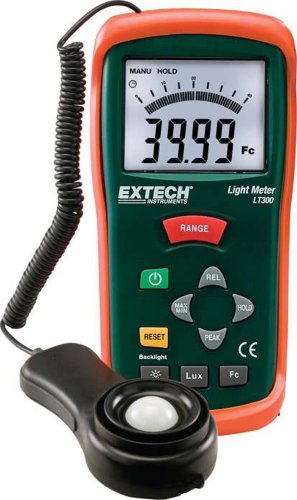
- Reads up to 40,000 lux
- Remote sensor and backlit LCD
- Min/max, hold, peak, and relative modes
Best For: Studio, workplace, laboratory, and facility light-level checks
Best Battery-Free Option
Sekonic L-398A Studio Deluxe III

- Battery-free amorphous photocell
- Analog full aperture/shutter dial
- Incident and reflected measurement
Best For: Users who prefer tactile, screen-free studio and location metering
Best High-Range Lux Meter
UNI-T UT383 Digital Illuminance Meter

- Measures up to 199,900 lux
- 0.5-second sampling time
- Backlit display with max/min and hold
Best For: Portable, broad-range illuminance checks in studios and other spaces
Professional Touchscreen Choice
Sekonic LiteMaster Pro L-478D-U
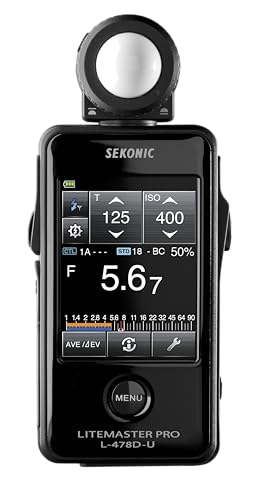
- Incident, ambient, and flash metering
- Cine frame rate and shutter angle controls
- Illuminance and luminance modes
Best For: Studio and motion-production workflows
Advanced Flash Control

- Measures flash duration and ambient exposure
- Wireless support for three flash systems
- Dust- and splash-proof construction
Best For: Wireless flash and low-light production
Budget Illuminance Meter
Digital 200,000-Lux Light Meter
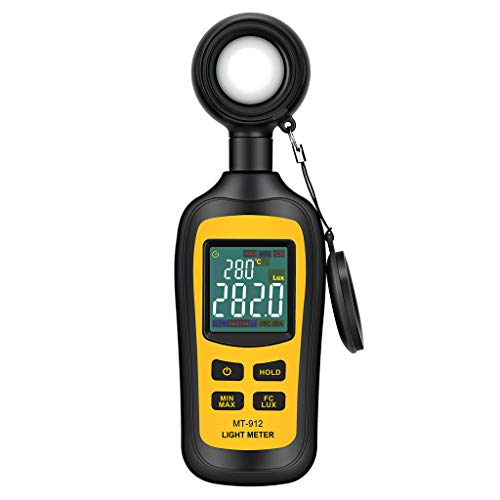
- Measures up to 200,000 lux
- Ambient temperature and MIN/MAX readings
- Compact body with two-year warranty
Best For: General lighting and set-design checks
Best Split-Probe Pick

- 0–199,900 lux measurement range
- 55cm separated probe lead
- Fast sampling with max/min and data hold
Best For: Film photography and hard-to-reach lighting measurements
Best Display Features

- Up to 200,000 lux and 20,000 FC
- Digital display with analog bar graph
- Backlight, hold, and MAX/MIN functions
Best For: Studio lighting adjustments and dim work areas
Best Rotating Sensor

- 360-degree rotating sensor
- 0–200,000 lux range with four settings
- Lux/FC switching and MIN/MAX functions
Best For: Measurements requiring flexible sensor positioning
Best All-Around Choice – Sekonic L-308X-U Flashmate
For photographers and videographers comparing studio handheld light meters, the Sekonic L-308X-U is a versatile compact option. It measures both incident and reflected light, supports ambient and electronic flash readings, and offers Photo, Cine, and HD Cine modes.
Best For: Still photographers, DSLR and mirrorless videographers, and cinema users who need flexible exposure readings.
Pros:
- Provides exposure accuracy down to a tenth of a stop.
- Supports ambient, corded flash, and cordless flash measurement.
- Offers shutter speeds, frame rates, and shutter angles for video workflows.
- Pocket-sized design with an LCD auto backlight.
Cons:
- Requires two AAA batteries.
- Its broad feature set may be more than needed for basic illuminance checks.
Choose this model if you want one small meter that can move between photography, HD video, and cinema exposure work without sacrificing fine-grained readings.
Best for Illuminance Checks – Extech LT300 Light Meter
Among studio handheld light meters, the Extech LT300 is geared toward straightforward illuminance measurement rather than camera exposure calculations. Its remote sensor, backlit display, and measurement range up to 40,000 lux make it practical for studios, labs, workplaces, and facility inspections.
Best For: Users who need portable lux and foot-candle readings with logging and comparison functions.
Pros:
- Measures up to 40,000 lux with lux and foot-candle readings.
- Cosine and color-corrected sensor supports varied lighting conditions.
- Includes minimum/maximum, data hold, peak, relative, and zero-adjustment functions.
- Large backlit LCD supports one-handed operation in dim areas.
Cons:
- It is an illuminance meter, not a dedicated photographic exposure meter.
- Requires a product-specific battery, which is included.
The LT300 is a sensible pick when your workflow centers on checking and comparing light levels rather than calculating aperture and shutter combinations.
Best Battery-Free Option – Sekonic L-398A Studio Deluxe III
The Sekonic L-398A Studio Deluxe III offers a traditional approach for buyers considering studio handheld light meters. Its battery-free amorphous photocell, analog dial, incident and reflected capabilities, and swivel head make it a durable choice for photographers and cinematographers who prefer direct, screen-free operation.
Best For: Studio and on-location users who value analog controls, battery-free operation, and a full exposure dial.
Pros:
- Battery-free photocell operates using ambient light.
- Displays complete aperture and shutter combinations on an analog dial.
- Swivel head helps position the incident dome while viewing the readout.
- Includes lumisphere, lumidisc, lumigrid, high slide, strap, and soft case.
Cons:
- Analog operation may require more hands-on adjustment than a digital meter.
- The supplied product details list a lithium-ion battery requirement despite the battery-free operation description.
This model stands out for photographers who want a tactile, dependable meter with broad included accessories and no reliance on routine battery changes.
Best High-Range Lux Meter – UNI-T UT383 Digital Illuminance Meter
The UNI-T UT383 is a compact digital choice among studio handheld light meters for users who primarily need illuminance data. It measures up to 199,900 lux or 18,500 foot-candles, provides a 0.5-second sampling time, and includes practical functions for quick checks in studios and other environments.
Best For: Photographers, studios, offices, laboratories, and other users needing a broad-range lux or foot-candle meter.
Pros:
- Measures from 0 to 199,900 lux and 0 to 18,500 foot-candles.
- Provides 0.5-second sampling with stated accuracy of ±(4%+8).
- Includes maximum/minimum, data hold, overload indication, and auto shutdown.
- Compact body with a large backlit four-digit LCD.
Cons:
- It reports illuminance rather than photographic aperture and shutter settings.
- Its stated accuracy may be less suitable when very fine exposure control is required.
Pick the UT383 when measurement range and portability matter most, especially for evaluating bright studio lighting or comparing light levels across different spaces.
Professional Touchscreen Choice – Sekonic LiteMaster Pro L-478D-U
For studio handheld light meters that also support motion work, the Sekonic LiteMaster Pro L-478D-U combines touchscreen operation with incident ambient and flash metering. Its cine controls and technical measurement modes make it a versatile option for photographers, filmmakers, and hybrid creators.
Best For: Studio photographers and filmmakers who need flash analysis, cine controls, and expanded illuminance or luminance measurements.
Pros:
- Measures incident ambient and flash light, including flash-to-ambient analysis.
- Supports cine frame rate and shutter angle settings.
- Color touchscreen interface and optional 5° reflected spot capability.
- Includes illuminance and luminance measurement modes.
Cons:
- The reflected spot function requires an optional attachment.
- Its advanced feature set may be more than needed for simple exposure checks.
The L-478D-U is a strong all-purpose choice when a handheld meter needs to cover studio flash, ambient exposure, and basic cinema workflows in one compact device.
Advanced Flash Control – Sekonic L-858D Speedmaster
The Sekonic L-858D Speedmaster is one of the more capable studio handheld light meters for photographers and filmmakers who need detailed flash and ambient readings. It adds wireless compatibility, high sensitivity, and a durable dust- and splash-proof design for demanding shoots.
Best For: Photographers and filmmakers working with wireless flash systems or measuring difficult, low-light scenes.
Pros:
- Measures flash duration as well as ambient exposure.
- Reads ambient light in scenes as low as 0.1 lx.
- Compatible with Elinchrom, Phottix, and PocketWizard products.
- Dust-proof and splash-proof for added on-set durability.
Cons:
- Its advanced capabilities may be unnecessary for basic ambient metering.
- Uses AA batteries rather than the included AAA battery setup of some compact meters.
Choose the L-858D when flash measurement and wireless control matter as much as ordinary exposure readings. Its sensitivity and rugged construction also suit location work beyond the studio.
Budget Illuminance Meter – Digital 200,000-Lux Light Meter
For buyers seeking straightforward studio handheld light meters, this digital illuminance meter focuses on lux readings rather than photographic flash analysis. Its broad 0–200,000-lux range, temperature measurement, and compact design make it useful for set design and general lighting checks.
Best For: Set designers, offices, workshops, and home users who need simple illuminance and ambient-temperature measurements.
Pros:
- Measures light from 0 to 200,000 lux.
- Includes ambient temperature measurement, data hold, and MIN/MAX readings.
- Compact 6.7-ounce design with a color LCD screen.
- Backed by a stated two-year warranty.
Cons:
- Does not list incident photographic, flash, or cine metering functions.
- Accuracy varies by measurement range.
This is a practical choice when the goal is quantifying illuminance rather than dialing in camera exposure. It is less specialized than the Sekonic meters but well suited to general lighting evaluation.
Best Split-Probe Pick – UNI-T UT383S
For studio handheld light meters that need to reach into awkward positions, the UNI-T UT383S stands out with its separated probe and 55cm lead. It measures up to 199,900 lux, offers fast 0.5-second sampling, and supports both lux and foot-candle readings.
Best For: Film photography, lighting checks, and narrow or high-brightness measurement areas.
Pros:
- Wide 0–199,900 lux and 0–18,500 FC measurement range
- 55cm lead helps position the probe away from the operator’s eyes
- Fast sampling, auto-ranging, data hold, and maximum/minimum readings
- Large backlit display with overload and low-battery indicators
Cons:
- Its split-probe design may be more equipment than casual users need
- Accuracy is specified as ±(4% + 8), so it is not positioned as a laboratory-grade reference meter
The UT383S is a practical choice when probe placement matters as much as the reading itself. Its broad range and dedicated support add flexibility for studio and general illumination checks.
Best Display Features – POROMETISTO LT01
Among studio handheld light meters, the POROMETISTO LT01 combines a broad 200,000-lux range with a digital reading and analog bar graph. Its backlight, hold mode, and two-readings-per-second sampling make it convenient for tracking changing illumination.
Best For: Photography studio adjustments, plant lighting, and users who want a readable display in dim environments.
Pros:
- Measures up to 200,000 lux or 20,000 FC
- Digital and analog bar graph display with green backlight
- Data hold and MAX/MIN modes support quick comparisons
- Includes batteries, sensor cap, lanyard, and a two-year warranty
Cons:
- The stated accuracy applies under standard incandescent lamps
- Its included documentation lists two AAA batteries, while the product details also describe them as included; verify the package if battery type is important
The LT01 is a well-rounded option for everyday studio and facility checks. The bar graph adds visual context to the numeric reading, while the warranty provides extra purchase reassurance.
Best Rotating Sensor – DANOPLUS DP-331
The DANOPLUS DP-331 is a flexible choice for studio handheld light meters because its sensor rotates 360 degrees independently from the meter. With four lux ranges, foot-candle switching, and a 0–200,000 measurement range, it can adapt to different measurement angles and brightness levels.
Best For: Studios, offices, homes, schools, and other spaces where sensor positioning is important.
Pros:
- 360-degree rotating sensor supports easier positioning
- Four automatic lux ranges from 200 to 200,000 lux
- Switchable lux and foot-candle units
- Includes MIN/MAX, data hold, and selectable auto-power-off functions
Cons:
- Accuracy is specified as ±4% ±10 digits
- The stated 400–700nm spectral range focuses on visible light rather than a broader spectrum
The DP-331 makes a strong case when convenient sensor alignment is a priority. Its compact design and straightforward measurement modes suit routine brightness checks across studio and general indoor settings.
How We Picked the Best Studio Handheld Light Meters
We evaluated these Studio Handheld Light Meters by looking at measurement type, practical range, display readability, operating modes, portability, and suitability for photography or video. Models with incident and reflected readings are generally more useful for exposure control, while lux meters are better suited to measuring illumination across a set or comparing fixtures.
We also considered flash measurement, cine features, battery requirements, sensor positioning, controls, and compatibility with common studio workflows. The selection includes established photographic meters from Sekonic alongside simpler digital meters for general light-level checks.
Quick Comparison
| Best For | Recommended Type | Look For |
|---|---|---|
| Portrait and studio photography | Incident/reflected photo meter | Reliable exposure modes and a swiveling or rotatable sensor |
| Flash photography | Flash-capable light meter | Flash percentage, sync, and wireless triggering support |
| Filmmaking | Cine-oriented meter | Frame rate, shutter angle, and HD cine settings |
| Lighting audits | Digital lux meter | Wide lux range, remote sensor, and clear display |
| Battery-free operation | Analog meter | Mechanical controls and dependable ambient-light measurement |
Key Buying Factors for Studio Handheld Light Meters
Measurement Type
Incident meters measure light falling on the subject and are often the easiest way to establish consistent exposure. Reflected meters measure light bouncing from the subject and can help evaluate specific tones or backgrounds. A combined meter offers the most flexibility.
Flash and Video Features
For strobes, choose a model with flash measurement and, if needed, wireless triggering or compatibility with your flash system. Video users should prioritize frame-rate, shutter-angle, and cine exposure modes rather than relying only on lux readings.
Range, Accuracy, and Readability
A wide measurement range is useful when moving between dim modeling lights and powerful fixtures. A backlit or high-contrast display helps in dark studios, while a remote or rotating sensor can make readings easier around modifiers and stands.
Controls and Power
Consider whether you prefer tactile analog controls, a compact digital interface, or a touchscreen. Battery-free meters avoid power concerns, but digital models typically provide more modes and automation. Check battery availability and expected runtime before buying.
Who Should Buy Which Studio Handheld Light Meters?
Photographers who need dependable exposure readings should start with a dedicated incident/reflected meter such as a Sekonic model. Studio flash users should choose a flash-capable option with wireless support when their trigger system is compatible. Filmmakers will benefit most from a meter with dedicated cine and HD cine settings.
If your priority is measuring fixture output, checking illumination uniformity, or comparing LED panels, a UNI-T or other high-range digital lux meter is usually the better value. Choose an analog meter when simplicity, tactile operation, and battery-free use matter more than advanced features. For occasional home-studio checks, an affordable handheld illuminance meter can provide useful readings without the cost of a professional photographic meter.