
The best portable handheld light meters make it easier to check illumination accurately instead of relying on visual judgment or a phone app. The models in this roundup cover broad lux ranges, foot-candle measurements, rotating sensors, backlit displays, and compact handheld designs.
Whether you need to balance photographic lighting, verify workspace brightness, monitor plants, or troubleshoot indoor illumination, the right meter should be simple to aim, quick to read, and suited to your measurement range.
Best 10 Portable Handheld Light Meters Picks for 2026
Compact Value Pick
200,000-Lux Digital Light Meter
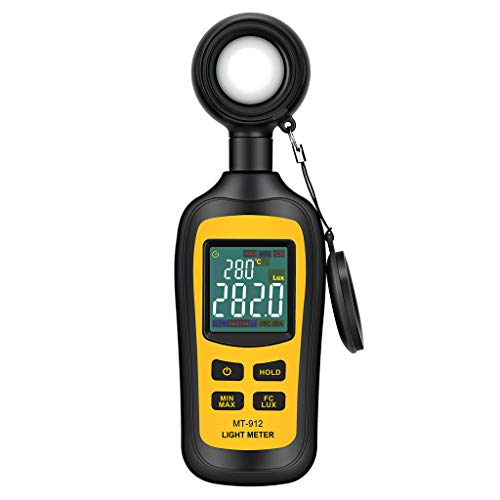
- Measures up to 200,000 lux and ambient temperature
- Color LCD with MIN/MAX and data hold
- Lightweight design with two-year warranty
Best For: General-purpose home, office, factory, and set-design checks
Best for Flexible Readability

- Rotating sensor and backlit 2.25-inch LCD
- Measures lux, foot-candles, temperature, and humidity
- Includes case and three AAA batteries
Best For: Plants, LEDs, vehicles, homes, offices, and workshops
Widest Measurement Range
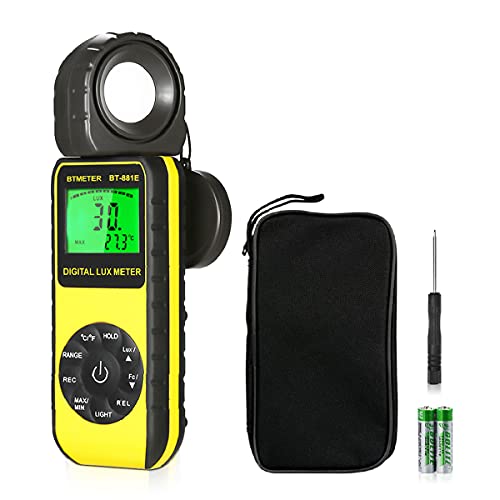
- Measures from 0.01 to 300,000 lux
- 270-degree rotating sensor with quick response
- Stores 33 readings and supports relative measurement
Best For: Extended-range checks and comparing readings across locations
Best Split-Sensor Design
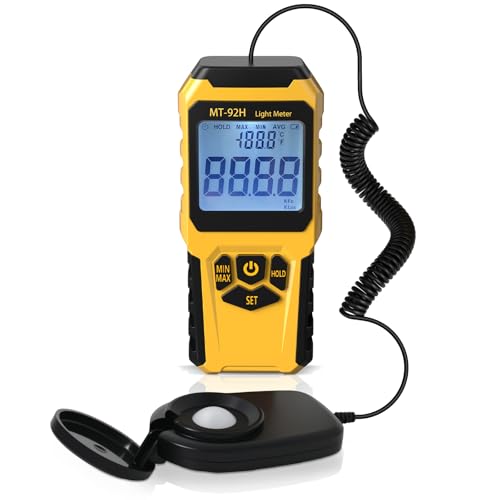
- Split sensor enables flexible probe positioning
- Measures up to 200,000 lux with 0.1-lux resolution
- Switchable units and backlight for varied conditions
Best For: Field and professional measurements needing flexible probe placement
Wide-Range Value Pick
S8608 200,000-Lux Digital Light Meter

- Measures up to 200,000 LUX / 18,500 FC
- Automatic range conversion and large display
- Includes hold, MAX/MIN, backlight, and auto-off
Best For: General-purpose indoor, outdoor, plant, and brightness measurements
Fast-Reading Garden Pick
Dr.meter 0–200,000-Lux Light Meter

- Fast readings at two measurements per second
- Selectable FC/LUX measurement units
- PEAK button records brief high-intensity pulses
Best For: Plant lighting, sunlight, and quick indoor or outdoor checks
Split-Probe Precision Pick
UNI-T UT383S Handheld Lux Meter

- 0–199,900 LUX range with selectable FC
- 0.5-second sampling for fast measurements
- 55cm lead helps position the probe away from bright light
Best For: Film, plant, and hard-to-reach or especially bright measurement areas
Best with Extra Features
POROMETISTO 200,000-Lux Light Meter

- 0–200,000 lux and 0–20,000 FC range
- Backlit digital and analog display
- Data hold, MAX/MIN, and two-year warranty
Best For: General plant, workspace, photography, and outdoor-light checks
Best Flexible Sensor
DANOPLUS Rotating-Sensor Lux Meter

- Separate sensor rotates 360 degrees
- Automatic ranges up to 200,000 lux
- Supports lux and foot-candle readings
Best For: Angled measurements in homes, offices, schools, and facilities
Best With Temperature Reading
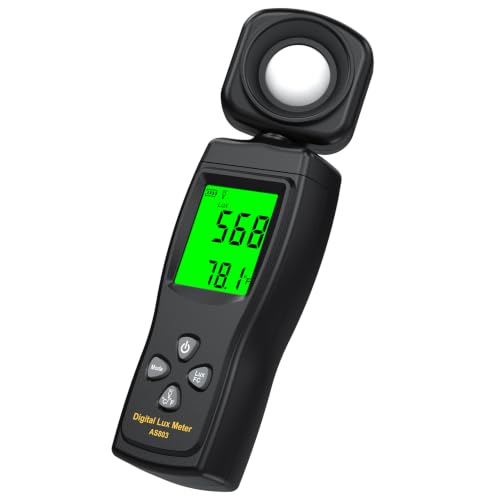
- Measures up to 200,000 lux
- Adds Celsius/Fahrenheit temperature readings
- 180-degree sensor and backlit LCD
Best For: Plant growing, photography, and indoor environment checks
Compact Value Pick – 200,000-Lux Digital Light Meter
For shoppers comparing portable handheld light meters, this compact digital model covers a broad 0–200,000-lux range while also measuring ambient temperature. Its color LCD, hold function, and MIN/MAX readings make it practical for home, office, factory, and set-design checks.
Best For: General-purpose light measurements when you want a lightweight meter with temperature readings.
Pros:
- Measures illumination up to 200,000 lux.
- Includes MIN/MAX, data hold, auto power-off, and low-battery indication.
- Compact 6.7-ounce design with a two-year warranty.
Cons:
- Uses three AAA batteries, which are not listed as included.
- Accuracy varies by measurement range.
This is a straightforward choice for routine indoor and workplace checks, especially if you value a small body and basic convenience features over specialized functions.
Best for Flexible Readability – TopTes TS-710 Light Meter
The TopTes TS-710 is one of the more adaptable portable handheld light meters for checking plants, LEDs, car headlights, and workspaces. Its rotating sensor, fast sampling, and large backlit display help you take readings from awkward angles and in dim areas.
Best For: Plant, home, office, workshop, and automotive lighting checks requiring flexible sensor positioning.
Pros:
- Measures 0.1–200,000 lux and 0.1–20,000 foot-candles.
- 180-degree rotating probe and 0.5-second sampling support angled measurements.
- Also measures temperature and humidity, with MAX/MIN and data hold.
- Includes a backlit LCD, soft case, and three AAA batteries.
Cons:
- Auto shut-off occurs after 10 minutes of inactivity.
- The temperature sensor adapts to new environments over time.
Choose this model if display visibility and measurement flexibility matter as much as the light range. The included case and batteries also make it ready for use out of the box.
Widest Measurement Range – BTMETER 881E Photometer
Among these portable handheld light meters, the BTMETER 881E stands out for its unusually wide 0.01–300,000-lux measurement range and quick response. Its 270-degree rotating sensor and 33-reading memory are useful when measuring changing light conditions across different angles.
Best For: Users who need an extended measurement range, fast sampling, and stored readings for plants, aquariums, offices, or LED lighting.
Pros:
- Measures up to 300,000 lux and 30,000 foot-candles.
- Samples two to three times per second with a stated 0.4-second response.
- 270-degree rotating sensor helps with readings from multiple angles.
- Stores 33 readings and includes a relative measurement mode.
Cons:
- Temperature testing is listed, but specific temperature range details are not supplied.
- Accuracy specifications vary between the lower and upper ranges.
This is the strongest fit for range-conscious buyers who want more memory and sensor rotation than a basic meter provides. Its added capacity is particularly useful for comparing readings across several locations.
Best Split-Sensor Design – MT-92H Light Meter
The MT-92H offers a practical split-sensor layout for portable handheld light meters, allowing the probe to be positioned separately from the display. It combines 0–200,000-lux measurements with lux/foot-candle switching, temperature readings, and a switchable backlight.
Best For: Professional or field use where flexible probe placement and readable measurements in bright or dark conditions are important.
Pros:
- Measures 0–200,000 lux with 0.1-lux resolution and stated ±3% accuracy.
- Separate probe supports flexible positioning and measurement monitoring.
- Switches between lux and foot-candles, and between Celsius and Fahrenheit.
- 0.5-second refresh rate and switchable backlight improve usability.
Cons:
- At 7 ounces, it is heavier than some compact models in this group.
- Uses three AAA batteries.
Consider the MT-92H when probe placement and display visibility are priorities. Its compact profile and included batteries make it suitable for mobile professional measurements without giving up unit flexibility.
Wide-Range Value Pick – S8608 200,000-Lux Digital Light Meter
For shoppers comparing portable handheld light meters, the S8608 stands out with a broad 0–200,000-lux measuring range, automatic range conversion, and a large display. It supports both LUX and foot-candle readings for indoor, outdoor, plant, and photography-related measurements.
Best For: General-purpose brightness checks at home, in schools, hospitals, factories, airports, and growing spaces.
Pros:
- Measures up to 200,000 LUX, or 18,500 FC.
- Automatic range conversion simplifies readings.
- Includes data hold, MAX/MIN, backlight, low-battery alert, and auto power-off functions.
- Compact 4.6-ounce design with three included AAA batteries.
Cons:
- Designed to measure visible brightness rather than provide specialized light-spectrum analysis.
- Its feature set may be more than needed for occasional basic checks.
Choose this model if you want a lightweight, broadly applicable meter with a high maximum range and straightforward measurement features.
Fast-Reading Garden Pick – Dr.meter 0–200,000-Lux Light Meter
This Dr.meter is a practical option among portable handheld light meters, pairing a 0–200,000-lux range with readings twice per second. Its selectable FC/LUX units and PEAK button make it useful for checking plant lighting and capturing brief, high-intensity light pulses.
Best For: Gardeners and users measuring sunlight or indoor lighting in homes, offices, factories, and plant-growing areas.
Pros:
- Provides a wide 0–200,000-lux measurement range.
- Fast response delivers readings two times per second.
- Switches between foot-candles and lux.
- PEAK recording can capture the highest value from brief light pulses.
Cons:
- Uses a 9V battery rather than AAA batteries.
- At 12 ounces, it is heavier than the lightest option in this roundup.
- The notes identify only a light meter as an included component.
The Dr.meter is a sensible fit when quick readings and peak-value recording matter, especially for plant-light checks and changing or momentary light sources.
Split-Probe Precision Pick – UNI-T UT383S Handheld Lux Meter
The UNI-T UT383S offers a split-probe design that can be easier to position in tight or unusually bright areas. For buyers seeking portable handheld light meters with fast sampling, it combines a 0–199,900-lux range, 0.5-second sampling, selectable LUX/FC units, and a 55cm lead.
Best For: Film photography, plant measurements, and readings where keeping the display away from the light source is helpful.
Pros:
- Measures 0–199,900 LUX, or 0–18,500 FC.
- 0.5-second sampling supports fast readings.
- Split probe with a 55cm lead helps avoid bright light affecting the user’s eyes.
- Includes auto range, data hold, MAX/MIN, backlight, overload indication, and auto power-off.
Cons:
- Its split-probe setup adds a separate lead and probe to manage.
- Accuracy is specified as +/- (4% + 8), which may not suit applications requiring tighter stated tolerances.
Pick the UT383S when probe placement is a priority. Its fast sampling and remote sensor make it particularly practical for narrow, high-light, or awkward measurement environments.
Best with Extra Features – POROMETISTO 200,000-Lux Light Meter
For shoppers comparing portable handheld light meters, the POROMETISTO LT01 offers a broad 0–200,000 lux range in a compact body. Its digital and analog displays, backlight, and recording functions make it practical for checking plants, workspaces, photography lighting, and outdoor fixtures.
Best For: Users who want wide-range readings, quick visual feedback, and an included starter kit for general-purpose light checks.
Pros:
- Measures 0–200,000 lux and 0–20,000 foot-candles.
- Combines a digital reading with an analog bar graph and backlight.
- Includes data hold, MAX/MIN recording, auto shutoff, batteries, and a two-year warranty.
Cons:
- Specified accuracy is based on standard incandescent lamps.
- The supplied details list the batteries as both AAA in the feature notes and AA in the specifications.
The LT01 is a versatile choice when portability and a generous measurement range matter most. Its hold and MAX/MIN functions are especially useful when taking readings in awkward or changing environments.
Best Flexible Sensor – DANOPLUS Rotating-Sensor Lux Meter
The DANOPLUS DP-331 is one of the more adaptable portable handheld light meters for measurements taken from difficult angles. Its separate 360-degree rotating sensor helps you position the sensing head independently, while automatic ranging simplifies readings from dim indoor light to bright illumination.
Best For: Home, office, school, hospital, and factory users who need flexible sensor positioning and straightforward lux or foot-candle measurements.
Pros:
- Offers four automatic ranges up to 200,000 lux and switchable foot-candle units.
- 360-degree rotating, separate sensor supports angled measurements.
- Includes MIN/MAX, data hold, selectable auto power-off, and low-battery indication.
Cons:
- Listed accuracy is ±4% ±10 digits, so it is not the tightest stated accuracy among these options.
- The sensor’s 400–700 nm range is intended for visible light rather than all wavelengths.
The DP-331 stands out for sensor flexibility. If you regularly measure light around fixtures, plants, or rooms where the meter body cannot face the source directly, its rotating head can make setup easier.
Best With Temperature Reading – Ohcans AS803 Light Meter
The Ohcans AS803 adds temperature monitoring to the core functions expected from portable handheld light meters. With a 0–200,000 lux range, 180-degree rotating sensor, backlit display, and fast sampling, it suits plant rooms, photography setups, and indoor evaluations.
Best For: Growers and indoor-space users who want light readings alongside real-time temperature in Celsius or Fahrenheit.
Pros:
- Measures up to 200,000 lux with stated accuracy of ±4% +10.
- 180-degree rotating sensor and backlit LCD support flexible, low-light use.
- Adds temperature readings, data hold, MAX/MIN recording, and three measurement modes.
Cons:
- Requires three AAA batteries, compared with two batteries for the other listed meters.
- The sensor rotates 180 degrees rather than the full 360 degrees offered by the DANOPLUS model.
- The supplied description contains a typo in one application reference, so intended use should be judged from the listed features.
The AS803 is the strongest fit when environmental context matters as much as illuminance. Its temperature function can help users monitor plant or office conditions without carrying a separate thermometer.
How We Picked the Best Portable Handheld Light Meters
We focused on practical features that affect real-world measurements: maximum and minimum lux range, foot-candle support, sensor positioning, display readability, refresh speed, temperature functions, and overall portability. We also considered whether each design is useful for photography, home and office checks, plant care, workshop tasks, or general lighting diagnostics.
A wide range is helpful, but it is not the only priority. A rotating or split sensor can make it easier to measure awkward fixtures, while a backlight improves readability in dim locations. Products with clear controls and stable handheld operation earned preference over meters that offer specifications without comparable ease of use.
Quick Comparison
| Feature | What to look for | Why it matters |
|---|---|---|
| Measurement range | Up to about 200,000 lux | Handles both dim rooms and bright light sources |
| Units | Lux and foot-candles | Supports different workflows and reference standards |
| Sensor design | Rotating, split, or flexible sensor | Improves positioning around lamps and equipment |
| Display | Large LCD with backlight | Makes readings easier to see in varied conditions |
| Extra functions | Temperature, hold, or fast refresh | Adds convenience for repeated checks |
Key Buying Factors for Portable Handheld Light Meters
Range and Accuracy
Choose a meter that covers the environments you measure most often. A range near 200,000 lux provides flexibility for bright daylight and strong artificial sources, while resolution and repeatability matter when comparing small lighting changes. For professional calibration work, confirm the manufacturer’s accuracy specifications rather than relying only on the headline range.
Sensor Placement
A 180-degree or 360-degree rotating sensor can point toward a light source without forcing you to twist the entire meter. Split-sensor designs are useful when the display must stay at eye level while the detector sits in a tight or elevated location.
Readability and Controls
Look for a large, high-contrast display, backlight, data hold, and intuitive unit switching. These features reduce errors when you are measuring overhead fixtures, moving between rooms, or recording several readings quickly.
Portability and Durability
For field work, prioritize a lightweight body, protective sensor design, accessible buttons, and a secure grip. Battery type and automatic shutoff also affect ongoing convenience, especially if the meter stays in a camera bag or tool case.
Who Should Buy Which Portable Handheld Light Meters?
Photographers and videographers: Choose a model with fast refresh, lux and foot-candle modes, a readable backlit screen, and a sensor that is easy to aim.
Home, office, and facility users: A broad-range meter with simple controls and data hold is usually the best balance for checking desks, rooms, corridors, and work areas.
Plant growers: Select the easiest meter to position around shelves and canopies, and remember that lux is a visible-light measurement rather than a complete substitute for a plant-specific PAR meter.
Technicians and workshop users: Favor rugged handling, a flexible sensor, quick response, and dependable readings across both low-light and high-intensity environments.