
The best handheld light meters make it easier to measure illumination accurately instead of relying on visual estimates. Whether you are checking a workspace, setting up photography lighting, or troubleshooting uneven brightness, the right meter should be easy to position and quick to read.
We compared 10 popular models with features such as broad lux ranges, rotating sensors, foot-candle modes, backlit displays, and temperature readings. Use the guide below to narrow your choices by accuracy, convenience, and intended use.
Best 10 Handheld Light Meters Picks for 2026
Best Precision Pick
Dr.meter Digital Illuminance Light Meter

- 0–200,000 lux measuring range
- Fast readings at twice per second
- Peak hold plus FC/lux conversion
Best For: Plant lighting and general indoor or outdoor measurements
Best Wide-Range Option
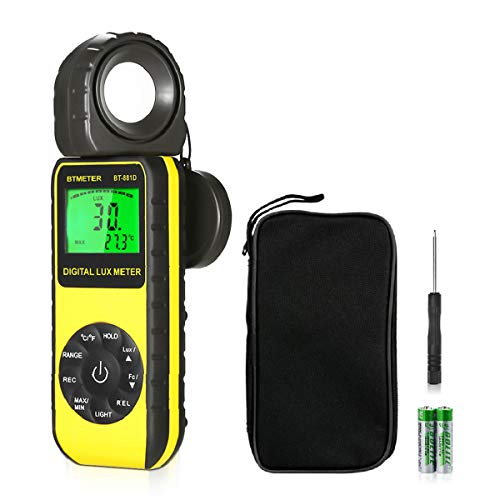
- Measures up to 400,000 lux
- 270° rotating light sensor
- Stores 33 readings with relative mode
Best For: Wide-range testing across plants, offices, schools, and outdoor settings
Best Feature-Rich Pick

- Backlit display with rotating 180° probe
- Light, temperature, and humidity readings
- Includes case and three AAA batteries
Best For: Plant care, home diagnostics, and workshop measurements
Best Compact Choice

- Compact meter with backlit LCD
- 0–199,900 lux and 0–18,500 FC range
- Max/Min, hold, and auto-shutdown functions
Best For: Portable checks in homes, offices, labs, agriculture, and studios
Best Split-Sensor Pick
MT-92H 200,000-Lux Light Meter
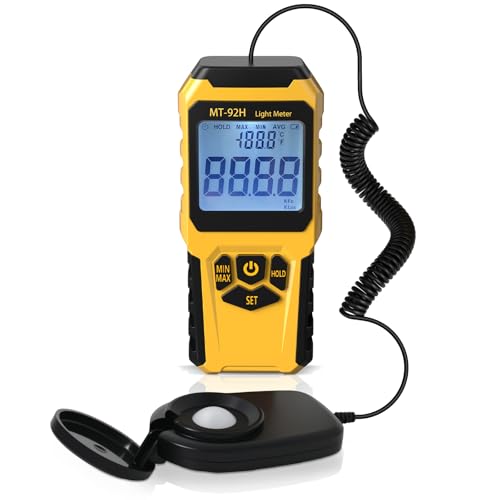
- 0–200,000 Lux range with 0.5-second refreshes
- Separate probe supports flexible positioning
- Backlit display and Lux/Fc switching
Best For: Fast, flexible portable light measurements
Best Straightforward Value
S8608 Digital Illuminance Meter

- Measures up to 200,000 Lux or 18,500 FC
- Automatic range conversion
- MAX/MIN, hold, backlight, and auto-off functions
Best For: Routine indoor and outdoor brightness checks
Best Warranty Coverage
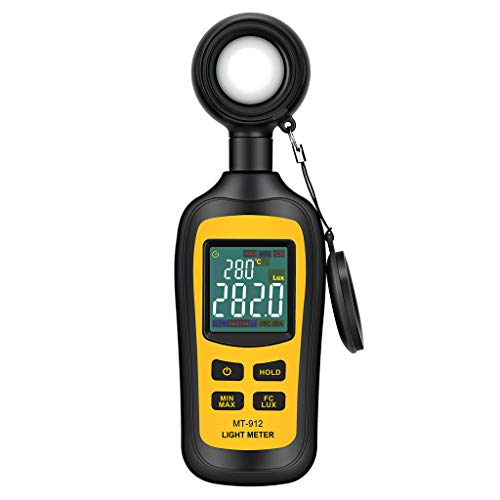
- 0–200,000 Lux range with ambient temperature measurement
- Color LCD with MIN/MAX and data hold
- Two-year warranty and compact 6.7-ounce design
Best For: Home, office, factory, and set-design measurements
Best Split-Probe Pick
UNI-T UT383S Handheld Light Meter

- 0–199,900 lux measurement range
- 55cm lead with separate probe
- Fast sampling and data-hold features
Best For: Photography, plants, and awkward measurement positions
Best Rotating-Sensor Option

- Measures up to 200,000 lux
- 360-degree rotating sensor
- Batteries included with lux/FC switching
Best For: Adjustable sensor positioning at home, work, or school
Best Value Range
Mcbazel Digital Illuminance Light Meter

- Measures up to 200,000 lux
- Backlit display with lux/FC selection
- Hold, min/max, and auto-shutoff functions
Best For: General indoor, garden, plant, and photography checks
Best Precision Pick – Dr.meter Digital Illuminance Light Meter
For gardeners and general-purpose users seeking handheld light meters, the Dr.meter offers a broad 0–200,000 lux range, fast readings, and simple FC/lux switching. Its peak-hold function is also useful when checking brief, intense light pulses.
Best For: Plant-light checks, household and workplace measurements, and users who want peak-value recording.
Pros:
- Measures up to 200,000 lux.
- Samples twice per second for quick readings.
- Switches between foot-candles and lux.
- Peak recording captures the highest detected pulse.
Cons:
- Uses a 9V battery, which is not included in the supplied notes.
- No rotating sensor or backlit display is specified.
This is a straightforward choice when fast, high-range illuminance readings matter more than extra environmental sensors or data-storage features.
Best Wide-Range Option – BTMETER BT-881D Light Meter
The BTMETER BT-881D stands out among handheld light meters for its exceptionally wide 0.01–400,000 lux range. A 270-degree rotating sensor makes it easier to position the meter while keeping the display visible.
Best For: Users measuring varied light levels, including LED grow lights, offices, schools, gardens, and outdoor sources.
Pros:
- Very wide 0.01–400,000 lux range.
- Fast 0.4-second response with two to three samples per second.
- Rotating sensor supports measurements from different angles.
- Stores 33 readings and provides relative measurement mode.
Cons:
- Accuracy varies by range, from ±4% to ±5% plus 10 digits.
- The supplied notes do not specify a backlit display or included battery.
Choose this model if maximum range, angled sensor positioning, and basic reading memory are more important than the smallest possible form factor.
Best Feature-Rich Pick – TopTes TS-710 Light Meter
The TopTes TS-710 is one of the more versatile handheld light meters, combining a 0.1–200,000 lux range with a rotating probe, large backlit screen, and temperature and humidity readings. It also includes a case and three AAA batteries.
Best For: Plant growers, homeowners, workshop users, and anyone who wants light readings alongside basic temperature and humidity information.
Pros:
- 180-degree rotating probe and 2.25-inch backlit LCD.
- Measures 0.1–200,000 lux and 0.1–20,000 foot-candles.
- Includes temperature, humidity, MAX/MIN, data hold, and auto shutoff.
- Three AAA batteries and a soft case are included.
Cons:
- Temperature sensing adapts to new environments over time.
- Its 200,000-lux maximum is lower than the BTMETER BT-881D’s stated range.
This is a strong all-around option for practical home, plant, and workshop checks, especially if a readable display and extra environmental measurements are valuable.
Best Compact Choice – UNI-T UT383 Light Meter
The UNI-T UT383 is a compact option for handheld light meters, with lux and foot-candle measurement, a 0.5-second sampling time, and a backlit four-digit LCD. Its Max/Min and data-hold functions support quick checks in homes, offices, studios, and field settings.
Best For: Portable light-level checks in agriculture, offices, laboratories, photography, construction, and everyday household use.
Pros:
- Compact design with a backlit LCD.
- Measures up to 199,900 lux and 18,500 foot-candles.
- Provides Max/Min, data hold, overload indication, and auto shutdown.
- Samples every 0.5 seconds.
Cons:
- Its maximum range is slightly below 200,000 lux.
- The supplied notes do not specify an included battery or carrying case.
The UT383 makes sense for users who prioritize portability and essential measurement functions over rotating sensors, extensive memory, or temperature and humidity readings.
Best Split-Sensor Pick – MT-92H 200,000-Lux Light Meter
If you need a responsive handheld light meter for changing conditions, the MT-92H combines a 0–200,000 Lux range with 0.5-second refresh rates. Its separate probe, switchable Lux/Fc units, backlit display, and compact design make it a flexible choice for professional measurements.
Best For: Users who want fast readings, flexible probe positioning, and Lux/Fc measurement in a compact meter.
Pros:
- Measures from 0 to 200,000 Lux with stated ±3% accuracy and 0.1-Lux resolution.
- Split-sensor design supports flexible positioning while maintaining measurement integrity.
- Switchable backlight and a glare-resistant display improve readability in darkness or sunlight.
- Lightweight 188g design uses included AAA batteries.
Cons:
- Its temperature function covers only 14°F to 140°F.
- Requires three AAA batteries for operation.
The MT-92H stands out among handheld light meters when quick refreshes and a separate sensor matter. It is a strong all-around option for portable illuminance work, especially where display visibility and positioning flexibility are priorities.
Best Straightforward Value – S8608 Digital Illuminance Meter
The S8608 is a practical handheld light meter for measuring visible brightness across indoor and outdoor settings. With automatic range conversion, a large display, Lux/Fc switching, and useful hold and peak-reading functions, it covers common measurement needs without unnecessary complexity.
Best For: Homes, schools, workplaces, grow setups, and other users seeking broad-range brightness measurements with simple controls.
Pros:
- Measures illuminance up to 200,000 Lux, or 18,500 FC.
- Automatic range conversion simplifies readings across different light levels.
- Includes MAX/MIN, data hold, backlight, auto power-off, and low-battery indication.
- Large screen and included AAA batteries support convenient everyday use.
Cons:
- The supplied notes do not specify an accuracy rating.
- Uses three AAA batteries.
For shoppers comparing handheld light meters for general brightness checks, the S8608 offers a useful combination of range and basic measurement features. Its automatic ranging and readable display make it well suited to routine indoor and outdoor testing.
Best Warranty Coverage – Compact 4-Digit Light Meter
This compact handheld light meter measures up to 200,000 Lux while also monitoring ambient temperature. Its 4-digit color LCD, MIN/MAX readings, data hold, and stated two-year warranty make it a practical option for home, office, factory, and set-design work.
Best For: Buyers who value a compact meter with a color display, temperature readings, and extended warranty coverage.
Pros:
- Measures luminosity from 0 to 200,000 Lux and includes ambient temperature measurement.
- Provides stated accuracy of ±3% rdg ±8 digits below 10,000 Lux and ±4% rdg ±10 digits above it.
- Color LCD includes MIN/MAX, data hold, auto power-off, and low-battery indication.
- Includes a two-year warranty and weighs 6.7 ounces.
Cons:
- The supplied notes do not state the temperature measurement range.
- Accuracy is lower at readings above 10,000 Lux than below that threshold.
The main advantage of this model among handheld light meters is its balance of broad range, practical controls, and warranty support. It is a sensible pick when long-term coverage and a compact form matter as much as basic light measurement.
Best Split-Probe Pick – UNI-T UT383S Handheld Light Meter
For buyers comparing handheld light meters, the UNI-T UT383S stands out for its split design and broad 0–199,900 lux measuring range. Its 55cm lead helps position the probe away from bright light and can make measurements more comfortable in tight or challenging spaces.
Best For: Film photography, plant checks, and measurements where a remote probe is useful.
Pros:
- Wide 0–199,900 lux and 0–18,500 FC range
- 55cm lead and separate 10cm × 6cm probe
- 0.5-second sampling with stated accuracy of ±(4%+8)
- Auto ranging, backlight, data hold, and maximum/minimum readings
Cons:
- Its split-probe design may be more than casual users need
- Battery type and battery inclusion are not specified in the supplied notes
The UT383S is a practical choice when probe positioning matters. It combines fast readings and useful logging features with UNI-T support, making it a strong all-around option for repeated light measurements.
Best Rotating-Sensor Option – DANOPLUS Digital Lux Meter
The DANOPLUS is one of the more flexible handheld light meters for users who need to angle the sensor independently. It offers four automatic lux ranges up to 200,000 lux, switchable foot-candle readings, and a rotating sensor for positioning around lamps, workspaces, or plants.
Best For: Home, office, school, hospital, and plant-light checks that benefit from adjustable sensor placement.
Pros:
- Measures from 0 to 200,000 lux with four range settings
- 360-degree rotating sensor separates from the meter
- Switchable lux and foot-candle units
- Includes batteries and offers hold, minimum/maximum, and auto-power-off functions
Cons:
- Accuracy is specified as ±4% ±10 digits
- The four-digit LCD may provide less display detail than larger-screen models
Choose the DANOPLUS when sensor orientation is a priority. Its included batteries and straightforward controls also make it convenient for general-purpose brightness checks soon after unboxing.
Best Value Range – Mcbazel Digital Illuminance Light Meter
The Mcbazel digital illuminance meter is a compact option for shoppers who want a broad range without a complicated feature set. It measures up to 200,000 lux, samples up to twice per second, and adds a backlit LCD for readings in darker environments.
Best For: Grow plants, photography, indoor spaces, gardens, and general brightness checks.
Pros:
- Wide measurement range up to 200,000 lux
- Stated accuracy of ±3% ±10 digits below 10,000 lux and ±4% ±10 digits above it
- Backlight, lux/FC switching, data hold, and maximum/minimum readings
- Automatic shutoff and low-battery indicator help conserve power
Cons:
- Requires three AAA batteries, which are not included
- Readings below approximately 2 lux may display as zero
The Mcbazel is a sensible budget-oriented pick for everyday measurements and hobby projects. Keep its approximately 2-lux minimum identifiable threshold in mind if you need to measure very dim conditions.
How We Picked the Best Handheld Light Meters
We focused on practical features that affect everyday measurements: maximum and minimum lux range, sensor movement, display readability, response speed, measurement units, and portability. Models covering up to about 200,000 lux offer flexibility for both dim indoor spaces and bright environments. We also considered whether a meter supports foot-candle readings, useful for lighting specifications and certain photography workflows.
Because published specifications can vary by seller and production batch, verify the current listing for accuracy claims, battery requirements, included accessories, and warranty coverage before buying.
Quick Comparison
| Feature | What to look for | Why it matters |
|---|---|---|
| Measurement range | Up to 200,000 lux | Handles everything from low indoor light to strong daylight. |
| Sensor design | Rotating or split sensor | Makes it easier to measure awkward angles and recessed fixtures. |
| Display | Large LCD or backlit screen | Improves readability in dark rooms and bright work areas. |
| Units | Lux and foot-candles | Supports different lighting standards and workflows. |
| Extra readings | Temperature or hold function | Adds convenience during inspections and repeated measurements. |
Key Buying Factors for Handheld Light Meters
Range and Resolution
Choose a wide range if you work across different environments. Resolution matters when comparing small lighting changes, while a fast refresh rate is helpful for moving around a room and checking several surfaces quickly.
Sensor Flexibility
A rotating sensor can face a ceiling, lamp, or work surface without forcing you to twist the entire meter. Split-sensor designs place the display in your hand while the detector reaches into tighter spaces.
Screen and Controls
Look for a clear four-digit display, intuitive unit switching, data hold, and a backlight if you often work in dim conditions. Automatic range selection is convenient, while manual range control can help with more consistent comparisons.
Portability and Durability
For occasional home or office checks, a compact meter is usually sufficient. Frequent field users should prioritize a protective case, secure battery compartment, comfortable buttons, and a sensor that feels sturdy during repeated repositioning.
Who Should Buy Which Handheld Light Meters?
For general home and office checks: Choose an affordable digital meter with a broad range, simple controls, and a readable LCD.
For photographers and videographers: Prioritize lux and foot-candle modes, quick refresh rates, a hold function, and a rotating sensor that helps evaluate lighting from the subject’s position.
For electricians, facility managers, and inspectors: A wide-range model with strong display visibility, repeatable readings, and a flexible or remote sensor is the better choice.
For dark-room or low-light work: Select a meter with fine low-end resolution and a backlit display. For mixed indoor and outdoor use, favor models reaching roughly 200,000 lux.