
A camera slider can add controlled motion to interviews, product videos, time-lapses, and cinematic B-roll without requiring a full motion-control rig. The best beginner systems balance smooth movement, practical setup, camera support, and a learning curve you can manage.
We selected 10 manual and motorized options in different lengths and price ranges, including compact rails, carbon-fiber sliders, app-controlled models, and longer systems for broader camera moves.
Best 10 Camera Slider Systems for Beginners Picks for 2026
Best Motorized Long-Track Option
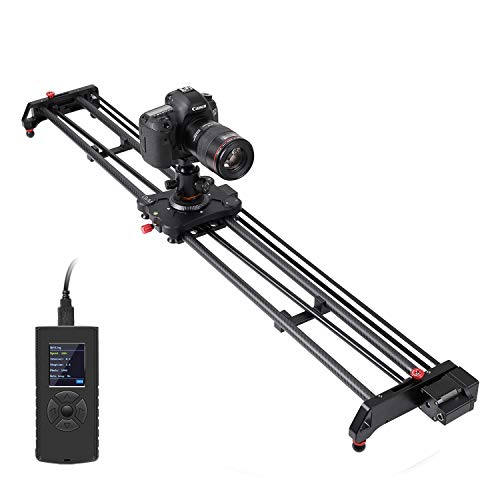
- Automated tracking, time-lapse, and panoramic modes
- 48-inch carbon-fiber track with adjustable feet
- Includes battery, remote, cables, charger, and bag
Best For: Beginners needing long, repeatable motorized camera movements
Best Portable Manual Starter
Zecti 24-Inch Carbon Fiber Slider

- Lightweight 1.4-pound travel-friendly construction
- Adjustable legs, bubble level, and non-skid feet
- Works with cameras, phones, action cameras, and camcorders
Best For: Beginners learning manual slider movement while traveling
Best App-Controlled Upgrade
NEEWER ER1 31.5-Inch Motorized Slider

- App-controlled motorized movement with video and time-lapse modes
- 11-pound horizontal load capacity and 45-degree tilt support
- Includes 4400mAh battery and quiet stepper motor
Best For: Creators wanting repeatable motion and app-based control
Best Budget Manual Rail
Andoer Aluminum Alloy Track Slider

- Four precision bearings for smooth, quiet manual movement
- Supports up to 11 pounds
- Multiple mounting threads for cameras and accessories
Best For: Beginners practicing manual slider shots on a simple rail
Feature-Rich Motorized Pick

- App-controlled motorized movement
- Six shooting modes with time-lapse support
- Long carbon-fiber rail with adjustable legs
Best For: Beginners wanting an advanced, long-range motorized slider
Portable Manual Pick
NEEWER 16-Inch Carbon Fiber Slider

- Lightweight 615 g travel-friendly design
- Smooth, noiseless four-bearing dolly
- Includes phone and action-camera accessories
Best For: Beginners using phones and lightweight cameras on the go
Remote-Controlled Value Pick

- Remote-adjustable speed and time-lapse settings
- Supports tracking, panorama, and video modes
- Carbon-fiber rail with versatile mounting ports
Best For: Beginners learning automated shots with remote control
Best Beginner Motorized Slider

- Video, time-lapse, and round-trip modes
- Supports multiple shooting angles
- Includes feet, cables, bag, and power adapter
Best For: Beginners seeking a compact motorized slider for versatile camera setups
Best Long-Rail Feature Set
GVM 48-Inch Carbon Fiber Slider
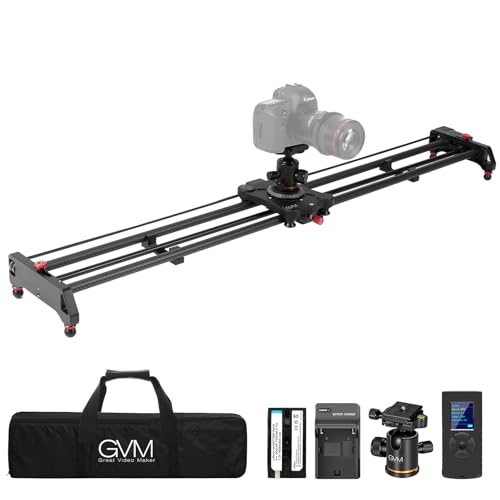
- 120-degree panorama and tracking modes
- Remote control with detailed motion settings
- Includes six shutter cables and an extension
Best For: Creators wanting a long rail and advanced automated shooting controls
Best App-Controlled Option

- App and optional 2.4G remote control
- Quiet motor with included 4400mAh battery
- Supports tilt, tracking, and panorama shots
Best For: Creators wanting lightweight long-rail movement with app-based control
Best Motorized Long-Track Option – GVM 48-Inch Motorized Slider
For beginners comparing camera slider systems for beginners, the GVM 48-inch model offers automated movement with adjustable start and end points, speed, intervals, and stop times. Its carbon-fiber track supports manual or motorized operation and includes a battery, remote, cables, and carrying bag.
Best For: Beginners who want long tracking shots, time-lapse sequences, panoramic movement, and repeatable automated motion.
Pros:
- 48-inch/120cm track provides substantial camera travel.
- Supports tracking, time-lapse, panoramic, manual, and electric shooting modes.
- Adjustable feet and multiple 1/4-inch and 3/8-inch mounting ports improve setup flexibility.
- Includes battery, charger, remote, shutter cables, extension cable, and bag.
Cons:
- At 11.8 pounds, it is less convenient to transport than shorter sliders.
- The track is 48 inches long, so storage and setup require considerable space.
- It is not water resistant.
This is a feature-rich starting point for creators who want automated camera movement rather than a purely manual learning tool. Its long, heavy design is best suited to planned setups where portability is secondary.
Best Portable Manual Starter – Zecti 24-Inch Carbon Fiber Slider
The Zecti 24-inch slider is a straightforward choice for beginners exploring camera slider systems for beginners without adding motor controls. Its lightweight carbon-fiber rail, adjustable legs, bubble level, and multiple mounting threads support flexible manual shooting with cameras, phones, and action cameras.
Best For: Travelers, smartphone creators, and beginners learning manual camera movement on horizontal, vertical, diagonal, or sideways setups.
Pros:
- Lightweight 1.4-pound design and included carrying bag suit travel.
- Four precision bearings and dual carbon-fiber rails are designed for smooth movement.
- Adjustable legs, non-skid feet, and a bubble level help with positioning.
- Compatible with cameras, camcorders, phones, action cameras, and general-purpose ballheads.
Cons:
- It is a manual slider, so it does not provide automated repeatable motion.
- Supplied guidance notes that overtightened screws can cause noise or rough movement.
- The maximum recommended load is 4.4 pounds.
For a beginner who values portability and simple operation, the Zecti offers a useful introduction to slider technique. Check the adjustment screws before shooting so the carriage is not overtightened.
Best App-Controlled Upgrade – NEEWER ER1 31.5-Inch Motorized Slider
For beginners seeking camera slider systems for beginners with room to grow, the NEEWER ER1 combines motorized movement with app control and an included 4400mAh battery. It supports manual, video, and time-lapse modes, while its carbon-fiber body and four roller bearings provide a stable platform for creative camera moves.
Best For: Content creators who want app-based control, repeatable motion, product videos, time-lapse work, and multiple shooting angles.
Pros:
- App control and 2.4G remote compatibility provide flexible operation.
- Supports manual, video, and time-lapse shooting modes with adjustable speed and intervals.
- Handles up to 11 pounds horizontally and supports 45-degree tilt shooting up to 5.5 pounds.
- Includes a 4400mAh NP-F750 battery and uses a quiet stepper motor.
Cons:
- The 2.4G remote is not included.
- A 5V 2A Type-C portable charger is not included.
- Minor shake may occur during macro photography.
The ER1 is a capable middle-ground option for beginners who want automated control without immediately moving to a very long slider. Its charging and remote-control exclusions should be factored into the setup budget.
Best Budget Manual Rail – Andoer Aluminum Alloy Track Slider
The Andoer track slider is a simple, compact entry point for camera slider systems for beginners. Its aluminum-alloy body uses four high-precision bearings, supports up to 11 pounds, and provides multiple 1/4-inch and 3/8-inch threads for mounting a camera, tripod, monitor, light, or microphone.
Best For: Beginners who want an affordable manual rail for DSLR, camcorder, product, and basic video photography setups.
Pros:
- Four high-precision bearings are designed for smooth, quiet sliding.
- Supports loads up to 11 pounds.
- Convertible 1/4-inch and 3/8-inch screw on the sliding plate accommodates a ballhead.
- Multiple track-length options are listed: 30cm, 40cm, and 50cm.
Cons:
- It is a manual slider with no motorized or automated modes.
- The supplied details do not list a carrying bag, battery, or remote.
- It is not water resistant.
This Andoer is a practical choice for learning the fundamentals of manual slider shots while keeping the system relatively simple. Its accessory threads and stated load capacity also make it useful for more than just a camera.
Feature-Rich Motorized Pick – GVM 48-Inch Motorized Slider
For beginners exploring camera slider systems for beginners, the GVM 48-inch motorized slider offers automated movement and a broad set of shooting modes. Its app control, adjustable legs, and multiple mounting threads make it a flexible choice for learning tracking shots, panoramas, and time-lapse work.
Best For: Beginners who want a long motorized rail with app-controlled movement and extensive shooting options.
Pros:
- Supports tracking, panoramic, time-lapse, video capture, and auto-loop modes.
- iOS and Android app control lets you manage motorized motion from a phone or tablet.
- Carbon-fiber construction, adjustable legs, and multiple 1/4-inch and 3/8-inch ports support horizontal, vertical, and 45-degree setups.
- Includes six shutter-release cables, an extension cable, and a carrying bag.
Cons:
- Its 48-inch length and 4 kg weight are less compact than a mini slider.
- Battery life is listed at approximately two hours.
- It is not water resistant.
The GVM is a capable learning platform for beginners who want automated camera movement and room for more advanced techniques. Choose it when a long travel distance matters more than minimal size and weight.
Portable Manual Pick – NEEWER 16-Inch Carbon Fiber Slider
For beginners comparing camera slider systems for beginners, the NEEWER CS1M keeps the setup compact and straightforward. Its manual dolly, adjustable ball head, phone clamp, and action-camera adapter make it useful for practicing smooth movements with lightweight gear.
Best For: Beginners using phones, action cameras, or lightweight cameras for portable tabletop and outdoor shots.
Pros:
- Lightweight 615 g design and included carrying bag are convenient for travel.
- Four precision bearings provide smooth, noiseless manual sliding.
- Includes a 360-degree rotating, 90-degree tilting ball head, phone clamp, and action-camera mount.
- Adjustable legs, a bubble level, and 1/4-inch and 3/8-inch threads support varied setups.
Cons:
- The 16-inch rail provides less travel than the longer GVM options.
- Weight capacity is limited to 4.4 pounds horizontally, 2.2 pounds at 45 degrees, and 2.2 pounds vertically.
- Manual operation does not provide automated time-lapse or tracking movement.
The CS1M is an approachable entry point when portability and accessory compatibility matter most. It is best suited to small cameras and mobile devices rather than heavier professional rigs or automated sequences.
Remote-Controlled Value Pick – GVM 31-Inch Motorized Slider
The GVM 31-inch motorized slider is a practical option for beginners seeking camera slider systems for beginners with automated control. Its remote supports movement settings, time-lapse parameters, and start-and-end points, while the carbon-fiber rail and adjustable legs keep the setup adaptable.
Best For: Beginners who want remote-controlled motorized shots and time-lapse functions in a mid-length slider.
Pros:
- Remote control adjusts speed, dwell time, sliding distance, pause time, and shot count.
- Supports tracking, panoramic, time-lapse, video capture, and auto-loop shooting.
- Carbon-fiber construction, adjustable legs, and multiple 1/4-inch and 3/8-inch ports support horizontal, vertical, and 45-degree shooting.
- Includes six shutter cables, an extension cable, and a one-year warranty.
Cons:
- Remote control is less direct than app control for users who prefer smartphone operation.
- It is not water resistant.
- The listing does not specify a precise item weight or battery runtime.
This GVM balances automated features with a shorter rail than the 48-inch model. It makes sense for beginners who want repeatable movement and time-lapse control without committing to the longest slider format.
Best Beginner Motorized Slider – 27-Inch GVM Camera Slider
For beginners exploring camera slider systems for beginners, this 27-inch GVM model offers a practical motorized starting point. Its aluminum-alloy rail supports video, time-lapse, and automatic round-trip shooting, while adjustable feet help with setup on a table or tripod.
Best For: Beginners who want a compact motorized slider for DSLR, video camera, or cellphone shooting.
Pros:
- Supports video, time-lapse, and automatic round-trip modes.
- Works horizontally, vertically, and at 45-degree angles.
- Includes adjustable non-slip feet, a carrying bag, wire controller, remote cable, and power bank adapter.
- Multiple 1/4-inch and 3/8-inch mounting holes support tripods and accessories.
Cons:
- The 2.5 kg maximum recommended load limits heavier camera setups.
- At 2.36 kg, it is less convenient to carry than some carbon-fiber alternatives.
- It is not water resistant.
This GVM slider is a sensible entry point if you want automated movement without moving straight to a larger professional rail. Its 27-inch length and included accessories make it useful for interviews, product clips, and basic time-lapse work.
Best Long-Rail Feature Set – GVM 48-Inch Carbon Fiber Slider
This 48-inch GVM model is a strong option among camera slider systems for beginners who want room to grow. The carbon-fiber rail combines tracking, horizontal, time-lapse, and 120-degree panoramic shooting with remote adjustment of speed, endpoints, dwell time, and looping.
Best For: Beginners and developing creators who need a long rail and detailed remote control for cinematic or time-lapse movement.
Pros:
- Offers tracking, horizontal, 120-degree panorama, video, and time-lapse modes.
- Remote control adjusts endpoints, speed, pauses, dwell time, shot count, and automatic looping.
- Supports up to 1,000 time-lapse photos and includes six shutter cables plus an extension cable.
- Multiple 1/4-inch and 3/8-inch ports allow tripod mounting.
Cons:
- The 120 cm rail and 5.42 kg weight make it less portable than shorter sliders.
- Its broader feature set may take more time for a beginner to learn.
- It is not water resistant.
The main advantage here is control: the long rail creates more pronounced camera movement, while the remote supports precise repeatable shots. Choose it when creative range and extended travel matter more than minimizing size and weight.
Best App-Controlled Option – NEEWER ER1 47.2-Inch Slider
For beginners who prefer app-based control, the NEEWER ER1 is one of the more flexible camera slider systems for beginners. Its 47.2-inch carbon-fiber rail supports manual, video, and time-lapse modes, with app control and a 2.4G remote option for setting speed, intervals, and exposure.
Best For: Content creators who want a lightweight long slider with quiet operation, app control, and included battery power.
Pros:
- Supports app control and 2.4G remote control for motion settings.
- Includes a 4400mAh NP-F750 battery and uses a quiet stepper motor.
- Offers horizontal, 45-degree tilt, tracking, and 120-degree panoramic shooting.
- Carbon-fiber construction, four roller bearings, and tripod threads support stable setups.
Cons:
- The charger is not included, and the 2.4G remote is also not included.
- Minor shake may occur during macro photography.
- Its rated load drops from 11 lb horizontally to 5.5 lb when tilting upward at 45 degrees.
The ER1 balances a long 120 cm travel distance with a relatively low 2.5 kg weight. It is particularly appealing if quiet movement and phone-based control fit your workflow, but budget for the missing charger and remote if you need both control options.
How We Picked the Best Camera Slider Systems for Beginners
We focused on the features that matter most when learning camera movement: stable construction, usable travel length, load capacity, setup simplicity, and control options. The selection includes manual sliders for straightforward dolly moves and motorized models for repeatable tracking, time-lapse, and panoramic shots.
Because beginner needs vary, we also considered portability. A 12- to 16-inch slider is easier to carry and use on a tabletop, while 31- to 48-inch models provide more dramatic movement but need a sturdier support setup. App control, remote controls, phone mounts, ball heads, and battery operation can add flexibility, but they may also increase setup time and maintenance.
Quick Comparison
- Best for portability: Compact 12- to 16-inch sliders are easier to pack and position.
- Best for general video work: 24- to 31-inch models offer a useful balance of travel and manageability.
- Best for cinematic movement: 47- to 48-inch sliders create longer, more visible camera moves.
- Best for repeatable shots: Motorized and app-controlled systems provide consistent speed and direction.
- Best for simple operation: Manual sliders have fewer controls and are often faster to set up.
Key Buying Factors for Camera Slider Systems for Beginners
Slider Length and Portability
Choose a length based on the shots you expect to make and how you transport equipment. Short rails work well for product clips, desktop scenes, and small cameras. Longer rails are better for wide B-roll, but they are heavier and more demanding to support.
Manual or Motorized Movement
A manual slider is usually the simplest starting point for basic push-ins and side-to-side moves. Motorized systems are more useful when you need slow, repeatable movement, time-lapse sequences, or automated round trips. Check whether the motor requires a separate battery or uses a built-in rechargeable pack.
Camera Support and Load Capacity
Verify the stated load limit and account for the complete setup, including the camera, lens, cage, microphone, and accessories. A slider should remain smooth under your actual payload, not just an unloaded camera body. A compatible tripod head or ball head may also be necessary.
Control, Speed, and Setup
Remote controls and smartphone apps can make speed adjustments easier, but confirm that the app is compatible with your device. Look for clear speed controls, reliable stopping, adjustable direction, and a stable carriage. Smooth results also depend on leveling the rail and tightening every connection.
Who Should Buy Which Camera Slider Systems for Beginners?
Choose a compact manual slider if you are learning basic camera movement, shoot mostly on a table, or need a lightweight travel option. Choose a mid-length slider if you want one versatile system for interviews, product videos, and general B-roll. Choose a motorized model if repeatability, time-lapse photography, or slow automated movement is a priority. Choose a long carbon-fiber slider if you regularly create cinematic establishing shots and have sturdy tripods or support stands available.