
The best beginner-friendly camera slider systems make it easier to create smooth tracking shots, controlled time-lapses, and repeatable camera moves without a complicated cinema rig.
We compared compact manual sliders, motorized models, app-controlled systems, and longer carbon-fiber rails to help you choose the right balance of portability, control, payload, and price.
Best 10 Beginner-Friendly Camera Slider Systems Picks for 2026
Best Lightweight Manual Pick
Zecti 24-Inch Carbon Fiber Slider

- Portable 654 g manual design
- Adjustable legs and bubble level
- Supports loads up to 4.4 pounds
Best For: Traveling beginners learning manual camera moves
Best Smart Compact System

- Programmable app-controlled motion
- Quiet motor with five shooting modes
- 7-hour battery and 2.4-pound payload
Best For: Compact-camera and smartphone creators
Best Compact Manual Starter
Zecti 16-Inch Carbon Fiber Slider

- Lightweight 600 g portable build
- Adjustable legs with bubble level
- Multiple 1/4-inch and 3/8-inch mounts
Best For: Beginners practicing short manual tracking shots
Best Long-Track Motorized Option

- 31.5-inch motorized carbon-fiber track
- App control for video and time-lapse
- 11-pound horizontal load capacity
Best For: Creators making repeatable product videos and time-lapses
Versatile Motorized Pick

- Automated time-lapse and round-trip modes
- Tripod and tabletop mounting options
- Supports up to 2.5 kg
Best For: Beginners using DSLR, video cameras, or phones
Most Portable Pick
GripGear MovieMaker Motion Kit

- Compact slider and panorama mount
- No app required for operation
- Supports phones, GoPros, and mirrorless cameras
Best For: Lightweight mobile and compact-camera shooting
Advanced Control Pick
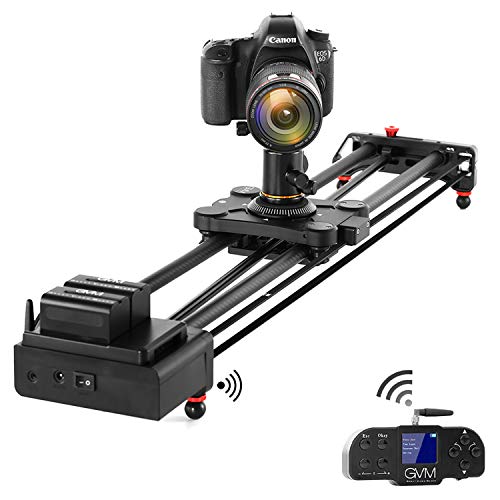
- Bluetooth and mobile-app programming
- Quiet motor for video capture
- High stated horizontal load capacity
Best For: Growing creators using heavier camera setups
Long-Track Automation
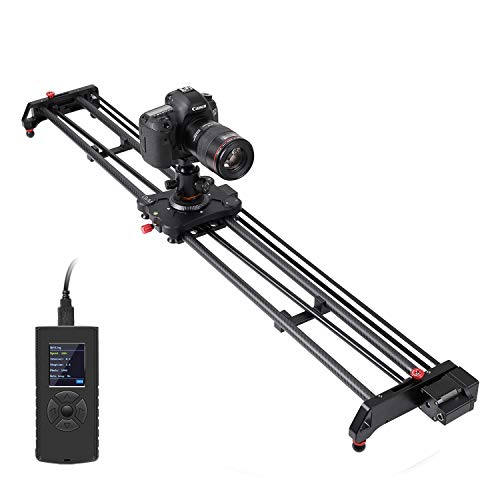
- 48-inch carbon-fiber rail with motorized and manual operation
- Supports tracking, time-lapse, and 120-degree panoramic shooting
- Includes battery, remote, cables, charger, and carrying bag
Best For: Longer programmed camera moves and time-lapse projects
Compact Motorized Starter
GVM 31-Inch Carbon-Fiber Slider

- Shorter 31-inch rail with a carbon-fiber build
- Offers horizontal, tracking, and 120-degree panoramic modes
- Includes ball head, battery, remote, charger, and shutter cables
Best For: New users wanting a versatile, shorter motorized slider
App-Controlled Versatility

- Controls motorized motion through an iOS or Android app
- Supports tracking, time-lapse, video, and panoramic shooting
- Includes adjustable legs, shutter cables, extension cable, and carry bag
Best For: Creators who want app-based control over longer camera moves
Best Lightweight Manual Pick – Zecti 24-Inch Carbon Fiber Slider
For beginners building a portable setup, this 24-inch Zecti is a straightforward option among beginner-friendly camera slider systems. Its manual carriage, adjustable legs, bubble level, and multiple mounting threads make it practical for learning horizontal, vertical, diagonal, and sideways camera moves.
Best For: Travelers and beginners using smartphones, action cameras, mirrorless cameras, or compact camcorders.
Pros:
- Lightweight 654 g design includes a carrying bag.
- Four precision bearings and dual carbon-fiber rails support smooth movement.
- Adjustable legs, rubber feet, and a bubble level help with setup on different surfaces.
- Supports cameras and devices up to 4.4 pounds, with 1/4-inch and 3/8-inch mounting holes.
Cons:
- Manual operation does not provide programmable or motorized moves.
- Overtightened screws may cause noise or uneven movement and can require adjustment.
- It is not water resistant.
This slider offers a useful balance of portability and flexibility for learning basic tracking shots. Beginners should check the carriage tension before filming, especially if movement feels noisy or rough.
Best Smart Compact System – iFootage Shark Slider PICO
The iFootage Shark Slider PICO is a compact, automated choice for beginners who want repeatable motion without manually pushing a carriage. Its app control, quick-mark system, and dedicated shooting modes make it one of the more approachable beginner-friendly camera slider systems for time-lapse and creative smartphone or compact-camera work.
Best For: Creators using DJI Pocket cameras, action cameras, or smartphones who want quiet, programmable movement.
Pros:
- Offers Video, Time-Lapse, Stop Motion, Panorama, and Multi-Target modes.
- Onboard controls and the app support up to eight programmable points.
- Brushless motor is designed for quiet operation during recording.
- Weighs 1.9 pounds, has a 7-hour battery, and supports Bluetooth, NFC, and USB-C connections.
Cons:
- Its 2.4-pound payload limits the camera setups it can carry.
- It is shorter than many full-size sliders, with a 15.8-inch length.
- Advanced features may take more setup than a basic manual slider.
The PICO is a strong fit when convenience and repeatability matter more than maximum payload or travel distance. Its direct compatibility with select DJI Pocket and action-camera models is particularly useful for compact content-creation rigs.
Best Compact Manual Starter – Zecti 16-Inch Carbon Fiber Slider
The 16-inch Zecti keeps the controls simple for newcomers who want to practice slider technique without adding motors or apps. Its compact rail, adjustable feet, bubble level, and multiple mounting points make it a practical entry in the beginner-friendly camera slider systems category.
Best For: Beginners who need a shorter, portable slider for tabletop work, straightforward tracking shots, and lightweight camera kits.
Pros:
- Compact 16-inch size and 600 g weight are easy to carry.
- Four precision bearings and dual carbon-fiber rails support stable movement.
- Removable adjustable legs and non-skid feet work on varied surfaces.
- Compatible with cameras, camcorders, mirrorless cameras, telephoto lenses, and smartphones with an appropriate holder.
Cons:
- The shorter track provides less travel than the 24-inch model.
- Manual operation requires the user to maintain a consistent push.
- The supplied note warns that overtightened screws can cause noise or rough movement.
This is a sensible first slider for learning composition, speed control, and mounting technique. Its shorter travel favors portability and controlled setups rather than long cinematic passes.
Best Long-Track Motorized Option – NEEWER ER1 31.5-Inch Slider
For beginners ready to automate longer camera moves, the NEEWER ER1 combines an 80 cm track with app-controlled motion and time-lapse functions. It is a more capable choice among beginner-friendly camera slider systems, while its load ratings and angle controls make it suitable for growing video setups.
Best For: Content creators making product videos, time-lapses, and repeatable moves with heavier camera equipment.
Pros:
- 31.5-inch track provides more travel for broad camera moves.
- App control supports manual, video, and time-lapse modes with adjustable speed, interval, and exposure.
- Silent stepper motor and four roller bearings support quiet, stable movement.
- Supports up to 11 pounds horizontally and 5.5 pounds at a 45-degree tilt.
Cons:
- At 8.7 pounds, it is substantially less portable than the compact options.
- A 2.4G remote is supported but not included.
- The supplied note mentions minor shake may occur during macro photography.
The ER1 is a useful upgrade for beginners who want repeatable motion and a longer rail without moving immediately to a more complex professional system. Its larger footprint and weight are best suited to planned shoots rather than casual travel.
Versatile Motorized Pick – GVM 27-Inch Motorized Slider
For creators seeking beginner-friendly camera slider systems, the GVM 27-inch motorized slider offers a practical balance of automated movement and flexible mounting. Its time-lapse, video, and auto round-trip modes make it useful for repeatable camera motion without requiring a complex setup.
Best For: DSLR, video-camera, and cellphone users who want automated horizontal, vertical, or angled moves.
Pros:
- Supports time-lapse, video, and automatic round-trip shooting.
- Adjustable non-slip feet help level the slider on a surface.
- Multiple 1/4-inch and 3/8-inch mounting holes support tabletop or tripod use.
- Supports cameras and cellphones, with a maximum recommended load of 2.5 kg.
Cons:
- At 2.36 kg and nearly 27 inches long, it is less portable than compact slider systems.
- It is not water resistant.
- A ball head may be needed for some camera mounting arrangements.
This is a capable entry point for learning motorized camera movement, especially if you want several shooting orientations and repeatable modes in one system. Its included carrying bag and one-year warranty add practical value for beginners.
Most Portable Pick – GripGear MovieMaker Motion Kit
The GripGear MovieMaker is one of the more beginner-friendly camera slider systems for creators who prioritize portability and a quick start. This compact kit combines a slider and panorama mount, requires no app, and works with phones, GoPros, mirrorless cameras, and other compatible devices.
Best For: Smartphone, GoPro, and mirrorless users making interviews, B-roll, panoramas, or simple time-lapse clips in small spaces.
Pros:
- Compact 2-in-1 design switches between sliding and panoramic movement.
- No app is required, and the kit includes a quick-start guide.
- Ping-pong motion can automatically move the camera back and forth.
- Supports vertical, horizontal, and upside-down use.
Cons:
- The maximum recommended load is 750 g, limiting heavier camera setups.
- The included track is compact; longer tracks up to 6 meters are sold separately.
- Battery life is listed at 2.5 hours, shorter than some larger motorized systems.
Its low weight, included mounts, USB-rechargeable power, and straightforward controls make this a friendly option for first-time users. Choose it when convenience and compact shooting matter more than supporting a full-size camera rig.
Advanced Control Pick – GVM 31-Inch Bluetooth Slider
The GVM 31-inch carbon-fiber slider is a strong choice among beginner-friendly camera slider systems for users who want room to grow into more precise motion control. Bluetooth remote and mobile-app control provide adjustable start and end points, keyframes, speed, delays, and looping for more customized shots.
Best For: Creators using heavier camera equipment who want silent, programmable movement for video, panoramas, or time-lapse work.
Pros:
- App and Bluetooth control support keyframes, adjustable speed, and custom endpoints.
- Ultra-silent step-motor operation is suited to video recording.
- Supports following, parallax, panoramic, time-lapse, and looping shots.
- Carbon-fiber and aluminum construction supports up to 25 lb horizontally and 7 lb vertically, according to the supplied notes.
Cons:
- Its 35-inch folded size and 7-pound weight make it less convenient to transport.
- App-based control may feel more involved for beginners than a simple wired controller.
- The supplied details list compatibility as a tablet rather than a broad device list.
This model is best for beginners who expect to explore programmable motion rather than only basic slides. Its quiet motor, extended controls, and substantial stated load capacity make it the most expandable option here, though its larger size adds setup and transport demands.
Long-Track Automation – GVM 48-Inch Motorized Slider
For creators comparing beginner-friendly camera slider systems, this 48-inch GVM model offers motorized movement with adjustable start and end points, automatic round trips, and time-lapse controls. Its carbon-fiber rail, adjustable feet, and included battery kit make it a practical choice for repeatable camera moves.
Best For: Longer tracking shots, time-lapse work, and users who want both manual and motorized operation.
Pros:
- 48-inch carbon-fiber rail supports extended camera movement.
- Offers tracking, time-lapse, and 120-degree panoramic shooting modes.
- Adjustable speed, interval, stop time, photo count, and motor torque provide flexible automation.
- Includes a battery, charger, remote, shutter cables, extension cable, and carrying bag.
Cons:
- At 11.8 pounds, it is relatively heavy to transport.
- The 48-inch folded length requires substantial storage and carrying space.
- It is not water resistant.
This slider is a strong fit when smooth, programmable movement matters more than portability. The included accessories and adjustable leveling feet also reduce the need to assemble a separate starter kit.
Compact Motorized Starter – GVM 31-Inch Carbon-Fiber Slider
This 31-inch GVM model is one of the more approachable beginner-friendly camera slider systems for creators who want motorized movement in a shorter, lighter setup. It combines three shooting orientations with video and time-lapse menus, plus a broad accessory kit for getting started.
Best For: Beginners seeking a compact motorized slider for cameras or camcorders and outdoor shooting.
Pros:
- 31-inch carbon-fiber construction balances a stable structure with a shorter form factor.
- Supports horizontal, tracking, and 120-degree panoramic shooting.
- Video and time-lapse modes can automate motion and round trips between set points.
- Includes a remote, NP battery, charger, ball head, cables, hex key, and extension cable.
Cons:
- Its shorter rail provides less travel than the 48-inch alternatives.
- The kit weighs 10 pounds, so it is not especially lightweight for travel.
- It is not water resistant.
The shorter rail and included ball head make this a sensible entry point for learning automated slider movements. Multiple screw ports also allow horizontal, vertical, and 45-degree tripod mounting.
App-Controlled Versatility – GVM 48-Inch APP Slider
For beginners who prefer smartphone controls, this GVM 48-inch model is a beginner-friendly camera slider system with iOS and Android app support. It provides programmable motorized motion, multiple shooting modes, adjustable leveling feet, and tripod mounting options in a portable carbon-fiber design.
Best For: Smartphone-controlled tracking, time-lapse, panoramic shooting, and more repeatable video moves.
Pros:
- App control works with iOS and Android smartphones or tablets.
- Six-in-one shooting support includes tracking, panoramic, time-lapse, and video capture functions.
- Adjustable speed, interval, stop time, photo count, start points, and end points support precise setups.
- Includes six shutter cables, an extension cable, adjustable legs, and a carrying bag.
Cons:
- App operation adds a smartphone or tablet to the setup.
- Its 120-centimeter rail is less convenient to store than a shorter slider.
- Battery life is listed at approximately two hours, and the unit is not water resistant.
The app-based controls are useful for users who want to adjust motion without relying on a hardwired controller. It is a feature-rich option, though its longer rail and need for a smart device may be more than a simple beginner setup requires.
How We Picked the Best Beginner-Friendly Camera Slider Systems
We focused on the features that matter most when learning camera movement: straightforward setup, stable construction, usable travel length, motor and control options, portability, and compatibility with common cameras and phones. The lineup includes manual sliders for simple operation, compact systems for travel, and motorized models for repeatable moves, time-lapse sequences, and remote control.
We also considered whether each design suits a tabletop setup, tripod-mounted production, or larger camera package. Since payload ratings and stability can vary by configuration, always confirm the manufacturer’s specifications before mounting a heavier camera, lens, or gimbal.
Quick Comparison
| Slider type | Best for | Main advantage | Potential limitation |
|---|---|---|---|
| Manual carbon-fiber slider | Beginners and simple tracking shots | Low complexity and fast setup | Requires consistent hand movement |
| Compact motorized slider | Travel, phones, and tabletop work | Portable repeatable motion | Shorter travel range |
| Motorized 27–31-inch slider | General video and time-lapse | Useful balance of reach and portability | Needs batteries or external power |
| Motorized 48-inch slider | Long tracking shots and studio work | Extended camera travel | Heavier and less convenient to transport |
Key Buying Factors for Beginner-Friendly Camera Slider Systems
Manual or Motorized Movement
Manual sliders are usually the easiest place to start if you want immediate control and minimal maintenance. Motorized systems are better for repeatable moves, automated returns, time-lapse photography, and slow cinematic motion, but they add controls, charging, and setup decisions.
Travel Length and Portability
Short sliders fit small studios, desks, and travel bags. Rails around 27 to 31 inches provide a versatile middle ground for product videos and interviews. A 48-inch slider creates more dramatic movement but generally needs more space, stronger support, and a larger carrying case.
Control and Shooting Modes
Look for the controls you will actually use, such as wired controls, Bluetooth remotes, mobile apps, round-trip movement, panorama functions, or time-lapse programming. App control can be convenient, while a no-app design may be preferable when reliability and simplicity matter most.
Support, Payload, and Camera Compatibility
Check the mounting thread, carriage design, maximum supported load, and whether the slider works best on a tabletop or two tripods. A heavier camera and lens combination requires more stable support than a phone or compact mirrorless setup.
Who Should Buy Which Beginner-Friendly Camera Slider Systems?
Choose a manual Zecti-style slider if you want the simplest, most affordable introduction to camera movement. Pick a compact iFootage or MovieMaker-style system for travel, phone shooting, tabletop scenes, or quick setups. A 27- to 31-inch GVM or NEEWER motorized slider is the strongest all-purpose choice for creators who want automated tracking, time-lapse, and repeatable motion without carrying a full-size rail.
Choose a 48-inch GVM system when long camera moves are central to your work and you have adequate space and support. Before buying, prioritize the type of shots you make most often rather than selecting the longest rail or most feature-heavy controller.