
Smooth camera movement can make product videos, interviews, tutorials, and cinematic social content feel far more polished. The right slider system helps you create repeatable tracking shots without requiring a full production crew.
Our roundup covers compact manual dollies, portable phone-friendly sliders, and motorized systems with app control, time-lapse support, and programmable movement. Use the buying guide below to match rail length, payload, control options, and portability to your workflow.
Best 10 Camera Slider Systems for Content Creators Picks for 2026
Best Motorized Control
NEEWER ER1 31.5-Inch Motorized Slider

- App-controlled video and time-lapse motion
- 11-pound horizontal load capacity
- 45-degree tilt and panorama options
Best For: Programmable studio and outdoor camera moves
Best Manual Travel Slider
Zecti 24-Inch Carbon Fiber Slider

- Lightweight 1.4-pound travel design
- Supports multiple shooting orientations
- Compatible with phones and small cameras
Best For: Portable manual camera moves with lightweight gear
Best for Compact Cameras

- Designed for DJI Pocket, action cameras, and phones
- Up to eight programmable motion points
- Seven-hour battery in a 1.9-pound body
Best For: Compact-camera creators making repeatable cinematic shots
Best App-Controlled Production

- Six programmable shooting modes
- Wireless iOS and Android app control
- Includes shutter-release cables and extension
Best For: YouTube and studio creators programming complex camera moves
Best Compact Manual Pick

- Linear or circular manual movement
- Quiet rubber wheels and adjustable ball head
- Compact phone-friendly design
Best For: Portable tabletop shots and smartphone content
Best Advanced Motion-Control Pick
IFOOTAGE PICO Pro Motorized Slider
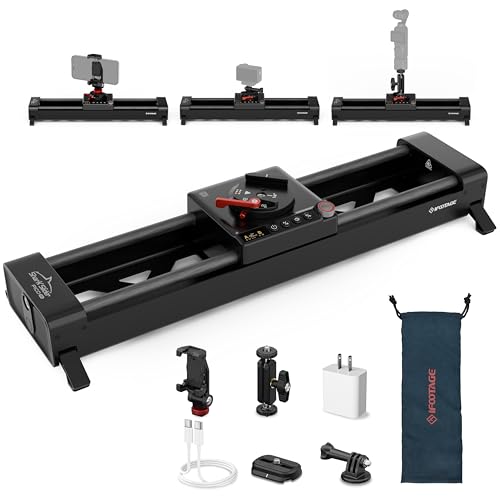
- Two-axis motion with 360-degree pan
- Carbon-fiber rail supports up to 1.1kg
- LCD and app control for repeatable shots
Best For: Product videos, time-lapse, interviews, and cinematic B-roll
Best Motorized Dolly for Camera Rigs

- App control with manual, live, and time-lapse modes
- 6.6-pound load rating and quiet dual motors
- Up to five hours of NP-F750 battery runtime
Best For: Wireless-controlled B-roll and time-lapse with larger camera setups
Best Motorized Long-Rail Option
GVM 48-Inch Carbon Fiber Motorized Slider
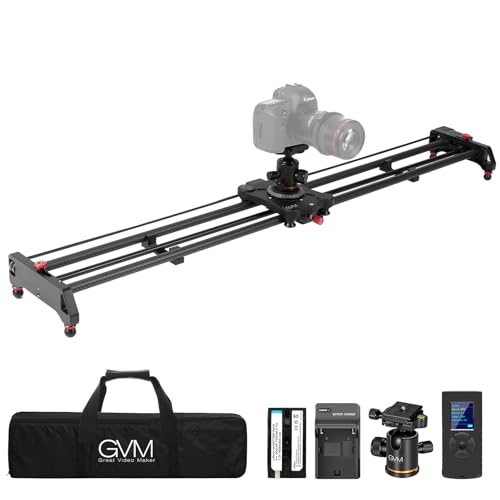
- Automated tracking, horizontal, panoramic, and time-lapse modes
- Remote control for speed, endpoints, loops, and shot settings
- 120 cm rail with multiple tripod mounting ports
Best For: Repeatable tracking shots, time-lapses, and panoramic footage
Best Portable Smartphone-and-Action-Camera Slider
NEEWER 16-Inch Carbon Fiber Slider

- Compact 615 g design with carrying bag
- Includes phone clamp and action-camera mount
- Adjustable legs, ball head, and smooth four-bearing movement
Best For: Travel creators using phones, action cameras, or lightweight cameras
Best App-Controlled Slider
GVM 48-Inch Motorized Camera Slider

- iOS/Android app controls motorized movement
- Supports tracking, panoramic, time-lapse, and video modes
- 120 cm carbon-fiber rail with adjustable legs
Best For: Programmable long-travel shots controlled from a phone or tablet
Best Motorized Control – NEEWER ER1 31.5-Inch Motorized Slider
For content creators comparing camera slider systems for content creators, the NEEWER ER1 combines a long 31.5-inch carbon-fiber rail with app-controlled motorized movement. It supports manual, video, and time-lapse modes, with horizontal loads up to 11 pounds and tilt loads up to 5.5 pounds at 45 degrees.
Best For: Creators who want programmable motion for product videos, time lapses, and larger camera setups.
Pros:
- App control with adjustable speed, interval, and exposure settings.
- Silent stepper motor and included 4400mAh NP-F750 battery.
- Supports horizontal, 45-degree tilt, tracking, and 120-degree panorama shots.
- Carbon-fiber construction with four roller bearings and tripod threads.
Cons:
- Minor shake may occur during macro photography.
- 2.4G remote control and charger are not included.
- At 8.7 pounds, it is less travel-friendly than lighter options.
The ER1 is a feature-rich choice when repeatable, powered camera movement matters more than minimum carry weight. Its long rail and substantial load rating suit studio and outdoor production, while the app adds useful control for solo shooting.
Best Manual Travel Slider – Zecti 24-Inch Carbon Fiber Slider
The Zecti 24-inch slider is a lightweight manual option for creators seeking camera slider systems for content creators without adding a motor or battery. Its carbon-fiber rail, adjustable legs, removable feet, and multiple mounting threads support horizontal, vertical, diagonal, and sideways setups.
Best For: Traveling creators using smartphones, action cameras, compact cameras, or camcorders.
Pros:
- Lightweight 1.4-pound design with a carrying bag.
- Four precision bearings and a double interior carbon-fiber rail.
- Adjustable legs, non-skid feet, and a bubble level aid setup.
- Multiple 1/4-inch and 3/8-inch mounting holes support varied configurations.
Cons:
- Manual movement can make noise or feel rough if the screws are overtightened.
- Maximum recommended load is 4.4 pounds.
- It does not provide automated or app-controlled movement.
The Zecti favors portability and flexible positioning over automation. It can be a practical entry point for lightweight creator rigs, but users should adjust the screws carefully and keep heavier camera setups within the stated load limit.
Best for Compact Cameras – iFootage Shark Slider PICO
The iFootage Shark Slider PICO is a compact motorized system designed for creators using DJI Pocket cameras, action cameras, and smartphones. For camera slider systems for content creators, its USB-C, Bluetooth, NFC, and app connectivity make it particularly suited to small-camera workflows and repeatable shots.
Best For: Smartphone, DJI Pocket, and action-camera creators who need compact automated motion.
Pros:
- Direct DJI Pocket 3/4 integration with 4-axis motion control.
- Five shooting modes, including video, time lapse, stop motion, panorama, and multi-target.
- App supports up to eight programmable points.
- 1.9-pound body with a 5000mAh battery rated for up to seven hours.
Cons:
- Its 2.4-pound payload limits it to lighter camera setups.
- The 15.8-inch travel length is shorter than the full-size sliders here.
- Its broadest feature set depends on compatible connected devices.
PICO stands out for creators who prioritize portability and integrated control over heavy payload capacity. Its quick-mark system and long battery runtime are useful for repeatable social, travel, and product content with compact cameras.
Best App-Controlled Production – GVM 32-Inch Motorized Slider
The GVM 32-inch motorized slider gives creators extensive app-based control over programmed camera movement. Among camera slider systems for content creators, it is a strong fit for studio, YouTube, and film workflows that require tracking, panoramic, time-lapse, and video modes with adjustable start and end points.
Best For: YouTube studios and filmmakers who want customizable wireless motion with broad camera connectivity.
Pros:
- Six shooting modes with adjustable speed, dwell time, pauses, and endpoints.
- Bluetooth app control works with iOS and Android devices.
- Carbon-fiber construction with adjustable legs for stable leveling.
- Includes six shutter-release cables and an extension cable.
Cons:
- The supplied notes do not specify battery runtime.
- At 5 pounds, it is less lightweight than compact slider options.
- It requires app setup for its most advanced programmed movements.
The GVM is aimed at creators who want detailed wireless control without giving up a full-length 32-inch rail. Its included triggering cables and multi-angle mounting options make it especially adaptable for planned studio sequences and time-lapse work.
Best Compact Manual Pick – NEEWER SD001 Camera Dolly
For creators who want an affordable entry point into camera slider systems for content creators, the NEEWER SD001 is a compact manual dolly for tabletop product shots, pans, and social-video B-roll. Its adjustable wheels support straight or circular movement, while the included phone clamp broadens its usefulness for smartphone setups.
Best For: Smartphone, action-camera, and lightweight mirrorless-camera creators who need portable manual movement.
Pros:
- Supports both linear and circular movement by adjusting the wheel angles.
- Quiet rubber-padded wheels work across floors, tables, and compatible sliders.
- Includes a rotatable phone clamp with a cold shoe for a small microphone or LED light.
- Compact aluminum construction weighs about 220g and fits easily in a kit bag.
Cons:
- Not suitable for telephoto lenses.
- Action-camera adapter compatibility may require a separately sold adapter.
- Manual operation does not provide programmable or motorized movement.
The SD001 makes the most sense when portability and simplicity matter more than automated repeatability. It is a practical choice for tabletop work, quick pans, and phone-first content.
Best Advanced Motion-Control Pick – IFOOTAGE PICO Pro Motorized Slider
The IFOOTAGE PICO Pro brings motorized control to camera slider systems for content creators without the bulk of a full-size rail setup. Its carbon-fiber rail combines linear movement with 360-degree panning, while the LCD screen and app support help creators build repeatable shots.
Best For: Filmmakers and production-focused creators making product videos, interviews, time-lapses, stop motion, and cinematic B-roll.
Pros:
- Provides two-axis motion with linear sliding and 360-degree panoramic rotation.
- Carbon-fiber construction offers a lightweight, rigid platform.
- LCD screen and mobile-app control simplify adjustments and repeatable sequences.
- Supports up to 1.1kg and offers video, time-lapse, stop-motion, panorama, and multi-point modes.
Cons:
- Its maximum 1.1kg payload limits heavier camera builds.
- Motorized features make it more involved than a basic manual dolly.
- App-controlled operation depends on a compatible mobile device.
Choose the PICO Pro when controlled, repeatable movement is central to your workflow. It offers a stronger feature set for planned productions while remaining more portable than a traditional long slider system.
Best Motorized Dolly for Camera Rigs – NEEWER DL400 Motorized Dolly
The NEEWER DL400 is a motorized dolly for creators who want app-controlled movement in a compact camera-slider workflow. Dual motors, five speed settings, and a 6.6-pound maximum load make it suitable for supported DSLR and mirrorless-camera setups, as well as phones and action cameras.
Best For: Creators who need wireless control for smooth B-roll, live video movement, or time-lapse projects with compatible cameras.
Pros:
- App control includes Manual, Live Video, and Time Lapse modes.
- Dual motors and nonslip wheel rings are designed for quiet movement under 30dB.
- Supports up to 6.6 pounds and includes a ball head with 360-degree rotation and 90-degree tilt.
- NP-F750 battery provides up to five hours of runtime and supports USB-C charging.
Cons:
- Time-lapse shooting requires an optional camera shutter cable.
- The dolly weighs 3.8 pounds, making it less travel-friendly than smaller manual options.
- The fastest 60-second-per-meter setting should be avoided when traveling uphill.
The DL400 is a versatile middle ground for creators who want motorized movement and a higher payload than a pocket dolly. Its app and battery features are especially useful for repeatable shots, provided the setup suits the terrain and camera connection.
Best Motorized Long-Rail Option – GVM 48-Inch Carbon Fiber Motorized Slider
For content creators seeking camera slider systems for content creators with automated movement, this 48-inch GVM model offers motorized horizontal, tracking, panoramic, and time-lapse shooting. Its remote control provides detailed control over speed, endpoints, pauses, loops, and shot counts.
Best For: Creators producing repeatable tracking shots, time-lapses, and 120° panoramic footage in a studio or controlled outdoor setup.
Pros:
- Supports tracking, horizontal, 120° panoramic, video, and time-lapse modes.
- Remote control adjusts endpoints, speed, dwell time, pauses, shot count, and looping.
- Includes six shutter cables plus an extension cable for broad camera compatibility.
- Multiple 1/4-inch and 3/8-inch ports support various tripod setups.
Cons:
- At 5.42 kg, it is less convenient to transport than a compact slider.
- It is not water resistant.
This is a feature-rich choice when a long 120 cm travel distance and programmable motion matter more than portability. The remote-controlled workflow is especially useful for repeatable sequences and time-lapse production.
Best Portable Smartphone-and-Action-Camera Slider – NEEWER 16-Inch Carbon Fiber Slider
For creators who need camera slider systems for content creators that are easy to carry, the NEEWER CS1M combines a 16-inch carbon-fiber rail with adjustable legs, a ball head, a phone clamp, and an action-camera mount. Its manual design keeps the setup compact for mobile shooting.
Best For: Travel creators and mobile filmmakers using smartphones, action cameras, or lightweight mirrorless and DSLR cameras.
Pros:
- Lightweight 615 g design includes a carrying bag.
- Adjustable legs and a bubble level help with uneven surfaces and alignment.
- 360° ball-head rotation and 90° tilt adjustment support flexible framing.
- Includes phone and action-camera mounting accessories, plus a cold shoe for accessories.
Cons:
- The 16-inch rail provides less travel than the 48-inch alternatives.
- Weight capacity is limited to 4.4 lb horizontally and 2.2 lb at a 45° tilt or vertically.
- Manual operation does not provide motorized or app-controlled movement.
The CS1M is a practical portable slider for short, smooth moves and lightweight camera setups. Its included phone and action-camera accessories make it particularly adaptable for social video and outdoor content.
Best App-Controlled Slider – GVM 48-Inch Motorized Camera Slider
This GVM model is a strong option among camera slider systems for content creators who want long motorized travel and smartphone control. Its iOS/Android app manages motion settings for tracking, panoramic, time-lapse, and video work, while adjustable legs support horizontal, vertical, and 45° shooting.
Best For: Creators who want programmable 120 cm camera movement controlled from a phone or tablet.
Pros:
- App control works with iOS and Android smartphones or tablets.
- Supports tracking, panoramic, time-lapse, and video capture modes.
- Offers adjustable speed, interval, stop time, shot count, looping, and motor torque.
- Carbon-fiber construction, adjustable legs, and a carrying bag support field use.
Cons:
- The 4 kg weight makes it less portable than the 16-inch NEEWER slider.
- It is not water resistant.
- App-based control may be less convenient for creators who prefer a physical remote.
Choose this version when app control is central to your workflow and you need a full 120 cm motion path. Its broad adjustment range suits repeatable creative shots, though the longer rail requires more space and transport capacity.
How We Picked These Camera Slider Systems for Content Creators
We focused on features that directly affect real-world shooting: motion smoothness, usable travel length, motorized control, payload support, mounting flexibility, portability, and compatibility with cameras, phones, and action cameras. We also considered whether each system suits solo creators who need repeatable movement for tutorials, product shots, interviews, time-lapses, and short-form video.
A longer rail can create more dramatic tracking movement, while a compact slider is easier to pack and set up. Motorized models generally offer better repeatability, but manual dollies can be lighter, quieter, and more affordable.
Quick Comparison
- Best for programmable movement: Choose a motorized model with app or remote control, time-lapse functions, and adjustable speed.
- Best for travel: Look for compact 15- to 24-inch systems with carbon-fiber construction and simple mounting.
- Best for longer tracking shots: A 32- to 48-inch rail provides more visible camera travel for cinematic footage.
- Best for phones and lightweight cameras: Prioritize included phone clamps, action-camera mounts, and smooth manual movement.
Key Buying Factors for Camera Slider Systems for Content Creators
Rail Length and Portability
Short sliders are convenient for desks, tabletop product videos, and cramped locations. Longer rails produce more pronounced movement but need more storage, setup space, and stable support. Consider the shots you make most often rather than choosing the longest rail automatically.
Manual or Motorized Operation
Manual sliders are quick to use and often work well for subtle movement. Motorized systems are better when you need consistent speed, repeatable takes, automated tracking, or time-lapse sequences. App control can simplify programming, but confirm that the controls support your preferred shooting modes.
Payload and Mounting
Check the stated capacity against your complete setup, including the camera, lens, battery, cage, microphone, and accessories. A stable ball head and secure mounting hardware matter just as much as the rail itself. Phone and action-camera compatibility is useful for creators who switch between formats.
Power, Noise, and Support
Motorized sliders may require batteries or external power, so review runtime and charging requirements before filming away from an outlet. For heavier cameras or longer rails, use a sturdy tripod or multiple support points. Also consider motor noise if you record dialogue close to the camera.
Who Should Buy Which Camera Slider Systems for Content Creators?
Choose a compact manual slider if you mainly create tabletop videos, social clips, product demonstrations, or phone content and want fast setup with minimal equipment.
Choose a compact motorized slider if you film alone and need repeatable movements, automated product shots, or time-lapse sequences in a portable package.
Choose a 32-inch motorized system for a flexible middle ground that suits studio tutorials, interviews, B-roll, and general content production.
Choose a 48-inch motorized slider if cinematic travel distance and smoother professional-looking motion matter more than portability. These models are best for creators with dedicated shooting space and heavier camera setups.