
The best premium camera slider systems make controlled camera movement easier to repeat, refine, and automate. Whether you shoot interviews, product videos, time-lapses, or cinematic tracking shots, the right slider can improve production value without requiring a full motion-control rig.
This roundup compares 10 systems across motorized and manual designs, compact travel options, long rails, high payload capacities, app control, and multi-axis movement. Use the guide below to match features, load ratings, and portability to your shooting style.
Best 10 Premium Camera Slider Systems Picks for 2026
Smart Motion Pick

- 47.2-inch carbon-fiber motorized rail
- App control and time-lapse modes
- Includes 4400mAh NP-F750 battery
Best For: Creators needing automated tracking and time-lapse shots
Heavy-Duty Dolly Pick

- Supports up to 50 pounds
- Three modular 23-inch aluminum rails
- Frictionless, quiet wheel platform
Best For: Heavy camera rigs and professional tracking shots
Complete Kit Pick
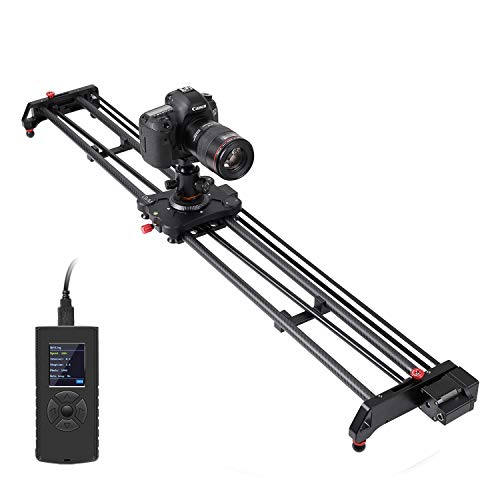
- Programmable motion and automatic looping
- Supports time-lapse and 120-degree panoramas
- Includes battery, charger, remote, and cables
Best For: Users wanting a ready-to-shoot motorized slider kit
Gimbal Integration Pick
IFOOTAGE Shark Slider Nano II-860

- 24.9-inch travel on a 34-inch slider
- Five-axis DJI RS gimbal compatibility
- Quiet AI-powered motion control
Best For: Advanced filmmakers using compatible DJI RS gimbals
Heavy-Duty Cinema Slider

- Supports up to 220 lb for cinema rigs
- 16-wheel design for smooth tracking
- Multiple professional mount options
Best For: Heavy cinema cameras and dolly-track productions
Smart Motorized Slider

- Programs up to eight motion points
- Offers AI face and object tracking
- Includes quiet motor and five shooting modes
Best For: Automated time-lapses, product shots, and multi-axis motion
Portable Carbon Slider

- Lightweight 1.4-pound travel-friendly design
- Works in multiple shooting orientations
- Includes adjustable legs and carrying bag
Best For: Small cameras, smartphones, and portable shooting kits
Compact Pro Control
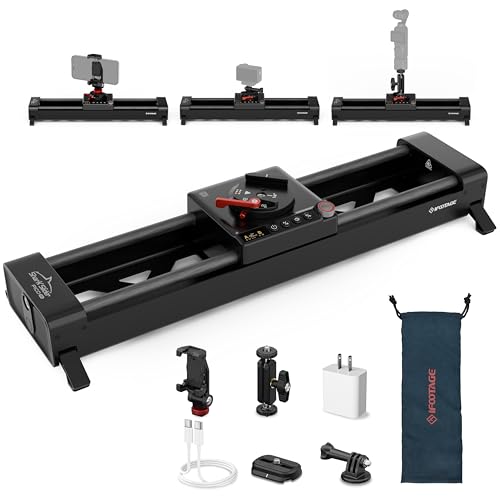
- 2-axis motion with 360° pan
- Carbon fiber rail with 1.1 kg load recommendation
- LCD and app control with up to 7-hour battery life
Best For: Portable cinematic shots, product videos, and controlled B-roll
Wireless Studio Flexibility

- Six programmable shooting modes
- Bluetooth app control for motion settings
- Carbon fiber rail with adjustable legs and mounting ports
Best For: YouTube, time-lapse, photography, and flexible studio setups
Long-Travel Production Workhorse

- 120 cm carbon fiber rail for extended movement
- Six shooting modes with detailed app programming
- Includes shutter cables, adjustable legs, and carry bag
Best For: Long tracking shots, commercial video, and production setups
Smart Motion Pick – NEEWER ER1 Motorized Slider
The NEEWER ER1 is a versatile option for creators seeking premium camera slider systems with automated movement, app control, and time-lapse capability. Its 47.2-inch carbon-fiber rail supports horizontal loads up to 11 pounds and can also handle 45-degree tilt shots.
Best For: Content creators, product videos, time-lapse photography, and portable motorized camera movement.
Pros:
- App control with manual, video, and time-lapse modes
- Included 4400mAh NP-F750 battery and quiet stepper motor
- Carbon-fiber construction with 1/4-inch and 3/8-inch tripod threads
- Supports tracking, panoramic, horizontal, and 45-degree tilt shots
Cons:
- Charger is not included
- 2.4G remote control is not included
- Minor shaking may occur during macro photography
The ER1 balances long travel, automated control, and relatively manageable portability. It is a practical premium camera slider system for repeatable creative moves, provided you account for the missing charger and remote.
Heavy-Duty Dolly Pick – Glide Gear DEV 4 Dolly
The Glide Gear DEV 4 is built for filmmakers who want premium camera slider systems with substantial payload capacity and smooth, quiet movement. Its modular setup uses three 23-inch aluminum rails for a combined four-foot track and supports up to 50 pounds.
Best For: Professional cinematography, heavy camera rigs, and smooth tracking shots across demanding setups.
Pros:
- 50-pound maximum payload supports substantial camera configurations
- Three 23-inch 6061 aircraft-grade aluminum rails
- Frictionless wheel platform is designed for smooth, quiet movement
- Base plate includes 28 mounting holes with 1/4-20 and 3/8-16 taps
Cons:
- Tripod or speaker-stand adapter is not included
- 12-pound system weight is less convenient for lightweight travel
- Four-foot rail assembly requires more setup space
The DEV 4 favors load capacity and stable dolly movement over compactness. Its modular rails, accessory mounting points, and included carry bag make it a strong choice for production users who can accommodate the larger setup.
Complete Kit Pick – GVM 48-Inch Motorized Slider
The GVM 48-inch motorized slider is a ready-to-use choice among premium camera slider systems, combining programmable movement with time-lapse and panoramic shooting. Its carbon-fiber rail supports up to 5 kilograms and includes a battery, charger, remote, shutter cables, and carrying bag.
Best For: Filmmakers who want a broadly equipped motorized slider for tracking, time-lapse, and panoramic work.
Pros:
- Programmable start and end points, speed, interval, stop time, and photo count
- Automatic round-trip and loop functions
- Supports manual and electric operation plus 120-degree panoramic shooting
- Includes battery, charger, remote, shutter cables, and carrying bag
Cons:
- Maximum payload is 5 kilograms, lower than the Glide Gear DEV 4
- At 11.8 pounds, it is relatively heavy to transport
- Not water resistant
The GVM stands out for its extensive included accessories and adjustable motion programming. It is a sensible all-in-one package for users who want to start shooting without assembling a separate control and power kit.
Gimbal Integration Pick – IFOOTAGE Shark Slider Nano II-860
The IFOOTAGE Shark Slider Nano II-860 targets filmmakers who need premium camera slider systems with advanced motion control and gimbal compatibility. It provides 24.9 inches of travel, supports up to 11 pounds horizontally, and integrates with selected DJI RS gimbals for coordinated five-axis movement.
Best For: Professional filmmakers using DJI RS2, RS3 Pro, RS4, or compatible gimbals for precise multi-axis shots.
Pros:
- Five-axis integration with DJI RS2, RS2 Pro, RS3 Pro, RS4, and RS4 Pro gimbals
- Quiet PD60W brushless motor system
- AI-powered tracking and app-based keyframe controls
- Supports up to 11 pounds horizontally and 5.5 pounds vertically
Cons:
- Gimbal integration is centered on compatible DJI RS models
- Its 24.9-inch travel is shorter than the 47- to 48-inch rails in this roundup
- Power support requires PD60W input or an NPF Battery 60W+ setup
The Nano II-860 is the most specialized option here, emphasizing synchronized gimbal motion, quiet operation, and intelligent control. It is best suited to advanced users who will take advantage of its compatible DJI ecosystem rather than those seeking a basic linear slider.
Heavy-Duty Cinema Slider – PROAIM Breeza
For productions that need premium camera slider systems with serious payload capacity, the PROAIM Breeza is a purpose-built choice. Its CNC aluminum dolly and 16-wheel floating-truck design are suited to smooth tracking shots on straight or curved 32–50 mm tracks.
Best For: Cinema cameras, gimbals, interview setups, product videos, and demanding dolly work.
Pros:
- Supports up to 100 kg / 220 lb.
- 16-wheel floating trucks are designed for quiet, repeatable movement.
- Includes Mitchell, 75mm, 100mm bowl, and flat-mount options.
- Track-end clamps support tripod or light-stand setup.
Cons:
- At 22.5 pounds, it is substantially heavier than portable slider designs.
- Track is required and is not included in the listed package.
- The system is likely more equipment than lightweight solo shooters need.
The Breeza stands out when stability, broad head compatibility, and high load capacity matter more than minimal travel weight. It is a strong fit for professional setups using supported dolly tracks.
Smart Motorized Slider – iFootage Shark Nano II
The iFootage Shark Nano II brings automated control to premium camera slider systems. Its motorized 26-inch platform combines touchscreen and app control with multi-point paths, AI subject tracking, and synchronized DJI gimbal movement for repeatable camera motion.
Best For: Time-lapses, product demonstrations, interviews, macro work, panoramas, and programmed multi-axis shots.
Pros:
- Supports up to eight customizable motion points.
- AI face and object tracking can help keep subjects centered.
- Includes five shooting modes, including time-lapse, stop-motion, macro, and panorama.
- Quiet brushless motor and real-time stabilization suit recording environments.
Cons:
- Its advanced controls may be more than needed for simple manual slides.
- DJI gimbal synchronization uses the included custom RS Adapter and may add setup complexity.
- The listed power setup relies on USB-C PD, with the battery grip sold separately.
The Nano II is the most automation-focused option here. Choose it when programmable movement, subject tracking, and repeatable multi-axis shots are more valuable than a simple, purely manual rail.
Portable Carbon Slider – Zecti 24-Inch Camera Dolly
For creators seeking accessible premium camera slider systems in a lightweight format, the Zecti 24-inch slider emphasizes portability and flexible positioning. Its carbon-fiber rail, four precision bearings, adjustable legs, and multiple mounting holes support small-camera and smartphone setups.
Best For: Travel photography, smartphones, action cameras, small mirrorless cameras, and lightweight tabletop or location shots.
Pros:
- Weighs about 1.4 pounds and includes a carrying bag.
- Supports horizontal, vertical, diagonal, and sideways operation.
- Adjustable legs, non-skid feet, and a bubble level aid setup.
- Multiple 1/4-inch and 3/8-inch mounting holes improve accessory flexibility.
Cons:
- Maximum recommended load is 4.4 pounds, limiting larger camera rigs.
- The supplied note warns that overtightened screws can cause noise or rough movement.
- It is a manual slider without the automated controls of motorized systems.
The Zecti is a practical lightweight option for compact cameras and travel kits. Buyers should keep the load within its 4.4-pound limit and check the adjustment screws if movement becomes noisy or uneven.
Compact Pro Control – IFOOTAGE PICO Pro
For creators seeking premium camera slider systems in a portable format, the IFOOTAGE PICO Pro combines a carbon fiber rail with motorized linear movement, 360° pan control, and app-based operation. Its compact design suits controlled cinematic work without the bulk of a full-size rail system.
Best For: Product videos, interviews, time-lapse footage, stop motion, and cinematic B-roll with mirrorless or compact camera setups.
Pros:
- Combines linear sliding with 360° panoramic rotation.
- Carbon fiber construction and a maximum recommended load of 1.1 kg.
- Offers LCD, mobile app, time-lapse, stop-motion, panorama, and multi-point controls.
- Battery life is listed at up to 7 hours.
Cons:
- The 1.1 kg maximum recommendation limits heavier camera rigs.
- Its compact rail may not provide the long travel range of larger sliders.
The PICO Pro is a strong fit when portability and advanced motion control matter more than maximum payload or extended rail length. Its pan capability and repeatable controls give it an advantage for detailed product and studio movements.
Wireless Studio Flexibility – GVM 32-Inch Motorized Slider
The GVM 32-inch motorized slider is a practical choice among premium camera slider systems for creators who want wireless programming and multiple shooting modes. Its carbon fiber rail, adjustable legs, and included shutter cables support both studio and location work.
Best For: YouTube production, photography, time-lapse sequences, tracking shots, and multi-angle studio or outdoor setups.
Pros:
- Provides six shooting modes, including tracking, panoramic, time-lapse, and video.
- Bluetooth app control allows adjustment of speed, start and end points, dwell time, and pauses.
- Carbon fiber construction is designed for smooth, stable movement while remaining portable.
- Multiple 1/4-inch and 3/8-inch ports support horizontal, vertical, and 45-degree positioning.
Cons:
- The listed 5-pound product weight may be less convenient for frequent travel than smaller systems.
- It is described as compatible with cameras, so users should verify camera-specific triggering needs.
This model balances a useful 32-inch travel length with app programming and flexible mounting. The included carry bag and shutter cables make it a well-rounded option for creators who need repeatable movement across varied shooting environments.
Long-Travel Production Workhorse – GVM 48-Inch Motorized Slider
For buyers prioritizing extended camera movement, the GVM 48-inch motorized slider offers a longer carbon fiber rail and app-controlled motion programming. It is a substantial option among premium camera slider systems, with support for tracking, panoramic, time-lapse, and video capture modes.
Best For: Long tracking shots, commercial video, time-lapse work, panoramic movement, and production setups using cameras or phones.
Pros:
- The 120 cm rail provides more travel than compact slider designs.
- Supports six-in-one shooting controls, including adjustable speed, intervals, stops, looping, and motor torque.
- Multiple 1/4-inch and 3/8-inch ports enable horizontal, vertical, and 45-degree shooting.
- Includes six shutter-release cables, an extension cable, adjustable legs, and a carry bag.
Cons:
- At 4 kg, it is less portable than shorter, lighter slider systems.
- Listed battery life is approximately 2 hours.
- The rail is not water resistant.
The GVM 48-inch model makes the most sense when smooth, extended travel is the priority. Its broad programming range and connectivity accessories support more involved productions, though the larger form factor and shorter stated battery life require more planning on location.
How We Picked the Best Premium Camera Slider Systems
We compared these Premium Camera Slider Systems by looking at the features that matter most in real-world production: travel length, payload capacity, drive and control options, motion smoothness, setup requirements, portability, and compatibility with cameras, tripods, gimbals, and accessories. Motorized models were assessed for app control, repeatable moves, time-lapse support, and additional axes. Manual sliders were considered for simplicity, reliability, and fast operation without batteries.
Because camera rigs vary widely, published payload ratings should be treated as a starting point. A camera, lens, cage, matte box, follow-focus unit, monitor, and fluid head can quickly add weight. Stability also depends on how the slider is supported and how far it is extended.
Quick Comparison
| Best For | Recommended Type | What to Prioritize |
|---|---|---|
| Automated time-lapse and repeatable moves | Motorized slider | App control, interval programming, battery life |
| Fast handheld-style production setups | Manual slider | Low friction, portability, simple leveling |
| Long tracking shots | 48-inch or 120cm rail | Support points, rigidity, transport size |
| Heavy cinema cameras | High-capacity dolly system | Payload rating, track stability, mounting hardware |
| Compact travel kits | Short carbon-fiber slider | Weight, folded length, battery and control system |
Key Buying Factors for Premium Camera Slider Systems
Travel Length and Working Space
A 24- to 32-inch slider is easier to transport and often sufficient for tabletop, interview, and product work. Longer 47- or 48-inch systems create more dramatic lateral movement but need more room and stronger support.
Payload and Rig Configuration
Check the rating for the complete moving setup, not just the camera body. High-capacity systems are better suited to cinema cameras and large fluid heads, while compact motorized sliders may be ideal for mirrorless cameras and lightweight lenses.
Motor Control and Motion Features
App control, automatic round trips, time-lapse programming, panoramic movement, and multi-axis compatibility can make complex shots repeatable. These features add flexibility but also increase setup time, battery dependence, and potential points of failure.
Support, Noise, and Portability
Carbon-fiber rails generally reduce travel weight, while aluminum systems can provide a sturdy platform for heavier rigs. Consider mounting threads, included legs or track ends, carrying cases, motor noise, battery format, and whether the slider can be leveled securely on your usual support.
Who Should Buy Which Premium Camera Slider Systems?
Choose a compact carbon-fiber motorized slider if you travel frequently or primarily use a mirrorless camera. A longer app-controlled model makes more sense for time-lapse, product, and commercial work requiring programmed motion. If you use a gimbal or want coordinated camera movement, prioritize a system designed for multi-axis control and check compatibility carefully.
For heavy cinema rigs, the high-payload dolly-style option is the safer choice, provided your stands or tripod support the total load. Choose a manual modular slider when you value speed, reliability, and battery-free operation over automated moves. Before buying, confirm rail length, payload, mounting points, power requirements, and the space available in your kit or studio.