
The right drone can extend a home studio beyond its walls, adding smooth overhead shots, moving establishing footage, and creative perspectives without requiring a full production crew.
We compared 10 camera drone systems across image quality, stabilization, flight automation, portability, control options, and overall value so you can choose a setup that fits your space, workflow, and experience level.
Best 10 Camera Drone Systems for Home Studios Picks for 2026
Premium Creator Pick
DJI Mini 5 Pro Fly More Combo Plus

- 1-inch CMOS with 4K/60fps HDR video
- 225° gimbal rotation and vertical filming
- Three batteries with up to 52 minutes each
Best For: Advanced creators seeking a compact, fully equipped filming system
Long-Range Value Pick

- 3-axis brushless gimbal for stabilized footage
- 6K photos and 4K/30fps video
- Up to 70 minutes of total flight time
Best For: Beginners wanting GPS automation and extended outdoor shooting
Balanced DJI Choice
- Compact approximately 249-gram foldable design
- 4K/60fps HDR video with a 1-inch sensor
- Three batteries and DJI RC 2 included
Best For: Beginners wanting premium imaging in a portable bundle
Professional Studio Capture

- 100MP Hasselblad camera with 6K/60fps HDR
- Dual tele cameras and 360° Infinity Gimbal
- 51-minute flight time with 30km O4+ transmission
Best For: Professional home studios needing maximum aerial image quality and camera versatility
Smart Studio Versatility

- 4K camera with 3-axis gimbal stabilization
- AI flight assistance and 360° LiDAR avoidance
- Up to 47 minutes of flight time
Best For: Beginners and compact studios seeking assisted 4K aerial shooting
Lightweight Creator Kit

- Under-249g foldable drone with 4K video
- 3-axis gimbal and beginner-friendly flight controls
- Three batteries provide up to 93 minutes total flight time
Best For: Beginners and portable studios prioritizing convenience and value
Compact Cinematic Pick
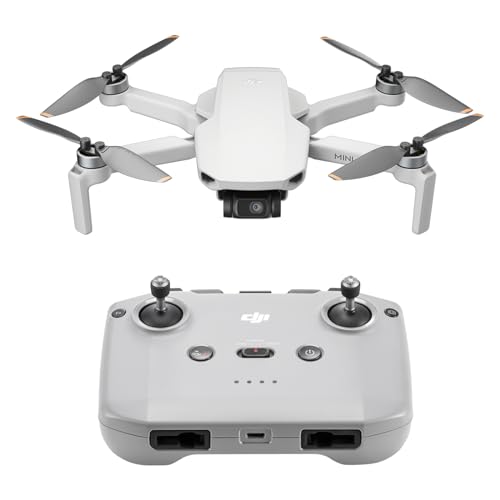
- 4K camera with 3-axis gimbal
- Under 249 g with GPS Return to Home
- Beginner-friendly QuickShots and controls
Best For: Beginners seeking stabilized 4K footage in a lightweight package
Automated Tracking Pick

- 4K adjustable camera with 5G FPV transmission
- Follow Me, Waypoint, and Point of Interest modes
- Two batteries with up to 32 minutes of flight time
Best For: Creators capturing hands-free outdoor action footage
Extended-Creation Bundle

- 4K camera with 3-axis gimbal stabilization
- Two batteries for up to 62 minutes total flight time
- Includes shoulder bag and spare accessories
Best For: Creators wanting longer stabilized 4K shooting sessions
Premium Creator Pick – DJI Mini 5 Pro Fly More Combo Plus
For creators comparing camera drone systems for home studios, the DJI Mini 5 Pro Fly More Combo Plus combines a compact design with a 1-inch CMOS sensor, 4K/60fps HDR video, and flexible gimbal movement. Its included RC 2 controller, three extended-life batteries, storage, ND filters, and charging hub make it a well-equipped option for planned shoots and mobile production.
Best For: Advanced creators who want high-quality footage, vertical filming, tracking, and extended flight sessions in a compact package.
Pros:
- 1-inch CMOS sensor supports 4K/60fps HDR video and 50MP stills.
- 225° gimbal rotation and true vertical filming expand composition options.
- ActiveTrack 360° and omnidirectional obstacle sensing support more confident flights.
- Three Intelligent Flight Battery Plus batteries offer up to 52 minutes each.
Cons:
- Night flights may require permits depending on local regulations.
- The DJI Fly app must be downloaded from DJI’s official website rather than Google Play.
This is the most feature-rich choice in the group for creators who prioritize image quality, tracking, and a complete accessory bundle. Its compact size also makes it easier to store alongside home-studio equipment.
Long-Range Value Pick – Bwine F7GIM 4K Drone
The Bwine F7GIM is a practical entry in camera drone systems for home studios when stable video, long flight sessions, and GPS-assisted controls matter. It pairs a 6K photo-capable camera and 4K/30fps video with a 3-axis brushless gimbal, beginner controls, and multiple automated flight modes.
Best For: Beginners and outdoor shooters who want long-range transmission, stabilized footage, and guided flight modes.
Pros:
- 3-axis brushless gimbal is designed to keep footage steady during flight.
- Supports 6K photos, 4K/30fps video, and 5X digital zoom.
- GPS modes include follow, orbit, cruise control, and waypoint planning.
- Offers up to 70 minutes of total flight time and up to 10,000 feet of transmission.
Cons:
- Video capture is limited to 4K/30fps rather than 4K/60fps.
- Using the correct app, cable, and MicroSD-card formatting may require extra setup.
With its gimbal, automated modes, and long operating time, the F7GIM is a flexible option for users who want to move beyond basic beginner drones without immediately choosing a premium DJI system.
Balanced DJI Choice – DJI Mini 5 Pro Fly More Combo
For home creators seeking camera drone systems for home studios, this DJI Mini 5 Pro Fly More Combo offers a strong balance of portability and imaging features. The 1-inch CMOS sensor, 4K/60fps HDR video, RC 2 controller, three batteries, and included filters make it ready for repeat shooting without a large equipment footprint.
Best For: Beginners and content creators who want premium camera features with a compact, lightweight setup.
Pros:
- Palm-sized foldable body weighs approximately 249 grams.
- Captures 4K/60fps HDR video and 50MP still images.
- Provides vertical filming, 225° gimbal rotation, and ActiveTrack 360°.
- Includes three batteries, a charging hub, ND filters, and DJI RC 2.
Cons:
- Standard Intelligent Flight Batteries provide up to 36 minutes each, less than the Plus-battery version.
- The DJI Fly app is not available through Google Play and requires an official DJI download.
This version is a sensible middle ground for creators who want DJI’s advanced camera and safety tools while keeping the bundle compact. Choose it over the Plus model if the standard battery configuration fits your flight needs.
Beginner-Friendly Gift Pick – Ruko F11PRO 2 6K Camera Drone
The Ruko F11PRO 2 is one of the more approachable camera drone systems for home studios, especially for users who value simple controls and stable footage over advanced sensor features. Its 3-axis mechanical gimbal supports 4K/30fps video and 6K photos, while GPS return-to-home and beginner mode help simplify outdoor flights.
Best For: New adult pilots, families, and property owners who want stabilized aerial footage with straightforward operation.
Pros:
- 3-axis mechanical gimbal helps reduce shakes and vibrations.
- One-key takeoff and landing plus Beginner Mode support new pilots.
- GPS auto return activates for low battery, lost signal, or manual command.
- Two batteries provide up to 70 minutes of total flight time.
Cons:
- Video recording is limited to 4K/30fps.
- The remote’s correct data-connection port can be easy to confuse with its charging port.
The F11PRO 2 is a practical choice for buyers who want a clear learning path and useful automated flight modes. It is well suited to family trips, estate overviews, and casual aerial content rather than the most demanding studio-grade workflows.
Professional Studio Capture – Flagship Tri-Camera Power
For camera drone systems for home studios that need premium aerial footage, the DJI Mavic 4 Pro is the most capable option here. Its 100MP Hasselblad camera, dual tele cameras, 6K/60fps HDR video, and 360° Infinity Gimbal are designed for cinematic production work rather than casual flying.
Best For: Home studios producing professional aerial photography, high-resolution video, and complex cinematic camera movements.
Pros:
- 100MP Hasselblad main camera with 6K/60fps HDR video
- Dual tele cameras provide detailed zoomed-in images
- 360° Infinity Gimbal enables dynamic camera angles
- Up to 51 minutes of flight time and 30km O4+ video transmission
Cons:
- At 2,372g, it is substantially heavier than the other options
- Its professional feature set may be more than casual creators need
- Android users must download the DJI Fly app from DJI rather than Google Play
The Mavic 4 Pro is the clear choice when image quality, camera flexibility, and advanced flight awareness matter most. Its weight and professional pricing profile make it better suited to dedicated studio teams than occasional users.
Smart Studio Versatility – AI-Assisted 4K Flight
The DCX Volo X EZ AI is a practical middle ground for camera drone systems for home studios, combining a 4K camera, 3-axis gimbal, AI-assisted controls, and 360° LiDAR obstacle detection. Its built-in-screen controller and foldable design also make it convenient for creators who want a ready-to-fly setup.
Best For: Beginners and small studios that want stabilized 4K footage, assisted flight features, and a travel-friendly design.
Pros:
- 4K camera with 3-axis gimbal and electronic image stabilization
- AI-assisted Follow Me and Precision Return-to-Home features
- 360° obstacle detection uses LiDAR sensors
- Up to 47 minutes of flight time with the upgraded battery
Cons:
- The camera resolution is lower than the DJI Mavic 4 Pro
- The supplied notes list different battery capacities, so buyers should verify the included configuration
- Users must remove the foam padding under the camera before first use
With its smart controller, obstacle sensing, and long claimed flight time, the Volo X EZ AI emphasizes ease of use. It is a sensible pick for learning aerial production without moving immediately to a high-end tri-camera platform.
Lightweight Creator Kit – Mini 4K Fly More Combo
For home studios seeking camera drone systems that are easy to transport and operate, the DJI Mini 4K Fly More Combo offers a lightweight 4K workflow. Its under-249g body, 3-axis gimbal, beginner-friendly controls, and three-battery package make it a convenient starting point for regular content creation.
Best For: Beginner creators and mobile home studios that prioritize portability, simple controls, and extended shooting sessions.
Pros:
- Under-249g foldable design is easy to carry
- 4K video and 3-axis gimbal support stabilized footage
- Combo includes three batteries for up to 93 minutes of total flight time
- GPS Return to Home and one-tap takeoff and landing simplify operation
Cons:
- Its 12MP still-image resolution is far below the Mavic 4 Pro’s 100MP specification
- It lacks the Mavic 4 Pro’s dual tele cameras and 360° gimbal
- Local registration and Remote ID requirements can vary by how and where it is flown
The Mini 4K is the most approachable option for creators who want dependable 4K footage without carrying a heavy professional drone. The Fly More Combo adds practical endurance, while QuickShots help beginners produce polished clips with minimal setup.
Compact Cinematic Pick – DJI Mini 4K
For shoppers comparing camera drone systems for home studios, the DJI Mini 4K is a compact beginner option focused on stable, polished footage. Its 4K camera, 3-axis gimbal, GPS return-to-home, and QuickShots make it useful for creating smooth outdoor clips without a complicated setup.
Best For: Beginners who want cinematic-looking 4K footage from a lightweight, regulation-friendly drone.
Pros:
- 4K video with 3-axis gimbal stabilization
- Under 249 g, with one-tap takeoff and GPS Return to Home
- Level 5 wind resistance and up to 31 minutes with the included battery
- QuickShots automate Helix, Dronie, Rocket, Circle, and Boomerang footage
Cons:
- The included configuration has one battery, so extended sessions require additional batteries
- The DJI Fly app must be downloaded from DJI’s official website rather than Google Play
This is a strong entry point for a home-studio creator who values stabilized 4K capture and simple flight controls. Check current local regulations before flying, even though the drone is marketed as under 249 g.
Automated Tracking Pick – BLINORY 4K GPS Drone
Among camera drone systems for home studios, this foldable BLINORY model stands out for hands-free shooting features. Its adjustable 4K camera, GPS flight functions, optical-flow hovering, and 5G transmission suit creators who want automated movement and easy phone-based sharing.
Best For: Beginners who want Follow Me, waypoint, and point-of-interest shooting for active outdoor content.
Pros:
- 4K camera with a 90-degree electrically adjustable angle
- Follow Me, Waypoint Flight, Circle Fly, Point of Interest, and Gesture Selfie modes
- GPS auto return for lost signal, low power, or out-of-range situations
- Two modular batteries provide up to 32 minutes of stated flight time
Cons:
- The listed transmission range and performance can depend on operating conditions
- Its feature-rich app control may require more setup than a basic beginner drone
This model is a practical choice when automated camera moves matter more than a stabilized three-axis gimbal. The foldable body and storage case also make it convenient for transporting to outdoor shoots.
Extended-Creation Bundle – DJI Mini 4K Combo
For home studios that need more shooting time, the DJI Mini 4K Combo adds a second battery and carrying accessories to the standard Mini 4K setup. It combines 4K capture, 3-axis gimbal stabilization, 10 km HD video transmission, GPS Return to Home, and QuickShots in a beginner-oriented package.
Best For: Creators who want stabilized 4K footage and longer sessions without buying a second battery immediately.
Pros:
- 4K video with 3-axis gimbal stabilization
- Two batteries provide up to 62 minutes of stated total flight time
- 10 km maximum HD video transmission and Level 5 wind resistance
- Includes a shoulder bag, propeller holder, spare propellers, and remote controller
Cons:
- The DJI Fly app must be downloaded from DJI’s official website rather than Google Play
- Actual flight time and transmission distance can vary with conditions
The Combo is the more practical Mini 4K configuration for repeat shooting days, since the extra battery reduces charging interruptions. It is especially appealing when a compact kit, stabilized footage, and beginner-friendly automation are higher priorities than advanced camera controls.
How We Picked the Best Camera Drone Systems for Home Studios
We focused on the features that matter most for studio creators: dependable camera output, stabilized footage, predictable flight behavior, easy monitoring, and a practical accessory package. The selection spans compact sub-249-gram models, larger flagship systems, and more affordable GPS drones, giving beginners and experienced operators useful options.
We also considered whether each package includes a dedicated controller, spare batteries, charging equipment, obstacle sensing, subject tracking, and automated flight modes. These details affect how quickly you can capture repeatable footage and how much extra you may need to spend after purchase.
Quick Comparison
| What to prioritize | Best fit |
|---|---|
| Maximum image flexibility | Tri-camera flagship drones |
| Portable studio companion | Sub-249-gram Mini models |
| Longer shooting sessions | Fly More Combo packages |
| Simple beginner operation | GPS drones with return-to-home and automated modes |
| Lower-cost stabilized video | Entry-level 4K models with a 3-axis gimbal |
Key Buying Factors for Camera Drone Systems for Home Studios
Camera and Stabilization
Look beyond headline resolution. A larger sensor can improve detail and low-light performance, while a 3-axis gimbal generally produces smoother, more professional movement than electronic stabilization alone. Check whether the drone supports the frame rates, aspect ratios, color profiles, and file formats your editing workflow requires.
Size, Flight Time, and Batteries
Compact drones are easier to store and transport, and sub-249-gram models may have regulatory advantages in some locations. However, smaller aircraft can be more affected by wind. A bundle with several batteries is valuable for studio sessions because charging interruptions can slow a shoot.
Safety and Control
Obstacle sensing, GPS positioning, return-to-home, geofencing, and reliable video transmission can reduce risk, but they do not replace an attentive pilot. Confirm the drone’s operating requirements and local rules before flying indoors or outdoors. Dedicated controllers are often preferable to phone-only control for precise framing.
Automation and Workflow
Active tracking, waypoint flight, orbit modes, and one-tap filming can help solo creators repeat moves consistently. For indoor studio work, verify that automated features function without strong GPS signals and leave adequate clearance around lights, stands, ceilings, and other equipment.
Who Should Buy Which Camera Drone Systems for Home Studios?
Choose a compact Mini model if portability, simple storage, and low operating weight are your priorities. A Fly More package is especially useful for frequent shooting. Choose a flagship multi-camera drone if you need greater focal-length flexibility, stronger low-light performance, and more control for professional productions.
Choose a budget 4K GPS drone for occasional content, learning, or basic outdoor footage. Choose an AI-focused model if automated tracking and obstacle avoidance are more important than maximum manual camera control. Before buying, match the drone’s size and safety features to your studio layout, then budget for memory cards, propeller guards where appropriate, spare props, and insurance or registration requirements.