
Choosing your first camera drone can be confusing when product listings promise 4K video, GPS, long flight times, and effortless controls at widely different prices. The best beginner-friendly camera drone systems make the learning curve manageable without sacrificing useful image quality.
This roundup compares ten options ranging from compact toy-style quadcopters to GPS-equipped drones with stabilized cameras. Use the buying guide below to match features such as altitude hold, return-to-home, brushless motors, controller displays, and flight time to your experience level and intended use.
Best 10 Beginner-Friendly Camera Drone Systems Picks for 2026
Best Overall

- 4K video with 3-axis gimbal stabilization
- Under 249 g with GPS Return to Home
- Two batteries and QuickShots included
Best For: Beginners wanting stabilized 4K footage and room to grow
Best Budget Starter

- One-key controls and altitude hold
- Adjustable 1080P Wi-Fi FPV camera
- Foldable design with case and two batteries
Best For: Casual first-time pilots and family outings
Best No-Phone Option
Fyrax 2K Drone with Screen Controller

- 4.3-inch controller screen needs no phone
- 2K adjustable camera and brushless motor
- Two batteries provide up to 30 minutes
Best For: Beginners who want built-in live viewing
Best for Simple Controls

- One-key flight controls and altitude hold
- Adjustable 1080P camera with app features
- Two batteries provide up to 24 minutes
Best For: New pilots seeking simple, close-range recreational flying
Screen-Controlled Starter
GPS 4K Drone with Built-In Display

- Built-in 4.5-inch screen needs no phone
- GPS return features support safer outdoor flights
- Two batteries offer about 60 minutes total flight
Best For: Beginners wanting a phone-free controller and longer flight sessions
Pocket Practice Pick
Compact 2K FPV Drone for Beginners

- Simple one-key controls and optical-flow positioning
- Folds small and weighs under 250g
- Includes case, guards, spare propellers, and two batteries
Best For: First-time pilots seeking an affordable, portable practice drone
Long-Range GPS Choice
N11 Pro 4K Drone with 3 Batteries

- Up to 90 minutes with three batteries
- GPS return, Follow Me, Tap Fly, and Point of Interest
- 4K camera with 5GHz FPV transmission
Best For: Beginners ready for longer-range, feature-rich outdoor flying
Easy-Start Pick

- Protected design with altitude hold and headless mode
- 90° electric tilt HD FPV camera
- Two batteries rated for up to 25 minutes total
Best For: First-time teen and adult pilots
Feature-Rich Gift Pick

- 1080P FPV camera with 90° lens adjustment
- Follow Me, trajectory, gesture, and gravity controls
- Two batteries rated for up to 30 minutes total
Best For: Portable family and beginner flying
Compact Fun Pick
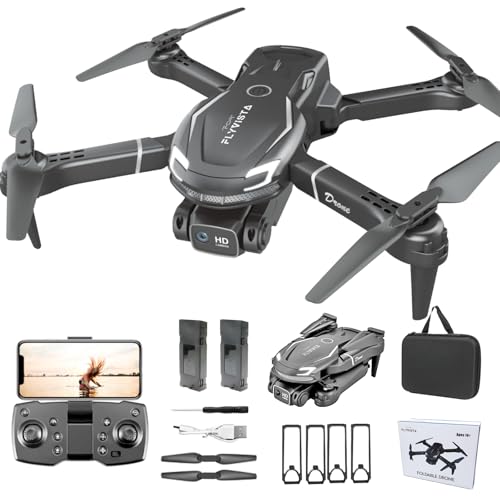
- Distinctive 100-gram shark-shaped design
- 1080P FPV camera with manual 90° adjustment
- Optical-flow positioning and beginner safety features
Best For: Kids and beginners flying indoors or in calm conditions
Best Overall – DJI Mini 4K Camera Drone
For shoppers seeking beginner-friendly camera drone systems with stronger image quality, the DJI Mini 4K combines 4K video, 3-axis gimbal stabilization, GPS-assisted features, and a lightweight design. The included two-battery combo is particularly practical for longer sessions.
Best For: Beginners who want stabilized 4K footage and a more capable camera drone system.
Pros:
- 4K video and 3-axis gimbal stabilization support smoother, more cinematic footage.
- Under-249-gram design, one-tap takeoff and landing, stable hovering, and GPS Return to Home simplify operation.
- Two batteries provide up to 62 minutes of listed maximum flight time, and QuickShots add automated video options.
- 10 km maximum HD video transmission and Level 5 wind resistance offer substantial outdoor capability.
Cons:
- The DJI Fly app must be downloaded from DJI’s official website rather than Google Play.
- Its more advanced feature set may be more than casual indoor or toy-drone users need.
The DJI Mini 4K is the strongest all-around choice here for beginners who want to learn on a relatively approachable platform without quickly outgrowing the camera system.
Best Budget Starter – Pallton 1080P FPV Drone
The Pallton is a straightforward pick among beginner-friendly camera drone systems, offering one-key controls, altitude hold, a foldable body, and a 1080P Wi-Fi camera. Its compact case and two batteries make it convenient for casual practice and family outings.
Best For: First-time pilots who want an affordable, portable drone for basic aerial video and stunts.
Pros:
- One-key takeoff and landing, altitude hold, headless mode, and three speed modes ease the learning curve.
- 1080P camera has a 90-degree adjustable angle and supports live FPV viewing over Wi-Fi.
- Two batteries provide up to 24 minutes of listed flight time.
- Foldable design and included carrying case make transport simple.
Cons:
- The camera resolution and listed 500-meter range are more modest than those of the DJI option.
- App-dependent features such as route drawing and gravity control may require additional setup.
This Pallton model emphasizes accessibility and fun rather than advanced imaging, making it a sensible entry point for pilots who want to practice basic controls before investing in a more capable system.
Best No-Phone Option – Fyrax 2K Drone with Screen Controller
For beginners comparing camera drone systems, the Fyrax stands out because its controller includes a built-in 4.3-inch screen, so live footage does not require a separate phone. It also adds a 2K adjustable camera, brushless motors, and several simplified flight controls.
Best For: Beginners who prefer an all-in-one controller and want a simple way to view live video.
Pros:
- Built-in 4.3-inch controller screen provides live viewing without a phone.
- 2K camera with a 90-degree adjustable lens supports forward and top-down perspectives.
- One-key takeoff and landing, one-key return, headless mode, and three speed modes support new pilots.
- Two batteries offer up to 30 minutes of listed total flight time, with a case and protective guards included.
Cons:
- A MicroSD card is required for recording photos and video and is not included.
- Some creative features, including trajectory and gesture controls, require app control.
The built-in screen is the main buying advantage: it reduces phone dependence while preserving beginner-focused controls and a more detailed 2K camera than basic 1080P starter drones.
Best for Simple Controls – Hiturbo S20 1080P Drone
The Hiturbo S20 keeps the beginner experience approachable with one-key flight controls, altitude hold, headless mode, voice control, and gesture features. As one of the more compact beginner-friendly camera drone systems, it is suited to casual practice and basic 1080P aerial clips.
Best For: New pilots who want simple controls, foldable portability, and playful app features.
Pros:
- One-key takeoff and landing, altitude hold, speed adjustment, and headless mode reduce setup complexity.
- 1080P camera angle can be manually adjusted for forward or downward views.
- Two batteries provide up to 24 minutes of listed flight time when swapped.
- Voice control, trajectory flight, gestures, and 3D flips add variety for casual flying.
Cons:
- Video capture requires a Wi-Fi connection to the Hiturbo FPV app.
- Several app features require disconnecting the remote controller and using the app separately.
- The listed maximum range is only 0.05 km, limiting it to nearby flying.
The S20 is best viewed as an easy-to-use starter and recreational drone rather than a long-range camera platform. Its simple controls and small body make it approachable, while the short listed range calls for close-range use.
Screen-Controlled Starter – GPS 4K Drone with Built-In Display
For shoppers comparing beginner-friendly camera drone systems, this foldable GPS model stands out for its built-in 4.5-inch controller screen. It avoids the need for a phone or app while adding 4K video, GPS return features, and beginner-oriented flight modes.
Best For: Beginners who want a ready-to-fly system with an integrated display, extended battery time, and GPS-assisted outdoor flying.
Pros:
- Built-in 4.5-inch screen allows FPV viewing without a smartphone.
- 4K camera has a remotely adjustable 90° lens.
- GPS supports one-key, low-battery, and signal-loss return-to-home.
- Two batteries provide approximately 60 minutes of combined flight time.
Cons:
- The feature-rich system may be more than casual indoor flyers need.
- The supplied notes do not specify the exact control range or video storage workflow.
Its screen-based controller reduces setup friction, while brushless motors, optical-flow mode, and multiple assisted flight functions give beginners room to build skills. The under-249g foldable design also suits travel and outdoor use.
Pocket Practice Pick – Compact 2K FPV Drone for Beginners
This compact Loiley model is a straightforward entry point among beginner-friendly camera drone systems. Its one-touch controls, optical-flow positioning, propeller guards, and included carrying case make it approachable for first-time pilots who want a lightweight camera drone.
Best For: New pilots, teens, and travelers who prioritize portability, simple controls, and basic aerial photos and video.
Pros:
- 2K camera includes a 90° remotely adjustable viewing angle.
- One-key takeoff and landing, headless mode, and altitude hold simplify operation.
- Folded size is listed as 5 x 3 x 2 inches and weight is under 250g.
- Package includes two batteries, a carrying case, propeller guards, and spare propellers.
Cons:
- Approximately 26 minutes of total flight time is shorter than the other listed options.
- It uses smartphone Wi-Fi FPV rather than a built-in controller screen.
- The camera resolution is 2K rather than 4K.
This is the most travel-friendly choice of the three, with beginner-focused controls and protective accessories. It is better suited to casual practice and social-media-style clips than to longer GPS-assisted outdoor shoots.
Long-Range GPS Choice – N11 Pro 4K Drone with 3 Batteries
For buyers seeking beginner-friendly camera drone systems with more outdoor capability, the N11 Pro combines GPS positioning, a 4K camera, brushless motors, and three batteries. Its listed 3,328-foot control range and automated flight modes make it the most ambitious option here for extended outdoor sessions.
Best For: Beginners who want GPS-assisted outdoor flying, longer combined flight time, and room to explore automated camera-drone features.
Pros:
- Three batteries provide up to 90 minutes of combined flight time.
- GPS supports auto return for low battery, signal loss, or one-key commands.
- 4K camera records listed 4096×3072 photos and 2048×1080 video.
- Follow Me, Tap Fly, and Point of Interest add automated-flight options.
Cons:
- The product notes state that no charger is included.
- Its broader GPS and automated feature set may require more learning than a basic toy drone.
- The supplied details do not specify a carrying case or propeller guards.
With optical-flow positioning for indoor use and GPS stabilization outdoors, the N11 Pro offers a strong progression path for beginners. The three-battery setup and brushless motors are especially useful when longer sessions and quieter, more powerful flight matter.
Easy-Start Pick – Adjustable FPV Mini Drone
For shoppers comparing beginner-friendly camera drone systems, this compact quadcopter emphasizes simple controls and protected indoor or outdoor flying. One-touch takeoff and landing, altitude hold, headless mode, and three speed settings give new pilots a manageable way to practice.
Best For: First-time teen and adult pilots who want a protected drone with an adjustable FPV camera.
Pros:
- Propeller guards, altitude hold, and headless mode support beginner practice.
- HD FPV camera has a remotely adjustable 90° electric tilt lens.
- Two batteries provide up to 25 minutes of listed total flight time.
- Includes a carrying case, spare propellers, phone holder, and charging cable.
Cons:
- The listed maximum range is 262 feet.
- Its 4.48-ounce plastic build is designed for casual flying rather than advanced aerial work.
This is a practical starter kit for learning basic controls while retaining room to experiment with flips and faster speed modes. The enclosed guards and included accessories make it especially convenient for early flights.
Feature-Rich Gift Pick – Foldable 1080P FPV Drone
This foldable model is one of the more feature-packed beginner-friendly camera drone systems in the group. It combines one-key flight controls and propeller guards with app features such as trajectory flight, Follow Me, gesture control, and gravity control.
Best For: Kids, teens, and adults seeking a portable beginner drone with extra app-based flight modes.
Pros:
- 1080P camera supports FPV viewing and a 90° adjustable lens.
- One-key takeoff and landing, altitude hold, headless mode, and three speeds simplify operation.
- Two batteries are listed for up to 30 minutes of total flight time.
- Foldable, under-249-gram design includes a case for transport.
Cons:
- The camera is specified at 2MP for still images.
- Wi-Fi FPV and app functions require a compatible phone connection.
Choose this option if portability and playful automated features matter as much as basic flight assistance. Its broad feature set can keep beginners engaged, though the camera system is aimed at casual footage rather than high-end imaging.
Compact Fun Pick – FLYVISTA Shark Mini Drone
With its shark-shaped design and compact 100-gram body, this FLYVISTA model gives beginner-friendly camera drone systems a playful, gift-oriented twist. Optical-flow positioning, altitude hold, emergency stop, and propeller guards are intended to make initial practice more approachable.
Best For: Kids and beginners who want a small, distinctive drone with 1080P FPV video and simple flight controls.
Pros:
- 1080P FPV camera has a manually adjustable 90° lens.
- Optical-flow positioning and altitude hold help support stable hovering.
- Includes two 1,800mAh batteries with approximately 20 minutes of listed total flight time.
- Offers emergency stop, headless mode, flips, gesture control, and path flight.
Cons:
- The manufacturer notes that wind can interfere with outdoor use.
- Each battery is listed at approximately 10 minutes, with flips and altitude changes reducing flight time.
- The camera lens adjustment is manual rather than electric.
This is a fun, compact choice when design and beginner-focused stability are priorities. It is best suited to indoor practice or calm outdoor conditions, with the included case and guards adding convenience for younger users.
How We Picked These Beginner-Friendly Camera Drone Systems
We focused on features that reduce the difficulty of learning to fly while still supporting useful photography and video. Key considerations included camera resolution, stabilization, GPS assistance, altitude hold, one-key takeoff and landing, return-to-home functions, controller design, portability, battery options, and the type of flying each drone is best suited for.
We also separated headline specifications from practical usability. A stated 4K resolution does not necessarily mean stabilized, high-quality footage, and advertised flight time often assumes ideal conditions with spare batteries. Beginners should consider the complete package, including replacement batteries, propeller guards, app or controller reliability, and local flight rules.
Quick Comparison
| Priority | Look For | Best Fit |
|---|---|---|
| Simple first flight | Altitude hold, one-key takeoff, headless mode | New pilots and casual users |
| Better positioning | GPS, auto return, stable flight modes | Outdoor flying and learners building confidence |
| Portable camera drone | Foldable body, compact controller, lightweight design | Travel and spontaneous flights |
| Longer sessions | Multiple batteries, charging hub, efficient motors | Families and frequent practice |
| More engaging controls | FPV display, gesture control, flips, speed modes | Recreational flying and supervised beginners |
Key Buying Factors for Beginner-Friendly Camera Drone Systems
Flight Assistance and Safety
Altitude hold helps the drone maintain height while you learn directional control. GPS and return-to-home can make outdoor flying less stressful, although they are not substitutes for keeping the aircraft in sight. One-key landing, low-battery alerts, emergency stopping, and adjustable speed modes are especially useful for first-time pilots.
Camera and Stabilization
Resolution is only one part of image quality. A 3-axis gimbal generally produces smoother footage than a fixed camera, while electronic stabilization may be more limited. Check whether the camera angle can be adjusted, whether video is saved locally or streamed through Wi-Fi, and whether the advertised resolution applies to recorded footage.
Battery Life and Control Range
Compare realistic flight time rather than the largest claim in the listing. Two or three batteries can be more valuable than a higher nominal maximum. Control and video-transmission ranges also vary with interference, obstacles, weather, and local regulations.
Size, Durability, and Controls
Foldable drones travel easily, but very small models can be more sensitive to wind. Brushless motors are typically quieter and more durable than brushed motors. A physical controller with a built-in screen may be easier to use outdoors than a phone-only setup.
Who Should Buy Which Beginner-Friendly Camera Drone Systems?
Choose the DJI Mini 4K if you want the strongest combination of compact size, 4K recording, gimbal stabilization, and a more polished flight experience. A GPS-equipped model is a better match for beginners who expect to fly outdoors and want positioning assistance and automated return features.
For low-cost practice, the 1080p and 2K foldable quadcopters are suitable for learning basic controls, altitude hold, and FPV viewing. Mini drones with tilt cameras, flips, or gesture controls are better for indoor or recreational flying, particularly when image quality is secondary. Families should prioritize propeller protection, spare batteries, simple controls, and supervised use over maximum range or resolution.
Before flying, read the manual, check applicable registration and airspace requirements, charge every battery safely, calibrate when instructed, and practice in a wide open area with little wind.