
The best studio instant cameras make it easy to create tangible photos for mood boards, guest books, displays, and creative projects. The right model depends on your preferred print size, lighting conditions, film costs, and how much control you want.
This roundup compares 10 current options, including compact Instax Mini cameras, wide-format models, Polaroid cameras, and a digital Zink alternative.
Best 10 Studio Instant Cameras Picks for 2026
Best Bundle for Beginners

- 40 sheets of Instax Mini film included
- Case, strap, and 64-pocket album included
- Automatic exposure with selfie and close-up modes
Best For: Beginners wanting a ready-to-use instant camera bundle
Best for Polaroid Effects
Now 3rd Gen Pebble White Bundle

- Includes 16 Polaroid color photos
- Supports i-Type and 600 film
- Adds autofocus, self-timer, and double exposure
Best For: Creators seeking full-sized Polaroid prints and creative modes
Best Classic Black Design

- Includes 16 Polaroid color photos
- Supports i-Type and 600 film
- Offers autofocus, self-timer, and double exposure
Best For: Polaroid fans wanting a versatile black instant camera
Best Everyday Pick

- Automatic exposure and flash control
- Selfie mirror with close-up parallax correction
- Compact design for travel and parties
Best For: Beginners, selfies, parties, and portable everyday use
Best Digital-Print Hybrid
Kodak Printomatic Instant Camera

- 5MP camera with wide-angle f/2 lens
- Ink-free Zink 2 x 3-inch prints
- Saves photos to a MicroSD card
Best For: Ink-free printing with digital photo storage
Best Ready-to-Shoot Bundle
Fujifilm Instax Mini 41 Bundle

- Includes a 10-pack of Instax Mini film
- Automatic exposure and flash control
- Instax UP! app supports digital scans
Best For: Buyers wanting included film and easy photo archiving
Wide-Format Group Pick

- Larger WIDE-format instant prints
- 20 exposures included
- Timer, Macro lens, and angle accessory
Best For: Group shots, landscapes, and travel memories
Beginner Bundle Pick
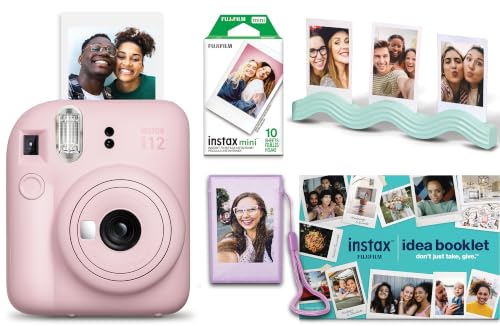
- Compact, easy-to-use design
- Selfie mirror and Close-Up mode
- Includes film, stand, and storage box
Best For: Beginners, selfies, and casual mini prints
Timer-Friendly Mini Pick

- 2- and 10-second self-timer
- Selfie mirror and Close-Up mode
- Automatic exposure and flash control
Best For: Selfies, close-ups, and timed portraits
Best Bundle for Beginners – Instax Mini 41 Starter Kit
For shoppers comparing studio instant cameras, this Instax Mini 41 bundle is a practical starting point because it combines the camera with 40 sheets of film, a protective case, and a 64-pocket album. Automatic exposure, a built-in flash, a selfie mirror, and close-up mode keep shooting straightforward.
Best For: Beginners and gift recipients who want an all-in-one Instax Mini setup.
Pros:
- Includes 40 sheets of Fujifilm Instax Mini film.
- Comes with a fitted case, strap, and 64-photo album.
- Automatic exposure, selfie mirror, and close-up mode simplify shooting.
Cons:
- Uses the smaller Instax Mini format rather than full-sized prints.
- Fixed prime lens has no zoom capability.
- Not water resistant.
This is a convenient choice when accessories and film matter as much as the camera itself. Its automatic operation favors easy snapshots over extensive manual control.
Best for Polaroid Effects – Now 3rd Gen Pebble White Bundle
This Polaroid Now 3rd Generation bundle is a strong option among studio instant cameras for photographers who prefer full-sized Polaroid prints and creative shooting modes. It includes 16 color photos and supports both i-Type and 600 film.
Best For: Creators who want classic Polaroid styling with autofocus and creative modes.
Pros:
- Twin-lens autofocus selects the appropriate lens automatically.
- Supports Polaroid i-Type and 600 film.
- Offers self-timer and double-exposure modes.
- USB-C battery lasts for over 15 film packs, according to the supplied notes.
Cons:
- Only 16 color photos are included.
- Not water resistant.
- Full-sized film can be less compact than Instax Mini prints.
With autofocus, automatic exposure, and distinctive double-exposure capability, the Now 3rd Generation balances accessibility with creative flexibility. The white finish also gives it a recognizable, modern-retro appearance.
Best for Wide Prints – Instax Wide 400
The Fujifilm Instax Wide 400 stands out among studio instant cameras for its larger Instax Wide format, making it useful for group shots, landscapes, and display-worthy prints. Automatic exposure and flash control keep operation simple, while the included accessories add flexibility.
Best For: Group photos, landscapes, and users who prefer larger instant prints.
Pros:
- Produces photos in the larger Instax Wide format.
- Includes automatic exposure and flash control.
- Provides Normal, Landscape, and Macro focus modes with the close-up lens.
- Includes a self-timer, shoulder strap, and camera-angle accessory.
Cons:
- Larger and heavier than many compact instant cameras.
- Wide film and accessories add to the carrying needs.
- Not water resistant.
This model is a sensible pick when print size is the priority. Its focus modes and angle-adjustment accessory support more deliberate compositions, though the wide body is less convenient for minimalist travel.
Best Classic Black Design – Now 3rd Gen Black Bundle
For buyers comparing studio instant cameras, the black Polaroid Now 3rd Generation offers the same straightforward autofocus platform and creative controls as the Now line in a classic finish. This bundle includes 16 color photos and works with both i-Type and 600 film.
Best For: Polaroid fans who want a classic black camera with self-timer and double exposure.
Pros:
- Twin-lens autofocus helps simplify focusing.
- Compatible with Polaroid i-Type and 600 film.
- Includes self-timer and double-exposure shooting modes.
- Features a built-in tripod mount and photo filter compatibility.
Cons:
- The bundle includes 16 color photos, so additional film may be needed.
- Not water resistant.
- Offers less control than cameras with extensive manual settings.
The black finish is a versatile choice for everyday use, while the tripod mount and filter compatibility give it room for more intentional setups. It remains focused on accessible, physical instant photography rather than advanced digital features.
Best Everyday Pick – Fujifilm Instax Mini 12
The Fujifilm Instax Mini 12 is a straightforward choice for shoppers comparing studio instant cameras for parties, travel, and casual photography. Its compact design, automatic controls, selfie mirror, and close-up mode make it easy to create credit-card-sized prints without manual exposure settings.
Best For: Beginners, selfies, parties, and portable everyday use.
Pros:
- Automatic exposure and flash control help produce balanced photos.
- Built-in selfie mirror and parallax-corrected close-up mode simplify self-portraits and nearby subjects.
- Prints high-quality 2 x 3-inch Instax Mini photos in approximately five seconds.
- Compact body includes a hand strap and two AA batteries.
Cons:
- Instax Mini film is sold separately.
- It does not offer water resistance or manual exposure controls.
The Mini 12 is a practical all-around option when ease of use matters more than advanced settings. Choose it if you want a simple camera that is ready for social moments and travel.
Best Digital-Print Hybrid – Kodak Printomatic Instant Camera
The Kodak Printomatic suits shoppers seeking studio instant cameras with digital capture as well as physical prints. It uses a 5MP sensor, automatically prints colorful 2 x 3-inch Zink photos, and saves images to a MicroSD card for added flexibility.
Best For: Users who want ink-free prints plus digital photo storage.
Pros:
- 5MP sensor and wide-angle f/2 lens provide an easy point-and-shoot setup.
- Zink printing requires no ink cartridges, toner, or traditional film.
- Prints are water-resistant, tear-resistant, and smudge-free.
- Can capture another image while the previous photo prints and saves photos to MicroSD.
Cons:
- No USB cable is included.
- Its digital image stabilization and 720p video features may appeal less to buyers focused only on instant prints.
- MicroSD storage is required for saving photos digitally.
The Printomatic stands out for combining instant physical copies with basic digital storage. It is a strong fit for users who prefer an ink-free, low-maintenance printing system.
Best Ready-to-Shoot Bundle – Fujifilm Instax Mini 41 Bundle
The Fujifilm Instax Mini 41 is a convenient pick among studio instant cameras because this bundle includes a 10-pack of Instax Mini film. Automatic exposure and flash control, a selfie mirror, and parallax-corrected close-up mode keep shooting simple while the Instax UP! app provides a way to digitize printed memories.
Best For: Buyers who want an Instax camera with film included and easy photo archiving.
Pros:
- Includes a 10-pack of Instax Mini film, hand strap, and two AA batteries.
- Selfie mirror and close-up mode support easier self-portraits and nearby subjects.
- Automatic exposure and flash control reduce the need for manual adjustments.
- Instax UP! app can scan physical prints into digital versions.
Cons:
- It uses Instax Mini film rather than larger instant photo formats.
- The camera is not water resistant.
- It offers automatic shooting rather than manual exposure control.
The Mini 41 is especially appealing if you want to start shooting immediately without buying film separately. Its included film and scanning-app support make it a well-rounded choice for sharing and organizing instant photos.
Wide-Format Group Pick – Instax WIDE 400 Bundle
For shoppers comparing studio instant cameras, the FUJIFILM instax WIDE 400 stands out when you want larger prints for group shots, landscapes, travel memories, and everyday photos. Automatic exposure and flash control simplify shooting, while the included film and accessories make this a ready-to-use bundle.
Best For: Group photography, scenic subjects, travel memories, and users who prefer larger instant prints.
Pros:
- Uses larger instax WIDE film and includes 20 exposures.
- Offers Normal, Landscape, and Macro shooting modes.
- Includes a self-timer, close-up lens, and camera angle adjustment accessory.
- Automatic exposure and flash control help simplify shooting.
Cons:
- The WIDE format is less compact than instax mini cameras and prints.
- Film is limited to the included 20 exposures unless additional film is purchased.
The WIDE 400 is a practical choice if print size matters more than portability. Its timer, adjustable angle, and included accessories are particularly useful for group photos and planned compositions.
Beginner Bundle Pick – Instax Mini 12 Holiday Bundle
Among studio instant cameras, the FUJIFILM instax mini 12 is an approachable option for casual snapshots and creative displays. Its compact design, automatic exposure and flash control, selfie mirror, and included film and storage accessories make it easy to start shooting right away.
Best For: Beginners, selfies, close-ups, parties, and shoppers wanting a complete mini-print starter bundle.
Pros:
- Compact design with simple lens-twist operation.
- Selfie mirror and Close-Up mode include parallax correction.
- Prints 2 x 3-inch instax mini photos in approximately five seconds.
- Bundle includes 10 sheets of film, a photo stand, and storage box.
Cons:
- The included film provides only 10 exposures.
- Its mini-format prints are smaller than instax WIDE photos.
The Mini 12 bundle is well suited to first-time instant-camera users who want more than just the camera in the box. The included display and storage accessories also make it convenient for organizing and showing finished prints.
Timer-Friendly Mini Pick – Instax Mini 13 Dreamy Purple
For buyers comparing studio instant cameras, the FUJIFILM instax mini 13 combines a compact mini format with automatic exposure and flash control, a selfie mirror, and built-in 2- and 10-second timers. It is a camera-only option, so instax mini film must be purchased separately.
Best For: Selfies, close-ups, timed portraits, and shoppers who want a compact camera with straightforward controls.
Pros:
- Compact rounded design with simple lens-twist power operation.
- Includes a selfie mirror and Close-Up mode with parallax correction.
- Offers both 2- and 10-second self-timer settings.
- Automatic exposure and flash control support bright, balanced photos.
Cons:
- Instax mini film is sold separately.
- Mini prints are smaller than the WIDE format.
The Mini 13 makes sense for users who value a small camera and flexible self-timer options. Compared with a bundle, its separate-film setup may require an additional purchase before the first shoot.
How We Picked These Studio Instant Cameras
We focused on cameras that suit studio-style creative work while remaining practical for events, portraits, crafts, and everyday use. Selection factors included print format, ease of operation, focusing and exposure aids, available film or paper, accessory value, portability, and suitability for different shooting environments. We also included both analog instant-film cameras and a digital Zink model so shoppers can compare immediate prints with a more flexible print-on-demand workflow.
Because bundles vary, check the exact contents before buying. Some packages include film, while others add accessories or extra value without changing the camera itself.
Quick Comparison of the 10 Options
- Best compact format: Fujifilm Instax Mini 41 or Mini 12.
- Best for larger prints: Fujifilm Instax Wide 400.
- Best Polaroid-style choice: Polaroid Now 3rd Generation.
- Best digital-print flexibility: Kodak Printomatic.
- Best bundle value: Compare the included exposure count, paper or film type, and accessories rather than relying on the product name alone.
Key Buying Factors for Studio Instant Cameras
Print Size and Film Type
Instax Mini prints are compact and easy to arrange on boards or albums. Instax Wide produces a more substantial image for group shots and display pieces. Polaroid I-Type photos offer a larger, classic format but require their specific film. Kodak’s Zink paper produces small adhesive-backed prints and does not use traditional instant film.
Lighting and Focus
Studio lighting can make exposure more predictable, but cameras still differ in how much help they provide. Look for selfie or close-up modes if you photograph products, portraits, or tabletop work. Flash behavior and minimum focusing distance matter when subjects are close to the lens.
Running Cost and Workflow
Calculate the cost per usable print, not just the camera price. Film packs with more exposures can reduce interruptions, while Zink paper avoids chemical film development and lets you choose when to print. Analog prints typically have a distinctive look, but digital printing offers easier retakes and storage.
Handling and Accessories
For events or busy creative spaces, simple controls and comfortable handling are valuable. Bundles with film, batteries, cases, or shutter accessories may be worthwhile if they match your workflow. Also check whether the camera requires batteries and whether those are included.
Who Should Buy Which Studio Instant Cameras?
Choose an Instax Mini model if portability, low-friction operation, and inexpensive compact prints are your priorities. The Mini 12 is a straightforward choice for casual users, while the Mini 41 and its bundles suit shoppers who want a newer styled option or extra supplies.
Choose the Instax Wide 400 for group portraits, larger displays, and scrapbook layouts where Mini prints feel too small. Pick the Polaroid Now 3rd Generation if you prefer Polaroid’s larger, recognizable format and want a camera designed around creative analog shooting. Finally, choose the Kodak Printomatic if you want digital capture with selectable physical prints and adhesive-backed Zink paper.