
The right dolly can add controlled movement, smoother pans, and more polished production value without requiring a large commercial studio. For home creators, the best choice depends on camera weight, available floor or tabletop space, and whether you need manual or motorized motion.
This roundup compares compact skater dollies, tabletop slider systems, tripod bases, and larger studio carts so you can match your setup to the shots you actually plan to make.
Best 10 Camera Dollies for Home Studios Picks for 2026
Best Studio Riser Set

- Four stackable heights for flexible setups
- 12-ply plywood construction
- Useful as dolly-track risers and camera platforms
Best For: Studios needing adjustable equipment support
Best Compact Manual Dolly

- Supports straight and circular movement
- Quiet rubber wheels for tabletop shooting
- Includes ball head and rotatable phone clamp
Best For: Compact phone and camera studio setups
Best Dark Finish Riser Set

- Four stackable sizes for adjustable elevations
- Useful for dolly tracks, sliders, and platforms
- Dark brown wooden studio finish
Best For: Semi-permanent home-studio support setups
Best Adjustable Path Dolly

- 22-pound load capacity
- Straight, curved, or circular paths
- 1/4-inch and 3/8-inch mounting threads
Best For: Flexible tabletop and floor-level tracking shots
Best Heavy-Duty Studio Cart
PROAIM Victor V1.1 Camera Cart

- 440.9-pound load capacity
- Adjustable shelf and mounting plate
- Folds to a 7-inch-thick suitcase
Best For: Moving heavy production gear around a studio
Best Skater-Style Dolly
Vidpro SK-22 Professional Skater Dolly
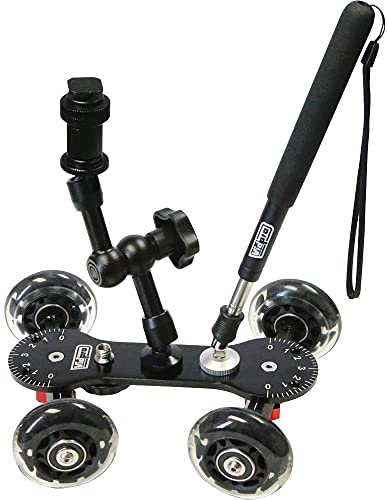
- 25-pound load capacity
- Straight, curved, and 360-degree movement
- Seven 1/4-inch-20 mounting points
Best For: Low-angle DSLR and camcorder tracking shots
Studio Décor Pick
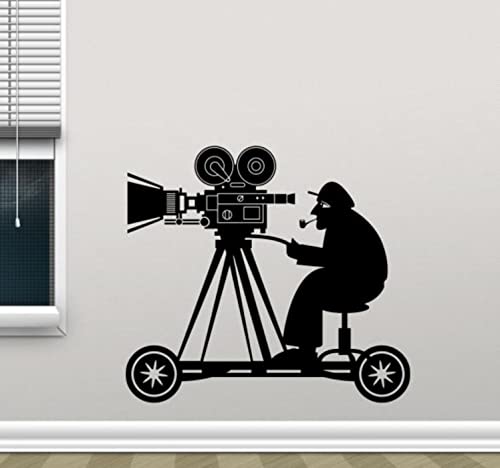
- Movie-themed vinyl wall art
- Waterproof single-piece design
- For studio décor, not camera movement
Best For: Home studio and editing-room decoration
Flexible Tabletop Pick

- Runs on smooth surfaces or slider tracks
- Adjusts for straight, curved, or circular paths
- Supports loads up to 22 pounds
Best For: Portable tabletop and compact studio tracking
Heavy-Duty Tripod Pick

- Supports tripod rigs up to 33 pounds
- Locking rubber wheels for static shots
- Folds flat with a carry bag
Best For: Full-size tripod and heavier studio rigs
Best Motorized Option – Wireless Video Camera Dolly
For camera dollies for home studios, the NEEWER DL100 stands out when you want repeatable movement without manually pushing the camera. Its remote control offers three speeds, direction changes, and pause control, while the adjustable wheels support straight or circular routes.
Best For: Home-studio creators who want motorized tabletop camera movement for cameras, phones, or action cameras.
Pros:
- Wireless remote controls speed, direction, and pauses from up to 19.7 feet away.
- Adjustable wheel angles support straight-line and circular movement.
- Built-in 1800mAh battery provides up to six hours of service time.
- Supports loads up to 6.6 pounds and includes a convertible 1/4-inch to 3/8-inch screw.
Cons:
- Accessories such as holders and action-camera adapters are not included.
- It is not water resistant.
The DL100 is a practical choice when hands-free, repeatable motion matters more than the smallest possible footprint. Fully charge it before first use and use the included wrench for wheel adjustments.
Best Studio Riser Set – Light Brown APPL-Boxes
While not a rolling dolly, this PROAIM APPL-Box set is a useful companion for camera dollies for home studios. Four stackable plywood boxes provide adjustable support for dolly tracks, sliders, cameras, props, monitors, or talent.
Best For: Home studios that need stable, adjustable risers for camera positioning, dolly-track setups, or staging.
Pros:
- Includes Full, Half, Quarter, and Pancake boxes for flexible height adjustments.
- Stackable design helps create the exact working height needed.
- 12-ply plywood construction is sanded smooth and hand-polished.
- Can also serve as seating, prop risers, camera platforms, or slider bases.
Cons:
- At 12.45 kg, the set is relatively heavy for frequent repositioning.
- It provides support and elevation, not motorized or wheeled camera movement.
This set makes sense when your home studio needs reliable height control around a dolly or slider. Its broad utility can help justify the floor space, especially in a multipurpose production area.
Best Compact Manual Dolly – SD001 Tabletop Dolly
For small spaces, the NEEWER SD001 is one of the more convenient camera dollies for home studios. This manual four-wheel dolly supports straight or circular movement, uses soft rubber wheels for quieter operation, and includes an adjustable ball head plus a rotatable phone clamp.
Best For: Creators making tabletop, phone, mirrorless-camera, or action-camera shots in a compact studio.
Pros:
- Adjustable wheels support linear and circular camera movement.
- Soft rubber wheel rings are designed for smooth, quiet operation.
- 360-degree ball-head rotation and 90-degree tilting expand framing options.
- Pocket-sized aluminum construction weighs about 220 grams.
Cons:
- It is not suitable for telephoto lenses.
- Action-camera adapters are sold separately.
- Manual movement requires the operator to push the dolly.
The SD001 is a strong fit when portability and low-noise tabletop movement matter most. Its phone clamp and cold shoe also make it useful for compact creator rigs, though heavier or longer-lens setups may need a different support solution.
Best Dark Finish Riser Set – Dark Brown APPL-Boxes
This dark brown PROAIM APPL-Box set is a practical support accessory for camera dollies for home studios. Its four stackable boxes can raise dolly tracks, sliders, cameras, props, or monitors to different heights while also serving broader studio and staging needs.
Best For: Home studios that want stackable wooden risers with a darker finish for camera, dolly-track, and set-building work.
Pros:
- Four included boxes offer Full, Half, Quarter, and Pancake height options.
- Stackable construction enables customized equipment and track elevations.
- Solid wooden construction is described as resistant to decay and insects.
- Can function as seating, leveling supports, platforms, wedges, or prop risers.
Cons:
- At 11.81 kg, it is not especially lightweight.
- These boxes support dolly setups but do not provide rolling or motorized movement.
- The set is not water resistant.
Choose this version when you want flexible studio support and prefer its dark brown appearance. It is especially useful for permanent or semi-permanent setups where adjustable elevation is more important than portability.
Best Adjustable Path Dolly – Neewer Camera Table Dolly
For home studios seeking flexible camera dollies for home studios, the Neewer Camera Table Dolly offers a compact way to create straight, curved, or circular tracking shots on flat surfaces. Its adjustable rods, marked scale, and rotating rubber wheels help you set up repeatable camera movements.
Best For: Creators who want versatile tabletop, floor-level, and around-the-object camera moves.
Pros:
- Supports equipment up to 22 pounds.
- Adjustable aluminum rods enable straight paths, curves, or complete circles.
- Offers 1/4-inch and 3/8-inch mounting threads plus four 1/4-inch screw holes.
- Fluid roller bearings and rotatable rubber wheels support smooth, quiet movement.
Cons:
- Designed for flat surfaces rather than uneven terrain.
- Its compact folded size may limit larger camera setups.
This is a strong choice when shot variety matters more than a fixed track length. The 22-pound capacity and multiple mounting options suit many DSLR, camcorder, action-camera, and phone configurations.
Best Heavy-Duty Studio Cart – PROAIM Victor V1.1 Camera Cart
The PROAIM Victor V1.1 is a production cart rather than a compact skater dolly, making it a practical option for home studios that need to move substantial camera, lighting, sound, or DIT equipment. Its adjustable shelf, mounting plate, and large pneumatic wheels prioritize capacity and studio utility.
Best For: Large home studios, production spaces, and users transporting heavy film gear between setup areas.
Pros:
- Supports up to 440.9 pounds of equipment.
- Four 9-inch pneumatic wheels are designed to roll across varied surfaces.
- Adjustable top shelf includes a mounting plate and a 22-inch cross-bar with 1/4-inch and 3/8-inch threads.
- Folds to a 7-inch-thick suitcase and offers tool-free setup after initial assembly.
Cons:
- Its 36-inch cart footprint is less suitable for small rooms.
- It is a gear transport cart, not a low-level camera tracking dolly.
- Pneumatic tires require attention to their stated 30 PSI pressure.
If your idea of camera dollies for home studios includes moving an entire production package, the Victor V1.1 stands out for capacity and storage convenience. Choose it over a skater dolly when transport and organization are the main priorities.
Best Skater-Style Dolly – Vidpro SK-22 Professional Skater Dolly
The Vidpro SK-22 is a compact skater dolly for low-level shooting, tracking, and panning. For home studios comparing camera dollies for home studios, its angle markers, rubber wheels, and multiple mounting points make it useful for repeatable straight, curved, and 360-degree movements.
Best For: DSLR and camcorder users creating low-angle product, tabletop, and cinematic panning shots.
Pros:
- Supports cameras and equipment up to 25 pounds.
- Axle adjustment markers help set straight lines, broad curves, or full circles.
- Seven 1/4-inch-20 mounting points accommodate cameras, extension arms, and ball joints.
- Includes a 27-inch extendable handle and articulated magic arm.
Cons:
- Its mounting system is limited to 1/4-inch-20 threaded points.
- It is intended for low-level movement rather than transporting full studio gear.
- It is not water resistant.
The SK-22 balances portability with useful camera-positioning flexibility. Its 2-pound weight and folded dimensions make it especially appealing for smaller studios where a full cart or long slider would be excessive.
Studio Décor Pick – Camera Dolly Wall Decal
For shoppers browsing camera dollies for home studios, this removable vinyl wall decal offers a way to reinforce a filmmaking theme without taking up floor space. Its movie design suits an office, editing area, or studio wall.
Best For: Home studio décor and movie-themed workspaces rather than camera movement.
Pros:
- Movie and cameraman theme complements filming spaces.
- Waterproof construction adds practical durability.
- Single-piece design is simple to use as wall art.
Cons:
- It is décor, not a functional camera dolly.
- Single-use reusability limits repositioning.
This is best treated as a visual accent for a home studio, not as equipment for stabilizing or moving a camera. Choose it when the goal is atmosphere rather than production functionality.
Flexible Tabletop Pick – 4-Wheel Camera Video Dolly
For camera dollies for home studios, this four-wheel dolly is designed for tabletop or floor use and can also run on a compatible slider track. Its adjustable wheels support straight, curved, or circular movement for compact shooting setups.
Best For: Creators who need portable tabletop tracking movement for DSLR cameras, camcorders, or smartphones.
Pros:
- Works on flat, smooth surfaces or a camera slider track.
- Adjustable setup supports straight paths, curves, and circles.
- Aluminum-alloy body and silica-gel wheels support up to 10 kg/22 lb.
- Compact, lightweight design is suitable for indoor, outdoor, or travel use.
Cons:
- Requires a flat, smooth surface for tabletop or floor operation.
- Camera or smartphone holder is not identified as included in the supplied details.
Its flexible wheel arrangement makes it a practical choice for product shots, tabletop scenes, and small studio moves. Verify your mounting hardware and keep the load within the stated 10 kg limit.
Heavy-Duty Tripod Pick – Acuvar Studio Camera Dolly
For camera dollies for home studios, the Acuvar tripod dolly provides a rolling base for full-size tripods and heavier video setups. Locking rubber wheels, adjustable leg mounts, and a fold-flat design make it suited to studio and location work.
Best For: DSLR and camcorder rigs weighing up to 33 pounds, including setups with fluid heads, lighting, and accessories.
Pros:
- Rubber wheels and precision metal bearings provide quiet, fluid movement.
- One-step wheel locks help secure the tripod for static shots.
- Adjustable leg mounts fit most full-size tripods.
- Folds flat and includes a carry bag for transport.
Cons:
- It is not water resistant.
- Its low rolling-base design is intended for tripods rather than direct camera mounting.
- The supplied details list a 90-day manufacturer warranty.
This is the most suitable option here for a home studio that uses a full-size tripod and needs both smooth repositioning and locked-off stability. Confirm your tripod’s leg spread and keep the complete rig within the stated weight limit.
How We Picked the Best Camera Dollies for Home Studios
We focused on the factors that matter most in a home production environment: footprint, rated load capacity, wheel design, movement control, setup requirements, and compatibility with cameras, tripods, phones, and common accessories. The selection includes tabletop and low-angle options for tight spaces, rolling tripod bases for studio floors, and larger carts for creators who need to move heavier equipment.
Because product types vary considerably, a compact skater dolly should not be judged by the same standard as a motorized slider or full-size camera cart. We considered each option according to its intended use rather than treating maximum weight alone as a measure of quality.
Quick Comparison
- Best for automated movement: A motorized dolly or slider can create repeatable passes for product videos, interviews, and time-based shots.
- Best for tabletop filming: Four-wheel skater and slider designs are suited to low-angle product work, food videos, and compact creator setups.
- Best for tripod mobility: A heavy-duty tripod dolly provides quick repositioning on a studio floor, especially when locking wheels are included.
- Best for heavier production gear: A camera cart offers substantially more capacity but needs considerably more room than a tabletop system.
Key Buying Factors for Camera Dollies for Home Studios
Camera and Accessory Compatibility
Check the mounting thread, platform dimensions, and whether the dolly supports a camera directly or requires a tripod head. If you regularly use a cage, monitor, microphone, teleprompter, or long lens, leave capacity beyond the camera’s listed weight.
Load Capacity and Stability
Rated capacity is only useful when the load remains stable while moving. A low-profile dolly may be ideal for a lightweight mirrorless camera, while heavier cinema rigs call for a wider platform, stronger wheels, or a dedicated cart. Keep the center of gravity low to reduce tipping and unwanted vibration.
Movement and Surface Requirements
Wheels perform best on smooth, level surfaces. Small rubber wheels can struggle over grout lines, carpet, cables, and uneven flooring. Look for adjustable or locking wheels when you need straight tracking, repeatable framing, or safe stationary shooting.
Manual Versus Motorized Control
Manual dollies are simple, quiet, and fast to reposition. Motorized models can provide more consistent speed and repeatable motion, but they add batteries, controls, noise considerations, and setup complexity.
Who Should Buy Which Camera Dollies for Home Studios?
Choose a compact skater dolly if you shoot products, tabletop scenes, or low-angle footage and need a small solution that stores easily. Choose a tabletop slider system if you want a more controlled linear move and need support for a phone as well as a camera. Choose a tripod dolly if your main goal is moving a conventional tripod around a smooth studio floor without repeatedly lifting it.
Choose a motorized option for repeatable camera moves, automated passes, and content that benefits from consistent timing. Choose a full-size camera cart only when you have the floor space and equipment weight to justify it. Before buying, measure your shooting area, identify the surfaces you will use, and confirm the complete rig weight rather than relying on the camera body specification alone.