
Choosing the right camera storage starts with how you carry your gear, how much protection you need, and whether you want a pouch, insert, or shoulder bag.
This roundup of the best camera lens storage bags for beginners focuses on simple, practical options that help new photographers keep lenses safe and easy to access.
Best 10 Camera Lens Storage Bags for Beginners Picks for 2026
Compact Lens Pouch

- Water-resistant polyester exterior
- Foam-cushioned interior protection
- Mesh pocket and belt-friendly carry
Best For: Beginners storing one compatible lens with simple protection
Travel Camera Bag
Large Padded Crossbody Camera Bag

- Removable divider for custom storage
- Dual side pockets for small accessories
- Padded waterproof build with shoulder strap
Best For: Beginners who want a roomy, all-purpose camera carry bag
Neoprene Pouch Set

- Four pouch sizes for better fit
- 5mm neoprene with reinforced sewing
- Flattens flat and clips to belt or bag
Best For: Beginners organizing several lenses in lightweight pouches
Camera Kit Case
Canon-Compatible DSLR Case with Dividers

- Three moveable dividers for custom layout
- Inner mesh pocket for accessories
- Compact soft case with handle and strap
Best For: Beginners packing a small camera kit with a lens and accessories
Flexible insert bag

- Fits a DSLR body plus 2 to 3 lenses.
- Padded dividers adjust to your gear layout.
- Works inside a backpack or as a shoulder bag.
Best For: Beginners who want flexible, padded storage for a growing kit.
Compact framed insert

- Sized for one camera and two lenses.
- Steel frame and padding add everyday protection.
- Lightweight enough for daypacks and totes.
Best For: Beginners with a small mirrorless kit who travel light.
Protective hard shell
ProCase Hard Shell Camera Case

- Hard shell EVA exterior helps protect against bumps and dust.
- Adjustable dividers organize a camera and accessories.
- Lightweight shoulder carry suits travel and day trips.
Best For: Beginners who want firmer protection in a compact carry case.
Modular Padded Insert
Flexible Partition Camera Padded Bag Insert Protection Handbag

- Removable dividers create up to 7 compartments.
- Protects gear from scratches and bumps.
- Fits cameras, lenses, batteries, and accessories.
Best For: Beginners who need a customizable padded insert for an existing bag.
Compact Shoulder Carry
CADeN Compact Camera Shoulder Crossbody Bag Case
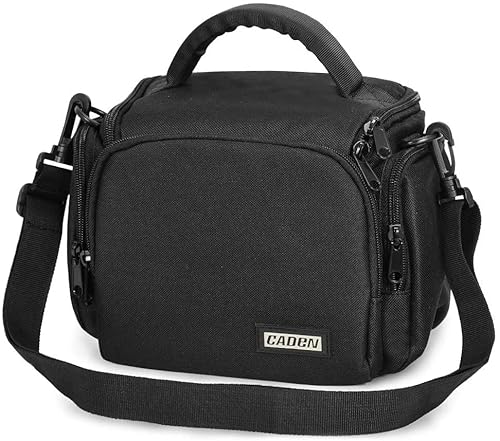
- Holds 1 camera plus 1 spare lens.
- Waterproof nylon with 10mm thick protection.
- Includes side, front, and inner accessory pockets.
Best For: Beginners wanting a compact waterproof bag for a basic camera setup.
Multi-Lens Travel Case
Medium Camera Case Bag for Canon/Sony/Nikon

- Three dividers create customizable storage space.
- Hard EVA body supports travel protection.
- Mesh pocket stores batteries, cards, and cables.
Best For: Beginners with multiple lenses who want a structured travel case.
Compact Lens Pouch – JJC Deluxe Lens Case Pouch
If you want camera lens storage bags for beginners that are simple to use and easy to carry, this JJC lens pouch is a practical place to start. It is built for lenses below 3.15 x 6.1 inches, uses a water-resistant polyester exterior with foam cushioning, and adds a mesh pocket for small accessories like a lens cap.
Best For: Beginners who need a lightweight, protective pouch for one lens and a few small accessories.
Pros:
- Water-resistant exterior helps protect against light weather and everyday wear.
- Foam-cushioned interior adds shock absorption for stored lenses.
- Mesh pocket in the lid keeps lens caps and small accessories together.
- Four carrying options and belt compatibility make it easy to attach and transport.
Cons:
- Only fits lenses within the listed size range.
- Soft, flexible construction may feel less structured than a hard case.
Overall, this is a straightforward lens pouch for beginners who want basic protection without extra bulk. Its simple layout and carry options make it a good everyday storage choice for one compatible lens.
Travel Camera Bag – Large Padded Crossbody Camera Bag
For beginners who want camera lens storage bags for beginners with room for more than just a lens, this padded camera bag offers a more versatile setup. It includes one removable divider, dual side pockets, and padded waterproof material, so it works well when you need a soft case for a camera body, accessories, and related gear.
Best For: New photographers who want a roomy, padded soft bag for travel, daily use, and organized gear storage.
Pros:
- Removable divider helps customize the interior layout.
- Dual side pockets are useful for batteries, memory cards, and accessories.
- Padded waterproof material adds protection from bumps and light weather.
- Top handle and shoulder strap provide flexible carrying options.
Cons:
- Large size may be more bag than needed if you only want lens storage.
- Single main compartment means setup is less specialized than dedicated lens pouches.
In practice, this bag makes sense if a beginner wants one soft case that can handle camera gear and accessories together. It is less compact than a lens-only pouch, but more adaptable for travel and everyday shoots.
Neoprene Pouch Set – Lightdow 4-Pack Lens Bags
These camera lens storage bags for beginners are a good fit if you want a simple way to sort multiple lenses or accessories by size. The Lightdow pack includes four soft neoprene pouches in different sizes, with reinforced sewing, pull-cord closure, and a belt or bag clip for easier transport.
Best For: Beginners who need an affordable multi-pouch set for organizing several lenses or small camera items.
Pros:
- Four sizes help match different lens dimensions more closely.
- 5mm thick neoprene provides soft protection during travel and field use.
- Flattens when empty for easier storage.
- Pull-cord closure and snap hood add convenience for carrying.
Cons:
- Soft pouches do not offer rigid structure.
- Best for items within the specified size range only.
This set is especially useful for beginners who want multiple lightweight pouches instead of one larger bag. The size variety makes it easier to keep lenses organized without adding much bulk.
Camera Kit Case – Canon-Compatible DSLR Case with Dividers
If you need camera lens storage bags for beginners that also hold a camera body and accessories, this case is built around a customizable interior. It includes three moveable dividers, an inner mesh pocket, and a shoulder strap, making it a compact soft case for packing gear in a more organized way.
Best For: Beginners who want a small, padded case for a camera kit, accessories, and one or more lenses.
Pros:
- Three moveable dividers let you adjust the storage layout.
- Inner mesh pocket is useful for batteries, a charger, and memory cards.
- Soft handle and shoulder strap make it easy to carry while traveling.
- Compact outer dimensions help keep the kit manageable.
Cons:
- Internal space is limited compared with larger camera bags.
- Only fits the listed camera systems and is case-only, not a full camera kit.
This is a practical starter option if you want one small case for a camera body, lens, and a few essentials. The adjustable dividers make it easier for beginners to keep gear separated without learning a more complex bag system.
Flexible insert bag – Koolertron DSLR Insert Bag
If you need camera lens storage bags for beginners, this Koolertron insert bag is a practical place to start because it gives you padded organization without forcing you into a rigid hard case. The customizable interior makes it easier to separate a camera body, multiple lenses, and small accessories, while the water-resistant nylon Oxford build adds everyday peace of mind.
Best For: Beginners who want one flexible bag that can sit inside a backpack or be carried on its own.
Pros:
- Fits a DSLR body plus 2 to 3 lenses in the main compartment.
- Repositionable padded dividers help you match the layout to your gear.
- Thick foam padding adds shock protection for travel and commuting.
- Can be used as a standalone shoulder bag or inserted into another bag.
Cons:
- Bulkier than a small insert-only pouch.
- Water-resistant material helps with splashes, but it should not be submerged.
Overall, this is a beginner-friendly option if you want room to grow into a larger kit. It balances storage, padding, and carry flexibility better than many basic camera organizers.
Compact framed insert – TARION ShellCore XS Insert
For camera lens storage bags for beginners, this TARION insert is a compact way to protect a small kit without adding much weight. It is designed for one camera and two lenses, and the removable top lid plus adjustable dividers make it easier to keep gear organized inside a daypack or tote.
Best For: Beginners with a compact mirrorless or DSLR setup who want lightweight everyday protection.
Pros:
- Compact size fits easily into 15-20L daypacks and similar bags.
- High-density padding and a steel frame help resist deformation and daily bumps.
- Two adjustable dividers keep one camera body and two lenses organized.
- Removable top lid allows quicker access when you need to reach gear fast.
Cons:
- Best suited to smaller kits rather than larger multi-lens setups.
- Strap is not included if you want to carry it as a standalone bag.
This is a strong pick if you value portability more than maximum capacity. It keeps the footprint small while still offering structure and padding for everyday use.
Protective hard shell – ProCase Hard Shell Camera Case
If you are comparing camera lens storage bags for beginners and want something more protective, this ProCase hard shell option is built for simple, organized carry. Its compact shape, adjustable dividers, and splash-resistant exterior make it a solid choice for day trips, outdoor use, and general travel.
Best For: Beginners who want a compact shoulder bag with firmer protection and easy organization.
Pros:
- Durable EVA hard shell helps shield gear from rain, dust, and bumps.
- Soft lining and padded divider protect the lens from scratches.
- Adjustable dividers support flexible storage for a camera and accessories.
- Lightweight design with shoulder strap makes it easy to carry.
Cons:
- Smaller, compact build may not suit larger kits.
- Hard shell style is less flexible than insert-style bags.
For beginners who want straightforward protection and a tidy layout, this case is easy to live with. It focuses on portable safety first, which makes it a dependable step up from a basic pouch.
Modular Padded Insert – Flexible Partition Camera Padded Bag Insert Protection Handbag
If you’re looking for camera lens storage bags for beginners, this padded insert is a simple way to add camera protection inside an existing handbag or travel case. The removable, adjustable dividers let you build up to 7 partitions, so you can separate a camera body, lenses, batteries, chargers, cables, and other small accessories without everything rubbing together.
Best For: Beginners who want a flexible padded organizer for carrying camera gear inside another bag.
Pros:
- Removable cushioned dividers can be arranged into 7 small compartments.
- Helps protect gear from scratches and collisions during travel.
- Fits a wide range of camera systems and accessories, including mirrorless gear and action cameras.
- Zipper closure and nylon build keep the insert practical and lightweight.
Cons:
- Storage case only; camera and accessories are not included.
- Designed as an insert, so it needs another bag or case to carry it.
This is a good pick if you want customizable protection without buying a full dedicated camera bag. It’s especially useful when you already have a tote, backpack, or travel case and just need organized padding for your gear.
Compact Shoulder Carry – CADeN Compact Camera Shoulder Crossbody Bag Case
For beginners comparing camera lens storage bags for beginners, this compact crossbody case is a straightforward carry option that holds one camera plus one spare lens. It adds organized accessory storage with side pockets, a front pocket, and an inner mesh compartment, while the 10mm thick body and waterproof nylon construction are aimed at everyday protection.
Best For: New camera owners who want a compact, waterproof shoulder bag for one camera and one lens.
Pros:
- Fits 1 camera plus 1 spare lens, with room for a phone and small accessories.
- Multiple pockets help separate chargers, SD cards, keys, filters, and cleaning items.
- 10mm thick body and velcro spacer add shock protection.
- Adjustable crossbody strap and web handle make it easy to carry.
Cons:
- Compact size limits how much gear you can bring.
- Only suitable for a basic one-camera, one-lens setup.
This bag makes sense if you want an affordable, easy-to-carry case that keeps essentials organized. It’s a practical step up from tossing gear into a general-purpose bag, especially for short trips or casual outings.
Multi-Lens Travel Case – Medium Camera Case Bag for Canon/Sony/Nikon
If you need camera lens storage bags for beginners that can grow with your kit, this medium hard travel case is built around adjustable storage. It comes with 3 movable dividers so you can set up space for multiple lenses and accessories, plus an inner mesh pocket for batteries, chargers, memory cards, and cables.
Best For: Beginners with a growing camera kit who want a more protective travel case for multiple lenses.
Pros:
- Three movable dividers let you customize the interior layout.
- Hard EVA construction is designed for travel protection.
- Inner mesh pocket helps organize batteries, chargers, cables, and memory cards.
- Soft handle and shoulder strap make transport easier.
Cons:
- Case only; camera is not included.
- Bulkier than a small shoulder bag or insert-style organizer.
This option is a strong choice if you want more structure and separation than a soft bag can offer. It’s especially useful when you’re carrying a camera with multiple lenses and want a dedicated travel case rather than an all-purpose insert.
How We Picked the Best Camera Lens Storage Bags for Beginners
We looked for beginner-friendly designs that balance protection, organization, and ease of use. The strongest picks use padded walls, durable materials, and closures that feel secure without being complicated. We also favored bags and inserts that work well for first-time camera owners who may not yet know their exact gear needs.
Quick Comparison: Which Style Fits Your Setup?
Soft lens pouches are best for single-lens protection inside a larger bag. Insert bags and padded organizers work well if you want to turn an everyday backpack or tote into camera storage. Hard shell cases offer the most structure for smaller kits, while shoulder and crossbody bags are better when you want everything in one easy-to-carry place.
Key Buying Factors for Camera Lens Storage Bags for Beginners
Protection Level
Choose padding based on how you travel. Light daily carry usually needs soft cushioning, while commuting, travel, or crowded environments call for thicker padding or rigid shells.
Size and Interior Layout
Make sure the bag fits your lens, body, and extras without forcing the zipper or leaving too much empty space. Adjustable dividers are useful because beginner kits often change over time.
Carry Style
Crossbody and shoulder bags are convenient for fast access, while insert bags are ideal if you already own a backpack you like. Lens pouches are the simplest option if you only need storage for one item at a time.
Material and Weather Resistance
Water-resistant fabric helps protect gear from light rain and spills. If you shoot outdoors, look for sealed seams, wipe-clean surfaces, and sturdy zippers.
Ease of Use
Beginners should prioritize simple layouts, clear visibility, and quick access. A bag that is easy to pack and unpack is more likely to get used regularly.
Who Should Buy Which Camera Lens Storage Bags for Beginners?
If you own one lens and want affordable protection, a padded pouch is the simplest choice. If you carry a camera body plus a lens or two, a compact shoulder bag or hard case may be a better fit. If you already have a travel backpack, an insert bag gives you the most flexibility.
For most newcomers, Camera Lens Storage Bags for Beginners should be chosen based on your current kit, not the gear you hope to own later. Start with the smallest solution that safely fits today’s setup, then upgrade as your collection grows.