
When outages last for hours—or even days—a capable portable generator can keep essential appliances, HVAC equipment, sump pumps, refrigerators, and home systems running. The best professional portable home generators combine high output with practical controls, flexible fuel options, and safer operation.
We compared 10 high-capacity models from Westinghouse, Champion, DuroMax, and DuroStar to help you choose the right balance of power, runtime, portability, and installation readiness for your home.
Best 10 Professional Portable Home Generators Picks for 2026
Top High-Capacity Pick
Westinghouse 14,500W Tri-Fuel Generator

- 14,500 peak and 11,500 running watts
- Gasoline, propane, and natural gas operation
- Remote start with up to 19-hour runtime
Best For: High-output whole-home backup with flexible fuel options
Heavy-Duty Tri-Fuel Choice
Champion 15,000W Home Backup Generator

- 15,000 starting and 12,000 running watts
- 717cc V-twin engine with electric start
- Includes propane and natural gas hoses
Best For: Demanding residential or commercial backup applications
Quiet Inverter Pick
Westinghouse 12,000W Tri-Fuel Inverter Generator

- Up to 12,000 peak and 9,000 running watts
- ≤3% THD with operation as low as 64 dBA
- Tri-fuel, remote start, and parallel capable
Best For: Quieter backup power for electronics and residential use
Compact Backup Value
Westinghouse 6,500W Dual-Fuel Generator
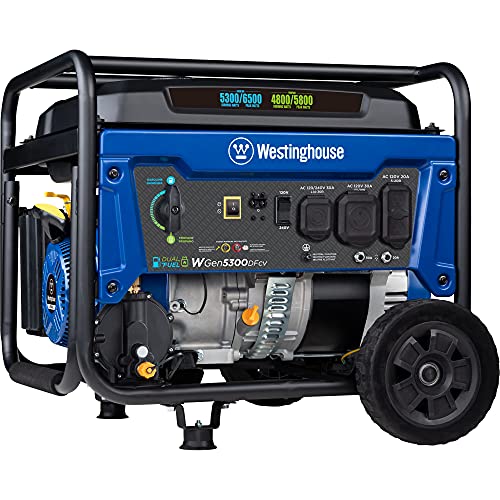
- 5,300 running and 6,500 peak gasoline watts
- Gasoline and propane operation
- Transfer-switch-ready 30A outlet and RV-ready outlet
Best For: Essential-circuit and RV backup on a smaller budget
Best Tri-Fuel Flexibility
Westinghouse 12500W Tri-Fuel Generator

- Up to 12,500 peak watts on gasoline
- Runs on gasoline, propane, or natural gas
- Remote, electric, and recoil starting
Best For: Homeowners seeking flexible, high-output backup power
Best Heavy-Duty Build
DuroMax XP13000EH Dual-Fuel Generator

- 13,000 starting and 10,500 running watts
- All-metal frame with copper windings
- Gasoline and propane operation
Best For: Demanding home backup users who value rugged construction
Best Dual-Fuel Value
Westinghouse WGen9500DF Generator

- Up to 12,500 peak watts
- Gasoline and propane operation
- VFT display with voltage and frequency readouts
Best For: Homeowners seeking convenient, high-output dual-fuel backup
High-Capacity Dual-Fuel Pick

- 13,000-watt output with 10,500 running watts
- Gasoline or propane operation
- Remote start, CO alert, and 50A outlet
Best For: High-capacity residential and RV backup
Long-Run Home Backup Pick

- 14,500 peak and 11,500 running watts
- Up to 19 hours at 25% load
- Less than 5% THD and remote start
Best For: Extended home backup with electronics support
Maximum-Output Backup Pick
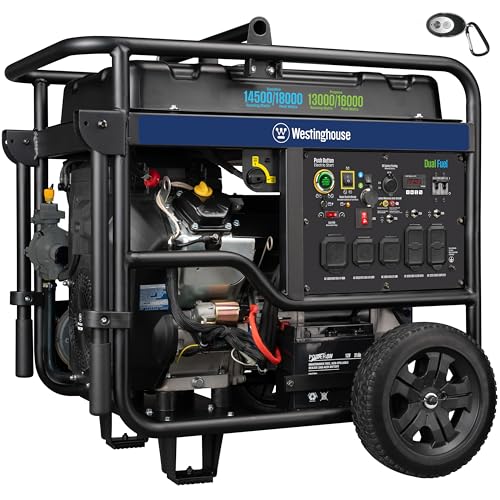
- 18,000 peak and 14,500 running watts
- Dual-fuel gasoline and propane operation
- Cleaner power, remote start, and CO sensor
Best For: High-demand whole-home backup
Top High-Capacity Pick – Westinghouse 14,500W Tri-Fuel Generator
For shoppers comparing professional portable home generators, the Westinghouse WGen11500TFc stands out with substantial output, tri-fuel flexibility, and transfer-switch readiness. Its 550cc engine provides 11,500 running watts on gasoline, while remote electric start and a long stated runtime support extended outages.
Best For: Whole-home backup users who want high output and gasoline, propane, or natural gas flexibility.
Pros:
- Delivers up to 14,500 peak and 11,500 running watts on gasoline.
- Runs on gasoline, propane, or natural gas.
- Less than 5% THD, remote start, and up to 19 hours of runtime at 25% load.
- Pressure lubrication, low-oil shutdown, CO sensor, and a 3-year limited warranty.
Cons:
- At 230 pounds, it is a substantial unit to move.
- Transfer switch systems are sold separately.
This is a strong choice when maximum portable capacity matters more than compactness. Its tri-fuel design and 50A/30A connections make it well suited to prepared home backup setups.
Heavy-Duty Tri-Fuel Choice – Champion 15,000W Home Backup Generator
The Champion 201161 is designed for demanding backup applications, pairing 15,000 starting watts with 12,000 running watts and a large 717cc V-twin engine. For buyers evaluating professional portable home generators, its included fuel hoses and electric start make setup across three fuel types especially practical.
Best For: Home or commercial users who need heavy-duty output and ready-to-use tri-fuel accessories.
Pros:
- Provides 15,000 starting watts and 12,000 running watts.
- Supports gasoline, propane, and natural gas.
- Includes propane and natural gas hoses with an NPT adapter.
- CO Shield, electric start, Intelligauge monitoring, wheels, and a 3-year limited warranty.
Cons:
- At 331 pounds, it is the heaviest generator in this roundup.
- The supplied notes list a 78 dBA noise level at 23 feet.
- The product details indicate a 9-hour gasoline runtime, while another listing field reports 3 hours.
This model prioritizes capacity and a robust engine over easy portability. Its included hoses and monitoring display are useful advantages for buyers building a serious backup-power setup.
Quiet Inverter Pick – Westinghouse 12,000W Tri-Fuel Inverter Generator
The Westinghouse iGen12000TFc combines substantial backup capacity with inverter technology and a fully enclosed design. Among professional portable home generators, it is particularly appealing for users who want tri-fuel operation, low stated THD, quieter performance, and digital runtime information.
Best For: Electronics-conscious homeowners seeking quieter, efficient whole-home backup power.
Pros:
- Produces up to 12,000 peak and 9,000 running watts on gasoline.
- Offers gasoline, propane, and natural gas operation with output ratings for each fuel.
- Less than or equal to 3% THD and operation as low as 64 dBA.
- Remote start, parallel capability, 50A outlet, CO sensor, and up to 19 hours of runtime at 25% load.
Cons:
- Its 9,000 gasoline running watts are lower than the two larger open-frame models here.
- It weighs 191 pounds and still requires appropriate connection equipment for home transfer use.
This is the most refined option for buyers who value cleaner power and lower noise without giving up tri-fuel flexibility. The data center and inverter efficiency also make ongoing operation easier to monitor.
Compact Backup Value – Westinghouse 6,500W Dual-Fuel Generator
The Westinghouse WGen5300DFcv offers a more manageable way to add backup power without moving up to the size and cost of the highest-output models. It is a practical entry among professional portable home generators, with dual-fuel operation, a transfer-switch-ready 30A outlet, and up to 14.5 hours of stated runtime.
Best For: Homeowners who need essential-circuit backup and a lighter, more affordable portable format.
Pros:
- Provides 5,300 running and 6,500 peak watts on gasoline.
- Supports gasoline and propane, with a propane hose included.
- Includes 120/240V selection, RV-ready TT-30R, and transfer-switch-ready L14-30R outlets.
- Automatic low-oil and CO shutdown, fuel gauge, wheel kit, and 3-year limited coverage.
Cons:
- Its output is substantially lower than the tri-fuel generators in this roundup.
- It does not support natural gas.
- The supplied details list 5,300 running watts, while the headline product wattage is 6,600 watts.
This generator makes sense when essential loads, RV use, or a smaller backup installation are the priority. Its dual-fuel flexibility and included accessories keep the setup straightforward while limiting overall capacity.
Best Tri-Fuel Flexibility – Westinghouse 12500W Tri-Fuel Generator
For shoppers comparing professional portable home generators, the Westinghouse WGen9500TFc stands out for its tri-fuel flexibility. It delivers up to 12,500 peak watts on gasoline and supports propane or natural gas, making it a practical option for extended home backup planning.
Best For: Homeowners who want high-output backup power with gasoline, propane, and natural gas options.
Pros:
- Produces up to 9,500 running watts on gasoline and 8,500 on propane.
- Supports gasoline, propane, and natural gas for added fuel flexibility.
- Includes remote, electric, and recoil starting, plus a transfer-switch-ready outlet.
- Offers up to 12 hours of runtime on its 6.6-gallon gasoline tank.
Cons:
- At 215 pounds, it is substantial to move despite its portable design.
- Its open-frame configuration may be louder than an enclosed inverter generator.
Automatic low-oil and CO shutdown, covered outlets, a fuel gauge, and a digital hour meter add useful operating safeguards. This is a strong fit when fuel choice and whole-home backup capability matter more than compact size.
Best Heavy-Duty Build – DuroMax XP13000EH Dual-Fuel Generator
The DuroMax XP13000EH is a heavy-duty choice among professional portable home generators, with 13,000 starting watts and 10,500 running watts. Its dual-fuel design, metal construction, and transfer-switch-ready 50-amp outlet make it suited to demanding emergency backup use.
Best For: Buyers prioritizing rugged construction, high output, and gasoline-or-propane operation for home backup.
Pros:
- Provides up to 13,000 starting watts and 10,500 running watts.
- Switches between gasoline and propane through its front-facing interface.
- Uses an all-metal frame and power panel with 100% copper windings.
- Includes electric start, foldable handle, no-flat tires, and a transfer-switch-ready 50-amp outlet.
Cons:
- At 234 pounds, it is the heaviest model in this comparison.
- The supplied specifications list only a three-hour runtime.
- Its dual-fuel design does not provide a natural-gas option.
The XP13000EH emphasizes durability and mobility, with a steel frame and no-flat tires designed for varied terrain. Its substantial weight and listed runtime are trade-offs, but the high output and robust construction make it compelling for serious backup needs.
Best Dual-Fuel Value – Westinghouse WGen9500DF Generator
The Westinghouse WGen9500DF offers a straightforward dual-fuel setup for shoppers evaluating professional portable home generators. It supplies up to 12,500 peak watts, runs on gasoline or propane, and includes remote starting plus a transfer-switch-ready connection for residential backup.
Best For: Homeowners wanting strong dual-fuel performance, long listed runtime, and convenient monitoring features.
Pros:
- Delivers 9,500 running watts on gasoline and 8,500 on propane.
- Provides up to 12 hours of runtime from its 6.6-gallon gasoline tank.
- Includes remote, electric, and recoil start options.
- VFT display shows voltage, frequency, and lifetime hours.
Cons:
- It supports gasoline and propane but not natural gas.
- Its open-frame design and 457cc engine make it a sizable 215-pound unit.
Covered outlets, automatic low-oil shutdown, a fuel gauge, and included setup accessories make this generator practical for planned or emergency use. Choose it over the tri-fuel model when dual-fuel operation covers your needs and the real-time display is especially useful.
High-Capacity Dual-Fuel Pick – DuroStar DS13000MX
For shoppers comparing professional portable home generators, the DuroStar DS13000MX offers substantial 13,000-watt output, dual-fuel flexibility, and transfer-switch readiness for residential backup, job sites, or RV use.
Best For: Homeowners who want high-capacity emergency power with gasoline or propane fuel options.
Pros:
- Provides 13,000 watts of listed output, with 10,500 running watts.
- Supports gasoline and propane, with a front-facing fuel selector.
- Includes remote electric start, CO detection, and low-oil shutdown.
- Its 50-amp outlet is suitable for transfer-switch connections.
Cons:
- At 220 pounds, it is substantial to move.
- The 8.3-gallon tank and open-frame design may require dedicated outdoor storage and fuel planning.
The DS13000MX is a practical fit when dependable, high-output backup matters more than compact size. Its steel construction, dual-fuel capability, and three-year limited warranty add useful flexibility for outage preparation.
Long-Run Home Backup Pick – Westinghouse 14500DFc
Among professional portable home generators, the Westinghouse 14500DFc stands out for its 14,500 peak watts, long stated gasoline runtime, cleaner power specification, and compatibility with manual or automatic transfer-switch setups.
Best For: Homeowners seeking strong whole-home backup potential, extended runtime, and remote starting.
Pros:
- Delivers 11,500 running watts and 14,500 peak watts on gasoline.
- Runs up to 19 hours at 25% load with its 9.5-gallon tank.
- Less than 5% THD is designed to provide cleaner power for sensitive electronics.
- Includes push-button and remote start, CO sensing, and low-oil shutdown.
Cons:
- The automatic transfer switch is sold separately.
- At 230 pounds, it is not a lightweight portable unit.
With gasoline and propane capability, 50A and 30A outlets, and pressure lubrication intended to support engine life, this Westinghouse model is a versatile choice for planned or emergency home backup.
Maximum-Output Backup Pick – Westinghouse 18000DFc
For buyers needing some of the highest output among professional portable home generators, the Westinghouse 18000DFc supplies up to 18,000 peak watts and 14,500 running watts, while retaining dual-fuel operation and transfer-switch compatibility.
Best For: Large-home backup applications requiring very high electrical capacity.
Pros:
- Offers 18,000 peak watts and 14,500 running watts on gasoline.
- Supports both gasoline and propane for fuel flexibility.
- Provides less than 5% THD for cleaner power to phones, computers, and TVs.
- Includes remote electric start, CO sensing, low-oil shutdown, and seven outlets.
Cons:
- At 352 pounds, it is considerably heavier than the other listed options.
- Its stated runtime is up to 16 hours at 25% load, while the specification section lists 11 hours.
- The automatic transfer switch is sold separately.
This is the capacity-focused choice in the group. Its 713cc engine, 10.5-gallon tank, 50A and 30A outlets, and automatic idle control suit demanding backup needs, but its weight requires careful placement and handling.
How We Picked the Best Professional Portable Home Generators
We focused on generators designed for serious residential backup rather than occasional recreational use. Our comparison considered advertised running and peak wattage, fuel flexibility, electric or remote starting, transfer-switch readiness, outlet configuration, CO safety technology, portability, and the practical demands of maintaining a large portable generator.
Tri-fuel models received special attention because they can run on gasoline, propane, or natural gas when compatible connections are available. Dual-fuel units can still be an excellent choice for buyers who want gasoline and propane flexibility without paying for natural-gas capability.
Quick Comparison
- Highest output: The 18,000-watt Westinghouse model is suited to especially demanding whole-home loads.
- Large-load flexibility: The 15,000-watt Champion and 14,500-watt Westinghouse models offer substantial capacity for multiple major appliances.
- Tri-fuel convenience: Champion and several Westinghouse models support gasoline, propane, and natural gas.
- Inverter option: The Westinghouse 12,000-watt inverter model is worth considering when cleaner, more stable power is a priority.
- More manageable capacity: The 6,500-watt Westinghouse model may fit smaller homes or buyers focused on essential circuits.
Key Buying Factors for Professional Portable Home Generators
Calculate Running and Starting Wattage
Do not choose based only on peak watts. Add the continuous wattage of the appliances you expect to run, then account for startup surges from refrigerators, well pumps, furnaces, air conditioners, and other motor-driven equipment. A licensed electrician can help verify your expected load and panel requirements.
Choose the Right Fuel Setup
Gasoline is widely available and often delivers strong output, while propane stores longer and may be easier to keep on hand. Natural gas can provide convenient, extended operation but requires a suitable household connection and proper installation. Output and runtime can vary by fuel, so check the specifications for each mode.
Plan for Safe Home Connection
Transfer-switch readiness does not mean a generator should be connected directly to a home panel without professional installation. Use a properly sized transfer switch or approved inlet setup, place the generator outdoors well away from doors and windows, and follow all carbon-monoxide, grounding, ventilation, and local-code requirements.
Balance Capacity with Portability
High-output generators are heavy and generally require wheels, a stable surface, and more storage space. Confirm that the intended location can support the unit and that you can move it safely when needed. Electric or remote starting is convenient, but the battery still requires periodic maintenance.
Who Should Buy Which Professional Portable Home Generators?
Choose a high-output 18,000- or 15,000-watt model if you need to support several major appliances simultaneously or have a large home with substantial startup loads. Choose a 14,500- or 13,000-watt unit for robust whole-home backup with somewhat lower capacity and potentially simpler fuel planning.
Choose a tri-fuel generator if long-term fuel flexibility is important or your property already has a compatible natural-gas supply. Choose a dual-fuel model if gasoline and propane meet your needs and you want a straightforward backup setup. Choose the 6,500-watt option when your priority is keeping selected essential circuits running rather than powering every large appliance at once.