
If you print with Bambu Lab, filament moisture can quietly ruin surface finish, cause stringing, and create frustrating clogs. The right dryer makes a noticeable difference in consistency, especially for hygroscopic materials like PETG, nylon, TPU, and many blends.
In this roundup, we focus on filament dryer for bambu lab options that fit real-world Bambu workflows, from AMS-compatible heater upgrades to multi-spool dry boxes and storage-first solutions.
Best 10 Filament Dryer for Bambu Lab Picks for 2026
Best High-Capacity Pick
Creality Space Pi X4 Filament Dryer

- 4-spool capacity for high-volume printing
- Dual 200W chambers for faster drying
- Doubles as sealed storage between prints
Best For: Bambu Lab users who need to dry and store multiple spools at once.
Best for Fast Drying
Creality Space Pi SE Filament Dryer

- Fast PTC heating reaches 65°C in about 15 minutes
- 360° airflow promotes even drying across the spool
- Easy no-assembly setup with humidity display
Best For: Bambu Lab users who want a quick, simple dryer for common 1KG spools.
Best for Dual-Spool Drying
Comgrow SH02 Filament Dryer Box

- Drying box for 2 spools at once
- 150W PTC heater with 360° airflow
- Preset profiles for common filament types
Best For: Print farms and Bambu Lab users who want to dry and store two spools at once.
Best Sealed Dry Box

- Stores two 1 kg spools in a sealed enclosure.
- Easy LCD controls for time and temperature.
- Compatible with 1.75 mm and 2.85 mm filament.
Best For: Bambu Lab users who want a simple sealed dryer box for common filaments.
Best Heavy-Duty Pick

- Two independent chambers for separate filament settings
- Dry-while-printing support for continuous jobs
- Automatic sealing and humidity control for storage
Best For: Bambu Lab AMS users who need multi-spool drying and storage in one system.
Best for Multi-Spool Drying
EIBOS Tetras AMS Heater Upgrade
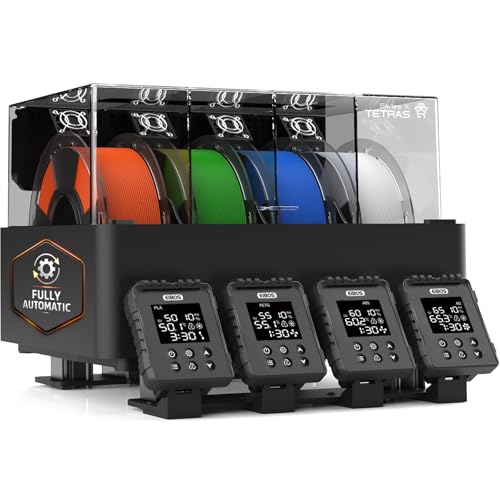
- Four independent drying chambers
- Dry and print at the same time
- Automatic sealing for storage protection
Best For: Bambu Lab AMS users who need separate drying control for multiple spools.
Best for AMS Drying – SUNLU AMS Heater for Bambu Lab
If you want a filament dryer for bambu lab workflows without adding a separate dryer box, this SUNLU AMS heater is a practical upgrade. It adds active drying inside the Bambu Lab AMS, so you can keep spools protected from humidity while printing and reduce common wet-filament issues before they ruin a job.
Best For: Bambu Lab AMS users who want built-in active drying, quick installation, and better protection against moisture-related print failures.
Pros:
- Adds active drying directly to the Bambu Lab AMS for print-and-dry convenience.
- Heats quickly with PTC technology and aims for even airflow across the spool.
- Supports humidity-based control and safety shutoffs for more hands-off operation.
- Easy plug-and-play install with no extra footprint required.
Cons:
- Only compatible with the Bambu Lab AMS 1st gen.
- AMS unit is not included, so this is an add-on rather than a standalone dryer.
For Bambu owners who primarily need a filament dryer for bambu lab printing setups, this is a smart niche solution: it keeps the AMS working as both storage and drying hardware, but it is not a universal dryer for other systems.
Best High-Capacity Pick – Creality Space Pi X4 Filament Dryer
If you need a filament dryer for bambu lab printing and you run multiple spools at once, the Creality Space Pi X4 is built for volume. Its dual heating chambers, 4-spool capacity, and up to 85°C drying range make it a practical choice for keeping filament ready to print, especially if you swap materials often or leave rolls sitting between jobs.
Best For: Bambu Lab users who want high-capacity drying and storage for several spools at once.
Pros:
- Holds up to 4 standard 1kg spools or 2 large 2kg spools
- Dual 200W chambers help dry filament faster than single-chamber boxes
- Works as both a dryer and sealed storage box to limit moisture re-absorption
- Wide temperature range supports PLA, PETG, TPU, ABS, and higher-temp materials
Cons:
- Bulkier than compact single-spool dryers
- Likely overkill if you only dry one roll at a time
- Not the cheapest option for casual users
For Bambu owners who keep a lot of filament on hand, this is a strong filament dryer for bambu lab setups because it combines capacity, speed, and storage in one unit. If you print frequently and want fewer moisture-related print issues, the Space Pi X4 is a sensible upgrade.
Best for AMS Users – SUNLU AMS Heater for Bambu Lab
If you want a filament dryer for bambu lab printing that works inside the workflow instead of slowing it down, the SUNLU AMS Heater is built for exactly that. It dries filament while printing, supports AMS Gen 1 integration, and adds smart humidity control for a more hands-off setup.
Best For: Bambu Lab users who want to dry four spools at once without giving up multi-color printing or adding a separate dryer box.
Pros:
- Drys filament while printing, so you do not lose production time
- Compatible with AMS Gen 1 and keeps the 4-spool workflow intact
- Heats to 70°C quickly with controlled airflow aimed at the filament area
- Simple 3-step installation with no drilling or permanent modification
Cons:
- Designed for AMS Gen 1, so compatibility is narrower than universal dryers
- Does not include the AMS unit itself
- Higher-capacity, integrated design may be more than casual users need
This is a strong pick if you want a filament dryer for bambu lab setups that emphasizes convenience, capacity, and minimal workflow disruption. It is especially appealing for multi-material users who want drying and printing to happen at the same time.
Best for Fast Drying – Creality Space Pi SE Filament Dryer
If you need a practical filament dryer for bambu lab printing, the Creality Space Pi SE is a strong fit for drying common 1KG spools before they hit the AMS or extruder. Its fast-heating PTC system, 360° hot-air circulation, and simple controls make it easy to dry moisture-sensitive materials without a complicated setup.
Best For: Bambu Lab owners who want a quick, no-assembly dryer for PLA, PETG, TPU, ABS, and similar 1KG spools.
Pros:
- Heats to 65°C in about 15 minutes for faster prep time
- 360° air circulation helps dry spools more evenly
- Simple knob-and-screen controls with humidity tracking
- Works with many common 1.75mm and 2.85mm filaments
Cons:
- Only supports 1KG spools, so larger rolls won’t fit
- 110V input may limit use outside compatible regions
- Not as feature-rich as higher-end multi-spool drying systems
For a filament dryer for bambu lab users who mainly want speed, simplicity, and broad material support, this model is a sensible pick. It won’t replace a full AMS drying workflow, but it can help reduce stringing, clogging, and poor first layers caused by wet filament.
Best for Easy Setup – SUNLU AMS Heater for Bambu Lab AMS Gen 1
If you want a filament dryer for bambu lab users that doesn’t replace the whole AMS, the SUNLU AMS Heater is a practical add-on. It upgrades the Bambu Lab AMS Gen 1 so you can keep printing while actively drying filament, with a simple lid swap and fast heat-up performance.
Best For: Bambu Lab AMS Gen 1 owners who want simultaneous printing and drying with a straightforward installation.
Pros:
- Supports simultaneous printing and drying for a more efficient workflow
- Installs in three steps by replacing the original lid
- Heats to 70°C in about 20 minutes for quick drying sessions
- Designed to protect AMS feeding motors with directed airflow
Cons:
- Only works with Bambu Lab AMS Gen 1
- AMS unit is not included
- Best suited to users who already own the AMS ecosystem
For Bambu owners who already use the AMS, this is a smart filament dryer for bambu lab setups because it adds drying without a complicated retrofit. The tradeoff is narrow compatibility, but within the right system it offers a clean, fast, and convenient upgrade.
Best for Dual-Spool Drying – Comgrow SH02 Filament Dryer Box
If you need a filament dryer for bambu lab printing setups that can handle more than one spool at a time, the Comgrow SH02 is a practical pick. Its sealed chamber, fast PTC heater, and preset material profiles make it easy to keep moisture-prone filament ready for consistent extrusion.
Best For: Users who want to dry two spools at once and feed filament directly to one or two printers with less setup hassle.
Pros:
- Holds 2 x 1kg spools, which is handy for multi-printer or high-output workflows
- Fast 150W PTC heater with 360° airflow for quicker, more even drying
- One-touch presets for common materials like PLA, PETG, TPU, ABS, and more
- Sealed design helps keep filament dry during storage and printing
Cons:
- Max temperature tops out at 70°C, so it is not ideal for every specialty material
- Larger footprint than single-spool dryers
- Preset-based controls are simple, but not as flexible as fully manual tuning
For Bambu Lab owners who want a straightforward dryer that can also function as sealed storage, the SH02 offers a strong balance of speed and capacity. It is especially appealing if you want a filament dryer for bambu lab use that can keep multiple rolls ready without adding much workflow complexity.
Best AMS Upgrade – SUNLU AMS Heater for Bambu Lab AMS
If you want a filament dryer for bambu lab printing without adding a separate box to your setup, this AMS heater is a practical upgrade. It turns a Bambu Lab AMS Gen 1 into an active drying chamber, so you can keep filament protected and drying during long jobs instead of pre-drying every spool.
Best For: Bambu Lab AMS Gen 1 owners who want in-AMS drying, humidity control, and fewer moisture-related print failures.
Pros:
- Turns the AMS into an active dryer during printing
- Heats quickly up to 70°C with even airflow circulation
- Built-in humidity monitoring and safety protections
- Easy 3-step installation with a compact, integrated fit
Cons:
- AMS main unit is not included
- Only compatible with Bambu Lab AMS Gen 1
- Not ideal if you need a standalone dryer for loose spools
For Bambu owners already using the AMS, this is a smart way to add drying without cluttering your workspace. It is especially appealing if you want a filament dryer for bambu lab setups that can help reduce stringing, layer issues, and clogs while keeping multi-color printing ready to go.
Best Sealed Dry Box – Comgrow Filament Dryer Box
If you want a practical filament dryer for bambu lab printing, the Comgrow dryer box is a straightforward option for keeping PLA, ABS, and silk spools dry before and during use. It focuses on moisture control, sealed storage, and simple controls rather than high-heat drying, making it a solid fit for everyday filament care.
Best For: Bambu Lab users who want a sealed, easy-to-use dryer box for keeping common filaments dry and ready to print.
Pros:
- Holds up to two 1 kg spools, which is useful for shared filament storage.
- Simple LCD controls make temperature and time settings easy to manage.
- Sealed box design helps reduce moisture, dust, and tangles during storage.
- Works with standard 1.75 mm and 2.85 mm filament sizes.
Cons:
- Max temperature tops out at 50°C, so it is less aggressive than some dryers.
- Designed only for filament drying, not for broader material prep or higher-temp uses.
- Requires attention to spool direction and setup for smooth feeding.
For shoppers comparing a filament dryer for bambu lab setups, this Comgrow model makes the most sense if you prioritize enclosed storage and moisture protection over advanced drying features. It is a sensible pick for keeping everyday materials print-ready without adding complexity.
Best Heavy-Duty Pick – EIBOS Dyas 4-Spool Dryer
If you want a filament dryer for bambu lab setups that can keep pace with multi-material printing, the EIBOS Dyas is built around Bambu Lab AMS users who need active drying and storage in one unit. Its dual independent chambers, adjustable heat, and sealed storage design make it a strong fit for moisture-sensitive filaments and long print runs.
Best For: Bambu Lab AMS owners who want to dry, store, and print from up to four spools with separate settings.
Pros:
- Two independent chambers let you dry different filament types at the same time
- Supports dry-while-printing operation for uninterrupted long jobs
- Automatic sealing and humidity control help keep spools print-ready
- Works with common materials like PLA, PETG, TPU, ABS, and nylon
Cons:
- More specialized and pricier than a basic single-spool dryer
- Designed primarily for Bambu Lab AMS workflows, so it may be overkill for simpler setups
Overall, the Dyas is a smart pick if you need a filament dryer for bambu lab printing that does more than just warm spools. It stands out for independent chamber control, active moisture removal, and sealed storage that helps maintain consistency between prints.
Best for Multi-Spool Drying – EIBOS Tetras AMS Heater Upgrade
If you want a filament dryer for bambu lab that can keep several spools ready at once, the EIBOS Tetras is built for exactly that workflow. It upgrades the AMS with four independent drying chambers, letting you dry and store different materials at their own settings while you print.
Best For: Bambu Lab owners who print with multiple materials and want independent drying control for up to four spools.
Pros:
- Four separate chambers with independent temperature and humidity control
- Can dry filament while printing, reducing prep time and moisture issues
- Automatic sealing helps keep spools dry for longer-term storage
- Works with common materials like PLA, PETG, TPU, ABS, and nylon
Cons:
- Designed specifically around the Bambu Lab AMS ecosystem
- More complex and likely pricier than a basic single-spool dryer
For Bambu Lab users who constantly swap materials or print demanding filaments, this is a strong filament dryer for bambu lab because it combines active drying, sealed storage, and per-spool control in one unit. If you need a simple all-purpose box dryer, this may be more machine than you need, but for AMS-heavy workflows it stands out.
How We Picked the Best Filament Dryer for Bambu Lab
We prioritized compatibility with Bambu Lab AMS setups, effective temperature control, practical capacity, and features that support drying while printing. We also looked for designs that make sense in a desktop workspace: easy loading, sealed storage, clear controls, and enough room for common 1 kg spools.
Because users shopping for a Filament Dryer for Bambu Lab often want either an AMS add-on or a standalone dryer box, we included both categories so you can match the product to your workflow instead of forcing a one-size-fits-all choice.
Quick Comparison
AMS heater upgrades are best if you want to dry filament directly in the ecosystem you already use. They are usually the cleanest choice for uninterrupted printing and minimal desk clutter. Standalone dryer boxes are better if you manage multiple materials, rotate spools often, or want a more universal option that works beyond Bambu Lab.
Multi-spool units add convenience for users with larger filament libraries, while single- or dual-spool dryers are typically simpler, more compact, and easier to place near the printer. If your priority is active drying during a print, check for stable heat output and reliable sealing. If storage matters more, focus on airtight construction and low-humidity retention.
Key Buying Factors for Filament Dryer for Bambu Lab
AMS Compatibility
Not every dryer integrates cleanly with an AMS. Look for products specifically designed for Bambu Lab AMS Gen 1 or made as an upgrade attachment. That reduces fitment issues and helps maintain smooth filament feeding.
Temperature Range and Control
Different materials need different drying temperatures. A useful Filament Dryer for Bambu Lab should offer enough heat for moisture-prone filaments without overshooting safer limits for sensitive materials. Precise sensors and stable heating matter more than raw wattage alone.
Spool Capacity
Choose based on how you print. One-spool units are compact, but 2-spool and 4-spool options can save time if you switch materials often or run multiple colors and composites. Bigger is not automatically better if your setup is small.
Active Drying Vs. Storage
Active drying is ideal for restoring damp filament. Sealed dry boxes are better for keeping already-dry filament in good condition. Many buyers need both, so consider whether the dryer will be used during printing, between prints, or for long-term storage.
Who Should Buy Which Filament Dryer for Bambu Lab?
If you use Bambu Lab AMS and want the least disruptive upgrade, choose an AMS heater attachment. If you print often with multiple materials, a standalone dual- or four-spool dryer may be more practical. If your filament mostly sits around between projects, prioritize airtight storage and simple temperature maintenance.
For most buyers, the best choice depends on workflow first and capacity second. The ideal Filament Dryer for Bambu Lab is the one that matches your spool rotation, material types, and space constraints while delivering steady heat and reliable sealing.