
The right macro lens depends on more than how close it focuses. A longer focal length can give you room to light an insect without crowding it, while a shorter lens may suit tabletop shots or wide-angle close-ups.
These 10 options span Sony E-mount lenses for full-frame and APS-C cameras, including autofocus choices, manual-focus specialists, and lenses that go beyond 1:1 magnification.
Best 10 Macro Lens for Sony Picks for 2026
Premium Autofocus Pick

- 1.4x native magnification
- Optical stabilization
- Fast, quiet autofocus
Best For: Stabilized macro and portrait shooting
Wide-Angle Creative Pick

- 110.5-degree field of view
- 0.5x close-up magnification
- Manual focus; no stabilization
Best For: Environmental close-ups with wide backgrounds
High-Magnification Manual Pick

- 2x life-size magnification
- 12-blade aperture
- Manual focus and exposure
Best For: Deliberate extreme close-ups
Compact Everyday Pick
Sony SEL30M35 30mm f/3.5 Macro

- True 1:1 magnification
- Lightweight 138 g build
- Very short 2.4 cm working distance
Best For: Portable close-ups of approachable subjects
Fast-Focusing Pick
Tamron 90mm F/2.8 Di III VXD Macro

- Full-frame Sony E-mount; 1:1 macro
- VXD autofocus and flat-field performance
- No built-in stabilization
Best For: Autofocus close-ups on Sony E-mount
Manual-Focus APS-C Pick
7artisans 60mm F2.8 Mark II Macro

- APS-C coverage and 1:1 magnification
- Manual focus with depth-of-field scales
- De-clicked aperture ring for video
Best For: Hands-on macro shooting with Sony APS-C cameras
Stabilized Sony Pick

- Full-frame lens with 1:1 magnification
- Optical SteadyShot for handheld use
- Sliding ring switches AF and manual focus
Best For: Handheld close-ups on full-frame Sony E-mount
Compact APS-C Pick
- 1:1 magnification
- Manual-focus Sony E-mount lens
- Listed at 13.1 oz (371 g)
Best For: Portable, hands-on APS-C macro shooting
Beyond Life-Size Pick
Laowa 100mm f/2.8 2X Ultra Macro APO

- Up to 2x magnification
- Full-frame Sony E-mount
- Manual focus; no stabilization
Best For: Detailed close-ups beyond life size
Stabilized Autofocus Pick
Sony FE 90mm f/2.8 Macro G OSS (Renewed)
- 1:1 magnification
- Autofocus and Optical SteadyShot
- Renewed; listed 90-day limited warranty
Best For: Handheld macro with autofocus
Premium Autofocus Pick – Sony FE 100mm F2.8 GM OSS
If you want a macro lens for Sony full-frame cameras that can also handle portraits, this 100mm G Master combines 1.4x magnification, an f/2.8 aperture, autofocus, and optical stabilization.
Best For: Sony E-mount shooters who want stabilized, autofocus macro capability with room for portrait work.
Pros:
- Reaches 1.4x magnification without accessories.
- Optical stabilization helps minimize shake during close-ups.
- Four XD Linear motors provide fast, quiet autofocus.
Cons:
- Reaching the stated 2.8x magnification requires an optional teleconverter.
- At 1.4 pounds, it is heavier than the compact Sony 30mm listed here.
Its blend of magnification, stabilization, and autofocus makes it the most versatile option here for photographers who alternate between tiny subjects and portraits.
Wide-Angle Creative Pick – Laowa 15mm f/4.5 0.5X Macro
This macro lens for Sony FE takes a different approach: its 15mm focal length and 110.5-degree view let you place a close subject within a much wider scene. It reaches 0.5x magnification at a stated minimum focusing distance of 5.08 inches.
Best For: Photographers who want environmental close-ups with visible landscapes, architecture, or other background context.
Pros:
- Wide field of view creates a distinctive environmental macro perspective.
- 0.5x magnification supports detailed foreground subjects.
- Five aperture blades can produce 10-point sunstars.
Cons:
- Manual focus demands more hands-on control.
- 0.5x magnification falls short of life-size 1:1 reproduction.
- No optical image stabilization is listed.
Choose this lens for compositions that show a subject and its surroundings, rather than for the tightest possible macro framing.
High-Magnification Manual Pick – TTArtisan 100mm F2.8 2X Macro
For a macro lens for Sony E-mount cameras that goes beyond life-size, the TTArtisan 100mm f/2.8 offers 2x magnification. Its manual-focus design suits deliberate work with insects, flowers, and small products.
Best For: Close-up photographers who prioritize 2x detail and are comfortable focusing manually.
Pros:
- 2x magnification captures subjects at twice life-size.
- 12-blade aperture supports smooth background blur.
- All-metal body and four cold-shoe mounting points offer a sturdy setup for accessories.
Cons:
- Manual focus is less convenient for rapidly moving subjects.
- Manual exposure control requires a more hands-on workflow.
This is a specialized choice when maximum magnification matters more than autofocus convenience, especially for carefully arranged close-ups.
Compact Everyday Pick – Sony SEL30M35 30mm f/3.5 Macro
If portability matters most in a macro lens for Sony E-mount cameras, the Sony SEL30M35 packs 1:1 magnification into a 138 g, 30mm prime. Its short working distance makes it particularly suited to subjects you can approach closely.
Best For: Everyday close-ups and travel when a compact, life-size macro lens is the priority.
Pros:
- Captures subjects at true 1:1 magnification.
- 138 g weight makes it easy to carry.
- Internal stepping motor and rear-focusing design support video capture.
Cons:
- The stated minimum working distance is only 2.4 cm, which may complicate lighting or startle skittish subjects.
- Its f/3.5 maximum aperture is narrower than the f/2.8 100mm options here.
This is a practical carry-around choice for approachable subjects; choose a longer focal length if you need more space between the lens and your subject.
Fast-Focusing Pick – Tamron 90mm F/2.8 Di III VXD Macro
Tamron 90mm F/2.8 Di III VXD 1:1 Macro for Sony E Mount Full Frame/APS-C Mirrorless Cameras
Check Price On AmazonIf you want a macro lens for Sony E-mount with autofocus and full-frame coverage, this Tamron 90mm f/2.8 offers 1:1 magnification. Its flat-field performance is especially useful when photographing flat subjects.
Best For: Sony shooters who want autofocus for life-size close-ups and a 90mm working perspective.
Pros:
- 1:1 magnification with full-frame and APS-C compatibility.
- VXD autofocus is designed for high-speed, precise focusing and subject tracking.
- Moisture-resistant construction, fluorine coating, and BBAR-G2 coating.
Cons:
- No built-in image stabilization.
- Effective macro shots may require a faster shutter speed or tripod.
Choose this lens if autofocus and flat-field performance matter more to you than in-lens stabilization.
Manual-Focus APS-C Pick – 7artisans 60mm F2.8 Mark II Macro
This macro lens for Sony E-mount is an APS-C-format, manual-focus option with 1:1 magnification. Its 60mm focal length provides a stated 96mm-equivalent view, making it useful for both close-ups and portraits.
Best For: APS-C Sony users who prefer hands-on focusing for macro photography and want a lens they can also use for portraits.
Pros:
- 1:1 magnification and a 6.9-inch minimum focus distance.
- Depth-of-field scales aid deliberate manual focusing.
- De-clicked aperture ring allows smooth, quiet adjustments during video.
Cons:
- Manual focus only.
- Full-frame A7 users need to switch to APS-C format.
- Not water resistant.
It suits photographers comfortable setting focus themselves; full-frame owners should account for its APS-C coverage before buying.
Stabilized Sony Pick – Sony FE 90mm F2.8 Macro G OSS
For a macro lens for Sony with full-frame coverage and built-in stabilization, the Sony FE 90mm f/2.8 G OSS combines 1:1 magnification with Optical SteadyShot. Its 0.28m minimum focus distance lets you work close to small subjects.
Best For: Full-frame Sony E-mount users who value optical stabilization and quick switching between autofocus and manual focus.
Pros:
- Optical SteadyShot helps with handheld shooting.
- 1:1 magnification and a 0.28m minimum focus distance.
- Sliding focus ring provides quick manual/autofocus selection.
- Dust- and moisture-resistant design.
Cons:
- At 602g, it may feel substantial in a lightweight kit.
This is the practical choice here if in-lens stabilization is a priority, while its sliding focus ring gives you direct control when a close-up calls for manual focusing.
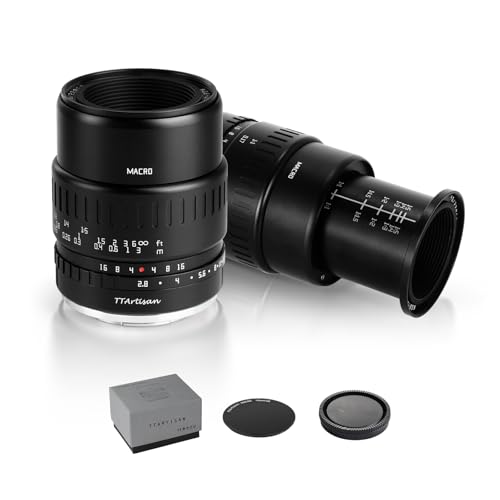
Compact APS-C Pick – TTARTISAN 40mm f/2.8 Macro
If you want a compact macro lens for Sony E-mount, this manual-focus TTARTISAN offers 1:1 magnification and focuses as close as 6.7 inches. Its 40mm focal length suits deliberate close-ups of jewelry, food, and plants.
Best For: APS-C Sony shooters who enjoy manual focusing and want a portable 1:1 macro lens.
Pros:
- Reaches life-size 1:1 magnification.
- All-metal construction weighs a listed 13.1 oz (371 g).
- f/2.8 maximum aperture allows background blur.
Cons:
- Manual focus requires hands-on adjustment.
- APS-C lens may not suit full-frame shooting without a crop.
Choose it for a small, hands-on macro setup; photographers who need autofocus should look elsewhere.
Beyond Life-Size Pick – Laowa 100mm f/2.8 2X Ultra Macro APO
Laowa 100mm f/2.8 2X Ultra Macro APO SLR Macro Lens (Black) Full Frame - for Sony E
Check Price On AmazonFor a macro lens for Sony that goes beyond life-size reproduction, the full-frame Laowa 100mm f/2.8 reaches 2x magnification. Its medium-telephoto focal length makes it a specialized option for detailed close-up work.
Best For: Sony E-mount photographers who want 2x close-ups and are comfortable focusing manually.
Pros:
- Captures subjects at up to 2x magnification.
- Designed for full-frame Sony E-mount cameras.
- 100mm f/2.8 focal length and aperture offer a useful macro shooting combination.
Cons:
- Manual focus only.
- No built-in image stabilization.
Its standout feature is 2x magnification; weigh that extra reach against the need for careful focusing and steady shooting.
Stabilized Autofocus Pick – Sony FE 90mm f/2.8 Macro G OSS (Renewed)
Sony SEL90M28G FE 90mm f/2.8-22 Macro G OSS Lens for Mirrorless Cameras (Renewed)
Check Price On AmazonIf you want a macro lens for Sony with autofocus and optical stabilization, this renewed FE 90mm f/2.8 G OSS brings both to a full-frame E-mount design. It reaches 1:1 magnification and has a listed minimum focus distance of 0.92 ft (0.28 m).
Best For: Sony E-mount shooters who want life-size macro capability with autofocus and stabilization.
Pros:
- 1:1 magnification for life-size close-ups.
- Optical SteadyShot supports handheld shooting.
- Autofocus and a sliding focus ring make switching to manual focus convenient.
- Dust- and moisture-resistant design.
Cons:
- Renewed product rather than a new lens.
- Listed limited warranty is 90 days.
This is the most feature-rich everyday option of the three if stabilization and autofocus matter, but check the renewed condition and warranty before buying.
How We Picked the Best Macro Lens for Sony
We compared the selected lenses by maximum magnification, focal length, sensor coverage, focusing method, stabilization, and practical shooting use. The list includes Sony lenses alongside third-party options, plus a renewed listing. Specifications help narrow the choice, but they cannot replace checking current price, seller terms, and hands-on performance before buying.
Quick Comparison: Which Type Fits Your Photography?
For a flexible full-frame starting point, compare the Sony FE 90mm f/2.8 Macro G OSS and Tamron 90mm f/2.8 Di III VXD. The Sony FE 100mm f/2.8 GM OSS offers 1.4× magnification for smaller subjects. If 2× is the goal, consider the TTArtisan 100mm f/2.8 or Laowa 100mm f/2.8; plan for more deliberate focusing and lighting at that scale. The Laowa 15mm f/4.5 offers a different look: 0.5× close-ups with a wide background view.
For smaller setups, the Sony 30mm f/3.5 is an E-mount option, while the 7artisans 60mm f/2.8 Mark II and TTArtisan 40mm f/2.8 are APS-C choices. A shorter focal length can make lighting skittish subjects harder because you must work closer.
Key Buying Factors for a Macro Lens for Sony
Magnification and Working Distance
A 1:1 lens records a subject at life size on the sensor; 2× records it at twice life size. More magnification is useful for tiny details, but it narrows the area in focus and makes camera movement more visible. Focal length affects how much room you have between lens and subject, though working distance also depends on lens design. Check the specified working distance rather than relying on focal length alone.
Sensor Coverage and Focus Controls
Match the lens to your camera’s Sony E mount, then check whether it covers full frame or APS-C. An APS-C lens on a full-frame body may require crop mode; a full-frame lens works on an APS-C body with a tighter field of view. Autofocus can help with general photography, while manual focus and focus peaking suit controlled macro work. Optical stabilization may help handheld framing, but a tripod, steady lighting, and careful technique still matter at high magnification.
Seller and Listing Details
The two Sony FE 90mm G OSS entries include a standard listing and a renewed listing of the same lens model, not two different optical designs. For renewed gear, verify condition, included accessories, return window, and warranty. Confirm mount and aperture-control details for third-party lenses before ordering.
Who Should Buy Which Macro Lens for Sony?
Choose a 90mm autofocus lens if you want one Macro Lens for Sony that can also handle everyday close-ups. Pick the Sony 100mm GM if its 1.4× capability matches your subjects and budget. Try a 2× manual-focus lens for stationary, very small subjects when you are willing to manage light and focus carefully. Go wide with the Laowa 15mm for environmental close-ups, or choose an APS-C-specific option if size and your camera format matter most.