
A poorly sealed door can undermine an otherwise well-treated studio, allowing sound, light, dust, and temperature changes through even narrow gaps. The right door seal can improve isolation without requiring a full door replacement.
These 10 studio door seals include acoustic kits, automatic drop-down seals, kerf-fit weather stripping, and adhesive silicone or rubber options for different gap sizes and installation needs.
Best 10 Studio Door Seals Picks for 2026
Best Complete Kit
Audimute Acoustic Door Seal Kit

- Combines perimeter seal and door sweep
- Treats one standard-size door
- Designed to reduce sound through gaps
Best For: Studios and apartments needing a complete standard-door kit
Best for Door Corners

- Eight self-adhesive corner pads
- Helps block drafts, dust, and moisture
- Useful for localized frame gaps
Best For: Doors with small corner gaps needing quick application
Best Clear Flexible Strip
Transparent Silicone Door Seal

- Clear silicone construction
- 32.8 feet of two-pack coverage
- Designed for drafts, debris, and noise
Best For: Multiple doors or frames where a discreet seal is preferred
Best Concealed Under-Door Seal
TMS Automatic Drop Down Door Seal

- Automatically seals gaps up to 1 inch
- Concealed mortise-mounted design
- Blocks sound, light, smoke, and drafts
Best For: Wooden studio doors needing a durable automatic bottom seal
Large-Gap Groove Seal

- Covers gaps from 3/10 to 7/8 inch
- Requires a compatible 1/8-inch groove
- Helps reduce drafts, dust, water, light, and noise
Best For: Grooved frames and larger studio door gaps
Easy-Install Draft Blocker

- Fits gaps from 0.1 to 0.22 inch
- Peel-and-stick installation needs no tools
- TPE D-seal helps reduce drafts and noise
Best For: Small, smooth-frame gaps needing quick installation
Flexible Silicone Seal
20FT Self-Adhesive D-Shaped Strip

- Recommended for 1/8 to 1/4-inch gaps
- Cut-to-fit silicone strip for doors and windows
- Includes adhesive promoter for smooth surfaces
Best For: Flexible sealing of small studio door and frame gaps
Best Adhesive-Free Pick
Ravinte Q-Shaped Kerf Foam Seal

- Push-in installation requires no adhesive
- 26 feet of dense polyurethane foam
- Fits 0.35- to 0.59-inch slots
Best For: Kerf-slot doors needing a removable-style seal
Best for Large Gaps
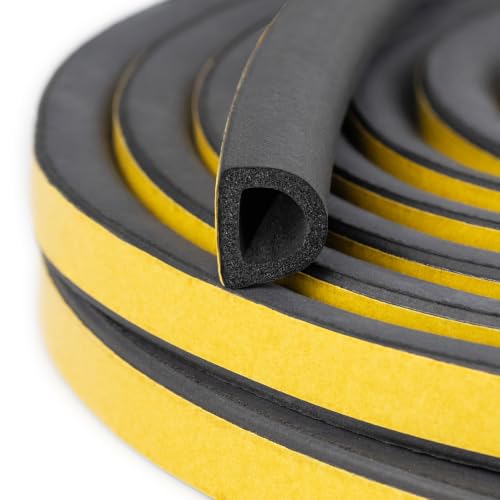
- Fits 5/16- to 15/32-inch gaps
- Flexible hollow EPDM profile
- Mesh-reinforced adhesive backing
Best For: Uneven or wide door gaps needing compression
Best Complete Kit – Audimute Acoustic Door Seal Kit
Audimute Soundproofing Acoustic Door Seal Kit - Door Sweep and Seal - (Standard Size)
Check Price On AmazonFor a straightforward studio door seals setup, the Audimute kit combines perimeter sealing with an under-door sweep. Its included materials are sized to treat one standard door and are intended to reduce sound transfer through common gaps.
Best For: Studios, apartments, and standard-size doors needing both edge and bottom sealing.
Pros:
- Includes both a 25-foot door seal and a 4-foot door sweep.
- Designed to block sound traveling through gaps around doors.
- Easy to install and suitable for one standard-size door.
Cons:
- Designed for standard-size doors rather than unusually large openings.
- Provides a basic seal kit rather than an automatic or concealed door-bottom mechanism.
This is a practical all-in-one choice when you want to address both the door frame and the gap beneath the door without assembling separate products.
Best for Door Corners – Zonon Foam Corner Seals
These corner-focused studio door seals target small gaps around the door frame. The self-adhesive foam and vinyl pads are easy to apply and can help limit drafts, dust, moisture, and some noise at vulnerable corners.
Best For: Door frames with corner gaps where quick, localized sealing is more useful than a full-length strip.
Pros:
- Includes eight self-adhesive corner seals.
- Peel-and-stick installation requires no separate adhesive.
- Helps reduce drafts, dust, moisture, and noise around door corners.
Cons:
- Corner pads do not provide a complete perimeter or under-door seal.
- Surface preparation is important for long-term adhesion.
- White PVC and foam may be more noticeable on darker door frames.
Choose this set when the main problem is concentrated at the corners of an otherwise reasonably fitted door, or as a supplemental seal alongside other weatherstripping.
Best Clear Flexible Strip – Transparent Silicone Door Seal
For a less visible approach to studio door seals, this clear silicone strip provides 32.8 feet of total material across two rolls. Its wide, flexible design is intended for doors, windows, and frames while helping reduce drafts, debris, and unwanted noise.
Best For: Interior or exterior doors where a transparent, flexible strip and generous coverage are priorities.
Pros:
- Clear silicone is designed to blend with doors, frames, and glass.
- Two-pack provides 32.8 feet of total coverage.
- Waterproof adhesive backing is suited to humid or cold conditions.
- Can help reduce drafts, dust, pollen, and hallway or outdoor noise.
Cons:
- Requires measuring, cutting, cleaning, and pressing the strip into place.
- Adhesive needs up to 24 hours to fully cure.
- Its 35 mm width may not suit every narrow gap or door profile.
This is a versatile option for covering multiple openings or preserving a cleaner appearance, provided the door surface is prepared carefully and the strip width matches the gap.
Best Concealed Under-Door Seal – TMS Automatic Drop Down Door Seal
For a more integrated studio door seals installation, the TMS automatic drop-down seal mortises into the bottom of a 36-inch wooden door. Its spring-loaded neoprene bulb drops when the door closes to seal gaps up to 1 inch, helping block sound, light, smoke, and drafts.
Best For: Standard wooden doors where a concealed, automatic under-door seal is worth the more involved installation.
Pros:
- Automatically drops when the door closes and retracts when it opens.
- Concealed mortise installation keeps the door face clean.
- Seals gaps up to 1 inch without floor contact when open.
- Heavy-duty aluminum casing and neoprene bulb are designed for frequent use.
Cons:
- Requires mortising into the door body for installation.
- Compatible with wooden doors having a bottom rail at least 1 3/8 inches wide.
- At 36 inches, it may require sizing consideration for narrower doors.
This is the most purpose-built choice here for a substantial under-door gap and frequent traffic, especially when a clean appearance and automatic operation matter more than simple installation.
Large-Gap Groove Seal – Kerf 40FT Door Frame Seal
For studio door seals where the frame has an installation groove and the gap is substantial, this 40-foot Kerf weather stripping is designed to cover larger openings. Its V-shaped, water-droplet-ended profile targets drafts, dust, water, light, and some outside noise.
Best For: Grooved door frames with gaps from 3/10 inch to 7/8 inch, including larger studio or exterior-door sealing projects.
Pros:
- Designed for larger gaps and supplied in a generous 40-foot length.
- PE-grid exterior, PU foam interior, and PVC card-slot construction support flexibility and durability.
- Helps address wind, dust, water, light, and noise around doors and windows.
- Includes four matching foam gaskets for cushioning or additional fit adjustment.
Cons:
- Requires a compatible door-frame groove; it is not a universal peel-and-stick option.
- Measurements must be checked carefully because the strip is intended for 1/8-inch grooves and specific gap sizes.
This is the most specialized choice of the three: a strong fit when you need extensive coverage and a grooved frame, but less convenient for smooth surfaces or small gaps.
Easy-Install Draft Blocker – Alophoty 23Ft TPE D-Seal
This Alophoty strip is a straightforward option for studio door seals when you want a self-adhesive installation. The TPE D-shaped profile is sized for smaller gaps and is intended to reduce drafts, dust, insects, temperature transfer, and unwanted sound.
Best For: Smooth door or window frames with gaps between 0.1 and 0.22 inch where a peel-and-stick seal is preferred.
Pros:
- Self-adhesive backing allows installation without tools.
- Flexible TPE material is designed for long-term use across changing temperatures.
- 23 feet of seal can cover multiple smaller projects.
- D-shaped construction supports draft reduction and soundproofing between rooms.
Cons:
- The small size is not intended for gaps wider than 0.22 inch.
- The surface should remain dry for 24 hours after installation for the adhesive to strengthen.
Measure first, then choose this seal for a clean, uncomplicated installation on appropriately sized gaps. A larger version is suggested in the supplied details for wider openings.
Flexible Silicone Seal – 20FT Self-Adhesive D-Shaped Strip
For studio door seals that need a flexible, cut-to-fit solution, this 20-foot silicone D-shaped strip is made for small door and window gaps. It compresses around frames and helps limit drafts, dust, moisture, light gaps, and everyday noise.
Best For: Door or window gaps measuring about 1/8 to 1/4 inch, especially when you need a strip that can be trimmed for several applications.
Pros:
- Flexible silicone remains soft through changing temperatures and offers good rebound.
- Peel-and-stick design can be cut to length with scissors.
- Helps improve insulation while reducing dust, moisture, light, wind, and outside noise.
- Includes an adhesive promoter for stronger bonding on smooth surfaces.
Cons:
- Recommended only for relatively small gaps from 1/8 to 1/4 inch.
- Installation requires a clean, dry surface and firm pressing for proper adhesion.
This is a versatile middle-ground pick for studios: easier to install than grooved weatherstripping and more adaptable than a pre-sized piece, provided your gap falls within its recommended range.
Best Adhesive-Free Pick – Ravinte Q-Shaped Kerf Foam Seal
For studio door seals that install without adhesive, the Ravinte Q-shaped foam strip fits directly into compatible kerf slots. Its dense foam core helps block light, drafts, dust, water, and some noise around the door.
Best For: Doors with 0.35- to 0.59-inch kerf slots where a push-in, no-adhesive installation is preferred.
Pros:
- Push-in installation leaves no adhesive marks.
- 26 feet of black polyurethane foam strip covers many door frames.
- Helps reduce light penetration, drafts, dust, water, and noise.
Cons:
- Requires a compatible 0.35- to 0.59-inch slot.
- Not suitable for doors without the necessary groove or recess.
Choose this seal when compatibility with a kerf slot matters more than a peel-and-stick installation. Measure the slot before ordering to ensure a secure fit.
Best Long Roll – Fingwerk D-Shape Rubber Seal
If you need studio door seals for several frames or a long installation, this Fingwerk D-shaped rubber strip provides 50 feet of material. Its self-adhesive backing is designed for measured gaps between 1/10 and 11/50 inches.
Best For: Smaller door or window gaps that need a flexible, cut-to-size adhesive seal and extended coverage.
Pros:
- 50-foot roll offers substantial coverage.
- Self-adhesive backing simplifies installation after surface preparation.
- Flexible rubber helps reduce drafts, dust, sound, and temperature transfer.
- Tailor scissors are included for cutting the strip to size.
Cons:
- Limited to gaps measuring about 2.5 to 5.5 mm.
- Requires a clean, dry surface and 24 hours for the adhesive to become firm.
This is a practical choice for a multi-door studio project or repeated repairs, provided your measured gap falls within the listed range. Its adhesive installation is convenient but less forgiving of poor surface preparation.
Best for Large Gaps – EPDM D-Shaped Door Seal
For studio door seals dealing with uneven or wider openings, this hollow D-shaped EPDM strip is designed for gaps from 5/16 to 15/32 inch. The mesh-reinforced adhesive backing and compressible profile support a secure, flexible fit.
Best For: Exterior, entry, RV, or studio doors with measured gaps in the 5/16- to 15/32-inch range.
Pros:
- Designed for larger, uneven gaps than many narrow weather strips.
- Flexible EPDM rubber remains usable in hot and cold conditions.
- Hollow profile compresses and rebounds during repeated door operation.
- Helps reduce drafts, dust, light leaks, energy loss, and some outside noise.
Cons:
- Only 20 feet are included.
- Adhesive requires a clean, dry surface and about 24 hours to bond.
- Gap measurements should be checked before installation.
This seal stands out when a studio door has a substantial or uneven perimeter gap. Measure the closed gap first, and warm the adhesive during cold installation for better bonding.
How We Picked These Studio Door Seals
We selected products based on their ability to close common sound-leak paths around studio doors, including the bottom edge, jambs, corners, and oversized frame gaps. We also considered installation method, seal material, coverage length, adjustability, durability, and suitability for renters or permanent studio builds.
The selection includes purpose-built acoustic hardware as well as weatherstripping that can reduce air movement and high-frequency leakage. No seal alone makes a door fully soundproof, so the best choice depends on the existing door, frame, and size of the gaps.
Quick Comparison
- Best complete acoustic approach: An acoustic door seal kit combining a sweep and frame seals.
- Best for the door bottom: An automatic drop-down seal, especially where a clean threshold is important.
- Best for large gaps: Kerf or large-gap D-shaped weatherstripping with enough compression.
- Best for simple installation: Self-adhesive silicone or rubber strips.
- Best for discreet appearance: Transparent silicone or a seal matched to the door and frame color.
Key Buying Factors for Studio Door Seals
Gap Size and Location
Measure the gap with the door closed before ordering. A thin strip may work for a narrow jamb gap, while a large or uneven opening needs a thicker compressible seal. For sound control, inspect all four sides rather than treating only the most visible opening.
Installation Type
Adhesive-backed seals are convenient and usually require only cleaning, measuring, and trimming. Kerf seals fit into a channel cut into the frame and can provide a neater, more secure installation. Mortise-mounted automatic seals require more tools and preparation but are often the strongest option for the bottom gap.
Material and Compression
Silicone, rubber, neoprene, foam, and brush-style materials perform differently. Choose a seal that compresses firmly without preventing the door from latching. Neoprene and rubber are useful for durable contact, while silicone is flexible and suitable for many irregular gaps.
Door Movement and Threshold Clearance
Check that the seal will not drag excessively across flooring or catch on a raised threshold. A drop-down seal can retract when the door opens, while a surface-mounted sweep may need careful adjustment.
Length and Replacement Needs
Compare the product’s total length with the frame perimeter and allow extra material for trimming or mistakes. Longer rolls are practical for multiple doors, but shorter kits may be easier to install accurately on one studio entrance.
Who Should Buy Which Studio Door Seals?
Choose a complete acoustic kit if you want a straightforward solution for a typical studio door and need both perimeter and bottom coverage. Choose an automatic drop-down seal for a permanent installation where sound, light, and drafts are escaping beneath the door.
Choose kerf weatherstripping when the frame already has a compatible kerf channel or you are renovating the doorway. Choose adhesive D-shaped or silicone stripping for quick, budget-conscious gap filling, rental-friendly work, or supplemental sealing around an existing door.
For the best result, combine a properly fitted perimeter seal with a bottom seal, then confirm the door still closes, latches, and compresses the material evenly.