
If wet filament is causing stringing, popping, or weak layer adhesion, a SUNLU filament dryer can make a noticeable difference fast. The right model helps you dry spools, hold stable humidity, and keep materials ready to print.
This roundup focuses on the best SUNLU options for different setup sizes, temperature needs, and workflows, so you can choose the most practical dryer for your printer and filament types.
Best 10 Sunlu Filament Dryer Picks for 2026
Best for Easy Setup
SUNLU Official Filament Dryer S1 Plus

- Ready to use with no assembly required
- Adjustable time and temperature settings
- Supports 1.75mm, 2.85mm, and 3.00mm filaments
Best For: Beginners and regular 3D printer users who want a simple, quiet filament dryer box.
Best for Multi-Spool Drying
SUNLU S4 4-Spool Filament Dryer

- Dries up to four 1kg spools at once
- Heats to 70°C with 350W PTC power
- Great for multi-printer and multi-color workflows
Best For: Multi-printer users and print farms that need to dry several spools together.
Best for Drying While Printing

- Dries and feeds filament at the same time
- 35°C to 55°C adjustable temperature range
- Fits 1.75mm, 2.85mm, and 3.00mm spools
Best For: Makers who want an affordable, all-in-one filament dryer for common spool sizes and everyday 3D printing use.
Best for Versatile Drying

- 70°C max heat with adjustable drying time
- Built-in fan and rotating support for more even drying
- Works as a storage box and active dryer during prints
Best For: Makers who want an easy, flexible dryer for common filament types and everyday use.
Best for Fast, Even Drying
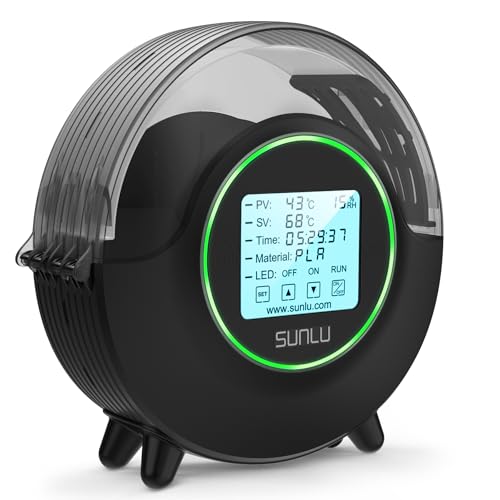
- 360° heating for more even drying
- 4.6" touch screen with humidity readout
- Supports 1.75/2.85/3.00mm filaments
Best For: Makers who want a simple, high-compatibility filament dryer for everyday use.
Best for Comfort
SUNLU S4 4-Spool Filament Dryer
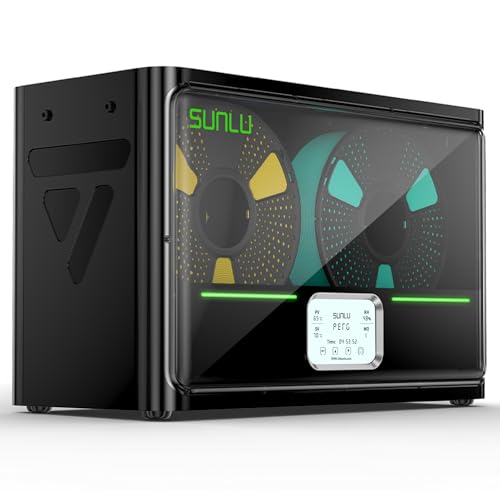
- Dry four 1 kg spools at once
- 350W PTC heater for quick warm-up
- Auto humidity control for easier maintenance
Best For: Multi-printer or multi-color users who want one dryer to manage several spools.
Best for Active Drying
SUNLU S1 Plus Filament Dryer Box

- Fan-assisted drying for quicker moisture removal
- LCD shows temperature, time, and humidity
- Supports 1.75 mm, 2.85 mm, and 3.00 mm filament
Best For: Makers who want an affordable dryer box for common 3D printing filaments.
Best for Annealing
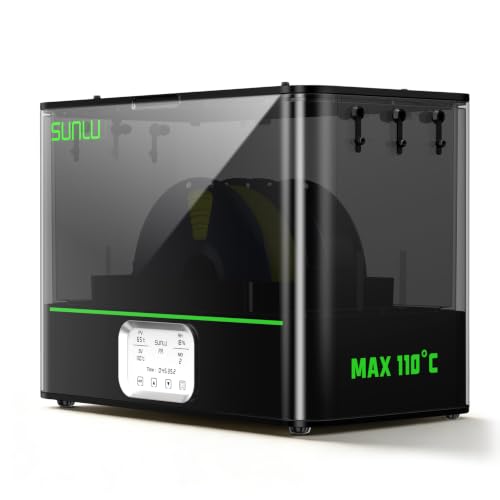
- 2-in-1 drying and annealing for advanced filaments
- 110°C max temperature for PA, PC, and CF/GF blends
- 500W PTC heater with dual-chamber thermal control
Best For: Makers printing engineering filaments who need drying plus annealing in one box.
Best for High-Volume Drying
SUNLU S4 4-Spool Filament Dryer

- Four-spool capacity suits multi-printer setups
- Three fans promote more even drying across the chamber
- Works with common materials plus tougher filaments like nylon and TPU
Best For: Makers and small shops that need to dry several filament rolls at once.
Best for Easy Setup – SUNLU Official Filament Dryer S1 Plus
If you want a simple way to keep moisture from ruining prints, the sunlu filament dryer is a practical pick. It arrives ready to use, supports common filament diameters, and lets you dial in drying time and temperature without a steep learning curve.
Best For: Beginners and everyday 3D printing users who want a no-fuss dryer box that can also store and feed filament while printing.
Pros:
- No assembly required, so it’s ready right out of the box.
- Adjustable drying time and temperature for different materials and conditions.
- Works with 1.75mm, 2.85mm, and 3.00mm filament sizes.
- Quiet operation and dual rollers support printing while drying.
Cons:
- Basic two-button design may feel limited for users who want more control.
- Single-spool capacity may not suit high-volume multi-material workflows.
Overall, this sunlu filament dryer is a solid everyday option if you care more about reliability and convenience than advanced features. It’s especially appealing for users who want to reduce clogs, stringing, and brittle filament without adding setup hassle.
Best for Multi-Spool Drying – SUNLU S4 4-Spool Filament Dryer
The sunlu filament dryer S4 is built for makers who need to keep multiple spools ready at once. With room for four 1kg rolls, heating up to 70°C, and compatibility with common filament diameters, it’s a practical pick for busy multi-printer setups and longer print runs.
Best For: Users running several printers or multi-color projects who want to dry multiple spools at the same time.
Pros:
- Holds up to four 1kg spools for simultaneous drying and feeding
- 70°C heating with a 350W PTC system for broad filament support
- Triple-safety design plus humidity control for more consistent drying
Cons:
- Larger footprint than single-spool dryers
- May be more capacity than casual hobbyists need
If you want a sunlu filament dryer that can support a more demanding workflow, the S4 stands out for capacity and steady, even heat. It’s especially appealing when you need dry filament ready across multiple machines without constant swapping.
Best for Drying While Printing – SUNLU S1 Plus Filament Dryer
If you need a practical way to rescue damp spools and keep print quality consistent, the sunlu filament dryer is a straightforward choice. It combines adjustable heat, timed drying, and an enclosed storage box so you can dry filament and feed it during long prints.
Best For: Makers who want an affordable, all-in-one filament dryer for common spool sizes and everyday 3D printing use.
Pros:
- Built-in circulation fan helps dry filament more evenly.
- Adjustable 35°C to 55°C temperature range covers many common materials.
- Works with 1.75mm, 2.85mm, and 3.00mm filament and can print while drying.
- Quiet operation and clear LCD screen make it easy to use at home or in a workshop.
Cons:
- Fits standard spools, but oversized rolls may not fit.
- Basic controls are functional, but not as advanced as higher-end dryers.
If your prints suffer from stringing, clogging, or weak adhesion, the sunlu filament dryer offers a simple fix without overcomplicating the setup. It is a strong pick for users who want dependable drying and storage in one compact unit.
Best AMS Upgrade – Sunlu AMS Heater for Bambu Lab
If you already use Bambu Lab’s first-gen AMS and want more protection from moisture, this sunlu filament dryer attachment adds active heating without replacing your existing storage system. It is designed to dry while printing, which makes it a practical upgrade for users fighting stringing, weak layer adhesion, and other humidity-related defects.
Best For: Bambu Lab AMS Gen 1 owners who want an integrated drying solution for moisture-sensitive filaments and multi-color printing.
Pros:
- Adds active drying to the AMS instead of just storing spools
- Heats quickly up to 70°C with dual-airflow circulation
- Includes humidity monitoring and multiple safety protections
- Easy 3-step installation with a transparent top window
Cons:
- Only works with Bambu Lab AMS Gen 1
- AMS main unit is not included
- More of an upgrade accessory than a standalone sunlu filament dryer
This is a strong pick if you want a more integrated drying setup than a standalone box, especially for long prints and filament types that absorb moisture easily. For the right AMS owner, it can reduce failed prints and make a sunlu filament dryer-style workflow much more convenient.
Best for Versatile Drying – SUNLU S2 Filament Dryer
If you need a practical sunlu filament dryer that can handle common materials and keep them dry during long prints, the SUNLU S2 is a solid pick. It combines a 70°C max temperature, built-in circulation fan, and easy touch controls for drying or storing filament without a complicated setup.
Best For: Makers who want an easy-to-use filament dryer for PLA, PETG, ABS, TPU, and nylon with enough capacity for everyday printing.
Pros:
- 70°C max temperature with adjustable time and heat settings
- Built-in circulation fan and rotating spool support for more even drying
- Works as both a drying box and storage holder during printing
- Compatible with 1.75mm, 2.85mm, and 3.00mm filament spools
Cons:
- Single-spool design limits capacity for multi-material setups
- Bulky enough that it may take up noticeable desk space
- Some buyers may need to verify the exact item received due to inventory issues
For most hobbyists, the sunlu filament dryer stands out because it is simple, flexible, and useful whether you are reviving damp filament or keeping a spool dry mid-print. It is a strong everyday choice if you want reliable drying without paying for a more complex system.
Best for Fast, Even Drying – SUNLU S2 360° Filament Dryer
If you print with moisture-sensitive materials, the SUNLU filament dryer is built to keep filament in better shape before it reaches the extruder. Its 360° heating fan setup, one-key controls, and clear touch screen make it a practical pick for reducing stringing, clogging, and weak layer adhesion.
Best For: Makers who want a simple, high-compatibility filament dryer with fast, even heating and easy day-to-day operation.
Pros:
- 360° circular heating aims for more even drying and faster warm-up
- 4.6″ touch screen shows temp, humidity, filament type, and countdown
- Works with 1.75, 2.85, and 3.00mm filaments, including PLA, PETG, ABS, and more
- One-key setup keeps operation straightforward for everyday use
Cons:
- Single-chamber design means it handles one spool at a time
- Best for drying support, not long-term multi-spool storage
The SUNLU filament dryer is a strong fit if you want a user-friendly way to improve print consistency without a complicated setup. It’s especially appealing for hobbyists who need reliable drying across common filament types and spool sizes.
Best for Comfort – SUNLU S4 4-Spool Filament Dryer
If you print in multiple colors or run several machines, the SUNLU filament dryer S4 is built to keep four 1 kg spools dry at once. The 350W PTC heater, auto humidity control, and 70℃ max temperature make it a practical option for users who want a single, centralized drying box instead of juggling multiple smaller units.
Best For: Makers who need to dry and store several spools at the same time, especially multi-printer or multi-color setups.
Pros:
- Handles 4 spools simultaneously, which is rare for a desktop dryer.
- Fast 350W heating helps it ramp up quickly for wetter filament.
- Auto humidity control adds convenience and helps prevent over-drying.
- Triple fans aim for more even drying across the box.
Cons:
- Its larger footprint will take more desk or workshop space than a 1- or 2-spool unit.
- May be more dryer capacity than casual users actually need.
As a sunlu filament dryer, the S4 stands out less for simplicity and more for throughput: it’s aimed at keeping a full rotation of filaments ready so you can print longer with fewer interruptions. If your workflow regularly burns through multiple spools, that extra capacity is the main reason to consider it.
Best for Active Drying – SUNLU S1 Plus Filament Dryer Box
If you print with moisture-sensitive materials or live in a humid area, the sunlu filament dryer is a practical way to keep filament ready while reducing stringing, clogging, and weak layer adhesion. The built-in fan and adjustable heat settings make it a useful upgrade for anyone who wants more consistent prints without a complicated workflow.
Best For: Makers who want an affordable, easy-to-use dryer box that can dry and store common 3D printing filaments during or before printing.
Pros:
- Fan-assisted drying helps move moisture out faster than basic passive boxes.
- LCD display shows temperature, time, and humidity at a glance.
- Adjustable 35°C–55°C settings suit PLA, PETG, ABS, TPU, and nylon blends.
- Works with 1.75 mm, 2.85 mm, and 3.00 mm filament sizes.
Cons:
- Single-box capacity may not be enough for high-volume multi-spool users.
- Temperature range is useful, but not as broad as some higher-end dryers.
Overall, the sunlu filament dryer is a solid pick if you want a straightforward box-style dryer that improves print consistency without taking over your workspace. It stands out more for reliable everyday performance than for premium extras.
Best for Annealing – SUNLU E2 Filament Dryer
If you want a sunlu filament dryer that goes beyond basic moisture control, the E2 is built for engineering-grade materials and post-processing. Its 110°C max temperature, dual-chamber design, and 500W PTC heating make it a strong fit for tougher filaments that need both drying and annealing.
Best For: Makers printing with PA, PC, CF/GF blends, or FR-ABS who need a dryer box that can also anneal parts for better strength and stability.
Pros:
- 2-in-1 drying and annealing design adds versatility for advanced filament users
- High 110°C maximum temperature supports engineering materials like nylon and PC
- 500W PTC heater helps it reach 70°C quickly for faster workflow
- Dual-chamber, ultra-airtight construction improves moisture and heat control
Cons:
- More expensive than basic filament dryers
- Overkill if you mostly print PLA or PETG
- Larger, more specialized unit than simple single-function dryers
For serious material testing and high-strength prints, the sunlu filament dryer E2 stands out because it handles drying and annealing in one machine. It’s a niche buy, but for engineering filaments it offers capabilities most standard dryers simply don’t.
Best for High-Volume Drying – SUNLU S4 4-Spool Filament Dryer
If you run multiple printers or routinely switch between materials, the sunlu filament dryer is built for serious throughput. Its four-spool capacity, eight filament exits, and 350W PTC heating make it a practical choice for keeping several rolls dry while you print.
Best For: Makers and small shops that need to dry multiple spools at once and keep a busy print farm fed with consistent filament.
Pros:
- Holds up to four 1kg spools for higher drying capacity
- Three circulation fans help spread heat more evenly
- Wide material support for PLA, PETG, ABS, TPU, nylon, and more
- Adjustable temperature and timer settings add flexibility
Cons:
- Large footprint may be too bulky for compact workbenches
- Higher capacity makes it more of a workshop tool than a casual accessory
Overall, the sunlu filament dryer stands out when capacity and convenience matter more than compact size. If you need to dry multiple spools at once and want broad material compatibility, this model is a strong fit.
How We Picked the Best Sunlu Filament Dryer
We looked for models that cover the most common buyer needs: single-spool drying, larger multi-spool capacity, stronger heating for demanding materials, and features that make everyday use easier. For a Sunlu Filament Dryer, that means reliable temperature control, airflow design, capacity that matches your workflow, and storage features that help maintain dryness between prints.
Quick Comparison
Smaller S1 Plus-style units are best for one spool at a time and compact desktops. S2 models are a good middle ground when you want a more refined interface and broader filament support. S4 models are the best fit for higher-throughput users who need to dry multiple spools at once. E2 stands apart for higher-temperature drying and annealing, which matters for advanced materials and more technical workflows.
Key Buying Factors for a Sunlu Filament Dryer
Temperature Range
Check the maximum temperature against the filaments you use most. PLA and PETG are straightforward, but nylon, ABS, and other engineering materials may benefit from stronger heat and better stability. If you print advanced materials, choose a model with a higher ceiling and consistent airflow.
Capacity and Workflow
Think about how many spools you typically keep in rotation. A single-spool unit is enough for casual printing, while larger homes or small shops may prefer 2- to 4-spool capacity to reduce downtime.
Airflow and Heating Design
Even heating matters as much as raw temperature. A good dryer should move warm air evenly through the chamber so the outer wrap and inner layers of the spool dry at a similar rate. That helps reduce brittle spots and inconsistent extrusion.
Storage and Convenience
Features like humidity control, touch controls, timers, and easy loading can save time if you dry filament often. If the dryer also serves as storage, you are more likely to keep filament protected between projects.
Who Should Buy Which Sunlu Filament Dryer?
Choose a compact Sunlu Filament Dryer if you mainly print one material at a time and want a simple upgrade from open-air storage. Pick a midrange S2-style model if you want better usability and dependable all-around performance. Go with an S4 if you manage multiple printers or want to prep several spools ahead of time. Select the E2 if your priority is higher heat for advanced filaments or drying plus annealing in one unit.
