
Wireless borescope cameras make it easier to inspect engines, pipes, wall cavities, HVAC systems, and other hard-to-reach spaces without dismantling equipment. The best models combine a useful camera diameter, strong lighting, dependable wireless connectivity, and enough cable length for the job.
This roundup compares 10 options ranging from slim cameras for tight openings to dual-lens and articulating designs for more demanding automotive, industrial, and home inspections.
Best 10 Wireless Borescope Cameras Picks for 2026
Dual-Lens Detailer
DEPSTECH DS300 Inspection Borescope
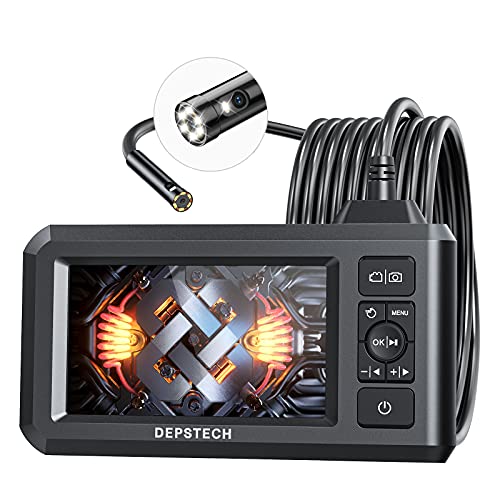
- Dual lenses with split-screen viewing
- 1080p video on a 4.3-inch IPS screen
- 16.5-foot waterproof semi-rigid cable
Best For: Extended inspections requiring front and side views
Articulating Workhorse
Teslong Two-Way Articulating Borescope

- Two-way 210-degree probe articulation
- 4.5-inch IPS screen with 1080p capture
- Includes 32GB storage and carrying case
Best For: Automotive and HVAC inspections around tight bends
Simple Long-Reach Scope

- 16.6-foot semi-rigid inspection cable
- 4.3-inch IPS display with eight LEDs
- Works without Wi-Fi or a smartphone app
Best For: Live DIY inspections where recording is unnecessary
Phone-Connected Specialist

- 180-degree joystick-controlled articulation
- USB-C phone and tablet compatibility
- App supports photo and video capture
Best For: Phone-based inspections in engines, walls, and plumbing
Best Standalone Display
Daxiongmao 1080P LCD Borescope

- Built-in 4.3-inch screen needs no phone or app
- 16.5-foot semi-rigid cable with IP67 probe
- Includes inspection accessories and 180-day warranty
Best For: Users who want direct viewing for automotive, plumbing, and DIY inspections
Best Professional-Style Wireless Pick
Klein Tools ET21 WiFi Borescope

- 5.5mm camera reaches tight inspection areas
- Wi-Fi connection works up to 30 feet
- IP67 probe and app support saving and sharing
Best For: Tradespeople who want compact smartphone-based inspections
Best Slim Wi-Fi Probe
NIDAGE 3.9mm Wireless Endoscope

- Ultra-thin 3.9mm probe reaches narrow spaces
- 1080P camera with three resolution choices
- IP67 cable and six adjustable LED lights
Best For: Engine, pipe, drain, HVAC, and wall inspections in tight spaces
High-Resolution Pick
DEPSTECH 2K Dual-Lens Borescope

- 2K 2560×1440 phone viewing
- Front and side lenses
- 16.5-foot IP67 probe
Best For: Detailed inspections with app-based photo and video capture
Dedicated-Screen Pick
TGJOR 5-Inch Dual-Lens Borescope

- Built-in 5-inch HD screen
- Front and side camera views
- 16.4-foot IP67 probe
Best For: App-free inspections without photo or video recording
Accessory-Rich Pick
Acoath 1920P Dual-Lens Borescope

- 1920×1440 photo and video capture
- Dual lenses with 16.4-foot cable
- Includes hook, magnet, and mirror
Best For: Multi-purpose phone-based inspections and repair work
Dual-Lens Detailer – DEPSTECH DS300 Inspection Borescope
For shoppers comparing wireless borescope cameras, the DEPSTECH DS300 stands out as a self-contained inspection tool with dual lenses, split-screen viewing, and a long 16.5-foot semi-rigid cable. Its built-in display avoids relying on a phone, while the 1080p video, adjustable lighting, and waterproof probe suit plumbing, HVAC, automotive, and general maintenance work.
Best For: Users who want dual-angle viewing and a dedicated screen for extended inspections.
Pros:
- Dual-lens switching and split-screen modes provide front and side views without installing a mirror.
- 4.3-inch IPS screen, 1080p video, and adjustable LED lighting support clearer inspections.
- 16.5-foot semi-rigid cable, IP67 waterproofing, and approximately four-hour battery life add practical versatility.
Cons:
- A Micro SD card is not included.
- The relatively long cable may be more than needed for short, simple inspections.
The DS300 is a strong choice when visibility and reach matter more than minimal size. Its dual-camera design can reduce repositioning, making it especially useful for complicated spaces and routine professional inspections.
Articulating Workhorse – Teslong Two-Way Articulating Borescope
The Teslong articulating model is one of the more maneuverable wireless borescope cameras for automotive, HVAC, and wall inspections. Its joystick-controlled probe bends in two directions, while the 4.5-inch IPS screen, built-in LEDs, and included 32GB media make it ready for detailed work without an app.
Best For: Mechanics and technicians who need controlled probe movement in tight, complex spaces.
Pros:
- Two-way 210-degree articulation helps guide the camera around challenging angles.
- Large 4.5-inch IPS display and 1080p capture provide a clear inspection view.
- Includes 32GB storage, eight LED lights, IP67 waterproofing, and a carrying case.
Cons:
- The probe cable is 5 feet long, offering less reach than some longer models.
- Articulating controls may add complexity for basic, straight-line inspections.
This Teslong is a practical upgrade for users who frequently lose sight of inspection targets around bends. The central joystick and rear photo button are designed for one-handed operation, while the dedicated screen keeps setup simple.
Simple Long-Reach Scope – MugEasy 1920P HD Borescope
For straightforward pipe, wall, sewer, and automotive checks, this MugEasy model offers a dedicated 4.3-inch screen and a 16.6-foot semi-rigid cable without app or Wi-Fi setup. Among wireless borescope cameras, it is better viewed as a self-contained handheld scope: it displays live 1080p imagery but does not take or store photos.
Best For: DIY users who need long reach and live viewing rather than inspection recordings.
Pros:
- Long 16.6-foot bendable cable reaches pipes, walls, sewers, and other confined areas.
- 4.3-inch IPS screen, eight adjustable LEDs, and IP67 waterproofing support dark or wet environments.
- No smartphone app, Wi-Fi connection, or driver installation is required.
Cons:
- It cannot take or store photos.
- The 7.9mm probe and 2–10cm focusing range may not suit every narrow or distant target.
This is a useful choice when the main goal is to see a live image quickly and keep a phone away from dirty work areas. Choose another model if documenting findings with saved photos or videos is important.
Phone-Connected Specialist – Teslong TD300 USB-C Borescope
The Teslong TD300 takes a different approach to wireless borescope cameras by using a USB-C connection to display inspections on compatible phones and tablets. Its joystick-controlled 180-degree articulating probe, 5-foot semi-rigid cable, adjustable LEDs, and app-based photo and video capture make it a compact option for plumbing, HVAC, wall cavities, and engine bays.
Best For: iPhone 15-and-newer and compatible Android users who prefer phone-based viewing and recording.
Pros:
- Joystick-controlled 180-degree articulation helps inspect around corners and inside tight spaces.
- SmartEndoscope app supports photo and video capture without an account or subscription.
- Eight adjustable LEDs and a shape-holding 5-foot cable suit one-handed inspections.
Cons:
- It requires a compatible USB-C device, OTG support on Android, and app setup.
- The 1MP camera offers less still-image resolution than the 2MP models listed here.
- Thick phone cases may need to be removed for the holder to fit.
The TD300 makes sense for users who already carry a compatible USB-C phone and want recordings saved directly to their device. Its shorter cable is manageable for engines, traps, and wall cavities, but it is less suited to long-run inspections.
Best Standalone Display – Daxiongmao 1080P LCD Borescope
For shoppers comparing wireless borescope cameras, the Daxiongmao takes a different approach: its built-in 4.3-inch LCD provides live viewing without pairing to a phone or installing an app. The 1080P camera, 16.5-foot semi-rigid cable, adjustable lighting, and IP67-rated probe make it a practical choice for general inspection work.
Best For: Mechanics, DIY users, and home inspectors who prefer a self-contained screen for automotive, plumbing, HVAC, and wall inspections.
Pros:
- Built-in 4.3-inch color LCD works without a smartphone or Wi-Fi connection.
- 16.5-foot semi-rigid cable offers useful reach while retaining maneuverability.
- IP67 waterproofing and eight adjustable LED lights support wet or dark inspection areas.
- Includes hook, magnet, side mirror, charging cable, and a 180-day warranty.
Cons:
- The 8mm probe is less suited to extremely narrow openings than slimmer models.
- The supplied notes state that the endoscope cannot take pictures or videos.
- Charging requires a suitable 5V/1A household charger; fast charging is not supported.
This model is a strong fit when convenience means avoiding phone setup and keeping the display attached to the inspection tool. Choose another option if recording, sharing, or entering very small spaces is a priority.
Best Professional-Style Wireless Pick – Klein Tools ET21 WiFi Borescope
The Klein Tools ET21 is a focused option among wireless borescope cameras, sending inspection video and images to an iOS or Android device over Wi-Fi. Its 5.5mm camera, five-foot flexible probe, adjustable LEDs, and IP67 rating are designed for seeing into tight, wet, or poorly lit areas.
Best For: Tradespeople and technicians who want a compact 5.5mm probe with smartphone viewing, saving, and sharing through the Klein Tools app.
Pros:
- Wi-Fi transmits video and images to a smartphone from up to 30 feet away.
- Compact 5.5mm camera is suited to confined spaces.
- IP67-rated five-foot camera cable is flexible while maintaining rigidity for maneuvering.
- Adjustable LED lighting and an iOS/Android app support viewing, saving, and sharing.
Cons:
- The listed video resolution is 480p, lower than several 1080P alternatives.
- The five-foot cable provides less reach than the longer Daxiongmao option.
- Phone or tablet use is required for viewing and app-based functions.
The ET21 prioritizes a slim probe and app-based workflow over maximum resolution or cable length. It makes the most sense for users already comfortable inspecting and documenting findings on a mobile device.
Best Slim Wi-Fi Probe – NIDAGE 3.9mm Wireless Endoscope
For tight-access work, the NIDAGE is one of the more capable wireless borescope cameras in this group. Its ultra-thin 3.9mm probe connects to Android, iPhone, and iPad devices over Wi-Fi, while the 1080P 2MP camera, adjustable LEDs, and five-foot semi-rigid cable support close-up inspections.
Best For: Users inspecting engine cylinders, pipes, drains, HVAC systems, walls, and other locations where a very narrow probe is useful.
Pros:
- 3.9mm probe can access especially tight spaces.
- 1080P output and three selectable resolutions provide flexible viewing options.
- IP67 waterproof cable and six adjustable LEDs support dark or wet areas.
- Compatible with Android 5.0+, iOS 9.0+, and iPad devices through the HD WiFi app.
Cons:
- The five-foot cable offers limited reach for deeper inspection points.
- The supplied notes specify a close-object focal range of 3–10cm.
- It requires app installation and a compatible smartphone or tablet for operation.
The NIDAGE stands out when probe diameter matters most, combining a 3.9mm tip with wireless mobile viewing. Its shorter cable and close-focus design are worth considering before choosing it for long-distance or broad-area inspections.
High-Resolution Pick – DEPSTECH 2K Dual-Lens Borescope
For shoppers comparing wireless borescope cameras, the DEPSTECH NTC55 stands out for its 2K phone-based viewing, dual-camera coverage, and long semi-rigid probe. It connects to compatible iPhone and Android devices through the DEPSTECHCAM app and is suited to detailed inspections in tight, damp spaces.
Best For: Buyers who want sharper-than-1080P images, dual viewing angles, and app-based photo and video capture.
Pros:
- 2K 2560×1440 resolution with 3.69 million pixels for detailed images.
- Front and side 7.9mm lenses provide broader inspection coverage.
- 16.5-foot semi-rigid cable, IP67 waterproofing, and adjustable LEDs.
- Includes hook, magnet, and protective cap accessories.
Cons:
- Requires the DEPSTECHCAM app and a compatible phone or tablet.
- Android devices need OTG support with OTG enabled.
The NTC55 is a strong choice when image detail and phone-based recording matter more than having a dedicated display. Its dual lenses and retrieval accessories add practical versatility for automotive, HVAC, plumbing, and general maintenance work.
Dedicated-Screen Pick – TGJOR 5-Inch Dual-Lens Borescope
This TGJOR model is a practical alternative among wireless borescope cameras for users who prefer a self-contained tool rather than a phone app. Its 5-inch screen, dual lenses, flexible 16.4-foot probe, and built-in lighting support plumbing, automotive, HVAC, and drain inspections.
Best For: Users who want plug-and-play operation with a large built-in display and no app or Wi-Fi setup.
Pros:
- 5-inch HD screen with a 170-degree wide-angle view.
- Switches between front and side camera perspectives.
- 16.4-foot semi-rigid cable with IP67 waterproofing.
- Eight adjustable LEDs and a 2,000mAh battery provide practical inspection support.
Cons:
- It cannot take pictures or record videos.
- It uses a fixed 1.2- to 4-inch focus range.
Choose this scope if immediate viewing is the priority and you do not need saved inspection files. The dedicated screen and straightforward controls make it convenient for hands-on work, while the lack of photo and video capture limits documentation.
Accessory-Rich Pick – Acoath 1920P Dual-Lens Borescope
The Acoath is a versatile option for shoppers evaluating wireless borescope cameras for home, vehicle, and maintenance tasks. It pairs with iOS and Android devices through the SUP-ANESOK app, delivers 1920×1440 video, and includes a semi-rigid 16.4-foot cable with useful retrieval accessories.
Best For: DIYers and professionals seeking a phone-connected inspection camera with broad device compatibility and included tools.
Pros:
- Dual 7.9mm lenses provide front and side inspection views.
- 1920×1440 capture supports photos and videos.
- IP67 probe can be used up to 3.28 feet deep for one hour.
- Includes magnet, hook, mirror, protective cap, and multiple connectors.
Cons:
- Requires downloading the SUP-ANESOK app.
- The probe is not heat-resistant, so hot automobile engines must cool before inspection.
- The waterproof coating can be damaged by sharp protrusions or forceful pulling.
The Acoath balances useful image quality, dual-lens flexibility, and a generous accessory package. It is especially appealing for varied repair jobs, provided users follow the temperature, cable-handling, and probe-protection precautions.
How We Picked the Best Wireless Borescope Cameras
We focused on the features that have the greatest effect on real inspection work: image quality, camera diameter, probe length, lighting, waterproofing, connection method, and ease of use. The selection includes wireless phone-connected models, Wi-Fi borescopes with dedicated viewing hardware, USB-C options, slim probes, dual-lens cameras, and articulating designs.
Resolution claims can vary by display and software, so they should not be considered in isolation. A smaller probe, brighter adjustable LEDs, stable video transmission, and a camera head that fits the target space may matter more than a higher advertised pixel count.
Quick Comparison
| Best For | Features to Prioritize |
|---|---|
| Automotive repairs | Articulation, durable probe, strong lighting, and a long cable |
| HVAC and wall inspection | Small camera diameter, flexible cable, and clear close-up imaging |
| Plumbing and drains | Waterproof camera head, adequate probe length, and reliable signal |
| Home maintenance | Simple phone setup, dual-lens viewing, and a manageable price |
| Very tight openings | A slim 3.9mm or similarly narrow probe |
Key Buying Factors for Wireless Borescope Cameras
Camera Diameter and Probe Length
Measure the access point before buying. A 3.9mm or 5.5mm camera can enter spaces that larger heads cannot, while a 16-foot probe provides more reach for walls, vehicles, and drains. Longer cables are useful, but they can be harder to control in confined areas.
Image Quality, Lighting, and Field of View
Look for adjustable LEDs and a camera that maintains detail at close range. Dual-lens models can reduce the need to reposition the probe by offering forward and side-facing views. Higher resolution is helpful on a large phone screen, but illumination and focus are equally important in dark, reflective, or dirty spaces.
Wireless Connection and Compatibility
Phone-connected cameras are convenient for saving photos and video, but they typically require an app and a compatible Wi-Fi or USB-C connection. Confirm support for your phone’s operating system and connector. Dedicated Wi-Fi viewing units may be preferable when you want a self-contained inspection tool.
Durability and Water Resistance
An IP-rated camera head is useful for drains, automotive components, and damp areas. Waterproofing usually applies to the probe and camera head rather than the entire device, so follow the manufacturer’s limits. A semi-rigid cable and protected controls also improve long-term usability.
Who Should Buy Which Wireless Borescope Cameras?
Choose an articulating Teslong model if directing the camera around corners is more important than having the simplest setup. DEPSTECH dual-lens options are a practical fit for users who want broader viewing flexibility for automotive or household inspections. The Klein Tools Wi-Fi model suits buyers who prefer a recognized trade-tool design and a dedicated inspection workflow.
For narrow openings, the 3.9mm slim endoscope is the logical choice. Basic 1080P or 1920P models are suitable for occasional home, vehicle, and HVAC checks, while a longer waterproof industrial-style probe is better for drains and deeper cavities. Before ordering, verify app compatibility, probe diameter, cable reach, and whether the advertised wireless connection matches your preferred phone or tablet.