
The best compact handheld light meters make it easier to check illumination quickly, whether you are setting exposure, evaluating a workspace, or troubleshooting uneven lighting. This roundup compares photography-focused meters with practical lux and foot-candle testers.
We considered measurement range, portability, display design, sensor flexibility, refresh speed, and useful extras so you can choose a meter that matches your work rather than simply chasing the highest specification.
Best 10 Compact Handheld Light Meters Picks for 2026
Best All-Around Meter

- Incident and reflected exposure readings
- Photo, Cine, and HD Cine modes
- Compact 3.52-ounce pocket-sized design
Best For: Photographers and videographers needing versatile exposure control
Best for Illuminance Range
- 0–200,000 lux measurement range
- Split sensor for flexible positioning
- Lux/Fc and temperature switching
Best For: Professional lighting and facility measurement tasks
Best Ultra-Compact Camera Meter

- Only 26g with a 0.96-inch OLED
- Rechargeable USB-C battery
- Camera-focused exposure and depth-of-field features
Best For: Film and Leica photographers prioritizing minimal weight
Best Simple Pocket Meter
Extech LT505 Pocket Light Meter

- 0–50,000 lux measurement range
- Lux and foot-candle readings
- Backlit LCD in a 3.2-ounce body
Best For: Quick portable lighting checks and general illuminance measurement
Wide-Range Pick
S8608 Digital Illuminance Light Meter

- Measures up to 200,000 lux
- Supports LUX and FC readings
- Lightweight with hold and backlight functions
Best For: General-purpose indoor and outdoor brightness checks
Fast-Reading Pick

- Reads up to 200,000 lux
- Updates twice per second
- Records peak light pulses
Best For: Plant lighting and fast-changing light measurements
Temperature-Tracking Pick
Digital Lux and Ambient Temperature Meter
- Measures light and ambient temperature
- Uses a 0–200,000 lux range
- Includes color LCD and two-year warranty
Best For: Light checks that also require ambient temperature readings
Best Value Wide-Range Meter
Mcbazel Digital Illuminance Light Meter

- 0–200,000 lux measuring range
- Backlit display with data hold
- Lux/FC switching and min/max readings
Best For: General plant, photography, and indoor brightness checks
Best Rotating-Sensor Design

- 360-degree rotating sensor
- Auto-ranging up to 200,000 lux
- Included batteries and data-hold function
Best For: Measurements requiring flexible sensor positioning
Best for Plant Monitoring
Ohcans AS803 Digital Light Meter
- Light and temperature monitoring
- 180-degree rotating sensor
- Backlit display with 0–200,000 lux range
Best For: Plant, photography, and indoor-environment checks
Best All-Around Meter – Sekonic L-308X-U Flashmate
For photographers and videographers comparing compact handheld light meters, the Sekonic L-308X-U stands out as a pocket-sized exposure meter with incident and reflected readings. It supports ambient and electronic flash measurements, with readings accurate to a tenth of a stop in full-stop mode.
Best For: Still photographers, DSLR and mirrorless videographers, and cinema users who need photo, cine, and HD cine exposure modes.
Pros:
- Supports ambient, corded flash, and cordless flash measurements.
- Offers Photo, Cine, and HD Cine modes with selectable frame rates and shutter angles.
- Wide ambient range and shutter-speed coverage, including speeds up to 1/8000 second.
- Compact 4.3-by-2.5-by-0.9-inch design weighs only 3.52 ounces.
Cons:
- Requires two AAA batteries.
- Its feature set may be more than needed for basic illuminance checks.
The L-308X-U is the most versatile choice here for exposure-focused work. Its dedicated flash and cinema controls make it especially useful when you need more than a simple lux reading.
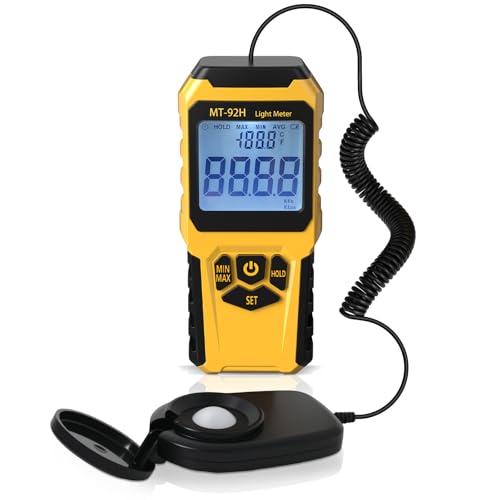
Best for Illuminance Range – MT-92H Split-Sensor Meter
The MT-92H is one of the more measurement-oriented compact handheld light meters, covering 0 to 200,000 lux with a stated ±3% accuracy. Its split-sensor design and fast 500-millisecond refresh rate suit users who need to monitor changing light conditions.
Best For: Professional lighting, facility, industrial, and environmental checks where a broad lux range, remote probe positioning, and switchable units are useful.
Pros:
- Measures from 0 to 200,000 lux with 0.1-lux resolution.
- Separate probe supports flexible sensor positioning.
- Switches between lux and foot-candles, plus Celsius and Fahrenheit temperature readings.
- Backlit display is designed for visibility in darkness or bright sunlight.
Cons:
- At 188g, it is heavier than the pocket-sized photography meters in this roundup.
- Requires three AAA batteries.
Choose the MT-92H when measurement range and flexible sensor placement matter more than minimum weight. It is particularly practical for general illuminance and environmental monitoring rather than camera exposure control.
Best Ultra-Compact Camera Meter – LightMate Lite 2R
Among compact handheld light meters, the LightMate Lite 2R is designed specifically around portable camera use. It weighs just 26g, uses a rechargeable battery, and combines a 30-degree metering lens with aperture-priority, shutter-priority, and several metering modes.
Best For: Film and Leica camera users who want a lightweight, rechargeable meter with a large OLED display and adjustable cold-shoe mounting.
Pros:
- Ultra-light 26g design with a 0.96-inch OLED screen.
- Rechargeable battery provides more than 20 hours of use and USB-C charging.
- Offers aperture and shutter priority, single, automatic, and average metering modes.
- Includes exposure compensation, ND filter compensation, depth-of-field calculation, and screen-flip display.
Cons:
- Its camera-oriented feature set is less suited to general lux measurement.
- Small screen and compact controls may require more menu interaction.
The Lite 2R is the strongest pick when low weight and camera integration are priorities. Its rechargeable design and adjustable mounting make it especially appealing for photographers carrying a compact film setup.
Best Simple Pocket Meter – Extech LT505 Pocket Light Meter
The Extech LT505 keeps compact handheld light meters straightforward, offering lux and foot-candle readings in a pocket-friendly body. Its 0 to 50,000-lux range and backlit LCD make it suitable for quick checks in studios, offices, workshops, and other indoor environments.
Best For: Photographers, facility managers, inspectors, and technicians who want a simple portable illuminance meter with dual measurement units.
Pros:
- Measures up to 50,000 lux or 5,000 foot-candles.
- Switches between lux and foot-candle readings.
- Large backlit LCD supports readings in dim spaces.
- Compact 3.2-ounce body is convenient to carry.
Cons:
- Does not provide the dedicated flash and cinema exposure modes of the Sekonic.
- Its maximum range is lower than the MT-92H’s 200,000 lux.
- Requires two AAA batteries.
The LT505 is a practical choice for uncomplicated light-level checks. It offers the essential lux and foot-candle functions without the added camera-exposure controls found on specialized photography meters.
Wide-Range Pick – S8608 Digital Illuminance Light Meter
For shoppers comparing compact handheld light meters, the S8608 offers a broad 0–200,000 lux measurement range in a lightweight 4.6-ounce design. It supports both lux and foot-candle readings, making it practical for checking lighting in homes, workplaces, grow spaces, and photography settings.
Best For: General-purpose indoor and outdoor brightness checks where a wide range and portable design matter.
Pros:
- Measures up to 200,000 lux and automatically converts ranges.
- Switches between LUX and FC units.
- Includes MAX/MIN, data hold, backlight, auto power-off, and low-battery functions.
- Compact 6.65-inch body and 4.6-ounce weight are easy to carry.
Cons:
- Requires three AAA batteries.
- The supplied notes do not specify measurement accuracy.
The S8608 is a versatile choice when portability and a high maximum reading are more important than specialized features. Its display and measurement controls make it suitable for routine brightness checks across multiple environments.
Fast-Reading Pick – Dr.meter 1330B-V Light Meter
The Dr.meter 1330B-V is a practical option among compact handheld light meters for users who want quick readings and peak-value recording. It measures from 0 to 200,000 lux, switches between FC and LUX, and responds at a stated rate of two readings per second.
Best For: Plant lighting checks and applications that benefit from fast readings or peak data capture.
Pros:
- Provides a 0–200,000 lux measurement range.
- Delivers readings two times per second according to the supplied notes.
- PEAK mode records the highest light pulse value.
- Includes FC/LUX conversion and a low-battery alert.
Cons:
- Uses one 9V battery rather than AAA batteries.
- At 12 ounces, it is heavier than some compact alternatives.
- The supplied notes do not provide a stated accuracy specification.
Choose this model if responsive readings and peak recording are useful to your workflow. Its broad range and unit conversion also make it adaptable for indoor, outdoor, office, factory, and plant-lighting measurements.
Temperature-Tracking Pick – Digital Lux and Ambient Temperature Meter
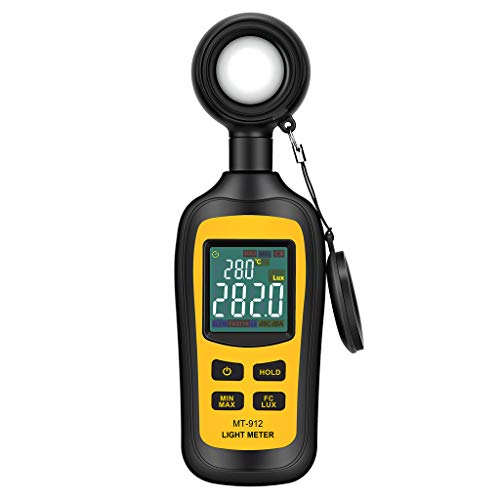
This digital meter stands out among compact handheld light meters by measuring both illumination and ambient temperature. Its 0–200,000 lux range, four-digit color LCD, and compact 6.7-ounce build suit routine checks in offices, homes, factories, and set-design environments.
Best For: Users who want light readings plus ambient temperature information in one handheld instrument.
Pros:
- Measures luminosity from 0 to 200,000 lux.
- Also measures ambient temperature.
- Offers stated accuracy of ±3% rdg ±8 digits below 10,000 lux and ±4% rdg ±10 digits above 10,000 lux.
- Includes MIN/MAX, data hold, auto power-off, low-battery indication, and a two-year warranty.
Cons:
- Requires three AAA batteries.
- The supplied notes do not mention FC support.
- Its accuracy varies above and below 10,000 lux.
The combination of illumination and temperature measurement gives this model broader utility than a light-only meter. It is a strong fit for users who value clear display information, documented accuracy, and warranty coverage.
Best Value Wide-Range Meter – Mcbazel Digital Illuminance Light Meter
If you need compact handheld light meters for general brightness checks, the Mcbazel offers a broad 0–200,000 lux range in a lightweight body. Its backlit LCD, hold function, and lux/foot-candle switching make it practical for plants, photography, indoor spaces, and routine field measurements.
Best For: Growers, photographers, hobbyists, and professionals who want wide-range readings with simple controls.
Pros:
- Measures up to 200,000 lux with stated accuracy of ±3% below 10,000 lux and ±4% above it, plus 10 digits.
- Backlit LCD and switchable lux/FC units support easier reading and flexible measurement.
- Records minimum and maximum values and includes a data-hold function.
- Automatic shutoff and low-battery indication help conserve power.
Cons:
- Requires three AAA batteries, which are not included.
- Readings below approximately 2 lux display as zero.
With its unusually broad range and straightforward feature set, this is a sensible all-purpose choice. Keep its low-light threshold in mind if you regularly measure very dim scenes.
Best Rotating-Sensor Design – DANOPLUS Digital Lux Meter
Among compact handheld light meters, the DANOPLUS stands out for its separate 360-degree rotating sensor. That flexible positioning can help when the meter body cannot face the light directly, while auto-ranging, a four-digit LCD, and included batteries keep everyday measurements convenient.
Best For: Users measuring plants, headlights, offices, or workspaces where sensor positioning is important.
Pros:
- Separate sensor rotates 360 degrees for flexible alignment with the light source.
- Provides four automatic lux ranges from 200 to 200,000 and supports foot-candle readings.
- Includes minimum/maximum, data hold, low-battery indication, and auto-power-off controls.
- Two required AAA batteries are included.
Cons:
- Its stated accuracy is ±4% plus 10 digits, rather than the tighter low-range specification of some meters.
- The sensor is designed for visible light in the 400–700 nm spectral range.
The rotating sensor is the key practical advantage here, especially for awkward angles or fixed lighting installations. It is a well-equipped option for routine visible-light measurements at home, work, or school.
Best for Plant Monitoring – Ohcans AS803 Digital Light Meter
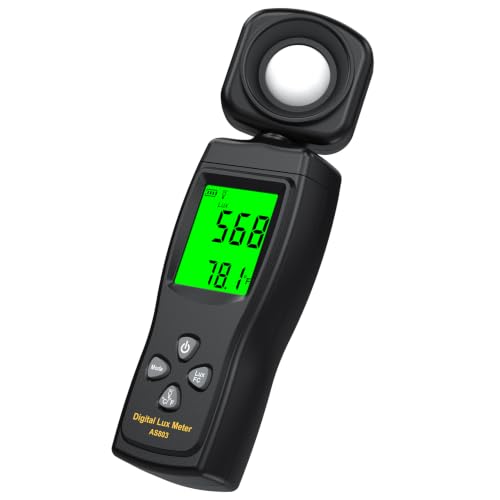
The Ohcans AS803 is one of the more versatile compact handheld light meters in this group, combining a 0–200,000 lux range with a 180-degree rotating sensor and backlit display. It also adds temperature readings, making it useful for checking both light and basic environmental conditions around plants or indoor work areas.
Best For: Growers and photographers who want flexible light readings plus temperature monitoring.
Pros:
- Measures from 0 to 200,000 lux with stated accuracy of ±4% plus 10.
- 180-degree rotating sensor and rapid 0.5-second sampling support flexible, real-time measurements.
- Tracks temperature in Celsius or Fahrenheit in addition to light levels.
- Offers data hold, maximum/minimum recording, three measurement modes, and a backlit LCD.
Cons:
- Requires three AAA batteries, although they are included.
- The rotating sensor has 180 degrees of movement, less than a full 360-degree design.
Its added temperature function gives the AS803 a broader monitoring role than a basic lux meter. Choose it when plant or indoor-environment checks matter alongside lighting, rather than paying for a light-only tool.
How We Picked the Best Compact Handheld Light Meters
We focused on meters that are genuinely portable and straightforward to use. The selection includes dedicated exposure meters, pocket-sized illuminance testers, and general-purpose handheld models. We compared their stated lux and foot-candle ranges, sensor layouts, display readability, response speed, operating modes, and practical features such as backlighting, temperature measurement, and rotating sensors.
Because these products serve different purposes, we did not treat a high maximum lux rating as the only measure of quality. A photographer may need incident and reflected exposure readings, while a facilities worker may care more about broad range, fast refreshes, and easy-to-read units.
Quick Comparison
| Best For | What to Prioritize | Recommended Type |
|---|---|---|
| Photography | Incident/reflected readings and exposure modes | Dedicated photographic light meter |
| Office or home checks | Simple lux readings and a clear display | Basic digital illuminance meter |
| Bright indoor or industrial areas | Wide measurement range | Up-to-200,000-lux handheld meter |
| Frequent spot measurements | Fast refresh and easy sensor positioning | Fast-response model with rotating or split sensor |
Key Buying Factors for Compact Handheld Light Meters
Measurement Type and Units
Lux measures illuminance in metric units, while foot-candles are commonly used in photography, lighting, and workplace standards. If you are measuring exposure for a camera, look for incident and reflected modes rather than a lux-only tester. For general lighting audits, a lux meter may be all you need.
Range and Accuracy
Choose a range that covers the environments you will measure. A meter rated to 200,000 lux offers flexibility in bright conditions, but range alone does not guarantee accuracy. Check the manufacturer’s stated accuracy, resolution, calibration information, and minimum reading before buying.
Sensor and Display Design
A remote, split, or rotating sensor can help you position the detector without blocking it with your hand. Large LCD or OLED screens are easier to read, especially during quick checks. Backlighting is useful in dim spaces, but it can increase battery consumption.
Portability and Controls
Compare overall size, weight, protective features, button layout, and battery access. A compact meter is most useful when it can travel in a pocket or tool bag and deliver a reading without a complicated setup.
Who Should Buy Which Compact Handheld Light Meters?
Photographers and filmmakers: Choose the Sekonic model if you need dedicated exposure functions, incident and reflected measurement, or cine-oriented modes.
Lighting, maintenance, and workplace users: A broad-range digital illuminance meter is a practical choice for checking offices, classrooms, work areas, and indoor fixtures.
Users who measure in awkward spaces: Consider a model with a rotating or split sensor, since flexible positioning can be more valuable than extra range.
Travelers and minimalist kits: Prioritize the smallest, lightest option with a readable screen and controls you can operate quickly.
Before ordering, verify the stated accuracy, battery type, included accessories, and whether the product measures illuminance only or also supports photographic exposure calculations.