
A dependable camera slider can add controlled movement, repeatable tracking shots, and polished time-lapse effects without requiring a full studio crew. The right system depends on your camera weight, available space, shooting style, and tolerance for setup time.
We selected 10 camera slider systems for home studios ranging from compact carbon-fiber rails to longer motorized models with app control, programmable movement, and panoramic shooting features. Use the guide below to narrow the list by stability, portability, control, and value.
Best 10 Camera Slider Systems for Home Studios Picks for 2026
Smart Motorized Pick
NEEWER 47.2-Inch Motorized Slider

- App and remote-control compatibility
- Includes NP-F750 battery
- Supports video, time-lapse, and tilt shooting
Best For: Programmable studio camera moves and time-lapse shooting
Heavy-Duty Track Pick

- 50-pound maximum payload
- Three modular 23-inch aluminum rails
- 28 accessory mounting holes
Best For: Large camera rigs and demanding tracking shots
Feature-Rich Motorized Pick
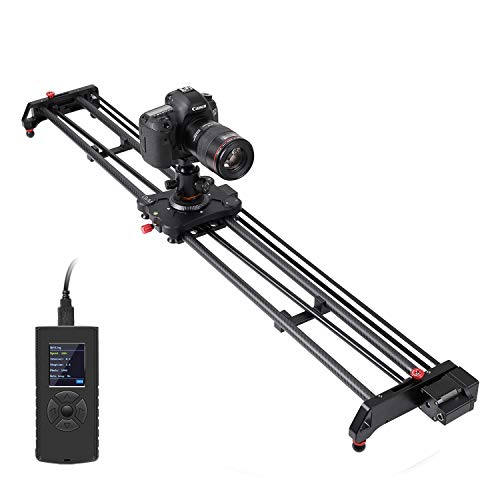
- Programmable speed and time-lapse settings
- Includes battery, charger, remote, and cables
- Supports automatic round trips and panoramas
Best For: Repeatable motorized video and time-lapse sequences
Compact Manual Pick
Zecti 24-Inch Carbon-Fiber Slider

- Lightweight 1.4-pound design
- Adjustable legs and bubble level
- Works with cameras, phones, and action cameras
Best For: Portable manual slides with smaller camera setups
Heavy-Duty Rail
Fotodiox Pro SlideCam 800-32-Inch Slider

- 32-inch ball-bearing rail supports smooth movement
- Works horizontally or vertically
- Adjustable legs and multiple mounting holes included
Best For: Stable studio slides with DSLR or heavier camera systems
Automated Tracking
GVM 31-Inch Carbon Fiber Motorized Slider

- Three shooting modes include 120-degree panorama
- Video and time-lapse menus support automated movement
- Kit includes battery, remote, ball head, and cables
Best For: Repeatable tracking shots and time-lapse production in a dedicated studio
Best App-Controlled Pick
32-Inch GVM Motorized Carbon Fiber Slider

- Six programmable shooting modes
- Wireless iOS/Android app control
- Portable carbon-fiber design with adjustable legs
Best For: Home studios needing flexible app-controlled camera movement
Best Value Aluminum Option

- Time-lapse, video, and round-trip modes
- Multiple mounting points for tripod use
- Adjustable feet and 2.5 kg load recommendation
Best For: Compact studios wanting basic automated slider movement
Best Long-Travel Pick
48-Inch GVM Carbon Fiber Slider

- 120 cm rail for extended camera travel
- Six programmable shooting modes
- App control with multi-angle mounting options
Best For: Larger home studios needing long tracking moves
Smart Motorized Pick – NEEWER 47.2-Inch Motorized Slider
For camera slider systems for home studios, the NEEWER ER1 combines automated movement with app control in a long carbon-fiber design. It supports horizontal loads up to 11 pounds, includes an NP-F750 battery, and offers video, manual, and time-lapse modes for repeatable camera moves.
Best For: Content creators who want programmable motion for product videos, tracking shots, and time-lapse work.
Pros:
- App-controlled manual, video, and time-lapse modes.
- Silent stepper motor and included 4400mAh NP-F750 battery.
- 120cm carbon-fiber rail with 1/4-inch and 3/8-inch tripod threads.
- Supports horizontal, 45-degree tilt, and up to 120-degree panorama setups.
Cons:
- 2.4G remote control and charger are not included.
- Minor shake may occur during macro photography.
- It weighs about 2.5kg, so it is less convenient for compact setups.
The ER1 is a strong fit when automated, repeatable movement matters more than minimal size. Its battery and app control suit a home studio, while the tripod mounting options add setup flexibility.
Heavy-Duty Track Pick – Glide Gear DEV 4 Dolly
The Glide Gear DEV 4 is a modular choice among camera slider systems for home studios, using three 23-inch aluminum rails and a frictionless wheel platform. Its 50-pound payload and multiple mounting holes make it suitable for heavier camera packages and accessories.
Best For: Filmmakers who need a high-capacity dolly track for substantial camera setups and smooth tracking shots.
Pros:
- Supports up to 50 pounds.
- Three 23-inch rails provide a modular track layout.
- Base plate includes 28 mounting holes with 1/4-20 and 3/8-16 taps.
- Front wheels rotate 90 degrees to function as a brake.
Cons:
- Heavy at approximately 12 pounds.
- Tripod or speaker-stand adapter is not included.
- The assembled system is relatively large for a small home studio.
Choose the DEV 4 when payload capacity and robust, frictionless movement are priorities. It is more demanding to store than compact sliders, but the modular rails and 50-pound rating offer considerable flexibility.
Feature-Rich Motorized Pick – GVM 48-Inch Camera Slider
The GVM 48-inch motorized slider offers adjustable start and end points, automatic round trips, and programmable time-lapse settings. For camera slider systems for home studios, its carbon-fiber rail, included battery, charger, remote, and shutter cables create a ready-to-use package for video and panoramic work.
Best For: Studio users who want adjustable automated motion with a broad set of included accessories.
Pros:
- Supports automatic looping, time-lapse, tracking, and panoramic shooting.
- Adjustable speed, interval, stop time, photo count, and motor torque.
- Includes battery, charger, remote, shutter cables, and carrying bag.
- Multiple 1/4-inch and 3/8-inch mounting ports support tripod setups.
Cons:
- Its 11.8-pound weight is substantial for a home-studio accessory.
- The maximum listed load is 5kg, limiting very heavy rigs.
- It is a 48-inch system, requiring adequate storage and shooting space.
The GVM is appealing for buyers who prefer a complete motorized kit rather than sourcing accessories separately. Its detailed motion controls are particularly useful for repeatable video and time-lapse sequences.
Compact Manual Pick – Zecti 24-Inch Carbon-Fiber Slider
The Zecti 24-inch slider is a lightweight manual option for camera slider systems for home studios. Its carbon-fiber rail, adjustable legs, bubble level, and multiple mounting threads support horizontal, vertical, diagonal, and sideways positioning with cameras, phones, and action cameras.
Best For: Beginners and mobile creators who need a portable manual slider for smaller cameras and tabletop-style shoots.
Pros:
- Lightweight design weighs about 1.4 pounds.
- Adjustable legs and non-skid feet support flexible placement.
- Compatible with cameras, phones, action cameras, and camcorders.
- Includes a carrying bag and multiple 1/4-inch and 3/8-inch screw holes.
Cons:
- Maximum recommended load is 4.4 pounds.
- The supplied note warns that overtightened screws can cause noise or rough movement.
- It has no motorized or automated shooting controls.
The Zecti is the most travel-friendly choice here and makes sense for compact cameras or phones. Check and adjust the screws carefully during setup to help maintain smooth manual movement.
Compact Motion – NEEWER 3-Wheels Wireless Video Camera Dolly
For creators comparing camera slider systems for home studios, the NEEWER DL100 offers a compact motorized dolly approach rather than a conventional rail. Its wireless remote provides three speeds, direction changes, and pause control, while adjustable wheel angles support straight or circular movement.
Best For: Compact tabletop setups, smartphone or action-camera shots, and creators who want simple automated motion.
Pros:
- Wireless remote controls speed, direction, and pause from up to 6 m.
- Three adjustable speeds range from 1.4 to 3.0 cm/s.
- Adjustable wheel angles support straight-line or circular routes.
- Built-in 1800mAh battery provides up to six hours of service time.
Cons:
- Its 6.6-pound maximum recommendation limits heavier camera setups.
- It is not water resistant.
- Camera, phone, and action-camera accessories are not included.
The DL100 is a practical choice when portability and creative movement matter more than a long, traditional track. Check your camera support and accessory needs before buying.
Heavy-Duty Rail – Fotodiox Pro SlideCam 800-32-Inch Slider
For home studios that need stable, repeatable camera movement, the Fotodiox Pro SlideCam 800 uses a 32-inch rail and ball-bearing slide mechanism. It can operate horizontally or vertically and includes adjustable legs for flat-surface use, making it a flexible option among camera slider systems for home studios.
Best For: DSLR and heavier camera systems that need smooth mechanical movement and multiple mounting options.
Pros:
- Ball-bearing mechanism is designed for smooth horizontal or vertical sliding.
- Removable adjustable legs include non-skid rubber feet.
- Multiple 1/4-20 and 3/8-inch mounting holes support different setups.
- Includes a carrying case and assembles in seconds.
Cons:
- At 5 pounds and 43 inches folded, it is less portable than compact dollies.
- Manual sliding does not provide motorized or remote-controlled movement.
- It is not water resistant.
The SlideCam 800 suits controlled studio work where smooth mechanical travel and support are priorities. Its longer folded length is worth factoring into storage and transport plans.
Automated Tracking – GVM 31-Inch Carbon Fiber Motorized Slider
The GVM 31-inch motorized slider combines a carbon-fiber rail with programmable movement for tracking, horizontal, and 120-degree panoramic shots. For camera slider systems for home studios, its video and time-lapse menus offer more automation than a basic manual rail, with tripod mounting and a supplied accessory kit.
Best For: Product videos, time-lapses, and repeatable camera moves using compatible cameras or camcorders.
Pros:
- Offers horizontal, tracking, and 120-degree panoramic shooting modes.
- Video mode supports uniform speed and automatic round trips.
- Time-lapse mode supports up to 1,000 photos with adjustable step distance.
- Includes remote, NP battery, charger, ball head, cables, and shutter-release cables.
Cons:
- At 10 pounds, it is relatively heavy for a 31-inch slider.
- Its 31-inch folded length requires substantial storage space.
- It is not water resistant.
The GVM is the most feature-rich option here for creators who want motorized repeatability and time-lapse control. Its weight and size make it better suited to a dedicated studio or carefully planned setup.
Best App-Controlled Pick – 32-Inch GVM Motorized Carbon Fiber Slider
For creators comparing camera slider systems for home studios, this 32-inch GVM model offers programmable movement without requiring a dedicated wired controller. Its app control, carbon-fiber construction, and multiple mounting ports make it a flexible option for tabletop video, time-lapse work, and product photography.
Best For: Home-studio creators who want app-controlled tracking, panoramic, time-lapse, and video moves in a relatively portable setup.
Pros:
- Offers six shooting modes with adjustable start and end points, speed, dwell time, and pause intervals.
- Bluetooth app control works with iOS and Android smartphones or tablets.
- Carbon-fiber construction, adjustable legs, and included carry bag support portable studio or location use.
- Multiple 1/4-inch and 3/8-inch ports support horizontal, vertical, and 45-degree setups.
Cons:
- The app-dependent controls may be less convenient for users who prefer a physical controller.
- Its 32-inch travel length is shorter than the 48-inch alternative in this roundup.
- Camera-triggering features depend on using the included compatible shutter cables.
This is a well-rounded choice when smooth programmed movement and portability matter more than maximum rail length. The six-mode feature set also gives home-studio users room to expand beyond basic side-to-side slides.
Best Value Aluminum Option – 27-Inch GVM Motorized Slider
This 27-inch GVM slider is a straightforward option among camera slider systems for home studios. Its aluminum-alloy rail supports video, time-lapse, and automatic round-trip shooting, while adjustable feet and broad mounting compatibility help it fit common DSLR, video-camera, and cellphone setups.
Best For: Home-studio users seeking a shorter motorized slider with basic automated shooting modes and a stated 2.5 kg maximum weight recommendation.
Pros:
- Supports time-lapse, video, and automatic round-trip shooting.
- Multiple 1/4-inch and 3/8-inch screw holes allow ground or tripod use.
- Adjustable non-slip feet help level the slider on different surfaces.
- Can be configured for horizontal, vertical, and 45-degree shooting, with a stated 2.5 kg weight recommendation.
Cons:
- It uses an aluminum-alloy build and weighs 2.36 kg, making it less light than the carbon-fiber models listed here.
- The supplied shooting modes are less extensive than the six-mode systems in the roundup.
- It is not water resistant, so it is intended for controlled indoor or dry conditions.
Choose this model if your home studio needs essential motorized movement rather than advanced app programming. Its shorter rail and included carrying bag make it practical for compact setups, provided your camera configuration stays within the stated load recommendation.
Best Long-Travel Pick – 48-Inch GVM Carbon Fiber Slider
For larger home studios, the 48-inch GVM provides extended travel for wider product shots, interviews, and cinematic moves. It combines app control, six shooting modes, carbon-fiber construction, and multiple mounting points, though its 120 cm length requires more dedicated studio space.
Best For: Creators who need long camera travel for tracking, panoramic, time-lapse, and video shots and can accommodate a full 120 cm rail.
Pros:
- Its six-in-one system supports tracking, panoramic, time-lapse, and video capture with configurable motion settings.
- iOS and Android app control enables wireless adjustment of movement parameters.
- Carbon-fiber construction, adjustable legs, and an included carry bag support stable, portable use.
- Multiple 1/4-inch and 3/8-inch ports enable horizontal, vertical, and 45-degree positioning.
Cons:
- The 120 cm rail needs substantially more room than the shorter sliders in this roundup.
- At 4 kg, it is heavier than the 32-inch carbon-fiber model.
- It is not water resistant and has a listed battery average life of two hours.
This is the strongest fit when a home studio prioritizes maximum travel and advanced programmed movement. Before choosing it, measure your available floor or tabletop space and confirm that the larger rail suits your camera and support arrangement.
How We Picked the Best Camera Slider Systems for Home Studios
We evaluated these sliders by the features that matter most in a home production space: usable track length, stated payload capacity, drive and control options, portability, construction, and shooting flexibility. Motorized models received extra consideration for time-lapse, repeatable moves, round-trip operation, and app or wireless control. Manual systems were judged on smooth travel, rail design, setup simplicity, and value for operators who prefer direct control.
Because accessories, payload ratings, batteries, and compatibility can vary by configuration, confirm the manufacturer’s specifications before purchasing—especially when pairing a slider with a cinema camera, telephoto lens, fluid head, or motorized pan-and-tilt unit.
Quick Comparison
| Type | Best For | Main Advantage | Potential Trade-Off |
|---|---|---|---|
| Compact manual slider | Small studios and tabletop work | Simple, quiet, and quick to position | Requires manual movement |
| Long manual slider | Controlled cinematic push-ins | Direct, responsive operation | Needs careful leveling |
| Motorized short slider | Repeatable moves in tight spaces | Programmable motion with a smaller footprint | Less travel distance |
| Motorized long slider | Time-lapse and wide product shots | Longer, smoother camera travel | Heavier and harder to store |
Key Buying Factors for Camera Slider Systems for Home Studios
Track Length and Available Space
Measure the usable floor, tabletop, or tripod space before choosing a rail. A 24- to 32-inch slider is easier to fit into a compact studio, while a 47- or 48-inch model creates more dramatic movement but needs additional clearance at both ends.
Payload and Stability
Calculate the combined weight of the camera, lens, cage, battery, quick-release plate, and any mounted accessories. Choose a slider with meaningful capacity beyond your working load. A rigid rail, secure carriage, and properly leveled support points are more important than headline length alone.
Manual Versus Motorized Control
Manual sliders are typically quieter, faster to deploy, and easier to operate for live moves. Motorized systems are better for repeatable product shots, unattended time-lapse sequences, and precise tracking. Check whether the controller uses an app, wired handset, or wireless remote, and verify battery runtime and charging requirements.
Noise, Speed, and Motion Quality
For dialogue or close-microphone work, motor noise may matter as much as smoothness. Look for adjustable speed, consistent travel, low-friction bearings, and a carriage that does not wobble when the camera changes direction.
Who Should Buy Which Camera Slider Systems for Home Studios?
Choose a compact manual slider if you shoot tabletop products, tutorials, or small-camera content and want the simplest setup. Choose a longer manual rail if you value silent operation and hands-on control for cinematic push-ins.
Choose a short motorized slider for a small studio where repeatability is more important than maximum travel. Choose a long motorized model if time-lapse, product demonstrations, panoramic moves, and automated tracking are central to your workflow.
Before checkout, confirm mounting-thread compatibility, support requirements, included power accessories, and whether the slider can be positioned securely on your preferred tripod or stand. These details often determine how useful the system will be after the initial setup.