
The best portable camera cranes make dramatic camera movement possible without the bulk of a full studio jib. This lineup spans compact carbon-fiber arms, telescoping cranes, heavy-duty jib systems, and automated options.
Use the buying guide below to compare payload, reach, portability, mounting compatibility, and setup requirements before choosing a crane for your camera package.
Best 10 Portable Camera Cranes Picks for 2026
Best Professional-Grade Pick

- 55-pound payload with 75mm/100mm head support
- Works with gimbals and pan-tilt heads
- No-tool setup with included storage bag
Best For: Professional crews needing a sturdy, high-capacity jib
Best Carbon-Fiber Design

- Carbon-fiber arm weighs 13.2 pounds
- 33-pound load capacity with 85-inch reach
- Supports multiple heads and creative mounting angles
Best For: Mobile shooters wanting a versatile carbon-fiber jib
Best Lightweight Budget Option

- Adjustable 1–1.95-meter front arm
- Includes tilt head and carry bag
- Designed for cameras up to 3.5 kilograms
Best For: Casual shooters using smaller camera packages
Best Quick-Assembly Pocket Jib
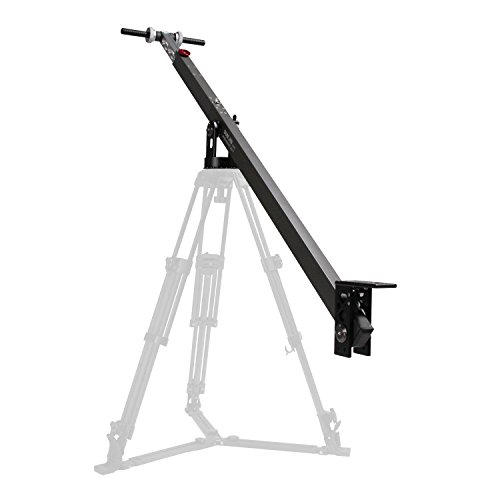
- Assembles and disassembles in about four minutes
- Works with flat bases and ball heads
- 20-kilogram maximum recommended load
Best For: Shooters prioritizing quick setup and mounting flexibility
Long-Reach Pick

- Supports rigs up to 8kg
- Configures to 14ft or 10ft
- 270-degree auto/manual tilt
Best For: Large rigs and sweeping high-angle shots
Ultra-Portable Pick

- Weighs about 1.52kg
- Folds to 75cm
- Supports cameras up to 5kg
Best For: Solo DSLR operators and travel shoots
Balanced Production Pick

- Supports rigs up to 8kg
- Compatible with several camera heads
- Two-section portable aluminum design
Best For: Crews needing payload and moderate reach
Programmable Motorized Crane

- 24 programmable movement presets
- Leveling dual-arm design
- 74.8-inch reach with tripod included
Best For: Repeatable product shoots and studio video
Lightweight Carbon-Fiber Pick

- 1.52 kg carbon-fiber construction
- 5 kg maximum load
- Carry bag and counterweights included
Best For: Lightweight mobile camera setups
Large-Camera Kit

- 5–8 kg jib camera range
- 340 cm horizontal extension
- Tripod, pan head, and bags included
Best For: Commercial and studio production with larger cameras
Best Professional-Grade Pick – Proaim Wave-2 7' Jib Crane
For production teams seeking portable camera cranes with substantial payload capacity, the Proaim Wave-2 combines a dual-rail build with a no-tool setup. It supports 75mm and 100mm fluid heads and can accommodate cameras, gimbals, and pan-tilt heads for sweeping indoor or outdoor shots.
Best For: Professional video crews needing a sturdy, higher-capacity jib for varied camera configurations.
Pros:
- Supports up to 55 pounds and works with 75mm/100mm fluid heads.
- Compatible with pan-tilt remote heads and 3-axis gimbals.
- Quick setup, bubble leveler, and included storage bag support mobile production.
Cons:
- At 40 pounds, it is heavier than the smaller jib options here.
- Its 7-foot design requires more transport and setup space.
The Wave-2 is the strongest choice in this group when stability, compatibility, and payload capacity matter more than minimizing equipment weight.
Best Carbon-Fiber Design – IFOOTAGE M1 III 85" Mini Jib
The IFOOTAGE M1 III is a practical option among portable camera cranes for shooters who want a compact carbon-fiber arm with flexible positioning. Its 85-inch reach, foldable design, and multiple mounting options support both standard and creative camera angles.
Best For: Mobile filmmakers and photographers who need a lightweight, versatile jib arm for varied angles.
Pros:
- 20-layer carbon-fiber square tube provides rigidity while keeping the arm at 13.2 pounds.
- Supports loads up to 33 pounds and reaches 85 inches.
- Offers tilt adjustment, low-angle and upside-down mounting, and 1/4-inch and 3/8-inch accessory threads.
- Includes quick-release plates for 60mm and 75mm fluid ball heads.
Cons:
- The 33-pound capacity is lower than the Proaim Wave-2’s rating.
- Its many adjustment and mounting features may require more setup familiarity.
With its carbon-fiber construction and broad mounting flexibility, the M1 III is a strong middle ground for portable productions that still need meaningful reach and payload capacity.
Best Lightweight Budget Option – GOWE 10.5-Foot Scalable Jib
For lightweight setups, this GOWE model is one of the more portable camera cranes, using an aluminum arm and a scalable front section. The front arm adjusts from 1 to 1.95 meters, allowing users to trade reach for a more compact working configuration.
Best For: Casual video makers using cameras around 3.5 kilograms and wanting an adjustable jib with a carry bag.
Pros:
- Scalable front arm adjusts from 1 to 1.95 meters.
- Includes a tilt head function for additional camera positioning control.
- Lightweight 1-kilogram aluminum design includes mounting plates, wire ropes, and a carry bag.
Cons:
- Maximum recommended camera weight is approximately 3.5 kilograms.
- The supplied notes do not specify compatibility with particular fluid-head sizes.
- The arm and accessories require a suitable tripod for installation.
The GOWE is appealing when low equipment weight and adjustable reach are priorities, but its lower payload rating makes it better suited to smaller camera packages.
Best Quick-Assembly Pocket Jib – KONOVA S1200 SUNJIB
KONOVA S1200 SUNJIB Camera Jib Arm Mini Crane Single Arm Pocket Jib DSLR RED Plate Bowl Compatible
Check Price On AmazonThe KONOVA S1200 is a compact choice among portable camera cranes, built around a concealed balancing system and a single-arm design. Its compatibility with both flat bases and ball heads makes it adaptable for DSLR, RED, and other camera setups.
Best For: Shooters who value fast assembly, broad base compatibility, and a compact jib format.
Pros:
- One-touch assembly and disassembly takes about four minutes.
- Hidden balance bar keeps the design compact and minimizes exposed components.
- Compatible with both flat-base and ball-head setups.
- Rated for up to 20 kilograms.
Cons:
- The 18-pound arm is heavier than the GOWE option.
- The supplied notes do not specify the jib’s reach or included carrying accessories.
The S1200 stands out for quick installation and balancing flexibility, making it a useful choice when setup speed and compatibility are more important than a detailed feature set.
Long-Reach Pick – Proaim 14ft Camera Crane Jib
For filmmakers needing maximum reach from portable camera cranes, the Proaim 14ft offers a modular setup that can extend to 14 feet or shorten to 10 feet. Its two-arm construction, 8kg capacity, and included carrying bags make it suited to larger DSLR, mirrorless, gimbal, and pan-tilt-head rigs.
Best For: Sweeping high-angle moves, overhead shots, crowd coverage, and productions using heavier camera rigs.
Pros:
- Supports camera setups up to 8kg (17.6lb).
- Adjusts between 14ft and 10ft configurations.
- Offers 270-degree platform tilt with auto and manual modes.
- Includes an LCD mounting point, monitor arm, and carry bags.
Cons:
- At 16kg, it is considerably heavier than a mini jib.
- Its extended size is better suited to spacious shooting locations.
The P-14 is the most capable option here for reach and payload, but its size and weight make it a better fit for crews that can accommodate a substantial jib system and support setup.
Ultra-Portable Pick – GOWE Carbon Fiber Mini JIB
The GOWE Sunrise mini jib is a lightweight choice for portable camera cranes, weighing about 1.52kg and folding to 75cm. Its variable-length carbon-fiber design can be operated without additional crew and supports DSLR cameras up to 5kg.
Best For: Solo operators, compact DSLR setups, travel shoots, and locations where quick setup and easy transport matter.
Pros:
- Lightweight carbon-fiber construction weighs about 1.52kg.
- Folds to 75cm for transport and storage.
- Variable-length design can be adjusted by removing an extension.
- Includes a carry bag, two counterweights, mounting screws, and a bowl adapter.
Cons:
- Maximum supported camera weight is 5kg, below the Proaim models.
- Its 120cm maximum radius and 210cm tilt length provide less reach.
This mini jib prioritizes portability over maximum height and payload. It is a practical match for solo shooters who want crane movement without transporting a full-size system.
Balanced Production Pick – Proaim 9ft Camera Crane Jib
The Proaim 9ft is a balanced option among portable camera cranes, pairing an 8kg payload with a shorter two-section aluminum arm. It supports compatible gimbals, pan-tilt heads, and fluid heads while providing auto or manual platform-tilt control for controlled camera movement.
Best For: Production crews wanting substantial payload capacity and crane movement in a more compact format than a 14ft jib.
Pros:
- Supports DSLR, mirrorless, camcorder, and compact video-camera setups up to 8kg.
- Works with compatible 3-axis gimbals, pan-tilt heads, and fluid heads.
- Uses a two-arm structure and thrust-bearing central fork for controlled movement.
- Includes an LCD mounting point and carrying bag.
Cons:
- Its 9ft reach is shorter than the 14ft Proaim model.
- At 22lb, it remains a substantial piece of production equipment.
The P-9 strikes a useful middle ground: it retains the 8kg capacity and head compatibility of a larger production jib while reducing reach and separating into two sections for transport.
Programmable Motorized Crane – Automated Camera Jib
For repeatable studio work, this motorized option stands out among portable camera cranes. Its controller supports up to 24 preset movement programs, while the dual-arm design helps keep the camera level during vertical moves.
Best For: Product photography, e-commerce videos, batch shooting, B-roll, stage recording, and live events.
Pros:
- Stores up to 24 programmable movement sequences with speed, pause, loop, and return controls.
- Dual-arm parallelogram design helps reduce unwanted camera tilt.
- Includes a servo motor, counterweights, heavy-duty tripod, and controller.
- Offers up to 74.8 inches of arm reach and 102.4 inches of working height.
Cons:
- Camera is not included.
- Requires careful counterweight adjustment before operation.
- Its 47.2-inch folded length may be less convenient for compact transport.
This is the most feature-rich choice for creators who need repeatable, automated camera movements rather than a simple manual jib. The included support system makes it a complete setup, although its larger footprint and counterweight requirements suit planned shoots better than quick run-and-gun work.
Lightweight Carbon-Fiber Pick – Portable 5KG Jib
This carbon-fiber model is a practical pick for shoppers comparing portable camera cranes with a lighter carry weight. It extends to 200 cm, folds to 75 cm, and is rated for cameras and accessories up to 5 kg.
Best For: Portable DSLR or video-camera setups, small crews, and shoots that require a relatively lightweight jib.
Pros:
- Carbon-fiber and aluminum-alloy construction keeps the jib weight to 1.52 kg.
- Supports a maximum load of 5 kg.
- Includes three counterweights, a quick-release plate, and a carry bag.
- Provides up to 200 cm of extended length and 120 cm of maximum radius.
Cons:
- A tripod is not listed among the included components.
- Its 5 kg capacity may not suit larger camera packages.
- Manual operation does not offer programmable movement control.
Choose this GOWE jib when portability matters more than automation or a bundled support system. The included counterweights and carry bag make transport simpler, but you will need a compatible tripod and head separately.
Large-Camera Kit – 8KG-Ready Jib and Tripod
GOWE Camera crane Jib Arm Crane For around 8 kilo Big Camera + Tripod Kit Crane jibs
Check Price On AmazonThis GOWE package is aimed at buyers who want a portable camera crane kit with broader camera support and a tripod included. It is designed for film, television, advertising, studio, and sports production, and can be assembled in under five minutes without tools.
Best For: Larger camera setups, commercial production, studio work, and event or sports video.
Pros:
- Suitable for cameras around 5–8 kg according to the jib specifications.
- Includes the jib arm, tripod with pan head, monitor mounting arm, support hardware, and two carrying bags.
- Offers a 340 cm horizontal extension and 360-degree smooth horizontal movement.
- Tool-free assembly is designed to take less than five minutes.
Cons:
- The supplied tripod is listed with a maximum load capacity of 6 kg, below the jib’s stated 5–8 kg camera range.
- The kit is heavier and less compact than a bare lightweight jib.
- The product notes provide varying load information, so buyers should verify their complete camera-and-accessory weight.
This is the most complete manual package for production teams that need a jib, tripod, and carrying cases together. Its long extension and larger-camera orientation are useful for expansive moves, but careful load checking is important because the jib and tripod specifications differ.
How We Picked These Portable Camera Cranes
We focused on the factors that matter most in real-world production: maximum payload, arm length, construction, transportability, mounting compatibility, balance, and control options. The selection includes compact mini jibs for DSLR and mirrorless cameras, larger systems for cinema rigs, and motorized equipment for repeatable programmed movements.
Because specifications and included accessories can vary, verify the listed payload, tripod or stand requirements, counterweights, bowl compatibility, and whether a fluid head, pan-tilt head, or camera plate is included before ordering.
Quick Comparison
| Best For | Look For | Typical Advantage |
|---|---|---|
| Travel and small crews | Carbon fiber, compact folded size | Lower weight and faster setup |
| DSLR and mirrorless cameras | Mini-jib design and modest payload | Affordable cinematic movement |
| Large cinema rigs | High payload and rigid arm construction | Greater stability and reach |
| Repeatable motion | Motorized presets and automated control | Consistent programmed shots |
| Flexible production setups | Telescoping or scalable arm | Adjustable reach and packing options |
Key Buying Factors for Portable Camera Cranes
Payload and Balance
Start with the complete moving load, not just the camera body. Include the lens, battery, monitor, wireless transmitter, cage, gimbal, fluid head, and mounting hardware. Choose a crane with comfortable headroom above that total so movements remain controlled and the arm is not operated at its limit.
Reach and Portability
A longer arm creates more dramatic elevation changes and sweeping perspectives, but it also needs more counterweight, floor space, and a sturdier support system. Short carbon-fiber jibs are easier to carry and better suited to location work, while 9- to 14-foot systems are more capable for larger sets.
Mounting Compatibility
Check whether the crane supports your required 75mm or 100mm bowl, fluid head, gimbal, pan-tilt head, or camera plate. A suitable interface can be more important than a few extra inches of reach, particularly when switching between stabilized and conventional camera setups.
Support, Counterweights, and Safety
Many Portable Camera Cranes require a heavy-duty tripod, stand, or dedicated base. Confirm that the support can handle both the camera-side load and the counterweight. Use manufacturer-recommended counterweights, secure every lock and pin, and keep people clear of the arm’s travel path during operation.
Manual Versus Motorized Control
Manual jibs are usually simpler, lighter, and quicker to deploy. Motorized models cost more and may require additional power or setup, but preset movements can be valuable for product videos, visual effects, interviews, and repeated takes.
Who Should Buy Which Portable Camera Cranes?
Choose a compact carbon-fiber mini jib if you shoot weddings, travel videos, small productions, or fast-moving location work. Choose a telescoping or mid-size crane if you want a balance of reach, payload, and transportability. Choose a heavy-duty 9- to 14-foot jib for cinema cameras, large lenses, gimbals, and ambitious high-angle moves. Choose a motorized crane when repeatability and programmed motion matter more than minimal weight and setup time.