
The best portable smart home security systems make it easier to protect a home, apartment, office, or temporary property without committing to complicated wiring. These kits combine wireless sensors, alarms, mobile alerts, cameras, and optional monitoring in different combinations.
Our roundup includes compact DIY alarm kits, expandable systems, solar-powered cameras, and options with Wi-Fi, cellular backup, or professional monitoring. Use the guide below to match features, setup requirements, and ongoing costs to your security needs.
Best 10 Portable Smart Home Security Systems Picks for 2026
Expandable Home Protection

- Includes sensors, keypads, base station, and range extender
- App alerts and remote system control
- Expandable with optional monitoring
Best For: 2- to 4-bedroom homes needing entry and motion coverage
Solar Outdoor Monitoring
2K Wireless Solar Camera System

- Four wire-free solar and battery cameras
- 2K color night vision with AI human detection
- Local or optional cloud storage
Best For: Outdoor property monitoring without power cables
Simple Monitored Security
SimpliSafe 8-Piece Wireless System

- No-drill setup with entry and motion sensors
- App, Alexa, and Google Assistant control
- Optional no-contract professional monitoring
Best For: Users wanting simple indoor protection with monitoring options
Best Expandable Value
15-Piece WiFi Wireless Alarm Kit

- Ten door sensors plus motion, keypad, and remotes
- Expandable to 20 sensors and five controls
- App alerts, Alexa support, and no monthly fees
Best For: Homes needing broad entry-point coverage and flexible expansion
Best Compact Setup
X-Sense AS05 5-Piece Security System

- Compact base station, keypad, sensors, and motion detector
- App scheduling with Home, Away, and Disarm modes
- Expandable to six keypads and 44 additional devices
Best For: Renters, apartments, dormitories, and smaller spaces
Best Touchscreen Controls
WiFi/GSM Alarm System with Touch Panel

- 2.4-inch touchscreen with temperature and weather display
- App, remote, touch, and voice control
- Includes RFID tags, remotes, motion sensor, and siren
Best For: Users wanting touchscreen operation and multiple control options
Best Cellular Backup Pick
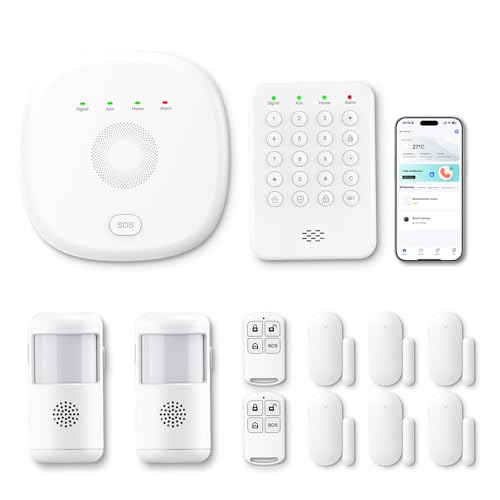
- Includes sensors, motion detectors, keypad, and remotes
- Switches from WiFi to 4G when WiFi disconnects
- App, Alexa, and no-monthly-fee operation
Best For: Larger homes needing expandable coverage and cellular backup
Best Touchscreen Control

- Touchscreen hub with multiple arm and SOS modes
- Six entry sensors, three motion detectors, and RFID fobs
- WiFi app alerts plus optional 4G calls and SMS
Best For: Families wanting extensive DIY coverage and touchscreen operation
Expandable Home Protection – Ring Alarm 14-Piece Kit
For shoppers comparing portable smart home security systems, the Ring Alarm 14-Piece Kit is a flexible choice for 2- to 4-bedroom homes. It combines entry and motion sensors with app control, optional professional monitoring, and compatibility with Alexa.
Best For: Households that want broad entry-point coverage and room to expand their alarm system.
Pros:
- Includes eight Contact Sensors, two Motion Detectors, two Keypads, a Base Station, and a Range Extender.
- Mobile notifications and Ring app control help you monitor the system remotely.
- Supports additional sensors and accessories as your needs grow.
- Optional 24/7 professional monitoring and Alexa voice control are available with a compatible Ring Protect Plan.
Cons:
- Professional monitoring and some added features require a separately sold Ring Protect Plan.
- Additional sensors and accessories are sold separately.
This kit stands out for its generous sensor count and expandable design. It is a practical starting point if you want a traditional alarm setup with app access and optional monitoring rather than cameras as the primary security tool.
Solar Outdoor Monitoring – 2K Wireless Solar Camera System
This 2K four-camera system is a strong option for portable smart home security systems when outdoor video coverage is the priority. Solar panels and backup batteries avoid power cables, while app control, color night vision, and AI human detection support around-the-clock monitoring.
Best For: Homeowners who want wire-free outdoor cameras with flexible storage and remote viewing.
Pros:
- Solar and battery power allow wire-free installation, with the detachable panels designed to maintain daily charging.
- 2K video, color night vision, and a motion-activated spotlight help capture activity in low light.
- Remote pan, tilt, and zoom provide 360-degree coverage, while IP65 weather resistance suits outdoor use.
- AI human detection, two-way audio, local microSD storage, and optional cloud storage offer flexible monitoring.
Cons:
- The microSD card is not included.
- Camera performance depends on suitable Wi-Fi coverage and available sunlight for ongoing solar charging.
- This is a camera-focused system rather than a dedicated door-and-window alarm kit.
With four wire-free cameras and no forced cloud subscription, this system is appealing for monitoring yards, driveways, and entrances. Its dual-band Wi-Fi support adds flexibility, though buyers should plan camera placement around signal strength and sunlight.
Budget DIY Alarm – Tolviviov 8-Piece Wi-Fi Alarm Kit
Among portable smart home security systems, this tolviviov kit offers a straightforward apartment or home alarm setup at an accessible level. The package includes door sensors, remote controls, and a Wi-Fi alarm station, with app alerts and expansion support but no subscription fee.
Best For: Renters and budget-conscious users who primarily need door and window alerts.
Pros:
- The eight-piece kit includes an alarm station, five door sensors, and two remote controls.
- Tool-free, self-adhesive installation avoids wall damage and is designed for quick DIY setup.
- Smartphone alerts, app control, remote controls, and voice modes provide several ways to manage the system.
- Supports expansion to up to 20 sensors and five remote controls or keypads, with no contract or subscription fee.
Cons:
- It works only with 2.4GHz Wi-Fi and does not support 5GHz networks.
- The alarm station must remain connected to AC power; its backup battery lasts about eight hours as an emergency supply.
- The included package does not include a motion detector.
This is a practical pick for basic perimeter protection, especially in an apartment or smaller home. Its main trade-offs are the 2.4GHz-only connection and limited backup power at the alarm station.
Simple Monitored Security – SimpliSafe 8-Piece Wireless System
For buyers seeking portable smart home security systems with an uncomplicated setup, this SimpliSafe package provides entry, motion, and panic-button protection without wiring or drilling. The app manages the system remotely, while optional professional monitoring adds emergency-response support.
Best For: Users who want an easy-to-install alarm system with optional no-contract professional monitoring.
Pros:
- Includes a Base Station, wireless Keypad, four Entry Sensors, a Motion Sensor, and a Panic Button.
- Plug-in setup and peel-and-place sensors require no wiring or drilling.
- The app supports remote arming and disarming, while Alexa and Google Assistant provide smart-home control.
- Optional 24/7 professional monitoring is available without a long-term contract, and the package includes one free month.
Cons:
- Professional monitoring is optional but requires a service plan for features such as monitored panic-button response.
- SimpliSafe products and monitoring are offered and supported only in the US.
- The included system is focused on alarm sensors rather than outdoor camera coverage.
SimpliSafe is a well-rounded choice when ease of installation and optional monitoring matter most. Its mix of entry sensors, motion detection, and a panic button provides useful indoor coverage without committing to a long-term monitoring contract.
Best Expandable Value – 15-Piece WiFi Wireless Alarm Kit
This 15-piece kit is a practical option for shoppers comparing portable smart home security systems with broad entry-point coverage. It includes ten door sensors, one motion sensor, a keypad, two remotes, and a WiFi base station, plus app control and smartphone alerts. DIY installation and no monthly fees make it approachable for renters, apartments, and homes that need flexible coverage.
Best For: Households that want many door sensors, app and remote control, and room to expand without subscription fees.
Pros:
- Includes ten door sensors, one motion sensor, a keypad, and two remote controls.
- Supports expansion to up to 20 sensors and five remote controls or keypads.
- Offers app control, real-time smartphone alerts, Alexa compatibility, and a 120 dB siren.
- DIY setup requires no professional installation or monthly fees.
Cons:
- Works only with 2.4 GHz WiFi, not 5 GHz networks.
- The listed maximum range is 100 feet.
Choose this system when included sensor quantity matters most. Its large starter bundle and expansion support provide more coverage flexibility than smaller kits, while the 2.4 GHz requirement is worth checking before purchase.
Best Compact Setup – X-Sense AS05 5-Piece Security System
The X-Sense AS05 is a streamlined choice among portable smart home security systems for apartments, dormitories, offices, and smaller homes. Its five-piece kit combines a base station, keypad, two door sensors, and a motion sensor, with app monitoring, scheduled modes, and Alexa support. Adhesive mounting or screws make the installation adaptable to temporary or permanent spaces.
Best For: Renters and smaller households seeking a compact kit with app scheduling and straightforward DIY installation.
Pros:
- Includes a base station, keypad, two door sensors, and one motion sensor.
- Supports Home, Away, and Disarm modes, automatic schedules, and app control.
- Offers keypad panic activation, multiple passwords, and Alexa compatibility.
- Can expand with up to six keypads and 44 additional devices.
Cons:
- Compatible only with 2.4 GHz WiFi.
- The starter kit includes fewer sensors than larger bundles.
This is a sensible fit when you want a less crowded starter package and the ability to build over time. Its scheduling features add convenience, while the limited initial sensor count may require expansion for larger properties.
Best Touchscreen Controls – WiFi/GSM Alarm System with Touch Panel
This eight-piece kit stands out among portable smart home security systems for its built-in 2.4-inch full-touch display. The package includes a control panel, motion sensor, door/window contact, two remotes, two RFID tags, and a siren, with app, remote, touch, and voice control. WiFi/GSM connectivity and a 120 dB siren make it a versatile option for homes, apartments, garages, and offices.
Best For: Shoppers who prefer touchscreen operation and multiple control methods in a compact alarm package.
Pros:
- Includes an integrated 2.4-inch touchscreen with temperature and weather information.
- Provides app, remote, touch, and voice control options.
- Includes two remotes, two RFID tags, a motion sensor, contact sensor, and siren.
- Uses WiFi/GSM connectivity and includes a 120 dB alarm siren.
Cons:
- The starter kit includes only one door/window contact sensor.
- The listed maximum range is 50 feet.
- Installation uses screws or self-adhesive mounting rather than a stated tool-free setup.
The touchscreen makes this system a strong choice for users who want local controls beyond a phone or keypad. Its included sensors are relatively limited, so it may be better suited to targeted coverage unless additional components are available.
Best Cellular Backup Pick – PGST 12-Piece WiFi + 4G Kit
For shoppers comparing portable smart home security systems, the PGST 12-piece kit offers broad coverage for a 3- to 5-bedroom home with app control, wireless sensors, and WiFi-to-4G connectivity. It also avoids monthly subscription charges.
Best For: Families wanting expandable coverage and cellular backup without recurring fees.
Pros:
- Includes a base station, keypad, four door/window sensors, two motion detectors, and two remote controls.
- Automatically switches to 4G when connected WiFi drops; a compatible SIM and service may be required.
- Supports Smart Life/Tuya app alerts, Alexa voice commands, and multiple defense modes.
- Allows additional sensors and PGST cameras to be added separately.
Cons:
- Works with 2.4GHz WiFi rather than 5GHz WiFi.
- Cameras and any additional sensors are sold separately.
Its included motion detectors and cellular fallback make this a flexible choice for larger homes, while the no-monthly-fee setup keeps ongoing costs predictable.
Best Touchscreen Control – GEN 2 16-Piece DIY Alarm Kit
This 16-piece system is a practical option among portable smart home security systems when you want an all-in-one touchscreen hub and extensive entry-point coverage. The pre-paired wireless accessories are designed for DIY installation in houses or apartments.
Best For: Households that prefer touchscreen control, many sensors, and loud wired-siren alerts.
Pros:
- Includes six door/window sensors, three PIR motion detectors, two remotes, two RFID key fobs, an SOS button, and a wired siren.
- Touchscreen hub offers Stay Arm, Away Arm, Disarm, and SOS modes.
- Provides Smart Life app alerts over 2.4GHz WiFi and supports 4G calls and SMS with a compatible SIM plan.
- Pre-paired accessories help simplify DIY setup, and the siren is rated at 120dB.
Cons:
- 5GHz WiFi is not supported.
- The 4G SIM card and cellular plan are sold separately.
- Its wired siren may be less convenient than a fully wireless alarm accessory.
The large accessory bundle and touchscreen interface make this a strong fit for multi-room protection, especially if you want RFID access and a dedicated SOS control.
Best Expandable Starter Kit – YISEELE WiFi Alarm System
For a straightforward entry point into portable smart home security systems, this YISEELE kit combines a compact hub, four door/window sensors, a remote, and a 120dB siren. Smart Life app alerts and voice control make it suitable for homes, apartments, garages, and small businesses.
Best For: Renters and small-property owners who want an affordable, expandable starter system.
Pros:
- Installation requires no wiring and can be completed in about 15 minutes.
- Supports Smart Life alerts, remote arm/disarm control, and event records over 2.4GHz WiFi.
- Works with Alexa and Google Home for voice-controlled Away Arm, Home Arm, and Disarm modes.
- Supports up to 100 accessories, including motion, smoke, water-leak, keypad, and siren devices.
Cons:
- The starter bundle includes only four door/window sensors and one remote.
- 5GHz WiFi is not supported.
- The listed maximum range is 10 meters, so placement may matter in larger spaces.
Its compact design, voice-assistant compatibility, and wide expansion capacity make it a sensible foundation when you want to begin small and add protection over time.
How We Picked the Best Portable Smart Home Security Systems
We compared these systems by looking at installation, portability, connectivity, sensor coverage, app control, alarm volume, smart-home compatibility, camera features, and subscription requirements. We also considered how well each kit can adapt to apartments, rental properties, small businesses, detached buildings, and homes that may need expansion over time.
Because “portable” can mean different things, this list includes both compact wireless alarm kits and broader systems designed to be removed or relocated more easily than hardwired security equipment. Battery operation, wireless communication, and straightforward mounting are particularly useful when permanent installation is not practical.
Quick Comparison
| System type | Best for | Notable considerations |
|---|---|---|
| Wireless alarm kits | Doors, windows, and room protection | Check sensor count and hub range |
| Camera-focused systems | Visual monitoring and remote verification | Review storage, power, and Wi-Fi needs |
| Expandable ecosystems | Growing homes or small businesses | Confirm compatible accessories |
| Cellular-capable systems | Backup connectivity | Potential plan or carrier requirements |
| Professional-monitoring options | Hands-off emergency response | Compare monthly fees and contract terms |
Key Buying Factors for Portable Smart Home Security Systems
Connectivity and Backup
Wi-Fi is convenient, but it depends on your router and internet connection. Systems with GSM or 4G connectivity may provide an additional communications path when Wi-Fi fails, although cellular features can require a compatible service plan. For cameras, verify whether the system supports both 2.4GHz and 5GHz networks and whether signal strength is adequate where cameras will be placed.
Installation and Portability
Look for wireless sensors, adhesive or screw mounting options, rechargeable or replaceable batteries, and a hub that can be moved without complex rewiring. Renters should confirm that mounting methods will not damage walls. Solar-powered cameras can reduce charging, but they still need suitable sunlight and a reliable wireless signal.
Coverage and Expansion
Count the doors, windows, entry points, and rooms that need protection before choosing a kit. An inexpensive starter package may be sufficient for a small apartment, while a larger home may benefit from extra motion detectors, contact sensors, keypads, or cameras. Check accessory compatibility before assuming the system can expand.
Monitoring, Alerts, and Privacy
App notifications are useful for everyday awareness, while professional monitoring may offer assistance when you cannot respond. Compare subscription costs, contract requirements, emergency dispatch policies, cloud storage, local recording, and camera privacy controls. A loud siren and reliable phone alerts are valuable even when no paid monitoring is selected.
Who Should Buy Which Portable Smart Home Security Systems?
Choose a compact DIY alarm kit if you need basic door, window, and motion protection for an apartment, rental, or small property. Choose an expandable system if you expect to add sensors or cover multiple rooms and outbuildings. Choose a camera-centered option if seeing activity remotely matters more than comprehensive entry-sensor coverage. Choose cellular-capable equipment for properties where internet outages are a concern, and choose professional monitoring if you want a service to help respond when you are unavailable.
Before buying, confirm battery life, return policies, app support, compatibility with your preferred voice assistant, and whether required monitoring or storage fees fit your budget.