
Reliable backup power does not always require the highest-priced permanent system. The best budget home standby generators balance usable wattage, dependable starting, fuel availability, and installation requirements for the appliances you need most.
This roundup includes true standby units alongside transfer-switch-ready portable and dual-fuel generators, making it easier to compare lower-cost backup strategies for outages, storms, and emergency home power.
Best 10 Budget Home Standby Generators Picks for 2026
Best Long-Term Value
Champion 8.5-kW Home Standby Generator

- Propane or natural-gas operation
- Includes 50-amp automatic transfer switch
- 10-year limited warranty and cold-weather starting
Best For: Homeowners wanting a permanently installed, fuel-flexible backup system
Best Budget Portable Pick
WEN 4,750-Watt Dual-Fuel Generator

- Gasoline and propane compatible
- Electric start with wheel kit
- 120V/240V output for essential loads
Best For: Portable emergency power on a tighter budget
Best High-Output Standby
Generac Guardian 18kW Generator

- 18,000 watts of automatic backup power
- Wi-Fi performance and maintenance monitoring
- Natural-gas or LP-gas operation
Best For: Larger homes requiring high-capacity automatic backup
Best Portable Whole-Home Alternative
Westinghouse 12,500-Watt Generator

- 9,500 running watts on gasoline
- Dual fuel with remote electric start
- Transfer-switch-ready 30A outlet
Best For: High portable output without permanent standby installation
Premium Automatic Backup

- Automatic power restoration in about 10 seconds
- Runs on natural gas or liquid propane
- Remote monitoring and PowerBoost starting support
Best For: Homeowners seeking automatic dual-fuel backup power
High-Output Flexible Backup
Westinghouse 14,500W Tri-Fuel Generator
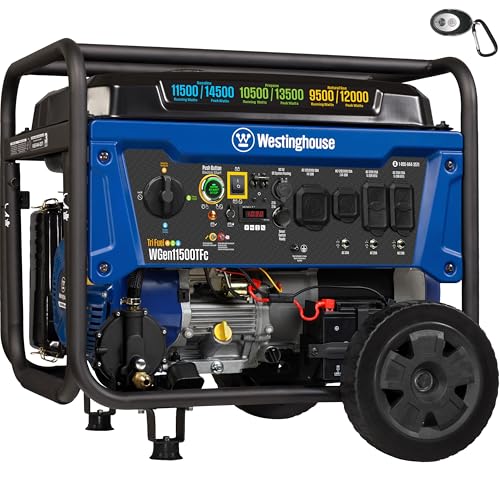
- Up to 14,500 peak watts and 11,500 running watts
- Uses gasoline, propane, or natural gas
- Up to 19 hours of gasoline runtime
Best For: Larger homes needing portable, high-capacity backup power
Quiet Whole-Home Coverage
Honeywell 14kW Home Standby Generator

- 14kW output with a 16-circuit transfer switch
- Quiet-Test self-test mode reduces noise and fuel use
- Less than 5 percent total harmonic distortion
Best For: Permanent residential backup with broad circuit coverage
Best Compact Inverter Value
PowerSmart 4300W Inverter Generator

- 3500 running watts for essential appliances
- Clean power under 3% THD
- Up to 12 hours at 25% load
Best For: Portable backup power for essential appliances and electronics
Best Mid-Range Home Backup

- 5300 running watts for household backup
- Up to 14.5 hours per tank
- 120/240V and transfer-switch-ready outlet
Best For: Extended portable backup with higher household capacity
Best High-Capacity Backup

- 20000 running watts for demanding loads
- Remote and push-button electric start
- Multiple 30A and 50A outlets
Best For: Large homes and properties needing high-output backup power
Best Long-Term Value – Champion 8.5-kW Home Standby Generator
For shoppers comparing budget home standby generators, the Champion 100177 offers automatic residential backup without routine refueling. Its propane or natural-gas operation, 8,500-watt output, and included 50-amp automatic transfer switch make it a practical choice for essential circuits.
Best For: Homeowners who want a permanently installed, fuel-flexible standby generator with a long warranty.
Pros:
- Runs on propane or natural gas for convenient backup fuel options.
- Includes a 50-amp, 10-circuit outdoor-rated automatic transfer switch.
- 24V starting system is designed for temperatures down to -22°F.
- Gullwing enclosure and 10-year limited warranty support serviceability and long-term ownership.
Cons:
- At about 394 pounds, it requires substantial installation planning.
- Its 8,500-watt capacity may be limiting for larger whole-home loads.
This Champion is a strong value-oriented standby option when automatic operation and cold-weather starting matter more than maximum output. Professional installation should be planned for this permanently installed system.
Best Budget Portable Pick – WEN 4,750-Watt Dual-Fuel Generator
WEN 4,750-Watt 120V/240V Dual Fuel Portable Generator with Wheel Kit and Electric Start (DF475T)
Check Price On AmazonThe WEN DF475T is a practical entry point for budget home standby generators if portability matters more than automatic whole-home operation. It provides dual-fuel flexibility, electric start, and 120V/240V output for selected appliances or a compatible transfer-switch setup.
Best For: Budget-conscious homeowners seeking a portable emergency generator for essential loads.
Pros:
- Switches between gasoline and propane with a selection dial.
- Electric start simplifies operation of the 224cc engine.
- 120V/240V output supports transfer-switch-ready applications.
- Wheel kit, handle, LPG hose, and oil are included.
Cons:
- Running output drops to 3,800 watts on gasoline and 3,500 watts on propane.
- It is portable rather than an automatic standby system.
- Its 2-year warranty is shorter than the coverage on some standby models.
Choose the WEN when you need flexible, movable backup power at a lower entry cost. Its 11-hour half-load runtime and modest output suit essential appliances, but users must handle deployment and connection during an outage.
Best High-Output Standby – Generac Guardian 18kW Generator
Although not the smallest option among budget home standby generators, the Generac Guardian 18kW is designed for homeowners who need substantially more capacity. It combines natural-gas or LP-gas operation with automatic whole-home backup, Wi-Fi monitoring, and clean 18,000-watt output.
Best For: Larger homes needing high-capacity automatic backup and remote status monitoring.
Pros:
- Delivers 18,000 watts of running power with True Power Technology.
- Wi-Fi connectivity enables remote performance and maintenance monitoring.
- Quiet-Test mode runs self-tests at lower RPM for quieter operation.
- Runs on natural gas or LP gas and includes a 5-year limited warranty.
Cons:
- Its 420-pound size and permanent installation increase setup requirements.
- Higher output may exceed the needs of shoppers seeking the lowest-cost backup option.
- Generac recommends installation by a certified, licensed electrician.
The Guardian is best viewed as a capacity-focused investment rather than a bare-bones budget generator. It makes sense when whole-home coverage, monitoring, and quieter self-testing justify a larger installation.
Best Portable Whole-Home Alternative – Westinghouse 12,500-Watt Generator
The Westinghouse WGen9500DF gives budget home standby generators a portable alternative to permanently installed equipment. Its dual-fuel engine, remote electric start, transfer-switch-ready outlet, and up to 9,500 running watts on gasoline make it suitable for substantial emergency loads.
Best For: Homeowners wanting high portable output and remote starting without buying a fixed standby system.
Pros:
- Produces 9,500 running watts on gasoline or 8,500 on propane.
- Remote key-fob, electric, and recoil start options provide flexibility.
- Includes a 50-amp RV-ready outlet and 30-amp transfer-switch-ready outlet.
- Digital display tracks voltage, frequency, and lifetime hours.
Cons:
- At 210 pounds, it is portable but still difficult for one person to move.
- It requires manual setup and is not an automatic standby generator.
- The 3-year limited warranty is shorter than the Champion’s listed coverage.
This Westinghouse is a compelling middle ground for buyers who want more output than a small portable generator but do not want a permanent installation. Its fuel gauge, remote start, and included accessories make outage preparation easier.
Premium Automatic Backup – Kohler 10kW Standby Generator
For shoppers comparing budget home standby generators, this Kohler model offers automatic residential backup with 10kW of output and a 10-second power restoration time. It runs on either natural gas or liquid propane and includes remote monitoring for added convenience.
Best For: Homeowners who want automatic backup power, dual-fuel flexibility, and remote generator status updates.
Pros:
- Automatically restores power in about 10 seconds.
- Supports natural gas and liquid propane.
- PowerBoost technology helps start large loads such as central air conditioners.
- OnCue Plus enables monitoring from a smartphone, tablet, or PC.
Cons:
- At approximately 400 pounds, it is not designed for portable use.
- Installation is more involved than with a conventional portable generator.
This is a strong option when automatic operation matters more than the lowest upfront cost. Its 10kW capacity, dual-fuel design, and five-year limited warranty make it a practical residential backup system.
High-Output Flexible Backup – Westinghouse 14,500W Tri-Fuel Generator
Among budget home standby generators, this Westinghouse unit stands out as a high-output portable alternative. It delivers up to 14,500 peak watts and can run on gasoline, propane, or natural gas, making it useful for larger homes as well as portable power needs.
Best For: Users who need substantial backup capacity, tri-fuel flexibility, and the ability to move the generator between locations.
Pros:
- Provides up to 11,500 running watts on gasoline.
- Supports gasoline, propane, and natural gas.
- Runs for up to 19 hours on its 9.5-gallon gasoline tank.
- Low-THD output is designed for sensitive electronics.
Cons:
- It is portable rather than an automatically starting standby system.
- At 230 pounds, moving it still requires significant effort.
- Its three-year limited warranty is shorter than the Kohler model’s listed warranty.
This generator offers more peak and running capacity than the other options here, while its tri-fuel capability adds useful flexibility. Choose it if portability and high output are priorities, but plan for manual setup and fuel management during outages.
Quiet Whole-Home Coverage – Honeywell 14kW Home Standby Generator
For buyers researching budget home standby generators, this Honeywell model combines 14kW of residential standby output with a 16-circuit transfer switch. It runs on natural gas or propane and adds lower-noise self-testing, clean power quality, and a weather-resistant aluminum enclosure.
Best For: Homeowners who want installed standby coverage for multiple circuits with quieter routine testing and protection for sensitive electronics.
Pros:
- Delivers 14kW of standby output.
- Includes a 16-circuit transfer switch.
- Quiet-Test mode runs at a lower RPM during self-tests.
- PrecisionPower Technology provides less than 5 percent total harmonic distortion.
Cons:
- It supports natural gas and propane but not gasoline.
- The listed three-year limited warranty is shorter than the Kohler’s five-year warranty.
- Its 48-inch length may require careful placement planning.
This Honeywell is a compelling fit for a permanent home installation where circuit coverage, quieter testing, and electronics-friendly output are important. Its included transfer switch can simplify planning, although installation still requires appropriate site preparation.
Best Compact Inverter Value – PowerSmart 4300W Inverter Generator
For shoppers comparing budget home standby generators, the PowerSmart 4300-watt inverter model offers a compact gas-powered option for essential appliances and electronics. It provides 3,500 running watts, clean power rated below 3% THD, and up to 12 hours of runtime at 25% load.
Best For: Homeowners who need portable backup power for refrigerators, microwaves, phones, laptops, and other essential electronics.
Pros:
- 4300 starting watts and 3500 running watts for common household appliances
- Inverter output with less than 3% THD for sensitive electronics
- Up to 12 hours of runtime at 25% load and Eco Mode
- Digital display, low-oil shutdown, overload protection, and a 2-year warranty
Cons:
- Its 3500-watt running capacity is lower than larger home-backup generators
- Recoil ignition rather than electric start
- Noise reaches 68 dBA at 23 feet under 25% load
The PowerSmart is a practical choice when portability, cleaner inverter power, and lower fuel consumption matter more than whole-home capacity. Its output is best suited to selected essentials rather than high-demand electrical loads.
Best Mid-Range Home Backup – Westinghouse 6600W Generator
Among budget home standby generators, the Westinghouse 6600-watt portable model balances stronger household output with useful connection options. It delivers 5,300 running watts, includes a transfer-switch-ready 30A outlet, and can run for up to 14.5 hours per tank.
Best For: Households seeking extended portable backup power with 120/240V capability and transfer-switch compatibility.
Pros:
- 6600 peak watts and 5300 running watts for broader home backup needs
- 4.7-gallon tank provides up to 14.5 hours of runtime per tank
- Includes 120/240V selection, RV-ready 30A outlet, and transfer-switch-ready L14-30R outlet
- CO and low-oil shutdown, fuel gauge, hour meter, and 3-year limited coverage
Cons:
- At 133.6 pounds, it is considerably heavier than compact inverter models
- Uses recoil start rather than electric start
- Open-frame design may be less convenient for noise-sensitive locations
This Westinghouse model is a strong middle-ground option for buyers who need more capacity and longer operation than a compact generator provides. Its transfer-switch-ready outlet can also make it more suitable for planned home backup installations, subject to proper setup.
Best High-Capacity Backup – Westinghouse 28000W Generator
For buyers who need substantially more than entry-level budget home standby generators provide, the Westinghouse 28,000-watt portable generator delivers 20,000 running watts and extensive outlet capacity. Its electric start, remote key fob, 17-gallon tank, and transfer-switch-ready connections support demanding backup applications.
Best For: Large homes, properties, or worksites requiring high-output backup power and multiple 120/240V connection options.
Pros:
- 28,000 peak watts and 20,000 running watts for very high electrical demand
- Remote electric start with key fob, push-button controls, and automatic choke
- Up to 15 hours of runtime at 25% load from the 17-gallon tank
- Multiple 30A and 50A outlets, CO shutdown, idle control, and low-THD operation
Cons:
- Very heavy at 541.1 pounds and substantially larger than portable residential models
- Its high-capacity engine and 17-gallon tank require considerable storage space
- More generator than necessary for basic essential-load backup
This Westinghouse is designed for maximum portable output rather than compact convenience. It makes sense when a home or property needs to support many circuits or high-demand equipment, but its size and weight make installation planning and placement especially important.
How We Picked the Best Budget Home Standby Generators
We evaluated these 10 generators around the factors that matter most during an outage: rated and peak output, fuel type, starting method, transfer-switch compatibility, portability, monitoring features, safety equipment, and likely installation complexity. The list includes permanently installed standby generators as well as portable models that can support selected circuits or a properly configured home inlet.
Because “standby” can describe different backup approaches, check each product’s exact specifications before purchase. A portable generator may require manual connection and outdoor placement, while a true standby system typically uses an automatic transfer switch and professional installation.
Quick Comparison
- Permanent standby systems: The Champion, Generac, Honeywell, and 10kW standby models are designed for automatic or dedicated home backup, depending on the included equipment.
- High-output portable options: Westinghouse 12,500-watt, 14,500-watt tri-fuel, and 28,000-watt models suit larger loads when portability and fuel flexibility matter.
- Compact portable choices: The WEN, PowerSmart, and Westinghouse 6,600-watt models are better for essentials, smaller homes, RV use, or occasional emergency power.
- Fuel flexibility: Dual-fuel and tri-fuel generators can use gasoline, propane, and—in applicable models—natural gas, but output and runtime vary by fuel.
Key Buying Factors for Budget Home Standby Generators
Match Rated Wattage to Essential Loads
Calculate the running watts of refrigerators, freezers, pumps, furnaces, medical equipment, lighting, and networking gear, then account for motor-starting surges. Avoid choosing solely by peak wattage; rated output is the more useful number for sustained operation.
Choose the Right Backup Setup
A permanent standby generator is convenient because it can start automatically, but it usually requires a transfer switch, gas connection, permits, and professional installation. A portable unit costs less upfront but needs safe manual setup, a compatible inlet or transfer switch, heavy-duty cords, and regular repositioning for refueling.
Consider Fuel and Runtime
Gasoline is widely available but has storage and shelf-life concerns. Propane stores longer, while natural gas can provide a convenient continuous supply where service and installation allow it. Compare runtime at a stated load rather than relying only on tank size.
Prioritize Safety and Maintenance
Operate every fuel-burning generator outdoors, well away from doors, windows, and vents, and install working carbon-monoxide alarms. Look for low-oil shutdown, overload protection, CO detection, weather protection, and accessible maintenance points. Follow the manufacturer’s service schedule and local electrical code.
Who Should Buy Which Budget Home Standby Generators?
Choose a permanent standby model if automatic outage response and seamless essential-circuit coverage are your priorities. Choose a dual-fuel portable generator if you want a lower purchase price and the ability to switch between gasoline and propane. Choose a tri-fuel model if natural-gas access and longer-duration backup are especially important. Choose a compact inverter or portable unit for a few critical appliances, quieter operation, RV use, or occasional emergencies.