
A dependable backup generator can keep essential systems, appliances, and comfort running when the utility power fails. The best choice depends on your home’s load, fuel supply, electrical service, and installation plan.
This roundup compares premium home standby generators alongside high-output dual-fuel alternatives, focusing on capacity, controls, transfer equipment, monitoring, and practical ownership considerations.
Best 10 Premium Home Standby Generators Picks for 2026
Maximum-Coverage Pick
Generac 28kW Cellular Standby Generator

- 28,000 watts for whole-home backup
- Cellular Mobile Link monitoring and alerts
- Natural gas or propane ready
Best For: Large homes needing high-output backup and remote monitoring
Power-Management Pick

- Automatic transfer in about 10 seconds
- PowerBoost starts large loads
- Includes a 200-amp transfer switch
Best For: Homes with central air conditioning or other high-starting loads
Balanced Whole-Home Pick
Generac Guardian 26kW Generator
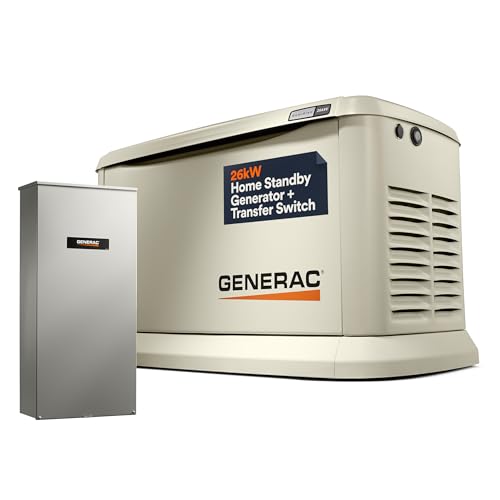
- 26,000 watts with whole-home coverage
- Includes a 200-amp transfer switch
- Wi-Fi monitoring and maintenance alerts
Best For: Homeowners wanting strong output with connected monitoring
Compact-Output Pick
Honeywell 14kW Home Standby Generator

- 14,000 watts for essential-circuit backup
- Includes a 16-circuit transfer switch
- Quiet-Test mode and multilingual LCD controls
Best For: Homes prioritizing essential circuits and clean power
Premium Whole-Home Protection
Kohler 20RESCL 20kW Standby Generator

- 20,000 watts with approximately 10-second startup
- 200-amp whole-house load-shedding transfer switch
- Corrosion-proof enclosure and 5-year/2,000-hour warranty
Best For: Large-home and coastal backup power
Connected Quiet Backup
Generac Guardian 18kW WiFi Generator

- WiFi monitoring with status and maintenance alerts
- 18,000 watts with under 5% harmonic distortion
- Quiet-test mode and natural gas or LP fuel
Best For: Connected, quieter residential backup
Flexible Fuel Backup
Westinghouse 13.5kW Tri-Fuel Generator

- Tri-fuel operation: gasoline, propane, or natural gas
- 13,500 peak and 10,500 running watts on gasoline
- Remote start and up to 19 hours of runtime
Best For: Portable, multi-fuel residential backup
Reliable Whole-Home Choice

- 14,000 watts with clean, stable output
- Includes 200A automatic transfer switch
- Wi-Fi monitoring and five-year warranty
Best For: Automatic whole-home backup with remote monitoring
Maximum Standby Capacity

- 22,000 watts on propane
- 19,800 watts on natural gas
- 10-year warranty and lifetime support
Best For: High-demand whole-home backup
Flexible Portable Backup
Westinghouse 14,500W Dual-Fuel

- 11,500 running watts on gasoline
- Dual-fuel gasoline and propane operation
- Remote start and low-THD output
Best For: Portable residential and multi-use backup power
Maximum-Coverage Pick – Generac 28kW Cellular Standby Generator
For shoppers comparing premium home standby generators, this 28kW Generac model is designed for whole-home coverage, automatic outage detection, and fuel-efficient operation. Built-in cellular capability supports remote monitoring and control through the Mobile Link app, while the aluminum-and-steel enclosure is designed for outdoor use.
Best For: Large homes that want high-output backup power and remote status monitoring.
Pros:
- 28,000 watts of automatic whole-home backup power
- Natural gas or propane ready with electronic fuel and ignition control
- Built-in cellular connectivity with performance and maintenance alerts
- Oil-level monitoring, cold-start support, and a five-year limited warranty
Cons:
- Heavy 524-pound design requires careful installation planning
- Mobile Link premium features require a subscription
- Professional installation is needed for a residential standby system
This is a strong premium choice when maximum listed output and away-from-home monitoring matter most. Its large footprint and installation requirements make it better suited to homeowners prepared for a substantial permanent backup-power system.
Power-Management Pick – Kohler 20kW Standby Generator
This Kohler is a compelling option among premium home standby generators for homeowners who want fast automatic transfer and strong load-starting capability. It includes a 200-amp outdoor-rated transfer switch and can operate on either natural gas or liquid propane, with advanced voltage and frequency regulation for connected electronics.
Best For: Homes with large startup loads, such as central air conditioning, that need dependable automatic transfer.
Pros:
- Restores power in about 10 seconds
- PowerBoost technology helps start large loads without dropping power to other appliances
- Runs on natural gas or liquid propane with field switching
- Includes a 200-amp service-entrance-rated automatic transfer switch
Cons:
- At 20kW, it provides less listed output than the 26kW and 28kW options here
- Heavy 485-pound enclosure requires a suitable installation location
- Requires professional installation and fuel-system planning
Its included transfer switch and PowerBoost technology make this a practical whole-home package for properties with demanding electrical loads. Consider a higher-output model if your backup plan includes unusually extensive simultaneous loads.
Balanced Whole-Home Pick – Generac Guardian 26kW Generator
The Generac Guardian 26kW balances substantial whole-home output with convenient Wi-Fi monitoring, making it a versatile entry in the premium home standby generators category. Its 200-amp transfer switch supports automatic integration, while True Power Technology is rated for clean power with less than 5% harmonic distortion.
Best For: Homeowners seeking high-capacity backup, automatic transfer, and Wi-Fi-based status updates.
Pros:
- 26,000 watts of whole-home backup power
- Includes a 200-amp automatic transfer switch
- Wi-Fi Mobile Link monitoring provides performance and maintenance alerts
- Natural gas or LP gas operation with a durable aluminum enclosure
Cons:
- Large, heavy unit weighs 518 pounds
- Wi-Fi monitoring depends on a suitable home network
- Installation should be completed by a certified, licensed electrician
This model is a well-rounded choice for buyers who want strong output without stepping up to the 28kW model. The included transfer switch simplifies system planning, but the generator still demands substantial space and professional installation.
Compact-Output Pick – Honeywell 14kW Home Standby Generator
For buyers who need a more focused backup setup, this Honeywell is a lower-output option among premium home standby generators. It includes a 16-circuit transfer switch, clean power rated below 5% total harmonic distortion, and a multilingual LCD controller that tracks battery status and maintenance intervals.
Best For: Homes that need essential-circuit backup rather than the highest available whole-home capacity.
Pros:
- 14,000 watts of standby output
- Includes a 16-circuit transfer switch
- PrecisionPower technology supports sensitive electronics and appliances
- Quiet-Test mode reduces test noise and fuel use
Cons:
- Lower output than the other generators in this roundup
- Three-year limited warranty is shorter than the five-year coverage offered by the larger models
- Does not list cellular or Wi-Fi remote monitoring
This Honeywell makes sense when your priority is backing up selected circuits with clean, controlled power rather than running every household load. Its included transfer switch and user-friendly controller add convenience, while the lower capacity keeps the system more targeted.
Premium Whole-Home Protection – Kohler 20RESCL 20kW Standby Generator
For homeowners seeking premium home standby generators, the Kohler 20RESCL-200SELS combines automatic startup, 20,000 watts of air-cooled power, and a 200-amp whole-house transfer switch. It can restore power in about 10 seconds and includes a corrosion-proof enclosure suited to demanding outdoor conditions.
Best For: Whole-house backup in larger homes, including coastal locations where corrosion resistance is a priority.
Pros:
- 20,000 watts with automatic startup and power restoration in about 10 seconds
- Includes a 200-amp service-entrance-rated load-shedding transfer switch
- Corrosion-proof enclosure and quiet operation
- Backed by a 5-year/2,000-hour limited warranty
Cons:
- At 500 pounds, it requires substantial handling and installation planning
- Its 48-inch length may require more installation space
- Requires a Group 51 battery
This Kohler is a strong premium choice when whole-house coverage, fast response, and weather resistance matter more than a compact installation footprint.
Connected Quiet Backup – Generac Guardian 18kW WiFi Generator
The Generac Guardian 18kW is one of the more connected premium home standby generators, pairing automatic whole-house backup with WiFi monitoring. Its True Power Technology delivers clean 18,000-watt output, while the quiet-test mode reduces noise and fuel use during self-checks.
Best For: Homeowners who want remote status and maintenance alerts along with quiet, automatic backup power.
Pros:
- WiFi connectivity enables remote performance and maintenance monitoring
- Produces 18,000 watts with under 5% harmonic distortion
- Quiet-test mode operates at lower RPM to reduce noise and fuel use
- Runs on natural gas or LP gas and includes a 5-year limited warranty
Cons:
- Installation should be completed by a certified, licensed electrician
- At 420 pounds, it is not a lightweight installation
- Automatic transfer switch details should be confirmed for the intended setup
Choose this Guardian if monitoring convenience and quieter self-testing are central to your buying decision. Its 18kW output offers substantial residential coverage without stepping up to the largest models.
Flexible Fuel Backup – Westinghouse 13.5kW Tri-Fuel Generator
The Westinghouse WGen10500TFc offers a flexible alternative to fixed standby systems for shoppers comparing premium home standby generators. This portable model supports gasoline, propane, or natural gas, provides remote electric start, and is transfer-switch ready for residential backup applications.
Best For: Homeowners who value portable deployment and the ability to choose among three fuel sources.
Pros:
- Delivers up to 13,500 peak and 10,500 running watts on gasoline
- Supports gasoline, propane, and natural gas with fuel-specific output ratings
- Remote key-fob start, electric start, and recoil start provide flexibility
- Offers up to 19 hours of runtime on a 9.5-gallon tank
Cons:
- It is a portable open-frame generator, not an automatic standby system
- Natural-gas output drops to 8,500 running watts
- Requires user setup and transfer-switch planning for home backup
This Westinghouse is compelling when fuel flexibility and portability outweigh the hands-off operation of a permanently installed standby generator. Its included accessories and three-year coverage simplify initial ownership.
Reliable Whole-Home Choice – Generac Guardian 14kW
For homeowners comparing premium home standby generators, the Generac Guardian 14kW combines automatic whole-house backup, a 200-amp transfer switch, and Wi-Fi monitoring in one residential system. It runs on natural gas or propane and delivers 14,000 watts with less than 5% harmonic distortion.
Best For: Homeowners seeking dependable automatic backup power with remote status and maintenance monitoring.
Pros:
- Includes a 200-amp automatic transfer switch for whole-house integration.
- Mobile Link Wi-Fi enables remote performance and maintenance alerts.
- True Power Technology provides clean, stable 14,000-watt output.
- Aluminum enclosure, low-maintenance engine, and five-year limited warranty.
Cons:
- Its 14kW output is lower than the Champion’s 22kW capacity.
- At 385 pounds, professional installation and site preparation are important.
The Guardian is a well-rounded premium option for standard whole-home coverage, especially if remote monitoring and an included transfer switch are priorities. Generac recommends installation by a certified, licensed electrician.
Maximum Standby Capacity – Champion 22kW Dual-Fuel
Among premium home standby generators, the Champion 22kW stands out for high continuous output and dual-fuel flexibility. It supplies 22,000 watts on propane or 19,800 watts on natural gas, while its included 200-amp transfer switch and fleX technology support demanding household loads.
Best For: Larger homes that need substantial standby capacity and flexible natural-gas or propane operation.
Pros:
- Provides up to 22,000 watts on propane and 19,800 watts on natural gas.
- Dual-fuel operation avoids manual refueling during an outage.
- 67 dBA operation, self-diagnostics, and cold-weather starting down to -22°F.
- Includes a 10-year limited warranty and free lifetime technical support.
Cons:
- At more than 634 pounds, it is especially demanding to move and install.
- Its larger enclosure and higher output may exceed the needs of smaller homes.
This Champion model is the strongest capacity-focused choice in the group. Its dual-fuel design, low-temperature starting capability, and long warranty make it a compelling fit where whole-home demand is high.
Flexible Portable Backup – Westinghouse 14,500W Dual-Fuel
The Westinghouse WGen11500DFc offers a flexible alternative to premium home standby generators for buyers who want high-output portable backup. It produces up to 11,500 running watts on gasoline or 10,500 on propane, with remote electric start, 240-volt output, and transfer-switch readiness.
Best For: Homeowners who want substantial backup power that can also serve jobsites, campsites, or other portable applications.
Pros:
- Dual-fuel operation provides gasoline and propane flexibility.
- Runs up to 19 hours on its 9.5-gallon gasoline tank.
- Low-THD output is designed for sensitive electronics.
- Remote electric start, fuel gauge, hour meter, and CO sensor add convenience and safety.
Cons:
- It is a portable open-frame generator rather than an automatic standby system.
- It requires fuel management and does not include an automatic transfer switch.
- Its three-year limited warranty is shorter than the standby models’ coverage.
The Westinghouse is best viewed as a versatile, high-output portable backup solution rather than a fully automatic whole-house generator. It makes sense for buyers who value mobility and dual-fuel operation.
How We Picked the Best Premium Home Standby Generators
We evaluated these generators by rated output, whole-home coverage potential, fuel type, transfer-switch compatibility, starting and monitoring features, and installation requirements. We also considered whether each model is designed for permanent standby service or is better suited to flexible portable backup. Because actual performance depends on the home’s electrical demand and installation, verify specifications with the manufacturer and a licensed electrician.
Quick Comparison
| What to Compare | Why It Matters |
|---|---|
| Rated wattage | Determines how many circuits or appliances can run simultaneously. |
| Fuel type | Natural gas and propane offer different availability, storage, and operating-cost advantages. |
| Transfer switch | Automatic whole-house switches provide faster, safer changeover than manual connections. |
| Monitoring | Wi-Fi or cellular connectivity can simplify status checks and maintenance alerts. |
| Installation | Permanent systems require site preparation, electrical work, fuel connections, permits, and code-compliant clearances. |
Key Buying Factors for Premium Home Standby Generators
Size the Generator to Your Real Load
List essential loads such as heating and cooling equipment, refrigerators, sump pumps, well pumps, medical devices, and electric water heaters. High-wattage appliances may require substantial starting power. A load calculation is more reliable than choosing by square footage alone, and load-shedding equipment can help manage competing demand.
Choose the Right Fuel Arrangement
Natural-gas models can provide convenient continuous supply where the utility remains available, while propane can be stored on-site and may be useful in rural locations. Dual-fuel portable units offer flexibility but usually require more hands-on setup and may not provide the same seamless operation as a permanently installed standby system.
Check Transfer-Switch and Service Compatibility
Confirm whether the package includes a 200-amp automatic transfer switch, supports service-entrance installation, or requires additional equipment. Compatibility with your electrical panel and utility service is essential.
Plan for Installation and Maintenance
Account for permits, concrete or composite pads, exhaust clearance, fuel-line work, battery replacement, exercise cycles, oil changes, and annual servicing. Remote monitoring is useful, but it does not replace physical inspections.
Who Should Buy Which Premium Home Standby Generators?
- Large homes with broad electrical demand: Consider the highest-output whole-home models, especially when central air conditioning, pumps, or electric heating must operate together.
- Typical homes seeking automatic backup: Midrange 14kW to 20kW standby systems can suit essential circuits or many whole-home applications after a professional load calculation.
- Homes prioritizing monitoring: Choose a compatible Wi-Fi or cellular-enabled system for alerts and status checks when you are away.
- Buyers needing fuel flexibility or a lower-commitment setup: Dual-fuel portable generators can provide strong output and easier relocation, but expect manual connection, storage, ventilation, and refueling responsibilities.
Before purchasing, compare the complete installed cost—not just the generator price—and confirm warranty terms, local service availability, noise expectations, and required maintenance.