
A dependable standby generator can keep essential systems, appliances, and whole-home circuits running when utility power fails. The right choice depends on more than wattage: transfer-switch design, fuel source, installation requirements, monitoring, and load management all matter.
We compare 10 leading options, including permanently installed natural-gas and propane models alongside transfer-switch-ready portable alternatives, to help you match backup capacity and features to your home.
Best 10 Professional Home Standby Generators Picks for 2026
Connected Whole-Home Backup
Generac 22kW Home Standby Generator

- 22,000 watts for automatic whole-home backup
- Built-in cellular monitoring and control
- Five-year warranty with cold-weather features
Best For: Homeowners wanting remote oversight and whole-house coverage
High-Output Dual-Fuel Choice

- 26kW on propane and 24kW on natural gas
- Includes a 200-amp automatic transfer switch
- 999cc Command Pro V-Twin engine
Best For: Larger homes prioritizing output and fuel flexibility
Quiet Electronics-Friendly Backup
Honeywell 14kW Home Standby Generator

- 14,000 watts with less than 5% harmonic distortion
- Includes a 16-circuit transfer switch
- Low-RPM Quiet-Test mode and LCD controls
Best For: Essential-circuit backup and sensitive electronics
Wi-Fi Whole-Home Power
Generac Guardian 26kW Generator
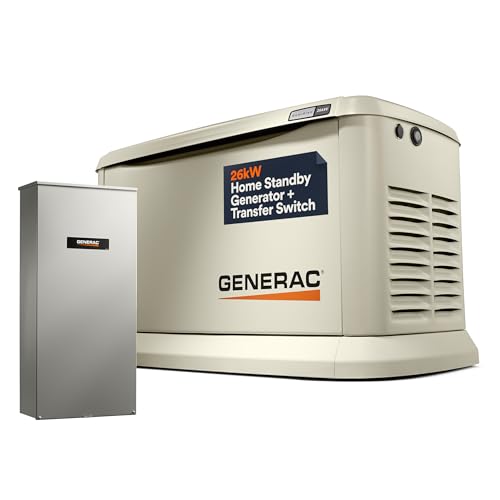
- 26,000 watts with under 5% harmonic distortion
- Includes a 200-amp automatic transfer switch
- Wi-Fi monitoring with five-year warranty
Best For: Whole-house backup with remote status monitoring
Premium Dual-Fuel Power

- 20kW on propane or 18kW on natural gas
- Includes 200A service entrance-rated transfer switch
- PowerBoost supports large motor loads
Best For: Whole-house backup with dual-fuel flexibility
Best for Everyday Use

- 14kW output with under 5% harmonic distortion
- Includes 200A transfer switch
- Wi-Fi monitoring provides remote alerts
Best For: Connected residential backup power
Coastal-Ready Whole-House Backup
Kohler 20kW Air-Cooled Standby Generator

- 20,000W automatic backup power
- Includes 200A load-shedding transfer switch
- Corrosion-proof enclosure for seaside conditions
Best For: Whole-house backup in coastal environments
Best Tri-Fuel Flexibility
Westinghouse 13,500W Tri-Fuel Generator

- Up to 10,500 running watts on gasoline
- Runs on gasoline, propane, or natural gas
- Remote start and transfer-switch-ready outlet
Best For: Homeowners seeking flexible, high-output portable backup power
Best Whole-Home Standby System
Champion 22kW Dual-Fuel Generator

- 22,000 watts on propane
- Includes a 200-amp automatic transfer switch
- 67 dBA operation and 10-year warranty
Best For: Permanent whole-home backup with automatic operation
Best Dual-Fuel Portable Option
Westinghouse 13,500W Dual-Fuel Generator

- Up to 10,500 running watts on gasoline
- Uses gasoline or propane
- Remote start with transfer-switch-ready output
Best For: Powerful portable residential backup using two common fuels
Connected Whole-Home Backup – Generac 22kW Home Standby Generator
For homeowners comparing professional home standby generators, this 22kW Generac model combines automatic whole-home backup with natural gas or propane compatibility. Its built-in cellular connectivity, fuel-control system, and cold-weather features make it a practical choice for year-round outage protection.
Best For: Homeowners who want whole-house coverage plus remote monitoring and maintenance alerts.
Pros:
- Provides 22,000 watts of automatic backup power for residential use.
- Built-in cellular connectivity supports Mobile Link monitoring and control away from home; premium subscription required for the listed real-time updates.
- Oil-level sensors, improved cold-start performance, and a sloped roof help support dependable operation in challenging weather.
- Includes a five-year limited warranty and 24/7/365 customer support.
Cons:
- At 451 pounds, it requires careful planning for delivery and installation.
- Remote monitoring features may require an additional premium subscription.
Choose this model if connectivity and whole-home convenience matter as much as output. Its monitoring features and weather-oriented design add useful reassurance, while the 22kW capacity suits many residential backup applications.
High-Output Dual-Fuel Choice – Kohler 26kW Standby Generator
This Kohler model is a strong option among professional home standby generators when higher output and fuel flexibility are priorities. It delivers up to 26kW on liquid propane, 24kW on natural gas, and includes a 200-amp automatic transfer switch for residential installation.
Best For: Larger homes that need high-capacity backup power and dual-fuel flexibility.
Pros:
- Provides 26kW on liquid propane and 24kW on natural gas.
- Includes a 200-amp automatic transfer switch.
- Uses a 999cc Command Pro V-Twin engine with electric start.
- OnCue Plus supports generator monitoring.
Cons:
- Its 625-pound weight can make delivery and installation more demanding.
- It is among the larger and heavier options in this roundup.
The Kohler stands out for combining substantial output with a transfer switch in the package. Consider it when your home’s electrical demands justify its larger footprint and heavier installation requirements.
Quiet Electronics-Friendly Backup – Honeywell 14kW Home Standby Generator
For smaller residential loads, this Honeywell unit offers a more compact 14kW approach to professional home standby generators. PrecisionPower technology, a low-RPM Quiet-Test mode, and an included 16-circuit transfer switch make it suited to homeowners focused on clean power and manageable routine operation.
Best For: Homes needing essential-circuit backup with quieter testing and protection for sensitive electronics.
Pros:
- PrecisionPower technology is rated at less than 5% total harmonic distortion.
- Quiet-Test mode runs at a lower RPM for five or twelve minutes and uses less fuel during testing.
- Includes a 16-circuit transfer switch and multilingual LCD controls.
- Its powder-coated aluminum enclosure is designed for corrosion resistance in all weather conditions.
Cons:
- The 14kW output may not cover every load in a larger home.
- The warranty is three years, shorter than the five-year coverage listed for several alternatives.
This Honeywell is best viewed as an essential-circuit solution rather than the highest-capacity whole-home option. Its clean power specification and quieter self-test mode make it appealing where electronics and neighborhood noise are key concerns.
Wi-Fi Whole-Home Power – Generac Guardian 26kW Generator
This Generac Guardian is a high-output option for shoppers evaluating professional home standby generators with integrated transfer equipment. Its 26kW output, 200-amp automatic transfer switch, Wi-Fi monitoring, and natural gas or LP compatibility are designed for comprehensive residential outage coverage.
Best For: Homeowners seeking high-capacity whole-house backup with Wi-Fi status and maintenance monitoring.
Pros:
- Delivers 26,000 watts with True Power Technology and under 5% harmonic distortion.
- Includes a 200-amp automatic transfer switch for whole-house integration.
- Wi-Fi connectivity supports remote performance and maintenance monitoring through Mobile Link.
- Features a purpose-built G-Force engine, aluminum enclosure, and five-year limited warranty.
Cons:
- At 518 pounds, installation and placement require substantial planning.
- Generac recommends installation by a certified and licensed electrician.
This Guardian is a well-rounded choice when high output, automatic transfer, and remote visibility are all important. It is particularly compelling for homeowners who want a single system designed around whole-house backup rather than selected circuits.
Premium Dual-Fuel Power – 20kW Kohler Standby Generator
For homeowners comparing professional home standby generators, this 20kW Kohler model combines automatic backup power, dual-fuel flexibility, and a 200-amp service entrance-rated transfer switch. It can run on natural gas or liquid propane and is designed to restore power in about 10 seconds.
Best For: Homes needing whole-house backup capacity, large-load starting support, and the option to switch between natural gas and propane.
Pros:
- Delivers 20kW on liquid propane and 18kW on natural gas.
- Includes a 200-amp outdoor-rated, service entrance-rated automatic transfer switch.
- PowerBoost technology helps start large loads such as central air conditioners.
- KOHLER Command PRO engine includes hydraulic valve lifters to reduce valve-adjustment needs.
Cons:
- At 485 pounds, it requires substantial planning for delivery and installation.
- Its 47-by-26.2-by-32.2-inch enclosure may require considerable outdoor space.
- The specified runtime is listed as 0 minutes, so fuel-use expectations should be confirmed with the installer.
This is a strong fit when high output and flexible fuel selection matter more than compact size. The included transfer switch and five-year limited warranty add practical value, but professional installation and site planning are essential.
Best for Everyday Use – Generac Guardian 14kW
This Generac Guardian is a practical choice among professional home standby generators for homeowners who value remote status updates. Its 14kW output, 200-amp transfer switch, natural gas or LP-gas compatibility, and Mobile Link Wi-Fi monitoring support convenient whole-house backup.
Best For: Homeowners who want automatic whole-house protection with Wi-Fi monitoring and a lower-capacity option than a 20kW generator.
Pros:
- Produces 14,000 watts with True Power Technology and under 5% harmonic distortion.
- Includes a 200-amp transfer switch for whole-house integration.
- Mobile Link Wi-Fi enables remote performance tracking and maintenance alerts.
- Runs on natural gas or LP gas and has a five-year limited warranty.
Cons:
- Its 14kW output is lower than the two 20kW alternatives in this roundup.
- Installation should be completed by a certified and licensed electrician.
- At 385 pounds, it still requires substantial handling and installation planning.
Choose this model if remote monitoring and clean, stable power are priorities. Its 14kW capacity can provide dependable residential backup, but homeowners with especially large electrical loads should confirm their requirements before purchase.
Coastal-Ready Whole-House Backup – Kohler 20kW Air-Cooled Standby Generator
This Kohler 20RESCL is built for homeowners seeking professional home standby generators with whole-house transfer capability and corrosion protection. It automatically starts during an outage, supplies 20,000 watts, and includes a 200-amp service entrance-rated load-shedding transfer switch.
Best For: Whole-house backup in demanding outdoor environments, including locations where corrosion resistance is a major concern.
Pros:
- Provides 20,000 watts of automatic standby power.
- Includes a 200-amp whole-house, service entrance-rated load-shedding transfer switch.
- Responds in about 10 seconds and is described as offering quiet operation.
- Its corrosion-proof enclosure is designed for harsh seaside conditions.
Cons:
- At 500 pounds, it is the heaviest generator in this selection.
- The 48-by-26.2-by-29-inch dimensions require adequate installation space.
- The supplied notes do not specify fuel type or remote-monitoring capability.
This model stands out for its combination of 20kW output, load-shedding transfer, and corrosion-resistant enclosure. It is especially compelling for coastal installations, provided the site can accommodate its size and weight.
Best Tri-Fuel Flexibility – Westinghouse 13,500W Tri-Fuel Generator
For shoppers comparing professional home standby generators, the Westinghouse WGen10500TFc offers substantial portable backup capacity with gasoline, propane, and natural-gas compatibility. Remote electric start, transfer-switch readiness, and up to 19 hours of runtime make it a flexible option for residential emergency power.
Best For: Homeowners who want high-output portable backup power and the option to use three fuel types.
Pros:
- Up to 13,500 peak watts and 10,500 running watts on gasoline.
- Supports gasoline, propane, and natural gas for added fuel flexibility.
- Includes remote key-fob start, CO and low-oil shutdown, and transfer-switch-ready output.
Cons:
- At 230 pounds, it is substantial for a portable generator.
- Its open-frame design may be less acoustically refined than an enclosed standby unit.
- Transfer-switch installation and household connection require appropriate planning.
This model stands out when fuel flexibility matters more than fully automatic standby operation. Its strong output, included startup accessories, and three-year limited warranty make it a practical whole-home backup candidate, provided you are prepared for its size and portable format.
Best Whole-Home Standby System – Champion 22kW Dual-Fuel Generator
Among professional home standby generators, the Champion 22kW system is designed for automatic whole-house backup rather than occasional portable use. It delivers 22,000 watts continuously on propane, 19,800 watts on natural gas, and includes a 200-amp automatic transfer switch.
Best For: Homeowners who want permanently installed, automatic backup for demanding household loads.
Pros:
- Provides up to 22,000 watts on propane and 19,800 watts on natural gas.
- Includes a 200-amp automatic transfer switch and Power Line Carrier technology.
- Features a weather-resistant aluminum enclosure, 67 dBA operation, and a 10-year limited warranty.
Cons:
- At over 634 pounds, it is intended for permanent installation rather than portability.
- It requires professional installation and suitable propane or natural-gas service.
- Its large 54-inch-long enclosure needs substantial installation space.
The Champion is the most complete standby solution in this group for households that prioritize automatic operation and high continuous output. Its dual-fuel design, cold-weather starting system, and long warranty support a more permanent backup-power setup.
Best Dual-Fuel Portable Option – Westinghouse 13,500W Dual-Fuel Generator
For buyers evaluating professional home standby generators but still wanting portable versatility, the Westinghouse WGen10500DFc combines high output with gasoline and propane operation. Its remote electric start, transfer-switch-ready connection, and 19-hour maximum runtime support residential outage preparedness.
Best For: Homeowners who want powerful portable backup without committing to natural-gas operation.
Pros:
- Produces up to 13,500 peak watts and 10,500 running watts on gasoline.
- Dual-fuel operation lets you switch between gasoline and propane.
- Includes remote start, a 50-amp RV-ready outlet, CO shutdown, and a digital hour meter.
Cons:
- Its 230-pound weight makes repositioning difficult.
- It does not support natural gas, unlike the tri-fuel version.
- As an open-frame generator, it may be louder and less enclosed than a stationary standby unit.
This is a strong middle ground for households that need serious backup capacity and fuel choice while retaining a portable design. Choose it over the tri-fuel model if gasoline and propane meet your needs; choose a stationary unit if automatic whole-home transfer is the priority.
How We Picked the Best Professional Home Standby Generators
We evaluated these generators by the factors that have the greatest effect on real-world reliability and ownership: rated output, whole-home or essential-circuit coverage, automatic transfer-switch compatibility, fuel options, remote monitoring, load management, installation complexity, and brand support. We also distinguished permanently installed standby systems from portable generators that require more hands-on setup during an outage.
Wattage claims can vary by fuel and operating condition, so compare continuous running output rather than peak numbers alone. A licensed electrician or generator installer should confirm service size, available gas capacity, local code requirements, and whether the selected transfer equipment is appropriate for your electrical panel.
Quick Comparison
| Generator type | Best for | What to prioritize |
|---|---|---|
| 14kW standby | Smaller homes and essential loads | Load calculation and selective circuit management |
| 20–22kW standby | Many average-size homes | Whole-home coverage, transfer-switch rating, and fuel supply |
| 26kW standby | Larger homes or heavier simultaneous loads | Service capacity, installation space, and load management |
| Dual- or tri-fuel portable | Flexible, lower-commitment backup | Manual setup, safe placement, inlet wiring, and runtime |
Key Buying Factors for Professional Home Standby Generators
Capacity and Load Calculation
Do not choose by square footage alone. List starting and running wattage for heating and cooling equipment, well pumps, sump pumps, refrigerators, medical devices, water heaters, and other priority loads. A professional load calculation can identify whether 14kW is sufficient or whether a 20kW-plus unit is more appropriate.
Transfer Switch and Electrical Compatibility
An automatic transfer switch detects an outage, disconnects the utility supply, and moves the home to generator power. Verify its amp rating, service-entrance configuration, phase, panel compatibility, and included accessories. Some packages include a transfer switch; others require separate equipment and installation.
Fuel, Runtime, and Installation
Natural gas offers convenient continuous supply where service is adequate, while liquid propane can be useful in areas without reliable gas infrastructure. Portable dual- and tri-fuel models provide flexibility but need outdoor operation, fuel handling, weather protection, and a properly installed connection. Never operate a generator indoors, in a garage, or near doors and windows.
Monitoring and Load Management
Wi-Fi or cellular monitoring can provide status alerts and maintenance information without requiring an on-site check. Load-shedding features help prevent overload by temporarily managing high-demand appliances, which can make a smaller generator more practical.
Who Should Buy Which Professional Home Standby Generators?
Choose a 14kW model if you mainly need essential circuits and have a carefully managed electrical load. A 20kW to 22kW standby generator is the practical middle ground for many households seeking broad automatic coverage. Choose a 26kW unit when a load calculation supports the added capacity or your home has substantial electric heating, cooling, pumping, or cooking demands.
Pick a portable dual- or tri-fuel generator when upfront cost, fuel flexibility, or occasional emergency use matters more than fully automatic operation. For seamless outage response and the least manual involvement, a permanently installed standby system with a correctly sized transfer switch and professional installation is the better fit.