
If you’re looking to enhance your filmmaking skills, choosing the right cinema lens can make all the difference. Whether you’re shooting wide landscapes or intimate portraits, the right lens can elevate your visuals considerably. With so many options out there, it’s essential to understand what features to prioritize. Let’s explore some of the top cinema lenses that can transform your projects and take your storytelling to the next level.
Meike 50mm T2.2 Mini Manual Focus Cinema Lens for M43 Cameras

If you’re a filmmaker using Micro Four Thirds cameras, the Meike 50mm T2.2 Mini Manual Focus Cinema Lens is an excellent choice for your video projects. With its wide aperture of T2.2, you can create stunning shallow depth of field shots. This lens offers a focal length equivalent to 100mm, perfect for both portrait and landscape work. Its compact design features seven groups and nine elements, ensuring sharp images with minimal distortion. Plus, users rave about the build quality and manual aperture adjustments, making it ideal for close-ups and music videos. Elevate your filmmaking with this exceptional lens.
Best For: Filmmakers using Micro Four Thirds cameras who are looking for a compact, high-quality lens for portrait and landscape shots.
Pros:
- Produces sharp images with low distortion and minimal chromatic aberration.
- Wide aperture of T2.2 allows for beautiful shallow depth of field effects.
- Highly praised build quality and manual aperture adjustments enhance creative control.
Cons:
- Manual focus may not be suitable for all users, particularly beginners.
- Limited compatibility with non-Micro Four Thirds cameras.
- Heavier than some other compact lenses, which may affect portability.
Meike 35mm T2.2 Mini Manual Focus Cinema Lens for M43 Cameras
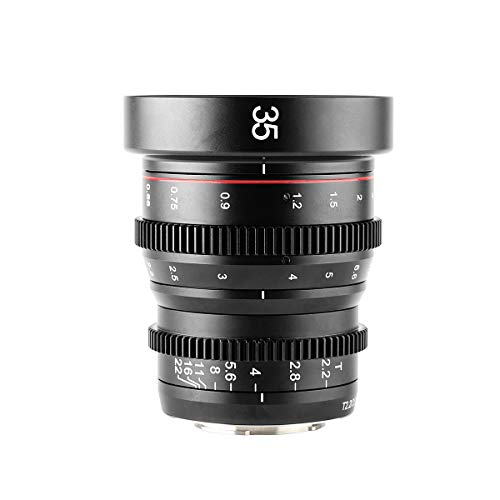
The Meike 35mm T2.2 Mini Manual Focus Cinema Lens is an excellent choice for filmmakers using M43 cameras who seek cinematic quality in a compact package. With a wide T2.2 aperture, you can achieve a beautiful shallow depth of field, perfect for portrait shots and interviews. The lens features a 35mm focal length, providing a 37-degree view angle that enhances your storytelling. You’ll appreciate its sharp image quality, low distortion, and minimal focus breathing. Built lightweight and compact, this lens is ideal for video use, making it a fantastic addition to your filmmaking toolkit. Elevate your projects effortlessly!
Best For: Filmmakers using M43 cameras looking for a compact lens that delivers cinematic quality for portrait shots and interviews.
Pros:
- Produces sharp images and videos with low distortion.
- Wide T2.2 aperture allows for beautiful shallow depth of field.
- Compact and lightweight design makes it ideal for video use.
Cons:
- Manual focus may not be suitable for all users, especially beginners.
- Limited to M43 camera mounts, restricting compatibility with other systems.
- Fixed focal length may limit versatility compared to zoom lenses.
Meike 16mm T2.2 Manual Focus Wide Angle Cinema Lens for M43 Cameras

For filmmakers and videographers using M43 Micro Four Thirds cameras, the Meike 16mm T2.2 Manual Focus Wide Angle Cinema Lens stands out as an excellent choice. Weighing just 8.1 ounces, it’s lightweight and compact, making it perfect for handheld shooting. This lens delivers sharp images with minimal distortion, offering a 73-degree view angle and beautiful bokeh. While its manual focus may require some practice, users appreciate the smooth focus and aperture rings. Although it’s not weather-sealed and can struggle with flares, its price and performance make it a fantastic value for both video and photography enthusiasts.
Best For: Filmmakers and videographers looking for a lightweight, budget-friendly cinema lens for M43 cameras that delivers exceptional image quality.
Pros:
- Produces sharp images with low distortion and beautiful bokeh.
- Smooth focus and aperture rings enhance user experience.
- Compact and lightweight design ideal for handheld shooting.
Cons:
- Not weather-sealed, making it less suitable for challenging outdoor conditions.
- Struggles with lens flares; use of a lens hood is recommended.
- Manual focus may require practice, particularly due to the nearly 360-degree focus ring.
SIRUI 35mm Anamorphic Lens F1.8 for M4/3 Mount

Designed for filmmakers seeking a cinematic edge, the SIRUI 35mm Anamorphic Lens F1.8 for M4/3 Mount offers a unique 1.33x squeeze factor that allows you to capture stunning full HD 2.4:1 video without any post-cropping. With an equivalent field of view of 26.3mm, it widens your horizontal perspective by 33%. The lens produces beautiful light streaks and star bursts, enhancing your visuals. While some users appreciate its sharpness, others report softness at wide open. Its compact design makes it portable, but manual focus might pose a challenge for beginners. Overall, it’s a solid choice for elevating your filmmaking.
Best For: Filmmakers and videographers looking for a lightweight, versatile lens that enhances their cinematic storytelling with anamorphic characteristics.
Pros:
- Produces a 1.33x squeeze factor for authentic cinematic framing in full HD.
- Compact design and lightweight build make it easy to handle and transport.
- Unique visual effects like blue flares and oval bokeh enhance the overall image quality.
Cons:
- Some users report difficulty achieving focus, especially with manual settings.
- Image sharpness can be inconsistent, with some finding it soft at wider apertures.
- Potential learning curve for beginners due to manual focus and de-squeezing requirements.
MEKE 16mm T2.2 Mini Cine Lens for Micro Four Thirds Cameras

Filmmakers using Micro Four Thirds cameras will find the MEKE 16mm T2.2 Mini Cine Lens an excellent choice for achieving professional-quality video. With a focal length equivalent of 32mm, this lens delivers sharp imagery and beautiful circular bokeh while minimizing focus breathing. Its all-metal construction guarantees durability, though the weight may impact stabilization. The manual focus and click-less aperture allow for precise control, making it ideal for cinematic work. Users appreciate its performance and value compared to higher-priced alternatives, though some have reported delivery issues. Overall, it’s a reliable option for anyone wanting to elevate their filmmaking experience.
Best For: Filmmakers using Micro Four Thirds cameras seeking a budget-friendly lens that delivers professional-quality video.
Pros:
- Sharp imagery with beautiful circular bokeh and minimal focus breathing.
- Durable all-metal construction enhances reliability and stability.
- Manual focus and click-less aperture provide precise control for cinematic shooting.
Cons:
- Heavier design may affect stabilization during handheld shooting.
- Some users reported delivery issues, including unsealed packaging and minor cosmetic damages.
- Requires manual settings for operation, which may not suit all users.
MEKE 25mm T2.1 Super 35 Prime Manual Focus Cinema Lens for EF-Mount Cameras

The MEKE 25mm T2.1 Super 35 Prime Manual Focus Cinema Lens stands out as an exceptional choice for those using EF-mount cine cameras like the Canon C200 and RED Komodo. With a focus throw of 270º and a wide T2.1 aperture, it excels in both landscape and portrait shooting. Its 13-element construction guarantees sharp imaging and beautiful circular bokeh, making it perfect for various cinematography applications. Weighing 2.57 pounds, this lens is built for durability and offers excellent usability with gimbals. Users rave about its cinematic quality and sharpness, giving it an impressive average rating of 4.4 stars.
Best For: Those seeking a high-quality cinema lens for EF-mount cameras that delivers exceptional sharpness and cinematic quality in both landscape and portrait shooting.
Pros:
- Excellent build quality ensures durability and longevity for professional use.
- Wide T2.1 aperture allows for low-light shooting and beautiful bokeh effects.
- Smooth focus throw of 270º enhances precision in manual focus scenarios.
Cons:
- Weight of 2.57 pounds may be cumbersome for extended handheld shooting.
- Manual focus only may not be suitable for users who prefer automatic focusing.
- Limited compatibility as it is specifically designed for EF-mount cameras.
Meike 12mm T2.2 Manual Focus Wide Angle Prime Cinema Lens for M43 Cameras

For those diving into the world of videography, the Meike 12mm T2.2 Manual Focus Wide Angle Prime Cinema Lens offers a compelling option for M43 camera users. With a wide 92-degree view angle and an aperture of T2.2, you’ll achieve stunning depth of field and sharp images. Its all-metal construction guarantees durability, making it a reliable choice for various shooting conditions. Perfect for landscape videography and cinematic applications, this lens pairs seamlessly with popular M43 models like the Panasonic Lumix GH5 and Olympus OMD-EM10. Elevate your filmmaking with this exceptional lens that combines quality, performance, and versatility.
Best For: Videographers and filmmakers using M43 cameras looking for a high-quality wide angle lens for landscape and cinematic shots.
Pros:
- Produces sharp images and videos with low distortion.
- Durable all-metal construction ensures longevity and reliability.
- Wide 92-degree view angle enhances creative shooting possibilities.
Cons:
- Manual focus may be challenging for beginners or fast-paced shooting.
- Fixed focal length limits versatility compared to zoom lenses.
- T2.2 aperture may not be ideal for low-light situations compared to faster lenses.
Meike 8mm T2.9 Mini Cinema Lens for M43 Micro Four Thirds Cameras

Designed specifically for M43 Micro Four Thirds cameras, the Meike 8mm T2.9 Mini Cinema Lens is a top choice for creators seeking a compact and versatile wide-angle option. With a T2.9 aperture, you’ll achieve a beautiful shallow depth of field, making it perfect for landscapes and environmental portraits. Weighing just 1.63 pounds and measuring 5.87 x 4.92 x 4.88 inches, it’s easy to carry around. Users praise its sharp images and low distortion, though be mindful of potential edge distortion in post-production. This lens encourages you to experiment with unique perspectives, elevating your filmmaking experience.
Best For: Filmmakers and content creators looking for a compact and versatile wide-angle lens for M43 Micro Four Thirds cameras.
Pros:
- Excellent optical performance with sharp images and low distortion.
- Compact and lightweight design, making it easy to carry for on-the-go shooting.
- De-clicked aperture allows for smooth adjustments during filming.
Cons:
- Some edge distortion may require post-production correction.
- Availability of compatible ND filters can be limited and expensive.
- Manual focus may demand extra attention in dynamic shooting scenarios.
7artisans 50mm T2.0 Cine Lens for Nikon Z-Mount

Crafted specifically for filmmakers and videographers using Nikon Z-Mount cameras, the 7artisans 50mm T2.0 Cine Lens stands out with its large aperture and exceptional image quality. This manual focus lens is perfect for full-frame sensors, delivering high-resolution images thanks to advanced optical design. With almost zero breathing during focus adjustments, you’ll maintain stability and clarity, even in low light. The 12 aperture blades create beautiful bokeh, while the 270-degree focus travel allows for precise control. Plus, its high-quality MC multilayer coating minimizes glare and ghosting, ensuring your footage has the contrast and detail it deserves.
Best For: Filmmakers and videographers using Nikon Z-Mount cameras who require a high-quality manual focus lens for cinematic projects.
Pros:
- Exceptional image quality with high-resolution results, even in low light.
- Almost zero breathing effect during focus adjustments for stable footage.
- 270-degree focus travel allows for precise and delicate focus control.
Cons:
- Manual focus may not be suitable for all users, particularly those preferring autofocus.
- Limited to Nikon Z-Mount cameras, reducing versatility for users with other camera systems.
- Higher price point compared to standard lenses may not fit all budgets.
MEKE 85mm T2.2 Mini Fixed Prime Cinema Lens for M43 Cameras

The MEKE 85mm T2.2 Mini Fixed Prime Cinema Lens is an outstanding choice for filmmakers using Micro Four Thirds cameras who want to achieve stunning portrait and landscape shots. With its wide T2.2 aperture, you’ll enjoy a shallow depth of field and beautifully blurred backgrounds. The lens features a compact design, making it easy to handle while shooting. It consists of 7 groups and 9 elements, providing sharp images with minimal distortion and chromatic aberration. Compatible with BMPCC 4K and Z CAM models, this lens elevates your video production, ensuring excellent performance in both center and corners.
Best For: Filmmakers and videographers using Micro Four Thirds cameras who seek high-quality portrait and landscape shots.
Pros:
- Produces sharp images with low distortion and minimal chromatic aberration.
- Compact and lightweight design enhances portability and ease of use.
- Wide T2.2 aperture allows for shallow depth of field and beautiful background blur.
Cons:
- Manual focus may not suit users who prefer autofocus capabilities.
- Limited to M43 mount cameras, restricting compatibility with other camera systems.
- May require additional accessories for optimal use in various shooting conditions.
Factors to Consider When Choosing a Cinema Lens for Video
When choosing a cinema lens for video, you need to take into account several key factors. Lens compatibility, aperture range, and focal length all play an essential role in achieving the look you want. Additionally, don’t overlook image quality and the build’s durability, as these elements can greatly impact your production.
Lens Compatibility
Choosing the right cinema lens for video involves several key factors that can greatly impact your shooting experience. First, verify the lens mount type matches your camera body; for example, use M43 for Micro Four Thirds or EF-Mount for Canon systems. Next, check the lens’ optical structure and design to confirm it meets your cinematic quality goals. Consider the focal length and field of view that align with your videography needs—whether you’re shooting portraits, landscapes, or wide angles. Also, evaluate if the lens supports manual focus and aperture control; these features are essential for achieving precise effects. Finally, review user feedback specific to your camera model to guarantee peak performance and avoid compatibility issues.
Aperture Range Importance
Understanding the importance of the aperture range in a cinema lens can greatly enhance your video production. The aperture controls how much light enters the lens, which directly impacts exposure and performance in low-light situations. A wider aperture, like T2.2, offers a shallower depth of field, allowing you to isolate your subjects and create that coveted cinematic look. If you’re working with zoom lenses, opt for those with a constant aperture to maintain consistent exposure during changes. Additionally, lenses with lower f-stop numbers produce beautiful bokeh effects, elevating the aesthetic quality of your footage. Grasping how aperture influences depth of field and exposure is essential for achieving your visual storytelling goals.
Focal Length Selection
What factors do you consider most important when selecting a focal length for your cinema lens? First, think about the angle of view you need. Shorter focal lengths, like 16mm, offer wider perspectives, perfect for landscapes or establishing shots. On the other hand, longer focal lengths, such as 85mm, excel in portraiture and tighter compositions. If you’re using a Micro Four Thirds camera, remember that a 35mm lens effectively acts like a 70mm, making it versatile for interviews. Also, consider depth of field; longer lenses create a shallower depth, enhancing background blur for a cinematic look. Finally, understand focal length equivalences across systems to guarantee you achieve your desired framing and storytelling impact seamlessly.
Image Quality Considerations
Image quality is a critical factor in selecting a cinema lens for video production, as it directly influences the overall look of your project. Higher element counts, like 13 elements in 10 groups, typically provide better sharpness and reduced distortion. A wide aperture, such as T2.2, not only enhances the cinematic feel by creating a shallow depth of field but also allows for better performance in low-light situations. Look for lenses with minimal focus breathing to maintain consistent framing during focus shifts. Additionally, consider how well the lens controls chromatic aberration, as this affects color fidelity. Finally, guarantee consistent sharpness across the frame, especially in the corners, to achieve professional-quality results.
Build Quality and Durability
When choosing a cinema lens for video, you’ll find that build quality and durability play crucial roles in ensuring reliable performance on set. High-quality cinema lenses often feature all-metal construction, enhancing durability and providing a solid feel during use, perfect for demanding environments. A heavier design can improve stability when mounted on rigs, although it might affect handheld stabilization. Look for lenses with protection features like the ability to install UV filters without protruding, safeguarding the front element. Smooth and satisfying focus and aperture rings are essential for precise adjustments during filming. Overall, a well-constructed lens impacts image integrity, influencing sharpness, focus breathing, and minimizing distortion in your captured footage. Choose wisely, and your filmmaking will benefit immensely.
Manual vs. Autofocus
Choosing the right focus system is just as important as considering build quality and durability in cinema lenses for video. Manual focus lenses, with their long focus throw, allow you to make precise adjustments, perfect for achieving specific cinematic effects. They’re favored for their tactile feedback, especially during critical focus scenarios like close-ups. Plus, manual lenses often offer smooth, click-less aperture adjustments for seamless exposure changes while filming. On the other hand, autofocus lenses provide speed and ease, which can be a lifesaver in dynamic environments with moving subjects. However, they might struggle in low-light situations or with certain subjects, where manual focus shines for its reliability. Ultimately, your choice depends on your shooting style and the demands of your project.
Weight and Size
Weight and size are essential factors that can make or break your shooting experience with cinema lenses for video. Heavier lenses can complicate stability, often necessitating more robust stabilization equipment. If you’re planning on handheld shooting, look for compact lenses around 1.34 pounds or less, as they’re easier to manage. Dimensions matter too; lenses measuring 4 to 6 inches fit more easily in your camera bag and work well in tight spaces. A lens’s size can also affect the overall balance of your rig, impacting comfort during long sessions, especially with manual focus. For mobile shooting, lightweight options under 2 pounds are ideal, while heavier lenses can enhance visual effects or depth of field in cinematic setups.