
When a power outage affects refrigeration, heating, medical equipment, or remote work, a premium inverter generator can deliver cleaner, more flexible backup power than a basic portable model.
We selected 10 standout options ranging from compact 3,000-watt Honda models to high-output tri-fuel systems designed for whole-home backup. Use the guide below to match capacity, connectivity, fuel choice, and convenience features to your needs.
Best 10 Premium Inverter Home Generators Picks for 2026
Best Tri-Fuel Capacity

- 12,000 peak and 9,000 running watts on gasoline
- Tri-fuel operation with low-THD inverter output
- 50A outlet, remote start, and 19-hour runtime
Best For: High-capacity whole-home backup with flexible fuel choices
Best Quiet Dual-Fuel Value
AIVOLT 11250W Inverter Generator
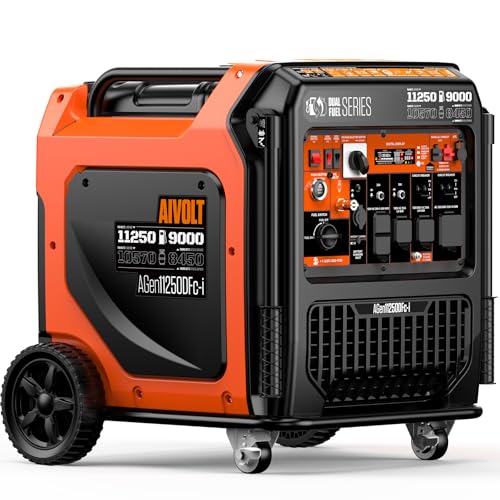
- Up to 9,000 running watts on gasoline
- Dual-fuel operation with 50A and ATS compatibility
- 60 dBA rating and remote start
Best For: Quiet home, RV, food-truck, and jobsite backup
Best Quiet Premium Compact Option

- Quiet 52–58 dB(A) inverter operation
- 7,000 watts with 120/240V capability
- Bluetooth app, CO-MINDER, and up to 16-hour runtime
Best For: Quiet gasoline backup for homes, RVs, and camping
Best Maximum-Output Tri-Fuel Choice

- 14,500 peak and 11,500 running watts on gasoline
- Tri-fuel operation with remote electric start
- 19-hour runtime and optional automatic transfer switch
Best For: Large-home backup requiring high output and fuel flexibility
Quiet Reliability

- 3,000-watt inverter output for home and RV essentials
- Very quiet 50–57 dB(A) operation
- Up to 19.6-hour runtime with CO-MINDER protection
Best For: Quiet home backup and RV power
Maximum Backup Flexibility

- Up to 13,500 peak watts on gasoline
- Runs on gasoline, propane, or natural gas
- ATS auto-start, Bluetooth, and CO protection
Best For: High-demand home backup and multi-fuel flexibility
Balanced RV and Home Backup

- 5,000 peak watts with gasoline or propane
- Quiet operation as low as 52 dBA
- Remote start and RV-ready TT-30R outlet
Best For: Quiet dual-fuel RV and emergency backup
Best High-Output Pick
GENMAX 17,000W Tri-Fuel Inverter

- 17,000 starting and 13,500 running watts
- Gasoline, propane, and natural-gas operation
- Two 50A outlets with ATS-compatible start/stop
Best For: Whole-home backup and demanding job-site tools
Best Balanced Home Backup

- 13,000 surge and 10,500 running watts on gasoline
- Tri-fuel operation with 120V/240V output
- Electric start, CO Watchdog, and transfer-switch-ready outlets
Best For: Residential backup and transfer-switch installations
Best Maximum-Capacity Option
DuroMax 28,000W Tri-Fuel Inverter
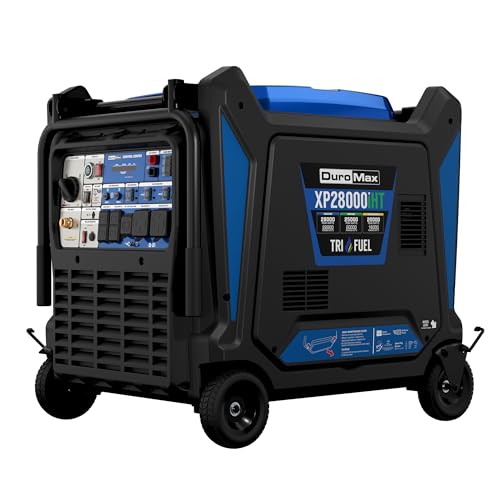
- Up to 28,000 watts for large backup loads
- Tri-fuel design with two 50A outlets
- Remote start and five-year warranty
Best For: Large homes and commercial-scale emergency backup
Best Tri-Fuel Capacity – Westinghouse iGen12000TFc
For shoppers comparing premium inverter home generators, the Westinghouse iGen12000TFc stands out with tri-fuel flexibility, substantial output, and electronics-friendly power. It provides up to 12,000 peak watts on gasoline and includes a 50A outlet for larger home-backup loads.
Best For: Homeowners who want high-capacity backup power with gasoline, propane, or natural gas options.
Pros:
- Tri-fuel operation supports gasoline, propane, and natural gas.
- Low THD of 3% or less is suitable for sensitive electronics.
- Runs up to 19 hours at 25% load and includes remote start.
- Transfer-switch and interlock-kit ready with a 50A outlet.
Cons:
- At 191 pounds, it is substantial for a portable generator.
- Its 9,000-watt gasoline running output may exceed the needs of smaller households.
The iGen12000TFc is a strong fit when fuel flexibility and whole-home capability matter more than compact size. Its digital data center, CO sensor, and parallel capability add practical convenience for extended outages.
Best Quiet Dual-Fuel Value – AIVOLT 11250W Inverter Generator
The AIVOLT 11250W is a practical option among premium inverter home generators for buyers who want dual-fuel flexibility, a 50A connection, and relatively quiet operation. It supplies up to 9,000 running watts on gasoline and supports remote or push-button starting.
Best For: Home backup users, RV owners, and food-truck operators seeking quiet dual-fuel power.
Pros:
- Delivers 11,250 starting and 9,000 running watts on gasoline.
- Runs on gasoline or propane and supports ATS connection.
- Rated at 60 dBA at 23 feet at 25% load.
- Includes remote start, CO shutoff, and overload protection.
Cons:
- Engine oil is not included in the kit.
- The 2-year warranty is shorter than some alternatives in this roundup.
- At 221 pounds, it is not especially easy to move.
With a claimed 19-hour runtime and a 50A outlet, the AIVOLT balances useful home-backup features with RV and mobile-work applications. It is worth considering if quiet operation and dual-fuel capability are priorities.
Best Quiet Premium Compact Option – Honda EU7000iS
The Honda EU7000iS is a refined choice among premium inverter home generators for buyers who value quiet operation, fuel efficiency, and established monitoring features. Its 7,000-watt output supports 120/240V use, while the inverter system is designed for computers and other sensitive electronics.
Best For: Homeowners, RV users, and campers who prioritize quiet, efficient gasoline power.
Pros:
- Operates at a quiet 52 to 58 dB(A).
- Runs 6.4 to 16 hours on a 5.1-gallon tank.
- My Generator app offers Bluetooth monitoring and remote stop features.
- CO-MINDER monitors carbon monoxide and can shut the generator down.
Cons:
- Gasoline is the only listed fuel type.
- Its 7,000-watt output is lower than the larger generators here.
- At 263.2 pounds, portability is limited despite the wheels.
The EU7000iS makes the most sense when low noise and polished operation outweigh maximum wattage or multi-fuel flexibility. Its 3-year residential warranty and app-based monitoring add reassurance for regular use.
Best Maximum-Output Tri-Fuel Choice – Westinghouse WGen11500TFc
For shoppers needing maximum capacity from premium inverter home generators, the Westinghouse WGen11500TFc combines 14,500 peak watts with tri-fuel operation. It is designed for home backup, offers remote electric start, and can pair with a compatible automatic transfer switch sold separately.
Best For: Larger homes needing high-output, tri-fuel backup with optional automatic transfer capability.
Pros:
- Produces 11,500 running and 14,500 peak watts on gasoline.
- Supports gasoline, propane, and natural gas.
- Runs up to 19 hours at 25% load on its 9.5-gallon tank.
- Includes CO sensing, low-oil shutdown, and remote start.
Cons:
- The WATS200 automatic transfer switch is sold separately.
- Its less-than-5% THD rating is higher than the other Westinghouse inverter model listed.
- The open-frame design and 230-pound weight favor capacity over portability.
The WGen11500TFc is a compelling high-output solution when a household needs substantial 120/240V power and multiple fuel choices. Its pressure-lubricated 550cc engine, copper windings, and 3-year residential warranty support long-term backup use.
Quiet Reliability – Honda EU3000iS
The Honda EU3000iS is a strong premium inverter home generator choice for essential backup loads, RV use, and quiet overnight operation. Its 3,000-watt output, electric start, inverter technology, and CO-MINDER protection make it practical for powering furnaces, refrigerators, computers, and most 13,500 BTU RV air conditioners.
Best For: Home essentials, RV owners, and buyers who prioritize quiet operation and long runtime.
Pros:
- Runs at approximately 50–57 dB(A), quieter than a normal conversation.
- Electric start and inverter power are convenient for home and RV use.
- Runs up to 19.6 hours on a 3.4-gallon tank under suitable conditions.
- CO-MINDER automatically shuts down the generator when CO levels become dangerous.
Cons:
- At 144 pounds, it is heavy for a portable generator.
- It is gasoline-only and offers 2,800 running watts.
- Not available in California; the supplied notes recommend model EU3200IAC2 instead.
The EU3000iS emphasizes dependable, quiet performance over maximum output or fuel flexibility. It is a sensible premium option when low noise, simple operation, and extended runtime matter more than lightweight portability.
Maximum Backup Flexibility – GENMAX 13500W Tri-Fuel
The GENMAX 13500W is built for high-demand backup, making it one of the more capable premium inverter home generators in this group. It combines tri-fuel operation, up to 13,500 peak watts on gasoline, 50A-capable output, automatic-start options, and pure sine wave power for demanding household or job-site loads.
Best For: Whole-home backup users, high-demand equipment, and buyers who need gasoline, propane, and natural gas flexibility.
Pros:
- Tri-fuel operation supports gasoline, propane, and natural gas.
- Delivers up to 13,500 peak and 11,500 running watts on gasoline.
- Offers five start methods, including ATS 2-wire auto-start and Bluetooth control.
- Pure sine wave output is rated at 3% or less THD for sensitive electronics.
Cons:
- At 273.7 pounds, it is substantially less portable than smaller models.
- Its 6.9-gallon tank provides up to 11.2 hours of runtime in the stated conditions.
- Its large size and high output may be excessive for basic emergency loads.
Choose the GENMAX when output capacity and fuel options are more important than compact size. The auto-start features, outlet selection, monitoring, and CARB compliance make it especially suited to prepared, higher-demand backup installations.
Balanced RV and Home Backup – Westinghouse iGen5000DFc
The Westinghouse iGen5000DFc offers a practical middle ground for shoppers comparing premium inverter home generators. It provides dual-fuel flexibility, remote electric start, RV-ready connectivity, quiet operation as low as 52 dBA, and up to 5,000 peak watts for emergency home use, camping, or job-site power.
Best For: RV owners and households seeking quiet, dual-fuel backup without moving to a large high-output unit.
Pros:
- Provides up to 5,000 peak watts on gasoline and 4,500 on propane.
- Runs on gasoline or propane and can operate up to 18 hours at 25% load on gasoline.
- Remote electric start, RV-ready TT-30R outlet, USB ports, and digital display add convenience.
- Quiet operation reaches as low as 52 dBA, with less than 3% THD.
Cons:
- It has no natural-gas option.
- The supplied output is 3,900 running watts on gasoline and 3,500 on propane.
- The optional parallel kit is sold separately.
The iGen5000DFc is a well-balanced pick for moderate home backup and RV applications. Its dual-fuel design and quiet, remote-start operation add flexibility, while parallel capability leaves room to expand later if a second compatible generator is added.
Best High-Output Pick – GENMAX 17,000W Tri-Fuel Inverter
For shoppers comparing premium inverter home generators, the GENMAX GM 17000iETC combines substantial whole-home capacity with gasoline, propane, and natural-gas flexibility. It delivers 17,000 starting watts and 13,500 running watts, while pure sine wave output rated at 3% THD or less is designed for sensitive electronics.
Best For: Whole-home backup and demanding construction-site tools where high output, tri-fuel operation, and automatic-start compatibility matter.
Pros:
- Tri-fuel operation with remote and push-button start
- 17,000 starting watts and 13,500 running watts
- Two 50A outlets and ATS-compatible two-wire start/stop
- CO shutdown, overload protection, digital display, and USB-C/A ports
Cons:
- At 308.6 pounds, it is difficult to move without its intended setup and handling plan
- Its 33-inch-plus footprint requires substantial storage space
The GENMAX stands out when power capacity and installation flexibility take priority. Its commercial-grade V-twin engine, maintenance-focused design, three-year warranty, and lifetime technical support add reassurance for frequent or extended backup use.
Best Balanced Home Backup – WEN 13,000W Tri-Fuel Inverter
The WEN TF1300iX is a practical option among premium inverter home generators for buyers who want tri-fuel flexibility without stepping up to the largest models. Its 120V/240V bonded-neutral output supports transfer-switch installations, and its 550cc engine provides up to 13,000 surge watts and 10,500 running watts on gasoline.
Best For: Residential backup, transfer-switch use, and Level 2 charging applications requiring flexible fuel choices and a quieter inverter design.
Pros:
- Switches among gasoline, propane, and natural gas
- 120V/240V output includes transfer-switch-ready outlets
- Electric start and CO Watchdog automatic shutdown
- Includes wheel kit, USB outlets, and a three-year limited warranty
Cons:
- Running output varies substantially by fuel, from 10,500 watts on gasoline to 8,000 on natural gas
- Half-load runtime is listed at up to 7.7 hours, so refueling may be needed during longer outages
With eight outlets, a 7.1-gallon tank, and straightforward electric starting, the WEN offers a balanced feature set for home emergency use. It is a sensible middle-ground choice for buyers who need broad connectivity and fuel flexibility more than maximum wattage.
Best Maximum-Capacity Option – DuroMax 28,000W Tri-Fuel Inverter
For buyers seeking the highest capacity among these premium inverter home generators, the DuroMax XP28000iHT is built for major whole-home backup demands. It supplies up to 28,000 watts, uses gasoline, propane, or natural gas, and includes two 50A outlets for generator interlocks or transfer switches.
Best For: Large residences, commercial applications, and emergency scenarios where maximum available inverter output is the primary requirement.
Pros:
- 28,000-watt output for extensive whole-home power needs
- Tri-fuel capability with an included 15-foot natural-gas hose
- Two 50A outlets for interlocks or transfer switches
- Remote electric start, CO sensor, digital display, and five-year warranty
Cons:
- At 466 pounds, it is substantially heavier than the other listed options
- Its 42-by-32-by-35-inch dimensions require considerable space
- The supplied details list gasoline and propane under the power-source field, so buyers should verify the natural-gas configuration before installation
The XP28000iHT prioritizes scale and connection flexibility over portability. Clean copper windings, sine-wave inverter power, remote starting, and included fuel-hose accessories make it well suited to a permanent or semi-permanent backup setup, provided the installation area can accommodate its size and weight.
How We Picked the Best Premium Inverter Home Generators
We evaluated these generators against the factors that matter most during an outage: continuous and peak output, 120/240-volt capability, fuel flexibility, transfer-switch or automatic-start compatibility, portability, noise-conscious design, controls, safety monitoring, and brand reputation. The lineup includes compact units for essential circuits, midrange generators for larger loads, and high-output models suited to whole-home backup.
Because specifications and included accessories can vary by configuration, confirm the exact model number, outlet arrangement, fuel ratings, and installation requirements before purchasing.
Quick Comparison
| Best For | Recommended Type | What to Prioritize |
|---|---|---|
| Essential appliances | 3,000–5,000 watts | Quiet operation, portability, and dependable starting |
| Most household circuits | 7,000–12,000 watts | 120/240V output, 50A service, and transfer-switch readiness |
| Whole-home backup | 13,000 watts and above | Tri-fuel operation, auto-start support, and load capacity |
Key Buying Factors for Premium Inverter Home Generators
Output and Load Management
Add the running wattage of the devices you need during an outage, then account for starting surges from pumps, refrigerators, air conditioners, and motors. A 120/240V generator is especially useful for homes with larger appliances or a professionally installed transfer switch.
Fuel Flexibility
Dual-fuel models run on gasoline and propane, while tri-fuel generators add natural gas. Gasoline typically offers stronger output, propane stores well, and natural gas can provide convenient long-duration operation when a suitable line is available. Check the output rating for each fuel rather than relying on the headline wattage.
Connection and Automatic Operation
Transfer-switch readiness, a 50-amp outlet, and two-wire auto-start support can make a major difference for home backup. A licensed electrician should handle transfer-switch installation and verify that the generator is compatible with your electrical panel.
Noise, Safety, and Maintenance
Inverter technology can provide cleaner power and improved efficiency, but large engines are not silent. Compare rated noise levels, CO shutoff protection, low-oil safeguards, display information, and remote or electric-start features. Operate every portable generator outdoors, far from doors and windows, and follow local code requirements.
Who Should Buy Which Premium Inverter Home Generators?
Choose the Honda EU3000iS or a similar compact model if you need efficient backup for a refrigerator, electronics, lights, or a few essential circuits. Step up to a 5,000- to 7,000-watt unit for an RV, workshop, well pump, or broader essential-load coverage.
For homeowners seeking a balance of capacity and flexibility, the 11,000- to 12,000-watt dual- or tri-fuel models are strong candidates, particularly when 240V output and transfer-switch compatibility are important. High-demand households should consider the 13,000- to 17,000-watt options, while the 28,000-watt class is best reserved for substantial whole-home loads, larger properties, or installations designed by a qualified professional.