
Professional thermal imaging cameras help technicians spot heat loss, electrical faults, and equipment issues faster than visual inspection alone.
Below, we narrow the field to 10 standout options for field service, facility maintenance, HVAC, and industrial diagnostics in 2026.
Best 10 Professional Thermal Imaging Cameras Picks for 2026
Pro-Grade Inspection Camera
FLIR E54 Advanced Thermal Imaging Camera
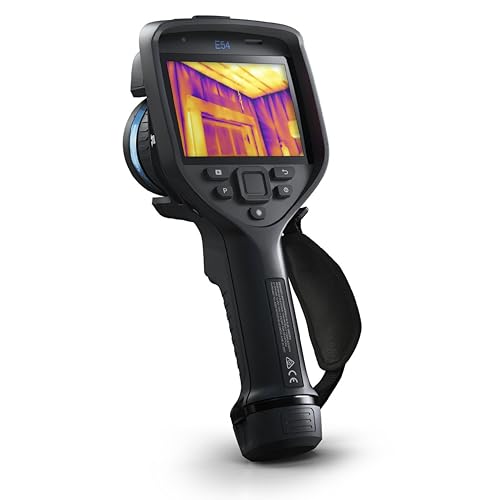
- 320 x 240 infrared resolution
- 4-inch touchscreen LCD
- METERLiNK data integration
Best For: Electrical and building inspections with detailed thermal reporting
Field Detail Upgrade
UNI-T UTi740H Professional Thermal Camera

- 384 x 288 infrared resolution
- 28° x 21° field of view
- 4.3-inch IPS display
Best For: Technicians wanting higher thermal detail and wide coverage
Connected Workflow Pick
FLIR i34 App-Enabled Thermal Camera

- Up to 240 x 320 resolution
- 40 mK NETD with MSX enhancement
- Wi-Fi and FLIR Ignite cloud integration
Best For: Teams using cloud-based inspection workflows and reporting
Budget Field Reporter
TOPDON TC005 Dual-Lens Thermal Camera
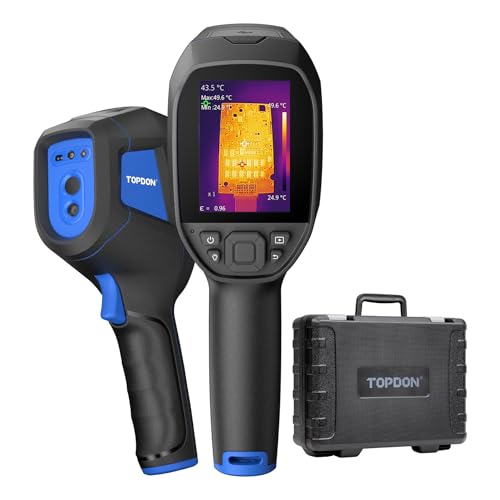
- Laser distance measurement up to 4 meters
- 64 GB internal storage
- IP54 housing with 8-hour battery life
Best For: Durable inspections with strong storage and reporting support
Premium Pro Thermal Flagship
FLIR E96 Advanced Thermal Imaging Camera with 24° + 14° Lens

- 640 x 480 thermal resolution with 307,000 measurement points
- MSX, UltraMax, and adaptive filtering improve image clarity
- Interchangeable auto-calibrating lenses and report tools
Best For: Professional inspectors needing detailed thermal imaging and flexible lens options
Field-Ready Value Thermal Camera
FOXWELL RT280 Thermal Imaging Camera

- 320 x 240 LCD with TISR-enhanced effective resolution
- Windows software supports 2D/3D analysis and reports
- IP54 rating and 6.6-foot drop resistance
Best For: Technicians needing a rugged, analysis-friendly inspection camera
Compact Smart Thermal Pick
Flir C5 Compact Thermal Imaging Camera

- 160 x 120 true thermal imaging with MSX clarity
- Wi‑Fi and FLIR Ignite cloud sharing
- Compact handheld body with 3.5-inch screen
Best For: Users wanting a compact thermal camera with easy cloud sharing
AI Super Resolution Thermal Imager
HSFTOOLS F2VW 640x480 with Visual Cam

- AI Super Resolution boosts 256x192 to 640x480
- Dual IR and visual cameras with 4 viewing modes
- Wi‑Fi sharing plus LED light and tripod mount
Best For: Users who want a detail-rich thermal imager with AI enhancement and easy sharing
Cloud-Connected MSX Camera
FLIR E5 Pro 160x120 with Ignite

- 160 x 120 thermal resolution for fault finding
- MSX overlays visual detail on thermal images
- Wi‑Fi and FLIR Ignite Cloud for sharing
Best For: Technicians who want a compact FLIR camera with cloud workflow tools
Commercial MSX Thermal Camera
FLIR E6-XT WiFi with Ignite Cloud

- 240 x 180 thermal resolution for more detail
- MSX technology improves image readability
- Wi‑Fi and Ignite Cloud support sharing and updates
Best For: Commercial users who want a higher-resolution FLIR camera with a wider measurement range
Pro-Grade Inspection Camera – FLIR E54 Advanced Thermal Imaging Camera
The FLIR E54 is a strong fit for buyers looking for professional thermal imaging cameras with dependable detail and field-ready usability. Its 320 x 240 infrared resolution, MSX visual enhancement, and 4-inch touchscreen help make thermal findings easier to interpret during electrical, moisture, and facility inspections.
Best For: Electrical and building inspectors who want a rugged FLIR camera with clear thermal detail and report-friendly workflow.
Pros:
- 320 x 240 infrared resolution with FLIR MSX enhancement for clearer image context
- 4-inch touchscreen LCD for easier on-site viewing and navigation
- METERLiNK support can embed data from select FLIR meters into IR images
- 24-degree field of view suits focused inspection work
Cons:
- Higher-end tool that may be more camera than casual users need
- 24-degree FOV is less wide than some general-purpose thermal cameras
Overall, the E54 is built for practical professional use, especially when image clarity and inspection documentation matter. If you want a thermal camera that balances resolution, screen quality, and FLIR workflow features, this is a compelling option.
Field Detail Upgrade – UNI-T UTi740H Professional Thermal Camera
The UNI-T UTi740H is a practical choice for professional thermal imaging cameras when you want higher infrared detail and a broad viewing area. With 384 x 288 resolution, a 28° x 21° field of view, and a 4.3-inch IPS display, it is geared toward clearer inspection work in the field.
Best For: Technicians who want a higher-resolution handheld thermal camera with a roomy display and wide inspection coverage.
Pros:
- 384 x 288 infrared resolution for more detailed thermal imaging
- 28° x 21° field of view supports broader scene coverage
- 4.3-inch IPS display improves on-site visibility
- NETD of ?60mK and IFOV of 1.3 mrad are listed for measurement-focused work
Cons:
- Supplied notes provide limited workflow and accessory details
- No built-in reporting or connectivity features are highlighted in the notes
For buyers comparing specs first, the UTi740H stands out for resolution and viewing area. It looks well suited to users who prioritize thermal detail and a straightforward professional handheld format.
Connected Workflow Pick – FLIR i34 App-Enabled Thermal Camera
The FLIR i34 is aimed at professionals who want thermal imaging cameras that fit into a connected inspection workflow. It combines up to 240 x 320 resolution, 40 mK NETD, FLIR MSX enhancement, and Wi-Fi/cloud tools for easier sharing, reporting, and analysis.
Best For: Teams that want app-enabled thermal inspections with cloud-based organization and reporting.
Pros:
- Up to 240 x 320 resolution with FLIR MSX enhancement for clearer thermal images
- 40 mK NETD supports sensitive thermal detection
- Wi-Fi, FLIR Ignite cloud integration, and app-enabled workflow improve sharing
- Built for building diagnostics, electrical/mechanical checks, HVAC, moisture, and energy loss work
Cons:
- Weighs 6.83 pounds, which may be heavier than some handheld alternatives
- Best value depends on whether you will use the connected workflow features
If you need a modern inspection tool that links image capture with organization and reporting, the i34 is easy to justify. Its strength is not just the thermal camera hardware, but the workflow features around it.
Budget Field Reporter – TOPDON TC005 Dual-Lens Thermal Camera
The TOPDON TC005 is built for users who want professional thermal imaging cameras with strong documentation features and a durable field design. Its dual-lens setup, laser targeting, 3.5-inch display, and reporting software support make it a practical inspection tool for organized on-site work.
Best For: Inspectors who need a durable thermal camera with easy documentation, app/PC analysis, and long runtime.
Pros:
- Integrated laser distance measurement up to 4 meters for more precise targeting
- 64 GB internal storage supports extensive image capture and retention
- Wi-Fi app and USB PC software compatibility help with analysis and report generation
- IP54 housing, 2-meter drop resistance, and 8-hour battery life suit field use
Cons:
- 3.5-inch display is smaller than some competing professional models
- Dual-lens design and extra features may be more than simple spot-check users need
The TC005 is especially appealing if your workflow depends on saving, transferring, and reporting inspection images. It focuses on practical field durability and documentation rather than just raw thermal specs.
Premium Pro Thermal Flagship – FLIR E96 Advanced Thermal Imaging Camera with 24° + 14° Lens
FLIR E96 Advanced Thermal Imaging Camera with 24° + 14° Lens, 640x480, -20°C to +1500°C
Check Price On AmazonIf you need one of the more capable professional thermal imaging cameras for electrical work, building surveys, or mechanical troubleshooting, the FLIR E96 is built for high-stakes inspections. Its 640 x 480 thermal resolution, MSX, UltraMax, and adaptive filtering are aimed at giving you clearer decision-making in the field, while interchangeable auto-calibrating lenses help you adapt to different viewing distances and targets.
Best For: Inspectors who want a high-resolution FLIR camera for detailed electrical, mechanical, and building-envelope diagnostics.
Pros:
- 640 x 480 thermal resolution with 307,000 non-contact measurement points
- MSX, UltraMax, and adaptive filtering for sharper thermal interpretation
- Interchangeable auto-calibrating lenses for telephoto or wide-angle inspection
- Built-in mic, routing software integration, and report-generation support
Cons:
- More camera than a basic homeowner tool if you only need occasional checks
- Multiple lens options and workflow features may be more than simple jobs require
The E96 stands out as a serious inspection tool when image clarity and workflow efficiency matter most. If your work depends on documenting problems quickly and accurately, this model is positioned as a premium field-ready option.
Field-Ready Value Thermal Camera – FOXWELL RT280 Thermal Imaging Camera
The FOXWELL RT280 is a practical pick for buyers comparing professional thermal imaging cameras that balance portability, analysis tools, and inspection-focused features. It pairs a 320 x 240 LCD with TISR-enhanced effective resolution, plus a 25Hz frame rate, so you can capture smoother thermal views for electrical, HVAC, automotive, or general troubleshooting work.
Best For: Technicians who want a rugged, analysis-friendly thermal camera for routine inspections and temperature tracking.
Pros:
- 320 x 240 LCD with TISR-enhanced effective resolution up to 240 x 180
- Windows PC software supports 2D/3D analysis and automatic report generation
- Stores over 20,000 images and videos on 8GB eMMC memory
- IP54 rating and 6.6-foot drop resistance for field use
Cons:
- PC analysis is Windows-only, not compatible with Mac
- Lower native thermal resolution than higher-end professional models
RT280 is a solid choice when you want inspection features, durable construction, and useful temperature tools without moving into the highest price tier. It looks especially well suited to everyday troubleshooting where documentation matters.
Compact Smart Thermal Pick – Flir C5 Compact Thermal Imaging Camera
For shoppers who want professional thermal imaging cameras in a compact, easy-to-carry format, the FLIR C5 focuses on speed and convenience. It measures from -20 to 400°C and combines 160 x 120 true thermal imaging with MSX, which helps make hidden faults easier to identify and document during routine inspections.
Best For: Users who want a compact FLIR thermal camera with Wi‑Fi sharing and straightforward reporting.
Pros:
- 160 x 120 true thermal imaging with MSX for clearer visuals
- Wi‑Fi and FLIR Ignite cloud connectivity for fast image upload
- Compact handheld design with a 3.5-inch screen
- Supports photo, infrared, MSX, and picture-in-picture shooting modes
Cons:
- Lower thermal resolution than larger professional-grade FLIR models
- Fixed focus limits flexibility for some close-up inspection needs
The C5 is a convenient choice when portability and simple documentation are more important than maximum thermal detail. It makes sense for users who want a compact tool that can quickly find issues and move images into reports.
AI Super Resolution Thermal Imager – HSFTOOLS F2VW 640×480 with Visual Cam
If you want professional thermal imaging cameras that emphasize detail and speed, the HSFTOOLS F2VW is built around a 256×192 detector with AI super resolution that boosts the viewing output to 640×480. It combines thermal and visual imaging, adds multiple viewing modes, and includes Wi‑Fi sharing for quick field use.
Best For: Users who want a detail-rich thermal imager with AI enhancement, dual cameras, and easy image sharing.
Pros:
- AI Live Super Resolution enhances the image from 256×192 to 640×480
- Built-in visual camera supports Visual, Thermal, Fusion, and PIP modes
- Wi‑Fi lets you send images to a smartphone or tablet
- Includes LED flashlight, tripod hole, and one-trigger capture for worksite convenience
Cons:
- Higher-end features may be more than basic home users need
- Resolution depends on AI enhancement rather than a native 640×480 detector
The F2VW is a practical choice when you need fast troubleshooting with strong detail, flexible viewing modes, and connected workflows. Its measurement tools and AI scene detection add useful inspection support for daily temperature checks.
Cloud-Connected MSX Camera – FLIR E5 Pro 160×120 with Ignite
Among professional thermal imaging cameras, the FLIR E5 Pro focuses on dependable troubleshooting with 160 x 120 thermal resolution and MSX technology to make images easier to interpret. Wi‑Fi and FLIR Ignite Cloud support image storage, editing, sharing, and over-the-air updates for a smoother workflow.
Best For: Technicians who want a compact FLIR camera with cloud connectivity and easy-to-read MSX images.
Pros:
- 160 x 120 thermal resolution helps identify hidden faults
- MSX technology adds visual detail to thermal images
- Wi‑Fi and FLIR Ignite Cloud support storing, editing, and sharing images
- OTA updates keep the camera current with the latest features
Cons:
- Thermal resolution is lower than higher-end commercial models
- Best suited to troubleshooting rather than advanced imaging needs
The E5 Pro is a sensible pick if you value FLIR’s workflow tools and clear thermal-to-visual overlay over raw resolution. Its feature set is aimed at making inspections faster and image management simpler.
Commercial MSX Thermal Camera – FLIR E6-XT WiFi with Ignite Cloud
If you need professional thermal imaging cameras for broader temperature ranges and clearer inspection images, the FLIR E6-XT offers 240 x 180 thermal resolution with MSX technology. It also adds Wi‑Fi and FLIR Ignite Cloud support, making it easier to store, edit, and share thermal photos in the field.
Best For: Commercial users who want a higher-resolution FLIR camera with cloud connectivity and a wider measurement range.
Pros:
- 240 x 180 thermal resolution provides more detail than entry-level cameras
- MSX technology improves image readability with visual edge detail
- Measures from -20°C to 550°C (-4°F to 1022°F)
- Wi‑Fi and FLIR Ignite Cloud streamline image storage and sharing
Cons:
- More expensive than basic thermal imagers
- Still relies on FLIR’s MSX approach rather than a visible-camera-heavy workflow
The E6-XT stands out as the strongest option here for users who want a more capable commercial thermal camera with a wider temperature range. It combines practical imaging detail with the cloud and update features that make ongoing field use easier.
How We Picked the Best Professional Thermal Imaging Cameras
For this roundup, we focused on Professional Thermal Imaging Cameras that balance image quality, temperature range, durability, and workflow features. We favored models that offer enough resolution for practical diagnostics, plus useful tools such as Wi‑Fi, cloud sharing, visual overlays, and interchangeable lenses where relevant. We also looked at value for money, especially for technicians who need dependable performance without overbuying features they may not use every day.
Quick Comparison
In general, higher-resolution models are better for detailed inspections, larger assets, and long standoff distances. Compact cameras are easier to carry and ideal for quick spot checks, while advanced units with higher temperature ranges and optical options suit demanding industrial and electrical work. App-connected and cloud-enabled models can speed up reporting, but they are most useful if your team already relies on mobile workflows.
Key Buying Factors for Professional Thermal Imaging Cameras
Resolution and Sensitivity
Resolution affects how clearly you can separate small temperature differences across components. For serious diagnostic work, look for models with at least 160 x 120 infrared resolution, while 320 x 240 and above is preferable for sharper images and better confidence on critical inspections. Sensitivity, often listed as NETD, matters too: lower values generally indicate better ability to detect subtle heat variations.
Temperature Range and Optics
Make sure the camera’s temperature range matches your job. HVAC and building work may not need extreme limits, but electrical and industrial applications often do. Lens field of view also matters; wider lenses help with close-range scanning, while narrower lenses are useful when you need to inspect targets from farther away or isolate small objects.
Workflow Features
Features like MSX-style image blending, Wi‑Fi, app control, and cloud storage can save time when documenting findings and sharing reports. For teams in the field, battery life, ruggedness, and ease of one-handed use may matter as much as raw image specs.
Who Should Buy Which Professional Thermal Imaging Cameras?
If you need the best all-around diagnostic tool, choose a higher-resolution camera with strong sensitivity and a practical temperature range. Building inspectors and HVAC techs may prefer compact, easy-to-carry models for routine walkthroughs. Electrical and industrial users should prioritize better resolution, tighter focus control, and a wider or higher temperature ceiling. If your job involves frequent reporting, a Wi‑Fi or cloud-connected model can streamline handoff and recordkeeping.
Ultimately, the best Professional Thermal Imaging Cameras are the ones that match your inspection environment, reporting workflow, and level of detail required—not just the highest specs on paper.