
If you are comparing microblading equipment for home practice or eyebrow work, this Eyebrow Microblading Tattoo Machine Kit review focuses on what the TP39 bundle actually includes and where it fits.
The wireless machine, adjustable output, assorted cartridge and microblading needles, inks, and shaping accessories make it a broad starter package rather than a bare tattoo pen.
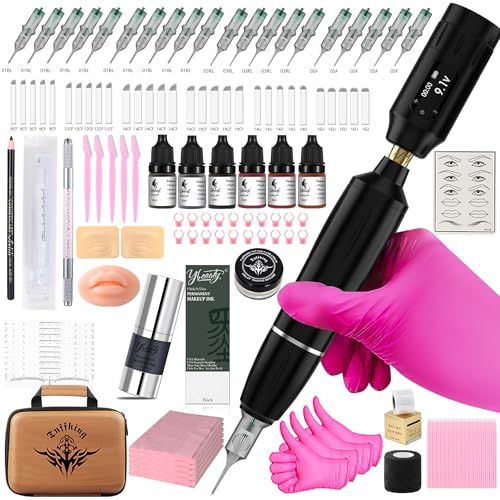
Eyebrow TP39 Review Summary
The Eyebrow TP39 is aimed at beginners and eyebrow tattoo artists who want a complete collection of practice and setup supplies in one purchase.
The listing describes a semi-permanent makeup machine with a 4V–12V output range, 4,000–11,000 RPM speed range, and a 2,000mAh built-in lithium battery.
At 8V, the manufacturer says it can operate for up to five hours, with a full charge taking about two to three hours.
That combination makes the TP39 most appealing to learners who value portability and bundle breadth.
The tradeoff is that the database record provides listing specifications but no independent testing, detailed machine dimensions, or information about ink ingredients and regulatory documentation.
Treat this as a practice-oriented kit, and verify local requirements, hygiene procedures, training, and pigment suitability before using it on clients. For someone asking “is Eyebrow Microblading Tattoo Machine Kit worth it?”, the answer depends heavily on whether the included accessories match their learning plan.
Review Scorecard
| Category | Score | Editorial assessment |
|---|---|---|
| Bundle completeness | 9/10 | Includes a machine, power supply, 50 needles, seven inks, razors, practice materials, and accessories. |
| Wireless portability | 8/10 | Built-in 2,000mAh battery and claimed five-hour runtime at 8V reduce cable dependence. |
| Adjustability | 8/10 | The stated 4V–12V output and 4,000–11,000 RPM range offer room to learn and tune technique. |
| Needle variety | 9/10 | Round liner, flat, curved-flat, and U-shaped options support different brow approaches. |
| Beginner value | 8/10 | Practice skin, shaping tools, inks, and a broad accessory set lower the need for separate starter purchases. |
| Evidence confidence | 6/10 | Several useful listing claims are supplied, but there are no independent measurements or hands-on notes. |
Key Features and Specifications of Eyebrow TP39
The central component is a wireless eyebrow tattoo gun paired with a power supply.
According to the listing, the machine is lightweight, designed for stable continuous operation, and intended to produce low noise, low skin loss, fast coloring, and no heat after long-term operation.
Those are manufacturer claims, not verified test results, so they should be read as intended design goals rather than guarantees.
The stated controls are useful for a learner because the machine covers a relatively broad operating range: 4V to 12V output and 4,000 to 11,000 revolutions per minute.
A variable range can help a trained user adapt the setup to technique and needle choice, although the correct setting still requires education and careful practice.
The battery is a major part of the TP39’s identity.
It has a built-in 2,000mAh lithium battery; the listing claims approximately five hours of work at 8V and two to three hours for a full recharge.
That is convenient for demonstrations, practice sessions, and workspaces where a power cable is awkward.
The record does not specify battery indicators, charging connector, replacement procedure, or performance at other voltage settings.
The included needle selection is unusually broad for a beginner bundle.
The cartridge portion contains 20 pieces: 1RL x10, 3RL x5, and 5F x5.
The listing separately identifies 30 microblading needles: 9CF x5, 12CF x5, 14CF x5, 19CF x5, 14U x5, and 16U x5.
It states that the tattoo needles are individually packaged sterile.
Even with that claim, buyers should inspect packaging and follow applicable single-use and disposal rules.
The rest of the package is built around eyebrow preparation and practice.
It includes seven eyebrow tattoo inks, five eyebrow razors, a practice skin, tools for marking symmetrical eyebrows, ink ring cups, eyebrow cling film, and an eyebrow aftercare butter.
The listing also describes the ink set as multicolor and specially formulated for eyebrow tattooing.
Because the record does not provide ingredient, shelf-life, shade, or compliance details, buyers should confirm those points before skin application.
Pros and Cons of Eyebrow TP39
Pros
- Broad all-in-one bundle: The package combines the machine, power supply, needles, inks, shaping tools, practice skin, and protective accessories.
- Wireless operation: The integrated 2,000mAh battery is more convenient for portable practice than a permanently tethered pen.
- Adjustable output: The stated 4V–12V range and 4,000–11,000 RPM range provide flexibility across learning exercises and needle types.
- Useful needle coverage: Round liners, flats, curved flats, and U needles give beginners multiple configurations to explore.
- Practice-oriented extras: Symmetry-marking tools and practice skin make the kit relevant before any live-skin work.
Cons
- No independent performance evidence: Noise, heat, skin impact, coloring speed, and runtime are listing claims rather than verified measurements.
- Limited technical detail: The record does not list dimensions, machine weight, charging interface, operating instructions, or replacement battery information.
- Unclear pigment documentation: The seven inks are described by purpose and color count, but not by ingredients, shades, expiration, or professional compliance.
- Potentially overwhelming selection: Fifty needle pieces and many accessories can be helpful, but a beginner still needs training to select and use them correctly.
- Not a substitute for education: A complete box does not establish sterile technique, brow mapping skill, depth control, or local legal compliance.
Who Should Buy Eyebrow TP39?
The best match is a beginner building a dedicated eyebrow practice station.
The practice skin, symmetry tools, razors, cling film, and multiple needle formats let a learner organize basic exercises around mapping, line work, shading, and brow-shape preparation.
The wireless format is also useful for people who move between a home practice area, class, or demonstration space.
It can also suit an eyebrow tattoo artist who needs a supplemental kit for practice or wants a spare machine-and-accessory bundle.
The adjustable range and included power supply may make it easier to keep a backup setup available, while the seven inks and 50 needles provide immediate variety.
However, this is not an ideal choice for a buyer who needs documented professional pigments, independently confirmed machine tolerances, or a fully specified clinical setup.
Experienced artists who already have preferred cartridges, pigments, batteries, and mapping tools may find much of the bundle redundant.
Anyone planning live procedures should skip relying on the kit alone until training, sanitation, local rules, and every consumable’s documentation have been checked.
How the TP39 Bundle Supports Brow Practice
Starting with mapping and symmetry
The inclusion of tools for marking symmetrical eyebrows, along with razors and cling film, supports the preparation stage that often determines whether practice is useful.
Buyers can work on brow outlines and shape consistency before focusing on machine movement.
Matching needles to technique
The 1RL, 3RL, and 5F cartridges offer a simple entry point into different line and fill patterns, while the 9CF through 19CF and 14U/16U microblading options broaden the practice set.
The bundle therefore has more technique coverage than a single-needle starter pack, but the buyer must learn what each configuration is intended to do.
Balancing battery life and settings
The claimed five-hour runtime at 8V is enough to make wireless practice sessions practical, and the two-to-three-hour recharge claim helps set expectations between sessions.
Since runtime can vary with voltage and use, a buyer who works long sessions should still understand charging status and keep an appropriate backup plan.
Treating included inks as unverified supplies
Seven colors can make exercises more flexible, and the listing says they are made for eyebrow tattooing.
Still, the supplied evidence does not identify shades, ingredients, expiration information, or certifications.
That makes the ink set a convenience feature, not a reason to bypass professional pigment checks.
Alternatives to Eyebrow TP39
If the TP39’s large bundle is more than you need, compare a Dragonhawk wireless tattoo pen for a machine-first setup with fewer bundled consumables.
It may be a better direction for buyers who already own pigments and mapping supplies.
For a more permanent-makeup-focused search, explore wireless PMU tattoo machines.
This category lets you compare pens marketed specifically around eyebrow, lip, and eyeliner work, while paying closer attention to cartridge compatibility and professional documentation.
Buyers who want to practice mapping before purchasing a machine can look at eyebrow microblading practice kits.
These may emphasize practice skins, mapping tools, and disposable accessories rather than battery performance.
If needle compatibility is the priority, search for PMU cartridge needle assortments separately.
A modular approach can be preferable for experienced users who want to choose specific configurations and verify packaging independently.
Is Eyebrow TP39 Worth It?
The Eyebrow TP39 is worth considering for beginners who want a wireless eyebrow practice bundle with broad needle coverage and supporting supplies. Its strongest advantages are the claimed adjustable output, 2,000mAh battery, five-hour 8V runtime, seven inks, 50 needles, and preparation accessories.
The buying decision should remain conditional.
The available evidence does not verify the machine’s real-world noise, heat, runtime, or coloring performance, and it does not document the included inks in enough detail for a professional skin-use decision.
Choose it when bundle completeness and practice convenience matter most; choose a more specialized or modular alternative when verified pigments, deeper technical specifications, or established professional compatibility are the priority.