
Finding hidden leaks, damaged components, and hard-to-reach problems is easier with the right inspection camera. This roundup compares 10 premium underbody inspection cameras selected for automotive work, HVAC inspection, maintenance, and industrial troubleshooting.
We focus on the features that matter in real use, including image quality, articulation, probe reach, screen design, lighting, durability, and ease of handling.
Best 10 Premium Underbody Inspection Cameras Picks for 2026
Professional Cable Reach
Bosch GIC5-27C Inspection Camera

- 11.5-foot IP67 camera cable
- 5-inch display with photo and video capture
- Includes battery, charger, accessories, and case
Best For: Contractors and mechanics needing extended reach
Maximum Flexibility
FOXWELL Y406D Dual-Lens Borescope

- 220-degree dual-lens articulation
- Slim 6.5mm probe for tight spaces
- HD IPS screen with 2x and 4x zoom
Best For: Automotive, HVAC, and plumbing inspections
Connected Field Inspection
Klein Tools ET19 Wi-Fi Borescope

- Dual-lens 1080p inspection imaging
- 9.8-foot armored 5.5mm snake
- Wi-Fi app sharing plus USB-C transfer
Best For: Pros who need to document and share inspections
Simple Articulating Control
Teslong Articulating Automotive Borescope

- Two-way 210-degree articulation
- 4.5-inch IPS screen with no app required
- 5-foot semi-rigid cable and five-hour battery life
Best For: Mechanics wanting simple, app-free inspections
Precision Pick
FOXWELL 2-Way Articulating Borescope

- Slim 0.24-inch probe with 220° articulation
- 1080P display with 2x/4x zoom
- 32GB storage and 5–7-hour battery
Best For: Detailed automotive and mechanical inspections in tight spaces
Deep-Reach Choice
Teslong 5-inch Dual Lens Borescope

- Forward and side cameras with independent LEDs
- 16.5-foot semi-rigid inspection cable
- 5-inch screen and included retrieval accessories
Best For: Long-reach automotive, HVAC, plumbing, and wall inspections
Versatile Articulation Pick
DXZtoz Dual Lens Articulating Borescope
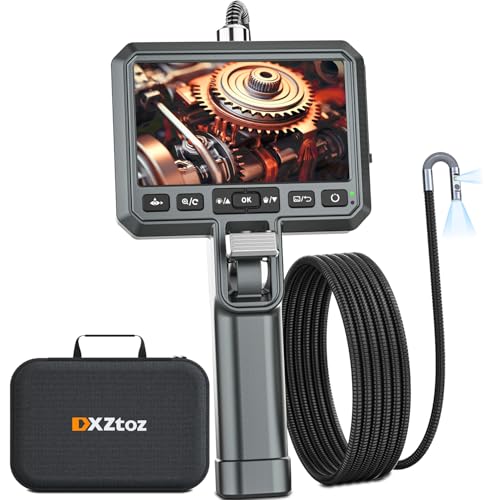
- 0.25-inch probe with 210° articulation
- Front and side cameras with three view modes
- 5-inch IPS display and 10x digital zoom
Best For: Tight-space inspections requiring angled views and precise control
Best Articulation Control
DXZtoz 220° Articulating Borescope

- 220° two-way steering for difficult angles
- 1080p camera with 8 adjustable LEDs
- IP67 probe and useful accessory kit
Best For: Mechanics inspecting around tight automotive and HVAC components
Best Dual-Lens Viewing
Teslong Articulating Borescope

- Front and side cameras for broader coverage
- 5-foot semi-rigid articulating probe
- 4.5-inch IPS screen with adjustable LEDs
Best For: Users switching between adjacent views in confined inspection areas
Best All-Around Value
Acoath Dual-Lens 1080p Borescope

- 210° articulation with dual front and side lenses
- 1080p video and adjustable eight-LED lighting
- IP67 probe, 32GB card, case, and 24-month warranty
Best For: Automotive, HVAC, sewer, and general repair inspections
Professional Cable Reach – Bosch GIC5-27C Inspection Camera
The Bosch GIC5-27C is a premium underbody inspection camera for users who need long cable reach, a large built-in screen, and a ready-to-use battery platform. Its 11.5-foot camera cable, high-resolution color display, and included accessories make it practical for vehicle, construction, and general maintenance inspections.
Best For: Contractors, mechanics, and maintenance professionals who need extended reach and a self-contained inspection system.
Pros:
- 11.5-foot cable reaches deep or difficult inspection areas.
- 5-inch display supports viewing, image capture, and video recording.
- Includes a 12V Max battery, charger, 32GB microSD card, hook, mirror, magnet, and carrying case.
- IP67 camera cable and adjustable light sensitivity support demanding inspection work.
Cons:
- The system weighs about 5 pounds, making it less compact than lightweight handheld scopes.
- Its manual focus and manual exposure controls may require more adjustment during inspections.
- Image storage is listed for up to 30 files on the display.
Choose the Bosch when reach, a generous screen, and included accessories matter more than minimizing equipment size. USB-C connectivity also makes transferring captured files to a computer straightforward.
Maximum Flexibility – FOXWELL Y406D Dual-Lens Borescope
The FOXWELL Y406D is a premium underbody inspection camera built for tight, complex spaces. Its ultra-slim 6.5mm probe, dual cameras, and 220-degree articulation help users switch between front and side views without repeatedly repositioning the tool.
Best For: Automotive, HVAC, and plumbing professionals inspecting narrow passages, cylinders, valves, and pipes.
Pros:
- Dual-lens design provides front and side views with 220-degree articulation.
- 6.5mm probe fits through narrow openings such as spark plug holes and small pipes.
- HD IPS display, adjustable LEDs, and 2x/4x zoom help reveal inspection details.
- IP67 protection, built-in 32GB storage, and USB-C file transfer support field use.
Cons:
- The supplied notes do not specify the probe length.
- Automatic heat protection shuts the system down above 70°C, limiting use in hotter areas.
- Its feature-rich articulating design may be more than needed for simple inspections.
The Y406D stands out when viewing angle and access are the main challenges. Dual cameras reduce blind spots, while onboard storage and one-touch capture keep the workflow independent of Wi-Fi or a phone app.
Connected Field Inspection – Klein Tools ET19 Wi-Fi Borescope
The Klein Tools ET19 is a premium underbody inspection camera for professionals who want dual-lens viewing plus convenient wireless sharing. Its 5.5mm armored snake reaches through bends, while the 4.3-inch LCD and companion app support on-site viewing, recording, and file transfer.
Best For: Plumbers, HVAC technicians, automotive users, and industrial maintenance teams that need to share inspection evidence.
Pros:
- Dual-lens camera captures high-resolution views from multiple angles.
- 9.8-foot armored snake navigates twists, turns, and bends.
- 4.3-inch adjustable-brightness LCD provides direct viewing without relying only on a phone.
- Wi-Fi app and USB-C support sending or downloading photos and videos.
Cons:
- The 4.3-inch screen is smaller than the displays on several competing models.
- Wireless sharing requires use of the ET19 app on a compatible smartphone.
- The supplied notes do not list included battery or storage capacity.
The ET19 is a strong choice for inspection teams that need to document and share findings quickly. Its armored cable balances reach and durability, while dual-lens viewing helps provide more context in pipes, walls, and mechanical spaces.
Simple Articulating Control – Teslong Articulating Automotive Borescope
The Teslong articulating borescope is a practical premium underbody inspection camera for users who prefer a dedicated screen and direct controls. Its 5-foot semi-rigid gooseneck, two-way 210-degree articulation, and bright adjustable LEDs help guide the probe through confined automotive, HVAC, and household spaces.
Best For: Mechanics and maintenance users who want an app-free borescope with maneuverable control and long battery life.
Pros:
- Two-way 210-degree articulation supports navigation through complex areas.
- 4.5-inch IPS screen provides high-resolution viewing without an app.
- 5-foot semi-rigid cable combines flexibility with shape retention.
- Includes 32GB storage, eight LED lights, IP67 waterproofing, and a carrying case.
Cons:
- The 5-foot cable is shorter than the reach offered by some professional models.
- Video is recorded in AVI format, which may be less convenient for some workflows.
- The supplied notes list 1.5x digital zoom, rather than a higher optical zoom capability.
The Teslong makes a sensible pick for straightforward field inspections where portability and ease of use matter. Its central joystick, rear photo button, and five-hour stated battery life support extended one-handed work without phone connectivity.
Precision Pick – FOXWELL 2-Way Articulating Borescope
For premium underbody inspection cameras, the FOXWELL stands out when you need a slim probe, controlled articulation, and clear onboard viewing. Its 0.24-inch probe, 220° dual-direction movement, 1080P imaging, and built-in storage make it well suited to detailed automotive and mechanical inspections without relying on a phone or Wi-Fi.
Best For: Mechanics and inspectors who need precise access around engines, valves, ducts, and other tight spaces.
Pros:
- 0.24-inch probe reaches narrow openings, including spark plug holes.
- 220° articulation and a 5.3-foot semi-rigid gooseneck improve maneuverability.
- 1080P display, 2x/4x zoom, six adjustable LEDs, and 32GB storage support detailed inspections.
- IP67 probe protection and a 5–7-hour battery suit extended field work.
Cons:
- Its advanced articulating design may be more capability than casual users need.
- Automatic heat protection shuts the unit down at 158°F, so very hot areas require caution.
The FOXWELL is a strong premium option for users who value fine control and narrow access. It combines useful imaging features with practical standalone operation for repeat inspections.
Deep-Reach Choice – Teslong 5-inch Dual Lens Borescope
Among premium underbody inspection cameras, the Teslong is a practical deep-reach model for users who need to inspect long runs, engine compartments, and hidden cavities. Its forward and side cameras, 16.5-foot semi-rigid cable, large IPS screen, and included retrieval accessories provide broad inspection coverage without an app or smartphone.
Best For: Automotive, HVAC, plumbing, and wall-cavity inspections where cable length and dual viewing angles matter.
Pros:
- Switchable forward and side cameras provide two viewing perspectives.
- 16.5-foot semi-rigid cable reaches deep ducts, drains, walls, and engine bays.
- Seven adjustable LEDs and a 5-inch IPS screen help illuminate and view dark areas.
- IP67 waterproof probe, 5000mAh battery, hard case, hook, magnet, and mirror add versatility.
Cons:
- 720p video and 2MP still resolution are less detailed than newer 1080P-class options.
- The approximately 4.5-hour runtime requires about five hours to recharge.
- The 8mm probe is not as slim as the narrowest cameras in this roundup.
The Teslong prioritizes reach and viewing flexibility over maximum resolution. It is a sensible choice for larger access paths and jobs that benefit from side-camera inspection or included retrieval tools.
Versatile Articulation Pick – DXZtoz Dual Lens Articulating Borescope
The DXZtoz earns a place among premium underbody inspection cameras by combining a slim 0.25-inch probe with dual lenses and 210° articulation. Its 5-inch IPS display, 10x digital zoom, thumb-stick control, and front-exit cable design are aimed at inspecting engine cylinders, pipes, walls, and other areas where straight and angled views are both useful.
Best For: Mechanics and contractors who need dual-angle viewing and precise probe control in confined spaces.
Pros:
- 0.25-inch probe and 210° articulation access tight engine and mechanical spaces.
- Front and side cameras offer three viewing modes for straight or angled inspection.
- 5-inch IPS screen and 10x digital zoom make small defects easier to examine.
- Dual-path thumb-stick, screen bracket, IP67 probe, and included hook and magnet improve usability.
Cons:
- Its listed video capture resolution is 720p despite 1080-pixel still-image specifications.
- The 5-foot probe is considerably shorter than the Teslong’s 16.5-foot cable.
- Digital zoom can enlarge details without adding true optical resolution.
The DXZtoz is a capable middle ground for complex inspections: slimmer and more articulated than basic scopes, while offering the convenience of a side camera. Choose it when maneuverability and angle changes matter more than maximum cable reach.
Best Articulation Control – DXZtoz 220° Articulating Borescope
For premium underbody inspection cameras that need to reach around obstructions, the DXZtoz combines two-way articulation, a semi-rigid gooseneck-style probe, and a built-in monitor. Its 1080p camera, adjustable lighting, and included accessories make it a practical choice for automotive and mechanical inspections.
Best For: Mechanics who need precise steering around engine components, pipes, and other confined spaces.
Pros:
- 220° two-way articulation helps navigate turns and obstacles.
- 1080p imaging, 8 adjustable LEDs, and 8X digital zoom support detailed viewing.
- IP67 waterproof, oil-resistant probe with a 4.3-inch IPS monitor.
- Includes a 32GB card, magnet, hook, side mirror, case, and rechargeable battery.
Cons:
- The 8.5mm probe may not fit the smallest inspection openings.
- Its feature set is geared toward close-range inspections rather than long-distance viewing.
The DXZtoz stands out when steering control matters most. Its articulation wheel and accessory kit can reduce the need to reposition the scope, while the standalone monitor avoids app or phone dependence.
Best Dual-Lens Viewing – Teslong Articulating Borescope
The Teslong is a practical option among premium underbody inspection cameras for users who want front- and side-facing views without constantly repositioning the probe. Its articulating control, 5-foot semi-rigid cable, and dedicated IPS display suit automotive, HVAC, and household inspections.
Best For: Inspectors who value quick switching between front and side views in tight spaces.
Pros:
- Dual front and side cameras provide broader visibility without rotating the probe.
- Two-way articulation and a semi-rigid 5-foot cable support controlled positioning.
- 4.5-inch IPS screen offers a clear view in bright or dim conditions.
- Adjustable built-in LEDs and no-app operation simplify field use.
Cons:
- The supplied video resolution is listed as 720p, lower than some competing models.
- Its listed weight is 1.44 kg, which may feel substantial during extended inspections.
The Teslong’s main advantage is viewing flexibility: the dual-lens design can reveal adjacent surfaces without withdrawing and reinserting the probe. It is a strong fit for inspection work where speed and convenient one-handed operation matter.
Best All-Around Value – Acoath Dual-Lens 1080p Borescope
The Acoath offers a balanced package for premium underbody inspection cameras, pairing 210° two-way articulation with dual lenses, 1080p capture, and a compact standalone display. Its slim probe, waterproof construction, and generous accessory bundle make it versatile for automotive, sewer, HVAC, and home repair work.
Best For: Buyers seeking broad inspection coverage, 1080p recording, and strong included accessories.
Pros:
- 210° articulation provides a 420° range of motion for challenging angles.
- Front and side cameras switch with one button for faster inspections.
- 1080p imaging, eight adjustable LEDs, and a 4.3-inch IPS screen support clear viewing.
- IP67 waterproof 5-foot probe includes a 32GB card, case, magnet, hook, and mirror.
Cons:
- The 0.33-inch probe may still be too large for very narrow openings.
- The listed macro focus range is relatively close, at 2–10 centimeters.
The Acoath is the most broadly equipped option in this group. It combines dual-lens convenience with high-resolution capture, waterproofing, and a 24-month warranty, making it a well-rounded choice for varied inspection tasks.
How We Picked These Premium Underbody Inspection Cameras
We evaluated these cameras around the demands of underbody and confined-space inspection: reaching behind components, positioning the lens accurately, seeing in dark areas, and reviewing images without unnecessary setup. We prioritized models with articulating probes, dual-lens viewing, bright adjustable lighting, useful display sizes, and construction suited to repeated workshop use.
Connectivity and recording features also matter, but they are secondary to dependable mechanical control and a clear live image. A camera that is easy to steer under a vehicle can be more useful than one with extra software features but limited probe flexibility.
Quick Comparison
- Best for professional connected workflows: BOSCH PRO GIC5-27C.
- Best for tight access points: FOXWELL’s 0.25-inch ultra-slim articulating model.
- Best for Wi-Fi viewing: Klein Tools ET19.
- Best for broad viewing flexibility: Dual-lens and 220-degree articulating models from FOXWELL, Teslong, DXZtoz, and Acoath.
- Best for straightforward inspection value: Teslong and DXZtoz models with integrated screens and adjustable lighting.
Key Buying Factors for Premium Underbody Inspection Cameras
Probe Diameter and Reach
A slimmer probe fits through smaller openings, while a longer cable helps reach deep inside frames, engine bays, walls, and HVAC systems. Check both measurements rather than judging size by the handle alone.
Articulation and Camera Coverage
Two-way articulation makes it easier to look around brackets and obstructions. Dual-lens designs can switch between a forward-facing view and a side-facing view, reducing the need to reposition the probe.
Image, Screen, and Lighting Quality
1080p video, a bright IPS display, and adjustable LEDs help reveal cracks, fluid residue, corrosion, and loose parts. A larger screen is helpful for shared diagnosis, while a compact screen can be easier to carry under a vehicle.
Durability and Handling
Look for an armored or semi-rigid probe, a comfortable grip, sealed controls, and a cable that holds its shape. Consider whether the camera will encounter oil, dust, moisture, or frequent contact with metal edges, and verify the manufacturer’s protection specifications.
Recording and Connectivity
Photo and video capture can document repairs or share findings with customers. Wi-Fi and app-based viewing may be convenient, but a built-in monitor usually offers the fastest setup when working in the shop.
Who Should Buy Which Premium Underbody Inspection Cameras?
Professional technicians and fleet managers should favor durable models with long probes, strong articulation, clear displays, and reliable recording. The BOSCH and Klein Tools options are appealing when brand support or connected workflows are especially important.
Mechanics who routinely inspect engine compartments, transmissions, and underbody panels should consider dual-lens cameras with broad articulation. These designs can reduce repositioning and improve visibility around obstructions. For narrow access holes, choose the slimmest compatible probe, such as the FOXWELL ultra-slim option.
Home users, DIY restorers, and occasional inspectors can save money by choosing a self-contained camera with an integrated screen, adjustable lighting, and simple controls. Before buying, confirm the probe length, camera diameter, articulation range, and included storage or recording features match the jobs you expect to perform.