
Inspecting a vehicle’s underbody, engine bay, or hidden HVAC components is easier when you can see the problem without removing surrounding parts. The best professional underbody inspection cameras combine a flexible or articulating probe, useful lighting, a clear display, and enough cable length for real-world access.
This roundup compares 10 inspection cameras ranging from connected 12V platforms to dual- and triple-lens borescopes. Use the buying guide below to match camera control, image quality, durability, and reach to your workload.
Best 10 Professional Underbody Inspection Cameras Picks for 2026
Connected Professional Choice
Bosch GIC5-27C Inspection Camera

- 11.5-foot IP67 cable for extended reach
- 5-inch display with photo and video capture
- Includes battery, charger, card, and retrieval accessories
Best For: Professionals needing long reach and inspection documentation
Articulating Dual-Lens Pick

- Front and side cameras reduce probe repositioning
- Two-way articulation with a semi-rigid 5-foot cable
- 4.5-inch IPS display and adjustable LED lighting
Best For: Tight automotive and maintenance inspections
Long-Reach Triple-Lens Option
DEPSTECH DS620 Inspection Camera

- Triple lenses provide fast multi-angle coverage
- 16.5-foot semi-rigid cable for deep access
- 1080p video, 5-inch IPS screen, and IP67 probe
Best For: Deep vehicle, pipe, wall, and machinery inspections
Wireless Articulation Value

- Two-way articulation for controlled automotive viewing
- 5-inch IPS screen with no-app operation
- Includes 32GB card and wireless image sharing
Best For: Mechanics inspecting engines and sharing findings
Precision Articulation Pick

- 210° articulation with angle lock
- 8.5mm IP67 probe and 4X zoom
- 4.3-inch display with 32GB recording
Best For: Precise automotive and equipment inspections in tight spaces
Extended-Reach Pick

- Forward and side cameras
- 16.5-foot semi-rigid cable
- 5-inch screen with 4.5-hour battery
Best For: Deep-reach HVAC, automotive, and wall inspections
Ergonomic Articulation Pick

- 210° articulation with central joystick
- 4.5-inch IPS screen and 1080p video
- IP67 probe with eight adjustable LEDs
Best For: One-handed automotive and HVAC inspections
Dual-Lens Versatility
DEPSTECH DS300 Inspection Camera
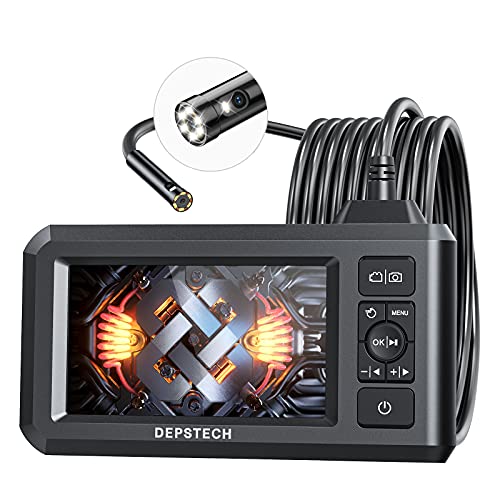
- Front and side cameras with three viewing modes
- 1080P recording on a 4.3-inch IPS display
- 16.5-foot cable with IP67 waterproofing
Best For: Extended automotive, HVAC, plumbing, and machinery inspections
Large-Screen Simplicity
TGJOR 5-Inch Dual-Lens Borescope

- Large 5-inch display with 170° viewing angle
- 16.4-foot waterproof semi-rigid probe
- App-free operation with eight adjustable LEDs
Best For: Live automotive, sewer, drain, and HVAC inspections
Precision Maneuvering

- 210° two-way articulation with 420° movement
- Dual lenses and 1080P photo/video capture
- 32GB card, case, and inspection accessories included
Best For: Detailed automotive and mechanical inspections around tight bends
Connected Professional Choice – Bosch GIC5-27C Inspection Camera
For professional underbody inspection cameras, the Bosch GIC5-27C stands out as a connected handheld system with an 11.5-foot cable, a high-resolution 5-inch display, and built-in image and video storage. Its orientation indicator, adjustable lighting, and included accessories make it practical for documenting automotive, construction, and equipment inspections.
Best For: Contractors, mechanics, and inspectors who want a long-reach camera with onboard recording and USB-C file transfer.
Pros:
- 11.5-foot IP67 camera cable reaches narrow or difficult spaces.
- 5-inch display supports color images and video, with storage for up to 30 files.
- Includes a 12V Max battery, charger, 32GB microSD card, hook, mirror, magnet, and carrying case.
- Orientation indicator helps show which end of the probe is facing upward.
Cons:
- The system weighs about 5 pounds, making it less compact than basic inspection scopes.
- Its Bosch 12V Max battery platform may be unnecessary for occasional users.
The Bosch is a well-equipped professional option when documentation, cable reach, and a familiar handheld tool format matter more than minimizing size or weight.
Articulating Dual-Lens Pick – Teslong Two-Way Borescope
This Teslong is a flexible choice among professional underbody inspection cameras, combining front- and side-view lenses with two-way articulation. The 4.5-inch IPS screen, semi-rigid 5-foot cable, and adjustable LEDs help users inspect automotive, HVAC, and household spaces without repeatedly repositioning the probe.
Best For: Mechanics and maintenance users who need controllable viewing angles in tight spaces.
Pros:
- Dual lenses provide front and side views without moving the probe as often.
- Two-way articulation and a semi-rigid gooseneck support precise positioning.
- 4.5-inch IPS screen provides high-resolution viewing without requiring an app.
- Built-in adjustable LEDs and an IP67 waterproof design suit dark or damp areas.
Cons:
- The 5-foot cable offers less reach than several longer inspection cameras.
- 720p video resolution is lower than the 1080p resolution offered by some alternatives.
Choose this Teslong when maneuverability and side-view access are priorities. Its articulating control layout is especially useful for targeted automotive inspections where probe placement is difficult.
Long-Reach Triple-Lens Option – DEPSTECH DS620 Inspection Camera
The DEPSTECH DS620 is designed for users who need broad coverage from professional underbody inspection cameras. Its triple-lens system switches between viewing angles at the press of a button, while the 16.5-foot semi-rigid cable, 5-inch IPS screen, and 1080p video support detailed inspections in vehicles, pipes, walls, and machinery.
Best For: Professionals and DIY users who need maximum cable reach and quick multi-angle viewing.
Pros:
- Triple-lens design captures multiple angles without constant cable adjustment.
- 16.5-foot semi-rigid cable reaches deep or distant inspection points.
- 1080p video and 2MP still images provide detailed documentation.
- IP67 probe, 10 adjustable LEDs, and included magnet and hook support varied jobs.
Cons:
- MicroSD card is required for saving media and is not included.
- Battery life is listed at approximately two hours.
The DS620 is a strong reach-focused option for large vehicles, plumbing runs, and equipment. Its three-lens layout can save time when a single forward-facing camera would require repeated repositioning.
Wireless Articulation Value – Teslong TD500 Borescope
The Teslong TD500 combines two-way articulation with a 5-inch IPS display and a 5-foot semi-rigid gooseneck cable. For professional underbody inspection cameras, it offers a practical out-of-the-box setup with a rechargeable battery, wireless image sharing, and a 32GB memory card for recording inspection photos and video.
Best For: Automotive inspectors who want articulated probe control and the option to share images with colleagues.
Pros:
- Two-way articulation helps view engine and automotive components without disassembly.
- 5-foot semi-rigid cable is easier to guide around parts than a fully flexible probe.
- Includes a 5-inch IPS screen, 3000mAh rechargeable battery, and 32GB memory card.
- Wireless adapter supports sharing images with an external tablet during inspections.
Cons:
- The 5-foot cable provides less reach than long-cable alternatives.
- Its 1.48 kg weight may feel substantial during extended handheld use.
The TD500 is a sensible choice for mechanics who value articulation and immediate recording without external hardware. It is particularly suited to engine-bay work where controlled probe movement matters more than maximum cable length.
Precision Articulation Pick – SATA Articulating Borescope
For professional underbody inspection cameras work, the SATA articulating borescope combines a slim 8.5mm probe with 210° two-way articulation, making it easier to inspect around engines, components, and other tight spaces. Its 4.3-inch display, 4X zoom, IP67 probe, and built-in recording features support detailed inspections without an app or phone.
Best For: Mechanics and technicians who need precise one-handed control in cramped automotive, HVAC, plumbing, or equipment-access areas.
Pros:
- 210° articulating probe with angle lock helps hold a chosen viewing position.
- Sharp 1600×1200 visuals, 4X zoom, and Full HD output support detailed documentation.
- IP67 probe, adjustable LEDs, and overheat protection suit demanding inspection environments.
- Includes a 32GB TF card and provides up to three hours of operation.
Cons:
- The 5-foot cable may be limiting for especially deep or extended inspection routes.
- Its compact 4.3-inch display is smaller than some larger-screen alternatives.
The SATA stands out when directional control matters most. The lockable articulation and slim probe are particularly useful for navigating around obstructions, while the self-contained screen and recording tools keep field inspections straightforward.
Extended-Reach Pick – Teslong Dual Lens Borescope
This Teslong is a practical choice among professional underbody inspection cameras when reach and viewing flexibility are priorities. Its dual-lens design switches between forward and side views, while the 16.5-foot semi-rigid cable helps access deep engine bays, ducts, wall cavities, drains, and other hard-to-reach areas.
Best For: HVAC technicians, mechanics, and inspectors who need long cable reach and both forward- and side-facing views.
Pros:
- Dual cameras provide forward and side inspection perspectives.
- 16.5-foot semi-rigid cable reaches deep spaces while retaining its shape.
- Large 5-inch IPS screen and adjustable seven-LED lighting improve visibility.
- 5000mAh battery offers approximately 4.5 hours of continuous use.
Cons:
- Its 720p listed video resolution is less detailed than higher-resolution options.
- The approximately five-hour charging time may require planning between inspections.
- At about 2kg, it may feel less convenient for extended handheld use.
The NTS300 is best suited to jobs where probe length and camera angle versatility outweigh compactness. The included case, hook, magnet, and mirror add useful flexibility for locating and examining objects in enclosed areas.
Ergonomic Articulation Pick – Teslong Two-Way Borescope
For professional underbody inspection cameras that need responsive handling, this Teslong articulating borescope offers two-way 210° movement through a centrally positioned joystick. The 4.5-inch IPS screen, 5-foot semi-rigid cable, adjustable LEDs, and IP67 waterproof probe make it a capable option for automotive, HVAC, wall, and household inspection tasks.
Best For: Technicians who value one-handed operation, compact handling, and controlled navigation through tight spaces.
Pros:
- Two-way 210° articulation helps maneuver around complex inspection paths.
- Central joystick supports one-handed use with either hand.
- 1080p video, 4.5-inch IPS screen, and eight LED lights provide clear viewing.
- Includes a 32GB microSD card and offers approximately five hours of battery life.
Cons:
- The 5-foot cable provides less reach than long-cable inspection models.
- Its 2MP still-image resolution is modest for highly detailed documentation.
- The product uses digital zoom rather than a more advanced optical zoom system.
This model focuses on control and operator comfort. Its joystick, rear photo button, and lightweight design make it well suited to inspections where frequent repositioning and quick image capture are part of the workflow.
Dual-Lens Versatility – DEPSTECH DS300 Inspection Camera
For professional underbody inspection cameras, the DEPSTECH DS300 stands out with dual front-and-side lenses, a wide-angle viewing mode, and a 16.5-foot semi-rigid cable. Its built-in screen, adjustable lighting, and recording capability make it practical for automotive, HVAC, plumbing, and machinery inspections.
Best For: Mechanics and technicians who need extended reach, multiple viewing angles, and image or video recording during underbody and equipment inspections.
Pros:
- Dual lenses and three viewing modes, including a 70° wide-angle option.
- 1080P video, 2MP still images, a 4.3-inch IPS screen, and adjustable LED lighting.
- 16.5-foot semi-rigid cable, IP67 waterproofing, and approximately four hours of battery life.
- Includes hook and magnet accessories, plus a 24-month warranty.
Cons:
- A Micro SD card is not included.
- Its front and side cameras have relatively short close-focus ranges, so positioning matters.
The DS300 is a well-rounded choice when inspection documentation and long probe reach matter. Dual-lens switching reduces the need to reposition the cable, while the durable waterproof design supports work in dark, confined areas.
Large-Screen Simplicity – TGJOR 5-Inch Dual-Lens Borescope
Among professional underbody inspection cameras, this TGJOR model emphasizes straightforward, app-free operation and a large 5-inch display. Its dual-lens probe, 16.4-foot semi-rigid cable, waterproof construction, and adjustable LEDs suit automotive, drain, sewer, and HVAC checks.
Best For: Users who prioritize a large live-view screen and simple plug-and-play inspections in wet or confined spaces.
Pros:
- 5-inch HD screen with a wide 170° viewing angle.
- Dual front-and-side views with 1080P image output and a 1.2- to 4-inch focus range.
- 16.4-foot semi-rigid cable, eight adjustable LEDs, and IP67 waterproofing.
- Requires no app or Wi-Fi and offers approximately three to four hours of battery runtime.
Cons:
- It cannot take pictures or record videos.
- The fixed-focus design provides less focusing flexibility than an autofocus model.
This TGJOR scope is best viewed as a live-inspection tool rather than a documentation camera. The large display and long waterproof probe are useful for locating problems under vehicles or inside pipes, while the lack of recording may limit reporting workflows.
Precision Maneuvering – Acoath Articulating Borescope
For professional underbody inspection cameras that need precise probe control, the Acoath articulating borescope offers two-way 210° articulation and a 420° range of motion. Its dual lenses, 1080P capture, 4.3-inch IPS screen, waterproof 5-foot cable, and included 32GB card support detailed work in tight automotive and mechanical spaces.
Best For: Mechanics and technicians who need to steer a short probe around bends and capture photos or videos without using a phone.
Pros:
- Two-way 210° articulation provides a 420° range of motion for difficult angles.
- Dual front-and-side cameras with 70° and 60° viewing angles.
- 1080P photo and video capture, autofocus, and eight LEDs with four brightness levels.
- Includes a 32GB TF card, protective case, hook, magnet, mirror, and a 24-month warranty.
Cons:
- The 5-foot cable offers considerably less reach than the 16-foot-class models in this roundup.
- The articulating mechanism and accessory package add weight, at about 570 grams.
The Acoath is the most maneuverable option here, making it attractive for inspections where precise steering matters more than maximum cable length. Its built-in storage and capture features also make it better suited to documenting findings than a live-view-only scope.
How We Picked the Best Professional Underbody Inspection Cameras
We focused on features that matter during automotive and industrial inspections: probe articulation, lens coverage, lighting, display quality, cable length, water resistance, recording options, and overall usability. Models with dual or triple cameras can reduce the need to reposition the probe, while articulating tips make it easier to look behind suspension components, inside engines, and around bends.
We also considered whether each camera is better suited to professional service work, occasional diagnostics, or broader tasks such as HVAC, walls, pipes, and equipment maintenance.
Quick Comparison
- Best connected professional platform: BOSCH PRO GIC5-27C, especially for users already invested in the Bosch 12V system.
- Best for broad viewing: Triple-lens DEPSTECH models can show forward and side perspectives with less probe repositioning.
- Best for tight directional access: Articulating Teslong, SATA, and Acoath models help steer the camera around obstructions.
- Best for long-reach inspections: The 16.4- to 16.5-foot options suit pipes, walls, HVAC runs, and difficult vehicle access points.
- Best for general versatility: Dual-lens 5-inch-screen models balance portability, visibility, and everyday inspection features.
Key Buying Factors for Professional Underbody Inspection Cameras
Articulation and Probe Control
A two-way or multi-directional articulating tip can be more valuable than a higher headline resolution when inspecting behind brackets, into engine passages, or around underbody shielding. Check the stated steering range and how easily the control wheel operates with gloves.
Lens Layout and Image Quality
A forward-facing camera is essential for navigation, while a side-facing lens can reveal corrosion, leaks, cracks, and obstructions without twisting the probe. Look for a bright IPS display, adjustable lighting, and sufficient resolution for recording evidence or sharing findings with a customer.
Reach, Flexibility, and Protection
Choose cable length based on the job rather than buying the longest option automatically. Longer probes help with sewer, wall, and HVAC work but can be harder to manage around a vehicle. For underbody use, water resistance, a durable insertion tube, and a lens that tolerates dust and grime are important.
Power, Storage, and Workflow
Consider battery runtime, charging convenience, photo and video storage, and whether files can be transferred easily. A familiar standalone screen is often faster in the shop, while a connected tool may integrate better with an existing professional battery platform.
Who Should Buy Which Professional Underbody Inspection Cameras?
Professional mechanics and fleet technicians should prioritize articulation, durable construction, strong lighting, and a display that remains readable in bright shop conditions. The Bosch is a practical choice for users who value a recognized tool ecosystem and connected inspection workflow.
Technicians who inspect engines, HVAC systems, walls, and pipes may prefer a long-reach dual-lens or triple-lens model. DIY vehicle owners usually get better value from a compact 5-inch-screen borescope with dual views, adequate lighting, and simple controls rather than paying for maximum reach or advanced connectivity.
Before buying, confirm the probe diameter, minimum bend radius, waterproof rating, included accessories, and warranty. These details often determine whether a camera can safely reach the inspection area and withstand repeated professional use.