
The best 360-degree cameras for content creators make it easier to capture immersive footage, reframe shots after recording, and produce engaging videos for social media, travel, sports, and virtual experiences.
This roundup compares 10 selected cameras and camera-style devices across resolution, stabilization, tracking, portability, audio, and creator-focused features.
Best 10 360-Degree Cameras for Content Creators Picks for 2026
Best Overall
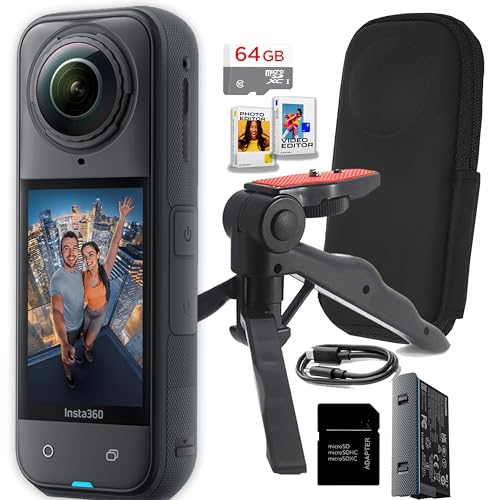
- 8K30 360-degree video with PureVideo processing
- Post-capture reframing and extensive creative modes
- Waterproof design with grip-tripod value bundle
Best For: Creators and videographers wanting maximum reframing flexibility
Best Beginner Pick

- 4K video and 75MP still photos
- 330-degree rotating lens for solo vlogging
- Wi-Fi and starter accessories included
Best For: First-time vloggers and casual travel creators
Best for Action

- 5.7K 360-degree video with Supersmooth stabilization
- Horizon Lock and AI subject tracking
- Includes invisible selfie stick and charging case
Best For: Adventure and action creators filming solo
Best for Tracking

- Face tracking with a 330-degree rotating design
- Up to 260 minutes of stated recording time
- Wi-Fi transfer and USB-C webcam mode
Best For: Solo vloggers, streamers, and subject-focused filming
High-Resolution Pick

- 11K, 60MP 360-degree photos
- 5.7K video with stabilization
- RAW, GPS, touchscreen, and replaceable storage
Best For: High-detail content and professional editing
Action-Creator Pick

- 5.7K 360 and 4K single-lens modes
- FlowState Stabilization and Horizon Lock
- Waterproof design with AI reframing
Best For: Vlogging, travel, and action sports
Value 4K Pick

- 4K 360 video at 30fps
- Four-channel spatial audio
- Compact body with Bluetooth and Wi-Fi
Best For: Simple immersive video and virtual tours
Adventure-Ready 360 Camera
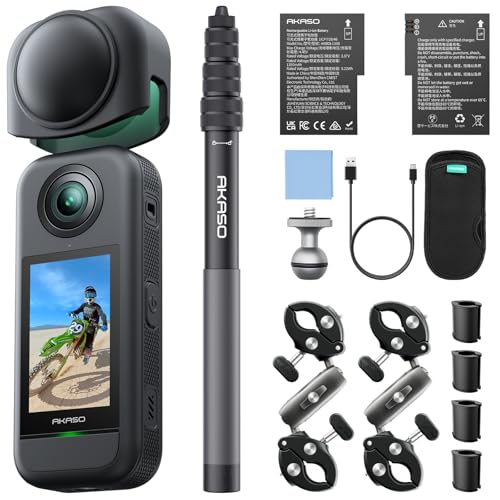
- 5.7K video and 72MP 360° photos
- Stabilization with horizon leveling
- Includes invisible selfie stick
Best For: Motorcycle riders and action creators
Meeting-Focused 360 Camera
TOUCAN SC360 Conference Camera
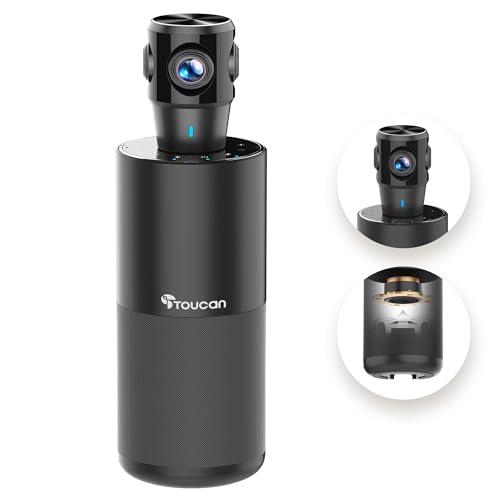
- 1080p 360-degree video
- Four microphones and built-in speaker
- USB plug-and-play connectivity
Best For: Remote meetings and spoken content
Creator-Ready 360 Camera

- 5.7K video with 72MP photos
- Includes 256GB card and charging case
- AI tracking and RAW photo support
Best For: Travel and social media creators
Best Overall – Insta360 X5
For creators who want maximum flexibility, the Insta360 X5 is one of the most capable 360-degree cameras for content creators. It records up to 8K30 360-degree video, supports post-capture reframing, and includes tools for producing conventional flat footage from a single take.
Best For: Content creators and videographers who want high-resolution 360 capture, flexible reframing, and strong action features.
Pros:
- 8K30 recording, Active HDR, and PureVideo processing for detailed footage in varied lighting.
- 360-degree post reframing, InstaFrame, Me Mode, and invisible selfie-stick support simplify composition.
- 49-foot waterproofing, stabilization, gesture control, and 4K60 single-lens recording suit active shooting.
- Value bundle includes 64GB memory and a grip-tripod.
Cons:
- Higher-resolution recording and advanced editing may require more storage and processing power.
- The camera relies on the Insta360 app for its broader editing suite and effects.
The X5 is the strongest all-around pick here for creators who prioritize resolution and editing flexibility. Its 8K capture and broad shooting modes make it especially useful when you want to decide on framing after recording.
Best Beginner Pick – 4K Vlogging Camera
This compact 4K vlogging camera is a straightforward option for beginners exploring 360-degree cameras for content creators. Its 330-degree rotating lens is designed for solo filming, while Wi-Fi and included accessories make it easy to start recording and sharing.
Best For: First-time creators, casual vloggers, and travelers who want a pocket-sized camera with simple solo framing.
Pros:
- Records 4K video and captures 75MP photos.
- 330-degree rotating lens helps with self-recording and flexible shooting angles.
- Built-in Wi-Fi supports wireless transfers to a smartphone.
- Includes a 16GB TF card, mini tripod, wrist strap, cable, and carrying bag.
Cons:
- It is not water resistant, limiting use in wet conditions.
- Battery life is listed at about 1.5 hours.
- Its 79-degree lens field of view is less expansive than a true 360-degree capture system.
This camera makes sense for beginners who value portability and uncomplicated solo recording over full spherical capture. The rotating lens and bundled kit reduce setup friction for everyday vlogs and social videos.
Best for Action – AKASO 360 Creator Combo
The AKASO 360 Creator Combo is built for active shooting and offers a practical balance of immersive capture and stabilization. For creators comparing 360-degree cameras for content creators, its 5.7K recording, Horizon Steady, subject tracking, and included invisible selfie stick are useful for adventure footage.
Best For: Action creators and travelers who need stabilized 360-degree footage with easy third-person perspectives.
Pros:
- 5.7K 360-degree video and 72MP 360-degree photos capture substantial detail.
- 360-degree Supersmooth stabilization and Horizon Lock help keep footage steady and level.
- AI subject tracking and shoot-first, frame-later workflows support solo filming.
- Creator Combo includes an invisible selfie stick and charging case.
Cons:
- The listed Creator Combo does not include a MicroSD card.
- At 0.54 kg, it is heavier than the compact X5 listed above.
- Its maximum video resolution is lower than the X5’s 8K output.
The AKASO is a compelling choice when stabilization and action-oriented features matter more than maximum resolution. It is particularly well suited to creators who want to capture movement first and choose the final viewpoint later.
Best for Tracking – Ourlife 4K Vlogging Camera
The Ourlife 4K Vlogging Camera focuses on keeping people or subjects in frame during solo recording. Its face tracking, 330-degree rotating movement, webcam mode, and long stated recording time give it a practical role among 360-degree cameras for content creators, especially for vlogs and live video.
Best For: Solo vloggers, interviewers, pet filmmakers, and streamers who prioritize automated tracking and long recording sessions.
Pros:
- 4K30 video with automatic face tracking for solo filming and interviews.
- 330-degree rotating tracking supports horizontal and vertical shooting.
- Built-in 2400mAh battery is rated for up to 260 minutes of recording and supports recording while charging.
- Wi-Fi transfer and USB-C webcam mode support sharing, streaming, and video calls.
Cons:
- The listed 1/4-inch photo sensor is smaller than the sensors in the other dedicated 360-degree models here.
- It uses manual focus and digital zoom rather than optical zoom.
- The supplied details list AVI capture, which may require conversion for some editing workflows.
The Ourlife stands out for creators who need hands-free framing and extended recording rather than the highest-resolution 360-degree imagery. Its tracking and webcam functions make it versatile for daily content, remote communication, and streaming.
High-Resolution Pick – Ricoh Theta X
The Ricoh Theta X is a strong choice among 360-degree cameras for content creators who prioritize detailed stills, high-resolution video, and hands-on camera control. It combines 11K, 60-megapixel 360-degree photos with 5.7K video, RAW capture, and a built-in touchscreen.
Best For: Creators making high-detail travel, real-estate, sports, or storytelling content who want flexible editing and expandable storage.
Pros:
- Captures 60-megapixel 11K 360-degree stills and 5.7K video.
- Supports 16-bit HDR-DNG RAW files for advanced editing.
- Includes built-in GPS, interchangeable battery, external memory, and a 2.25-inch color touchscreen.
- Image stabilization helps produce smoother video.
Cons:
- Its professional feature set may be more than casual users need.
- Some 5.7K recording modes have power or wireless limitations.
- No flash is included.
The Theta X stands out when image quality and shooting flexibility matter most. Its replaceable battery, memory-card support, and onboard controls also make it better suited to longer or more deliberate production sessions than a basic pocket camera.
Action-Creator Pick – Insta360 X3
The Insta360 X3 is one of the most versatile 360-degree cameras for content creators who film on the move. It pairs 5.7K 360 Active HDR video with a 4K single-lens mode, stabilization, waterproof construction, and AI-assisted reframing.
Best For: Vloggers, travelers, and action-sports creators who want smooth footage and the ability to choose the viewing angle after recording.
Pros:
- Records 5.7K 360 Active HDR video and 4K wide-angle footage.
- AI-powered reframing helps select angles after shooting.
- FlowState Stabilization and Horizon Lock support smooth, level video.
- Waterproof design suits travel and action activities.
Cons:
- MicroSD storage is required for recording.
- Its 16-megapixel still resolution is lower than the Theta X’s.
- Advanced reframing depends on the Insta360 app workflow.
The X3 is a practical all-rounder for creators who need one compact camera for immersive 360 footage and conventional action-camera shots. Its stabilization, touchscreen, and reframing tools reduce the need to perfectly frame every moment while recording.
Value 4K Pick – Ricoh Theta V 4K 360 Camera
The Ricoh Theta V is a straightforward option among 360-degree cameras for content creators who want 4K spherical video and spatial audio without a more complex feature set. Its compact body supports wireless smartphone connectivity and smooth 30fps recording.
Best For: Beginners and casual creators producing 4K 360 videos, virtual tours, or immersive clips with simple wireless control.
Pros:
- Records 4K 360-degree video at 30fps.
- Four-channel microphones capture omnidirectional spatial audio.
- Bluetooth and Wi-Fi support smartphone connection and wireless playback.
- Compact design and improved exposure and white-balance processing simplify shooting.
Cons:
- Internal battery and memory are not replaceable or expandable.
- It is not water resistant.
- Still photos are limited to 14 megapixels.
The Theta V makes sense for creators who value a compact, uncomplicated 4K 360 workflow. It lacks newer conveniences such as removable storage and waterproofing, but its spatial audio and wireless features remain useful for immersive everyday content.
Adventure-Ready 360 Camera – AKASO 360 Motorcycle Combo
For creators filming rides, sports, and other moving adventures, this AKASO model is a capable choice among 360-degree cameras for content creators. It combines 5.7K capture with digital stabilization, horizon leveling, AI tracking, and an included invisible selfie stick for flexible third-person footage.
Best For: Motorcycle riders and action-focused creators who want stabilized reframing options without carrying a separate gimbal.
Pros:
- Records 5.7K 360-degree video and 72MP 360-degree photos.
- 360° SuperSmooth stabilization and Horizon Steady help reduce shaky, tilted footage.
- AI subject tracking and shoot-first, frame-later workflows simplify filming.
- Includes an invisible selfie stick and supports DNG8 RAW photos.
Cons:
- This motorcycle combo is listed without a MicroSD card.
- Its fixed-focus fisheye lens may offer less control than an interchangeable-lens setup.
With dual 1/2-inch 48MP sensors, RAW support, and dedicated action features, the AKASO 360 Motorcycle Combo is oriented toward creators who prioritize immersive adventure footage and flexible post-capture framing.
Meeting-Focused 360 Camera – TOUCAN SC360 Conference Camera
For creators who produce meetings, interviews, presentations, or remote collaborations, the TOUCAN SC360 takes a conference-first approach to 360-degree cameras for content creators. It offers 1080p video, 360-degree viewing, four noise-reduction microphones, a speaker, and USB plug-and-play connectivity.
Best For: Home offices, conference rooms, and creators who need hands-free video and audio for Zoom, Teams, and similar platforms.
Pros:
- Captures 360-degree video at up to 1080p resolution.
- Four microphones and a built-in Bluetooth speaker support two-way communication.
- Plug-and-play USB connection includes a Type-C Male to USB-A Female adapter.
- Supports broad compatibility with PCs, laptops, Macs, tablets, Zoom, and Microsoft Teams.
Cons:
- 1080p resolution is lower than the 5.7K output of the action cameras in this roundup.
- It is not water resistant and weighs 1.28 kg, limiting portable outdoor use.
- Its conference-oriented design is less suited to fast-moving action footage.
The SC360 is best understood as an all-in-one conferencing device rather than an adventure camera. Its microphones, speaker, tracking, and easy computer connectivity make it practical for spoken content and group calls.
Creator-Ready 360 Camera – AKASO 360 Creator Combo
The AKASO 360 Creator Combo is designed for creators who want a ready-to-shoot package from the start. Among 360-degree cameras for content creators, it stands out with 5.7K video, dual 48MP sensors, AI tracking, RAW photo support, an invisible selfie stick, charging case, and a 256GB MicroSD card.
Best For: Travel, social media, and action creators who want flexible reframing and key accessories included in one bundle.
Pros:
- Captures 5.7K 360-degree video and 72MP 360-degree photos.
- 360° SuperSmooth and Horizon Steady help maintain smoother, level footage.
- Includes a 256GB MicroSD card, charging case, and invisible selfie stick.
- AI subject tracking, DNG8 RAW mode, and AKASO 360 Studio support a flexible editing workflow.
Cons:
- The fixed-focus fisheye lens provides limited manual lens control.
- Digital stabilization may not replace a dedicated gimbal for every high-impact scenario.
This is the most complete creator-oriented package of the three. The included storage and accessories reduce setup friction, while reframing, tracking, stabilization, and RAW capture give creators room to shape footage after recording.
How We Picked the Best 360-Degree Cameras for Content Creators
We evaluated the selected models by looking at image quality, recording formats, stabilization, reframing potential, design, accessories, and practical workflow features. We also considered whether each camera is better suited to action footage, travel videos, vlogging, livestreaming, virtual tours, or video conferencing.
Resolution matters, but it is not the only priority. A camera with reliable stabilization, useful companion software, fast file transfers, and good battery performance can be more valuable than a higher headline specification that is difficult to use in practice.
Quick Comparison
- Best for premium 360 video: Choose a high-resolution Insta360 or Ricoh Theta model with advanced recording and reframing tools.
- Best for action and travel: Look for waterproof construction, strong stabilization, replaceable lenses or lens guards, and a useful accessory bundle.
- Best for vlogging: Prioritize a compact design, rotating or single-lens modes, face tracking, an easy-to-use screen, and dependable audio.
- Best for meetings: A dedicated 360-degree conference camera with microphones, speaker support, and AI tracking may be more suitable than an action camera.
Key Buying Factors for 360-Degree Cameras for Content Creators
Resolution and Reframing
Because 360 footage spreads pixels across a spherical image, higher resolution generally produces sharper reframed clips. 5.7K is a practical baseline for many creators, while 8K and 11K options provide more cropping flexibility and detail for professional work.
Stabilization and Lens Protection
For walking, cycling, skiing, or motorcycle footage, electronic stabilization is essential. Check whether the camera is waterproof and whether replacement lens guards are available, since exposed 360 lenses are vulnerable to scratches and impacts.
Editing, Storage, and Battery Life
Review the desktop and mobile editing tools before buying. Features such as automatic tracking, keyframes, horizon leveling, and one-tap reframing can significantly reduce editing time. Also check memory support, storage capacity, charging speed, and whether spare batteries are available.
Audio and Connectivity
Built-in microphones may be adequate outdoors, but creators who speak on camera should confirm microphone compatibility, wind-noise handling, Bluetooth or wireless audio support, and transfer options. Wi-Fi and USB connectivity affect how quickly footage can move from camera to editing device.
Who Should Buy Which 360-Degree Cameras for Content Creators?
Choose a premium Insta360 model if you want strong stabilization, creator-friendly editing, and flexible reframing for action, travel, or social video. Choose a Ricoh Theta model if high-resolution stills, virtual tours, property photography, or professional spherical images are your main priorities.
Choose an AKASO model if you want an action-focused camera bundle with useful accessories at a more accessible price. Choose a compact vlogging camera if your work centers on straightforward talking-head videos, rotating-lens shots, face tracking, or casual handheld recording rather than fully immersive capture.
Finally, choose the TOUCAN conference camera for meetings, presentations, and remote collaboration rather than outdoor content. The right option depends on your shooting environment, editing workflow, and whether you need immersive 360 footage or simply a wider, smarter camera view.