
Digital 360-degree cameras make it possible to capture an entire scene and choose the viewing angle later. The best option depends on whether you prioritize image quality, action-ready stabilization, simple sharing, or professional virtual-tour work.
Our roundup compares 10 cameras and bundles across those use cases, including high-resolution Ricoh models, versatile AKASO action cameras, older budget-friendly options, and a dedicated 360-degree conferencing camera.
Best 10 Digital 360-Degree Cameras Picks for 2026
Premium Detail Pick

- 11K stills up to 60MP
- 5.7K stabilized video
- RAW, GPS, touchscreen, and expandable storage
Best For: Professional 360 photography and virtual tours
Everyday 4K Pick

- 4K video and 15MP photos
- Lightweight 4.6-ounce body
- App editing and IP53 water resistance
Best For: Casual travel, events, and Samsung users
Budget Starter Pick

- 360-degree photos and video
- Full HD recording at 30fps
- Wi-Fi live view and mobile transfer
Best For: Basic 360 projects and first-time users
Action Tracking Pick
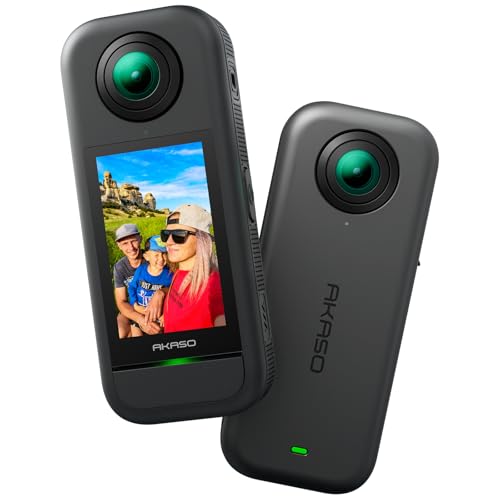
- 5.7K video and 72MP photos
- Horizon leveling and SuperSmooth stabilization
- AI tracking and shoot-first-frame-later editing
Best For: Sports, adventure, and stabilized reframing
Premium Image Quality

- Dual 1-inch sensors with 4K video and high-resolution photos
- 51GB internal storage and RAW capture
- Includes lens cap/tabletop stand and cleaning cloth
Best For: Serious creators and virtual-tour projects
Action-Ready Stabilization

- 5.7K 360-degree video and up to 72MP photos
- SuperSmooth stabilization and Horizon Steady
- Includes invisible selfie stick, charging case, and three batteries
Best For: Travel and action-focused shooting
Conference Room Convenience
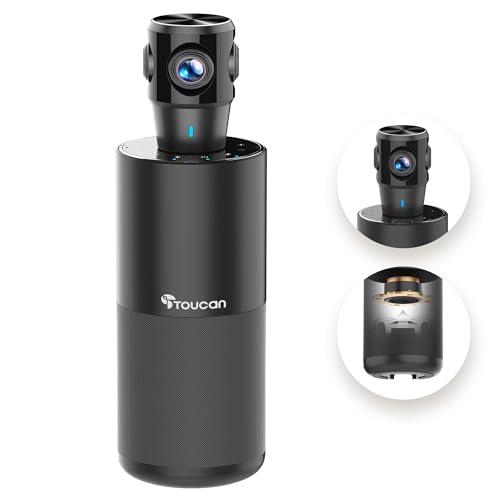
- 360-degree coverage with 1080p video
- Four microphones, built-in speaker, and AI tracking
- Plug-and-play compatibility with major meeting platforms
Best For: Office meetings and hybrid conferencing
Best Adventure Pick
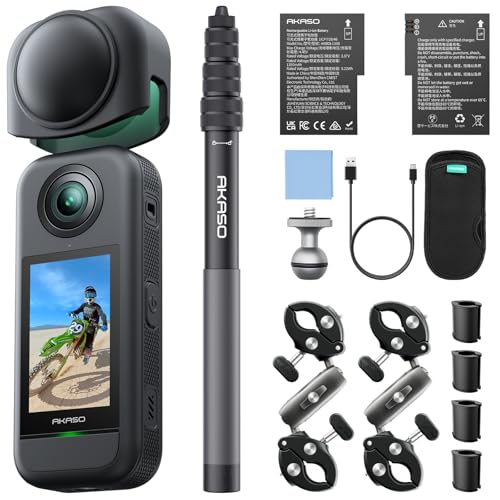
- 5.7K 360-degree video with 360° SuperSmooth stabilization
- 72MP photos, dual 48MP sensors, and AI subject tracking
- Includes an invisible selfie stick for third-person shots
Best For: Motorcycle footage and stabilized action recording
Best Simple Blue Camera

- Captures fully spherical 360-degree images and video
- Bright F2.0 lens and intuitive operation
- Theta+ apps support mobile editing and sharing
Best For: Casual 360-degree capture and mobile sharing
Best Resolution Details

- 5376 × 2688 spherical still-image mode
- 1920 × 1080 video capture at 30 fps
- Bluetooth, USB, and Wi-Fi connectivity
Best For: Portable 360-degree photos and basic video
Premium Detail Pick – Ricoh Theta X
The Ricoh Theta X is a strong choice among digital 360-degree cameras for buyers who want exceptionally detailed stills, high-resolution video, and more hands-on control. Its 11K, 60-megapixel photography, 5.7K video, built-in GPS, and touchscreen make it well suited to serious travel, property, and immersive-content work.
Best For: Professional photographers, virtual-tour creators, vloggers, and users who need expandable storage and replaceable batteries.
Pros:
- Captures 11K 360-degree still images at up to 60 megapixels.
- Records 5.7K video with image stabilization for smoother footage.
- Supports HDR-DNG RAW files, built-in GPS, interchangeable batteries, and external memory.
- Large color touchscreen enables previewing and adjustments without a smartphone.
Cons:
- Its professional feature set may be more than casual users need.
- The highest-resolution 5.7K modes have power and connectivity restrictions noted in the specifications.
The Theta X stands out when image quality, editing flexibility, and extended shooting options matter more than simplicity or a minimal feature set.
Everyday 4K Pick – Samsung Gear 360
The Samsung Gear 360 is a compact, approachable option among digital 360-degree cameras for capturing travel, family, and event footage. Dual 180-degree lenses produce 4K video and 15-megapixel photos, while the included app supports previewing, editing, and sharing.
Best For: Casual creators, travelers, Samsung phone owners, and buyers seeking a lightweight 360 camera with straightforward sharing features.
Pros:
- Records 4K video and captures 15-megapixel 360-degree photos.
- Compact 4.6-ounce design is easy to carry.
- IP53 water-resistant rating adds protection for everyday use.
- App-based previewing, editing, and social sharing are supported.
Cons:
- Compatibility is centered on specific Galaxy phones, select iPhones, and computer software.
- It offers lower photo and video resolution than newer high-end options.
- The listed battery life is approximately five hours.
The Gear 360 is a practical pick for simple 4K capture and quick sharing, especially if your phone is among the supported devices.
Budget Starter Pick – Ricoh Theta S
The Ricoh Theta S is an older, straightforward option for buyers exploring digital 360-degree cameras without needing modern high-resolution video. It captures spherical photos and Full HD video, offers mobile live view over Wi-Fi, and transfers footage directly to a mobile device.
Best For: Beginners, simple spherical-photo projects, and users who prioritize basic smartphone-connected operation.
Pros:
- Captures 360-degree spherical photos and video.
- Supports Full HD video at 30 frames per second.
- Provides mobile live view and direct wireless video transfer.
- Compact, lightweight design weighs 4.8 ounces.
Cons:
- Video resolution is limited to 1080p.
- Listed battery life is only about 25 minutes.
- It is not water resistant and uses internal 8GB storage.
The Theta S makes sense for basic 360 experimentation, but its short battery life and dated Full HD specification limit it for demanding or extended shoots.
Action Tracking Pick – AKASO 360 Action Camera
The AKASO 360 is designed for action-focused digital 360-degree cameras buyers who want high-resolution capture and advanced stabilization. It records 5.7K video, captures 72-megapixel photos, and adds horizon leveling, AI subject tracking, and shoot-first-frame-later editing.
Best For: Sports, adventure, travel, and vlogging creators who want stabilized reframing flexibility.
Pros:
- Records 5.7K 360-degree video and captures 72-megapixel photos.
- 360° SuperSmooth stabilization and Horizon Steady help reduce camera movement.
- AI subject tracking keeps the subject centered during tracking shots.
- DNG8 RAW mode provides additional editing flexibility, particularly in lower light.
Cons:
- HDR is not supported.
- Low-light video quality may be limited.
- The standard combo does not include a microSD card or invisible selfie stick.
With strong stabilization and reframing tools, the AKASO 360 is especially compelling for moving subjects and creative action footage, provided you account for the included-accessory limitations.
Premium Image Quality – RICOH THETA Z1 51GB
For creators prioritizing image quality and editing flexibility, the RICOH THETA Z1 is a premium choice among digital 360-degree cameras. Its dual 1-inch CMOS sensors, 4K video, RAW support, and built-in 51GB storage suit immersive content, virtual tours, and detailed 360-degree photography.
Best For: Serious creators, virtual-tour projects, and low-light 360-degree imaging.
Pros:
- Dual 1-inch sensors capture detailed 23MP photos and 4K video.
- 51GB of internal storage reduces reliance on removable media.
- RAW capture, manual exposure, spatial audio, and a four-channel microphone provide creative control.
- Bundle includes a lens cap that also functions as a tabletop stand, plus a cleaning cloth.
Cons:
- Not water resistant, so it is less suited to wet or rugged outdoor use.
- Fixed-focus lens and 1x optical zoom limit traditional camera-style flexibility.
- Its premium feature set may be more than casual users need.
The THETA Z1 stands out for sensor size, storage, and pro-oriented capture options. Choose it when final image quality and post-production control matter more than action-camera durability.
Action-Ready Stabilization – AKASO 360 Creator Combo
The AKASO 360 Creator Combo is built for active shooting and flexible reframing. Among digital 360-degree cameras, it combines 5.7K video, 360-degree horizon stabilization, AI subject tracking, and an included invisible selfie stick for polished adventure footage.
Best For: Travelers, action shooters, and creators who want to reframe footage after recording.
Pros:
- 5.7K 360-degree video and up to 72MP 360-degree photos capture substantial detail.
- 360-degree SuperSmooth stabilization and Horizon Steady help reduce shake and tilting.
- AI subject tracking and shoot-first, frame-later workflows simplify creative capture.
- Creator Combo includes an invisible selfie stick, charging case, USB-C cable, and three batteries.
Cons:
- The listed Creator Combo does not include a MicroSD card.
- Its 1/2-inch sensors are smaller than the THETA Z1’s 1-inch sensors.
- At 0.54 kg, it is less lightweight than some compact handheld options.
With strong stabilization and action-focused accessories, the AKASO is a versatile choice for moving subjects. It is especially appealing if you value smooth footage and the ability to choose the viewing angle later.
Conference Room Convenience – TOUCAN SC360
The TOUCAN SC360 is a meeting-focused alternative to traditional digital 360-degree cameras. It pairs 360-degree video coverage with 1080p output, four noise-reduction microphones, a speaker, AI tracking, and plug-and-play USB connectivity for hybrid meetings.
Best For: Small offices, conference rooms, and remote meetings using Zoom, Teams, or similar platforms.
Pros:
- 360-degree viewing helps include participants across a conference room.
- Four microphones are designed to capture voices clearly, while the built-in speaker supports two-way communication.
- 1080p video, AI tracking, and wide software compatibility support straightforward meetings.
- Plug-and-play USB setup includes a Type-C male-to-USB-A female adapter for PC compatibility.
Cons:
- 1080p resolution is lower than the 4K and 5.7K options in this roundup.
- It is not water resistant and is intended for indoor conferencing rather than action use.
- At 1.28 kg, it is comparatively heavy for a compact webcam.
The SC360 makes the most sense when communication is the priority rather than cinematic 360-degree capture. Its microphones, speaker, tracking, and broad compatibility make it a practical dedicated meeting device.
Best Adventure Pick – AKASO 360 Motorcycle Combo
The AKASO 360 is a feature-rich choice among digital 360-degree cameras for riders and action shooters. It combines 5.7K 360-degree video, electronic stabilization, horizon leveling, and an included invisible selfie stick for flexible reframing after recording.
Best For: Motorcycle footage, action sports, and creators who want stabilized 360-degree video with flexible editing options.
Pros:
- 5.7K 360-degree video and 72MP 360-degree photos provide detailed captures.
- 360° SuperSmooth stabilization and Horizon Steady help reduce shake and keep footage level.
- AI subject tracking, shoot-first re-framing, and an invisible selfie stick support creative solo filming.
- DNG8 RAW photo mode and AKASO 360 Studio offer added editing flexibility.
Cons:
- This motorcycle combo does not include a MicroSD card.
- Its action-focused feature set may be more than casual users need.
With dual 1/2-inch 48MP sensors, a compact 180-gram body, and water resistance, the AKASO 360 is the most capable option here for immersive action recording. It is especially appealing if stabilization and post-capture reframing matter more than simplicity.
Best Simple Blue Camera – Ricoh Theta SC Blue
The blue Ricoh Theta SC is a straightforward option for buyers exploring digital 360-degree cameras without an action-camera feature set. Its fully spherical image and video capture, bright F2.0 lens, and redesigned interface focus on easy operation and sharing.
Best For: Casual 360-degree photos and videos shared from an iOS or Android device.
Pros:
- Captures high-resolution, fully spherical 360-degree images and video.
- The bright F2.0 lens is suited to a simple, compact camera design.
- Works with iOS and Android devices.
- The Theta+ and Theta+V apps support spherical photo and video editing.
Cons:
- The supplied notes do not list detailed video resolution or frame-rate specifications.
- It uses CCD optical sensor technology rather than the newer sensor design listed for the AKASO.
The Theta SC Blue is a sensible pick when intuitive operation and mobile sharing are priorities. Its included camera, soft case, and USB cable make it a compact starter package for basic spherical capture.
Best Resolution Details – Ricoh Theta SC White
The white Ricoh Theta SC is a compact choice among digital 360-degree cameras for users who want clearly specified still and video modes. It records fully spherical content and connects through Bluetooth, USB, or Wi-Fi for a flexible sharing workflow.
Best For: Everyday spherical photography and video when documented resolution options and wireless connectivity are useful.
Pros:
- Large still images are specified at 5376 × 2688 resolution.
- Records 1920 × 1080 video at 30 fps in its listed high-quality mode.
- Bluetooth, USB, and Wi-Fi provide multiple connection options.
- Includes the Theta+ and Theta+V apps for editing spherical images and video.
Cons:
- The listed video modes are limited to 1080p/30 fps or 720p/15 fps.
- The supplied specifications identify a CCD optical sensor and JPEG media format.
The Theta SC White offers a clear, uncomplicated specification set for stills and basic video. Its light 3.52-ounce body and multiple connection methods make it convenient for portable, app-assisted 360-degree shooting.
How We Picked These Digital 360-Degree Cameras
We selected models that represent the main ways buyers use 360 cameras: travel photography, action recording, social video, real-estate documentation, virtual tours, and remote meetings. We considered resolution, video formats, stabilization, software workflow, battery design, storage, durability, included accessories, and overall usability.
The selection includes current higher-resolution cameras alongside older models that may appeal to shoppers seeking a simpler or less expensive entry point. Bundle contents also matter, particularly for motorcycle, creator, and general action use.
Quick Comparison
- Best for high-resolution stills: Ricoh Theta X or Theta Z1.
- Best for action and reframed video: An AKASO 360 Action Camera bundle.
- Best for a simple Ricoh workflow: Ricoh Theta SC or Theta S.
- Best for basic 4K 360 capture: Samsung Gear 360 (2017).
- Best for meetings: TOUCAN 360-Degree Video Conference Camera.
Key Buying Factors for Digital 360-Degree Cameras
Resolution and Image Quality
Higher resolution gives you more detail when cropping or reframing a 360-degree video. It is especially valuable for landscape photography, virtual tours, and footage viewed on large screens. Sensor size and lens quality also affect low-light performance, not just the advertised pixel count.
Video, Stabilization, and Reframing
Check the maximum video resolution and whether the camera offers electronic stabilization or a comparable smoothing mode. Action users should also confirm frame-rate options, horizon leveling, waterproofing, and compatibility with mounting accessories.
Battery, Storage, and Connectivity
Interchangeable batteries help during long shoots, while internal storage can be useful when memory-card access is limited. Review app compatibility, wireless transfer, USB connectivity, and whether the editing software supports your phone or computer before buying.
Handling and Workflow
A touchscreen, built-in GPS, quick-start controls, and automatic stitching can make a major difference in real-world use. Also check how easily the app exports ordinary flat video, since 360 files often need reframing before sharing.
Who Should Buy Which Digital 360-Degree Cameras?
Choose the Ricoh Theta X if you want a large display, high-resolution capture, GPS, and a replaceable battery. Choose the Theta Z1 if image quality and low-light still photography matter more than convenience or price.
Choose an AKASO bundle for cycling, motorcycling, travel, or creator work where stabilization and included mounting gear are priorities. Match the bundle to your activity rather than paying for accessories you will not use.
Choose a Ricoh Theta SC, Theta S, or Samsung Gear 360 for straightforward casual capture if you accept older specifications and potentially more limited app support. Choose the TOUCAN camera for 360-degree meetings and presentations rather than outdoor photography.