
Inspecting a vehicle’s underbody is much easier when you can see behind panels, around suspension components, and inside narrow spaces without dismantling everything. The best beginner-friendly underbody inspection cameras combine straightforward controls, useful lighting, a flexible probe, and a display that is easy to read.
This roundup compares 10 practical borescopes and endoscopes suited to first-time users, DIY maintenance, automotive troubleshooting, plumbing, and general home inspection.
Best 10 Beginner-Friendly Underbody Inspection Cameras Picks for 2026
Best Dual-Lens Pick
T TAKMLY 4.3-Inch Dual-Lens Endoscope

- Front and side cameras
- 1080p 4.3-inch display
- 16.4-foot IP67 probe
Best For: Beginners needing flexible live inspection views
Best for Steering Control
Teslong Articulating Borescope

- Two-way 210° articulation
- 4.5-inch IPS screen
- Includes 32GB MicroSD card
Best For: Targeted inspections requiring precise camera positioning
Best Simple Starter
WEWECAR 1080p Industrial Endoscope

- App-free operation
- 4.3-inch LCD display
- 16.5-foot IP67 probe
Best For: First-time users wanting straightforward live inspections
Best for Recording Findings

- Photo and video capture
- 16.5-foot IP67 cable
- 1.5x zoom and rotating display
Best For: Users who want to save and review inspection evidence
Versatile Dual-Lens Pick
DEPSTECH DS300 Dual-Lens Borescope
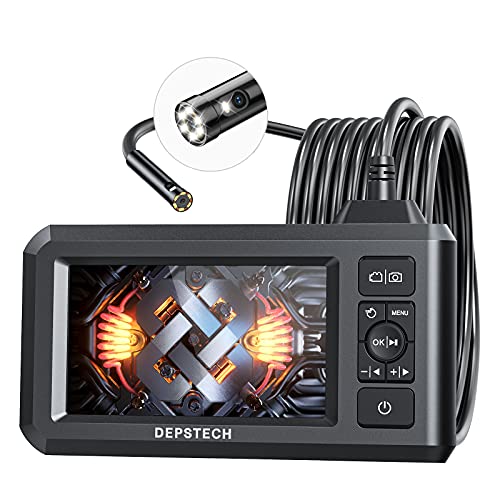
- Front and side cameras with split-screen viewing
- 4.3-inch screen with 1080p video
- 16.5-foot waterproof semi-rigid cable
Best For: Beginners needing flexible, long-reach inspections
Simple Long-Reach Option
COOVIE 1920P HD Inspection Camera

- Dedicated 4.3-inch IPS display
- 16.4-foot semi-rigid waterproof cable
- Eight adjustable LEDs for dark spaces
Best For: First-time users wanting phone-free inspections
Precision Steering Choice
DXZtoz 220° Articulating Borescope

- Two-way 220-degree camera articulation
- 1080p display with 8x digital zoom
- Oil-resistant, IP67 waterproof probe
Best For: Mechanics inspecting around tight obstacles
Best Smartphone-Compatible Pick
Kinpthy 1920P Endoscope Camera
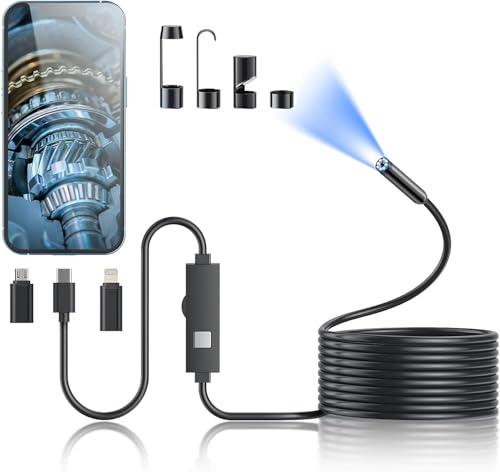
- 1920P photo and video resolution
- 16.4-foot semi-rigid waterproof probe
- Includes iOS, Android, hook, magnet, and mirror accessories
Best For: DIY users who prefer smartphone viewing and recording
Best Simple Plug-and-Play Pick
MugEasy 1920P Borescope Camera

- Built-in 4.3-inch IPS display
- No app, Wi-Fi, or smartphone required
- IP67 probe with eight adjustable LEDs
Best For: Beginners wanting live inspection without photo storage
Best Simple Pick
TGJOR 5-Inch HD Inspection Borescope

- Front- and side-view dual-lens camera
- Large 5-inch HD screen
- 3–4 hours of battery runtime with IP67 probe
Best For: Vehicle and pipe inspections requiring side-view flexibility
Best Dual-Lens Pick – T TAKMLY 4.3-Inch Dual-Lens Endoscope
For shoppers comparing beginner-friendly underbody inspection cameras, the T TAKMLY stands out for its straightforward standalone display and dual-lens design. Its 16.4-foot semi-rigid cable, adjustable lighting, and IP67 rating make it practical for checking automotive components and other damp, confined spaces.
Best For: Beginners who want front- and side-view inspection flexibility for vehicles, pipes, vents, and walls.
Pros:
- Dual front and side cameras can be switched during inspection.
- 4.3-inch HD IPS screen shows 1080p images without requiring an app.
- Long 16.4-foot semi-rigid probe and IP67 waterproofing suit hard-to-reach areas.
- Includes hook, magnet, and mirror attachments.
Cons:
- It cannot capture photos or videos.
- The 8mm probe may be too large for especially narrow openings.
This is a practical choice when live viewing matters more than recording. The second lens adds useful perspective, while the integrated screen and simple controls keep the learning curve low.
Best for Steering Control – Teslong Articulating Borescope
The Teslong articulating borescope is a strong option among beginner-friendly underbody inspection cameras when positioning the lens is the main challenge. Its two-way articulating probe, joystick control, and standalone 4.5-inch screen help beginners navigate complex spaces without relying on a phone app.
Best For: Automotive and HVAC users who need precise lens direction in tight, winding areas.
Pros:
- Two-way 210-degree articulation improves maneuverability.
- Central joystick supports one-handed operation.
- 4.5-inch IPS display and adjustable LEDs provide clear viewing in dark areas.
- Includes a 32GB MicroSD card and supports photo and video capture.
Cons:
- The probe is 5 feet long, shorter than several competing models.
- Its articulation features may add complexity compared with a fixed probe.
Choose this model if steering the camera around components is more important than maximum reach. The compact length and joystick are particularly helpful for targeted automotive inspections.
Best Simple Starter – WEWECAR 1080p Industrial Endoscope
For beginners who prefer a no-fuss tool, this WEWECAR endoscope keeps operation simple: turn it on, view the image on the built-in screen, and adjust the lights as needed. Its 16.5-foot semi-rigid probe and IP67 water resistance also make it suitable for automotive, plumbing, HVAC, and general home inspections.
Best For: First-time users seeking a simple, app-free camera for vehicle, pipe, wall, and household checks.
Pros:
- No Wi-Fi or app connection is required.
- 4.3-inch LCD screen provides real-time viewing.
- Eight adjustable LEDs help illuminate dark spaces.
- Long 16.5-foot probe and IP67 rating support wet or confined inspections.
Cons:
- The supplied notes do not indicate photo or video recording capability.
- The 7.9mm probe may not fit the narrowest access points.
This is one of the easiest choices for a beginner who values immediate operation over advanced features. It offers useful reach and lighting for routine inspections while avoiding smartphone setup.
Best for Recording Findings – Teslong 16.5-Foot Borescope
The Teslong 16.5-foot borescope is a practical pick among beginner-friendly underbody inspection cameras for users who want to document what they find. It combines a simple standalone screen with photo and video capture, adjustable lighting, a semi-rigid cable, and useful retrieval accessories.
Best For: DIYers and mechanics who need to inspect, save, and review findings from vehicles, plumbing, HVAC systems, or walls.
Pros:
- Captures photos, videos, and freeze frames to an SD card.
- 16.5-foot semi-rigid IP67 cable provides reach and positioning control.
- Eight adjustable LEDs, 1.5x zoom, and a rotating display improve viewing.
- Includes hook, magnet, side mirror, and a 24-month warranty.
Cons:
- The SD card is not included.
- The listed video capture resolution is 720p.
- Battery life is rated for up to 3 hours.
This model makes sense when inspection records are valuable, such as documenting a suspected fault or sharing evidence with a repair professional. Its controls remain approachable while offering more documentation features than a live-view-only scope.
Versatile Dual-Lens Pick – DEPSTECH DS300 Dual-Lens Borescope
For beginners comparing underbody inspection cameras, the DEPSTECH DS300 offers a straightforward way to view hard-to-reach areas. Its dual lenses, built-in 4.3-inch screen, 16.5-foot semi-rigid cable, and one-button viewing controls make it useful for automotive, plumbing, HVAC, and general home inspections.
Best For: Beginners who want flexible viewing angles and a long cable for inspecting vehicle undersides, pipes, ducts, and other narrow spaces.
Pros:
- Dual-lens design supports front and side viewing, with three observation modes.
- 4.3-inch IPS screen displays 1080p video and 2MP still images.
- 16.5-foot semi-rigid cable holds its shape and reaches distant inspection areas.
- IP67 waterproof construction, adjustable lighting, and approximately four hours of battery life.
Cons:
- The package does not include a TF card.
- Its front and side cameras have relatively short focal ranges, so positioning matters for close-up details.
The DS300 is a practical all-around choice when ease of use and viewing flexibility matter more than probe articulation. Its longer cable is especially helpful for underbody and structural inspections.
Simple Long-Reach Option – COOVIE 1920P HD Inspection Camera
For shoppers seeking beginner-friendly underbody inspection cameras, this COOVIE endoscope keeps the setup simple with a dedicated 4.3-inch IPS display and no app requirement. Its 16.4-foot semi-rigid cable, adjustable LEDs, and IP67 waterproof probe are suited to basic automotive, drain, pipe, and household inspections.
Best For: First-time users who want a dedicated-screen inspection tool for wet or dark areas without relying on a phone.
Pros:
- 4.3-inch IPS screen provides a wide approximately 170-degree viewing angle.
- 1920×1080 video, 8 adjustable LED lights, and a 0.7- to 4.0-inch focal range support close inspections.
- 16.4-foot semi-rigid cable can bend while retaining its shape.
- IP67 waterproofing and included hook, magnet, and side mirror add practical versatility.
Cons:
- The charging plug is not included.
- The fixed-focus camera has no zoom function.
This COOVIE model is a sensible entry-level choice for straightforward inspections. The dedicated screen reduces setup friction, while the long cable helps reach under vehicles and into extended pipe runs.
Precision Steering Choice – DXZtoz 220° Articulating Borescope
Among beginner-friendly underbody inspection cameras, the DXZtoz stands out when reaching around obstacles is the main challenge. Its two-way 220-degree articulation control, compact 8.5mm probe, dedicated 4.3-inch monitor, and IP67 waterproof, oil-resistant design provide more directional control for automotive and mechanical work.
Best For: Beginners and DIY mechanics who need to steer the camera around bends, engine components, or other obstructions.
Pros:
- Two-way 220-degree articulation helps aim the camera without repeatedly repositioning the probe.
- 8.5mm probe, 8x digital zoom, and a 1-15cm focal range support close-up inspection.
- 1080p imaging appears on a dedicated 4.3-inch IPS monitor with no app required.
- IP67 waterproof and oil-resistant probe includes adjustable LEDs and useful accessories.
Cons:
- The 5.5-foot probe is substantially shorter than the long-reach options in this roundup.
- Articulation controls may require more practice than a fixed straight probe.
The DXZtoz is the better fit when positioning precision matters more than reach. Its articulating tip can simplify inspections around engine parts and other tight obstacles, while the included case supports organized storage.
Best Smartphone-Compatible Pick – Kinpthy 1920P Endoscope Camera
For shoppers seeking beginner-friendly underbody inspection cameras, the Kinpthy combines smartphone connectivity with a long, semi-rigid probe. Its 1920P imaging, adjustable lighting, and included attachments make it a practical option for checking areas around a vehicle, engine, wiring, or pipes.
Best For: DIY users who want a smartphone-connected inspection camera for automotive and household checks.
Pros:
- 1920P image and video resolution for close-range inspection.
- 16.4-foot semi-rigid cable helps reach confined areas.
- IP67 waterproof probe and eight adjustable LED lights support dim or wet locations.
- Includes magnet, hook, mirror, and connectors for iOS and Android devices.
Cons:
- Requires a compatible phone or tablet and app installation.
- Fixed focus and a 7.9mm probe may not suit every narrow opening.
The Kinpthy is a flexible, feature-rich choice for beginners comfortable using a phone as the display. It is especially useful when you want captured photos and videos as well as live viewing.
Best Simple Plug-and-Play Pick – MugEasy 1920P Borescope Camera
This MugEasy model is one of the more beginner-friendly underbody inspection cameras because it works without a phone, Wi-Fi connection, or app. A built-in 4.3-inch IPS screen, adjustable LEDs, and a 16.5-foot semi-rigid cable keep operation straightforward for vehicle, pipe, wall, and drain inspections.
Best For: Beginners who want an independent inspection camera with simple controls and a built-in display.
Pros:
- 4.3-inch IPS screen provides a wide viewing angle of approximately 170 degrees.
- 1920x1080P real-time imaging with brightness and color-flip controls.
- Eight adjustable LEDs and an IP67 waterproof probe suit dark or wet areas.
- Long semi-rigid cable and included hook, magnet, and side mirror improve reach and versatility.
Cons:
- Cannot take or store photos.
- Its 7.9mm probe may be too large for especially narrow openings.
Choose this model if ease of use matters more than image storage. The dedicated screen removes phone compatibility concerns, making it a convenient starter tool for occasional inspections.
Best Simple Pick – TGJOR 5-Inch HD Inspection Borescope
For beginner-friendly underbody inspection cameras with a larger display, the TGJOR offers a 5-inch screen and switchable front and side lenses. Its plug-and-play design, semi-rigid 16.4-foot probe, and built-in lighting are well suited to automotive, plumbing, HVAC, and other hard-to-reach inspections.
Best For: DIYers and mechanics who want front-and-side viewing on a large screen for vehicle or pipe inspections.
Pros:
- Dual-lens design lets users switch between front and side views.
- 5-inch HD screen with an approximately 170-degree viewing angle.
- 16.4-foot semi-rigid cable, eight adjustable LEDs, and IP67 waterproofing support difficult environments.
- No app or Wi-Fi is required, and the 2000mAh battery provides approximately 3–4 hours of runtime.
Cons:
- Cannot take pictures or record videos.
- The larger 5-inch display and dual-lens hardware may be more than casual users need.
The TGJOR is a strong choice when viewing angle and inspection flexibility are priorities. Its dual-lens setup can reduce repositioning, while the simple controls keep it approachable for first-time users.
How We Picked These Beginner-Friendly Underbody Inspection Cameras
We focused on features that reduce the learning curve while remaining useful for real automotive inspections. The selected cameras offer combinations of built-in lighting, dedicated screens, long or semi-rigid probes, waterproof construction, and image resolutions suitable for spotting leaks, corrosion, loose components, and obstructions.
We also considered probe flexibility, camera diameter, dual-lens or articulating designs, control simplicity, and whether a unit can work in dark, cramped areas. Because specifications and included accessories can vary by listing, confirm the current package contents before ordering.
Quick Comparison
- Best for general DIY use: Choose a straightforward 1080P or 1920P camera with a built-in screen and adjustable LEDs.
- Best for reaching around obstacles: Look for an articulating probe or dual-lens design.
- Best for long-distance inspection: Select a 16.4- or 16.5-foot semi-rigid probe when access points are far apart.
- Best for wet areas: Choose an IP67-rated model, while avoiding immersion beyond the manufacturer’s limits.
- Best for detailed positioning: A smaller probe diameter and a controllable tip can make tight spaces easier to inspect.
Key Buying Factors
Image, Lighting, and Display
Resolution matters, but lighting and screen visibility often matter more beneath a vehicle. Adjustable LEDs help prevent dark spots and glare. A built-in 4.3- or 5-inch screen is convenient because it avoids depending on a phone connection, while an IPS display can improve viewing from different angles.
Probe Length and Flexibility
A semi-rigid probe can hold its shape while you guide it around the engine bay or underbody. Longer probes provide reach but may be harder for beginners to control. For routine vehicle work, balance reach with manageable handling rather than choosing the longest option automatically.
Camera Direction and Access
Dual-lens cameras let you switch between forward and side views, which is useful when inspecting behind brackets or along frame rails. Articulating models provide more precise positioning but may require additional practice and careful control.
Durability and Waterproofing
IP67 protection is helpful around oil residue, road grime, and occasional moisture. It does not mean every camera is designed for prolonged submersion or harsh chemicals. Clean the probe after use and follow the stated operating limits.
Who Should Buy Which Beginner-Friendly Underbody Inspection Cameras?
New DIY mechanics should prioritize a built-in screen, simple controls, adjustable lighting, and a medium-length semi-rigid probe. Experienced automotive users may benefit more from dual-lens or articulating designs that improve access around hidden parts. Homeowners and multi-purpose users should consider longer probes and waterproof construction for plumbing, HVAC, walls, and drains as well as vehicles.
Before buying, check the probe diameter, screen size, power source, recording or snapshot capabilities, included guides, and warranty. The right camera is the one that matches your access distance and inspection habits—not necessarily the model with the highest advertised resolution.