
Choosing the right scanner can make or break a reverse-engineering workflow. The best options balance precision, capture speed, tracking stability, and easy export into CAD or 3D printing software.
In this roundup, we focus on scanners that can handle real-world parts, from compact consumer components to more demanding engineering and inspection jobs.
Best 10 3d Scanner for Reverse Engineering Picks for 2026
Best Wireless Pick
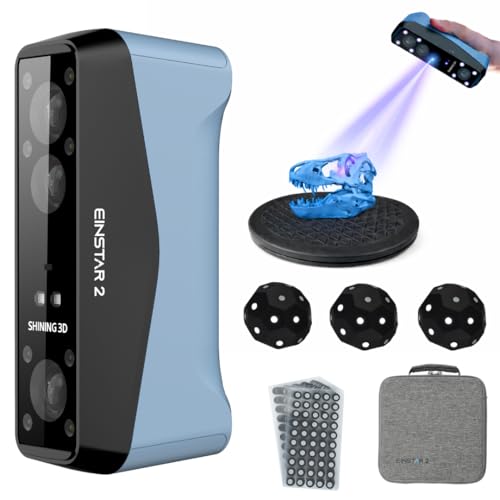
- Hybrid laser + infrared scanning for varied objects
- Wireless, battery-powered handheld operation
- Full-color capture with CAD-friendly export formats
Best For: Engineers and creators who need a portable scanner for reverse engineering and 3D modeling.
Best for Metrology-Grade Detail
Creality Raptor Pro 3D Scanner

- 0.02 mm claimed accuracy for fine part capture
- 22 cross and 7 parallel blue laser lines
- Up to 60 fps and 660,000 points/sec
Best For: Automotive modders, engineers, and makers scanning parts for redesign or inspection.
Best for Photogrammetry-Grade Reverse Engineering
Revopoint MIRACO Plus 3D Scanner

- Photogrammetric kit improves measurement workflows on larger objects
- Near/Far modes handle tiny parts through large assemblies
- 32GB RAM and multiple export formats support CAD-focused work
Best For: Engineers and makers who need accurate scan-to-CAD capture for reverse engineering.
Best Standalone Scanner
Creality Sermoon P1 3D Scanner

- Built-in PC enables true standalone scanning
- Multiple laser/NIR modes handle tough surfaces and details
- 0.02mm accuracy suits reverse engineering and QA
Best For: Mobile reverse engineering teams and technicians who need a self-contained scanner.
Best for Spray-Free Scanning
Revopoint INSPIRE 2 3D Scanner

- Dual scan modes for structured light and multi-line laser work
- Up to 0.03 mm precision for detailed reverse engineering
- Wireless, lightweight design with iOS, Android, Windows, and macOS support
Best For: Users who want a portable scanner that handles challenging surfaces with less prep.
Best for Metrology Detail
Creality Sermoon S1 3D Scanner

- 0.02 mm accuracy for detailed reverse engineering
- Blue laser and NIR modes for small and large scans
- Compatible with Geomagic and Verisurf workflows
Best For: Engineers and makers who need a precision-focused scanner for reverse engineering and inspection.
Best for Portable Reverse Engineering
Creality Otter Lite Basic 3D Scanner

- 0.05mm claimed precision with dual scanning ranges
- Color texture capture for detailed reference models
- Portable 235g handheld design with a full starter kit
Best For: Makers and small teams who need a portable scanner for detailed part capture and reverse-engineering workflows.
Best for Detailed Reverse Engineering

- 0.03 mm claimed accuracy for fine detail
- Five modes for parts, holes, reflective metal, and outdoor scanning
- AI segmentation and WiFi 6 help streamline workflows
Best For: Engineers and designers needing a portable, detail-focused scanner for parts and prototypes.
Best for Precision Modeling
Revopoint MetroX Pro 3D Scanner

- 0.01 mm claimed single-frame precision
- Multiple laser modes for tricky surfaces
- Turntable and software tools support workflow automation
Best For: Engineers and makers who need a high-precision scanner for reverse engineering and inspection.
Best for Precision Reverse Engineering
Revopoint MetroY Ultra Laser 3D Scanner

- 0.01 mm single-frame precision
- 5 scan modes for mixed part sizes
- Wireless, battery-powered field scanning
Best For: Engineers and makers who need high-detail scans for reverse engineering and inspection.
Best Wireless Pick – EINSTAR 2 Handheld 3D Scanner
If you need a 3d scanner for reverse engineering that can move from bench work to field capture, the EINSTAR 2 stands out for its hybrid laser and infrared modes. It’s built to handle everything from small parts to larger objects, with full-color texture capture and flexible export options for downstream CAD and 3D printing workflows.
Best For: Designers, engineers, and small teams that want a portable scanner for mixed-material parts, reflective surfaces, and mobile scanning sessions.
Pros:
- Hybrid scan modes combine 17 blue laser lines with infrared capture for versatile use
- Wireless, battery-powered design makes it easier to scan away from the desktop
- Captures full color and exports common formats like STL, OBJ, PLY, and 3MF
- Handles dark or reflective surfaces better than many entry-level scanners
Cons:
- More specialized than a basic plug-and-play scanner for casual users
- Reverse engineering results still depend on good technique and post-processing
- Premium feature set may be overkill if you only scan simple objects
For buyers prioritizing mobility and material flexibility, this is a strong 3d scanner for reverse engineering, especially when you need both handheld freedom and workable output for design iteration.
Best for Metrology-Grade Detail – Creality Raptor Pro 3D Scanner
If you need a 3d scanner for reverse engineering, the Creality Raptor Pro is built for capturing both small precision parts and larger automotive surfaces with minimal passes. Its 22 cross blue laser lines, 7 parallel laser lines, and metrology-grade claimed accuracy make it a strong fit for workflows where fit, finish, and repeatable measurements matter.
Best For: Automotive modders, engineers, and makers who need fast, high-detail scans of parts for redesign, inspection, or replication.
Pros:
- 0.02 mm claimed accuracy with 7-line blue laser mode for fine-detail capture
- Up to 60 fps scanning and 660,000 points per second for faster workflows
- One-shot imaging and anti-shaking design help maintain tracking on handheld scans
- CrealityScan software adds guided workflows, editing tools, and marker scanning
Cons:
- Advanced feature set may be more than casual users need
- Best results will depend on using the right mode for the part size and surface
For buyers comparing a 3d scanner for reverse engineering, the Raptor Pro stands out for speed, laser-line flexibility, and a workflow designed around technical parts rather than simple hobby scans. It’s especially appealing if you want one scanner that can handle everything from engine components to larger body panels.
Best for Photogrammetry-Grade Reverse Engineering – Revopoint MIRACO Plus 3D Scanner
If you need a 3d scanner for reverse engineering that can handle both detailed small parts and larger assemblies, the Revopoint MIRACO Plus stands out for its built-in photogrammetric metrology and flexible scanning modes. It combines high reported precision, color capture, and export-friendly file support in a portable package, making it a practical fit for CAD workflows and part recreation.
Best For: Engineers, product designers, and makers who want photogrammetry-assisted scanning for accurate reverse engineering and scan-to-CAD work.
Pros:
- Photogrammetric metrology kit helps improve measurement accuracy on larger objects
- Wide scanning range with Near and Far modes for tiny parts and bigger assemblies
- 32GB RAM, 256GB storage, and multiple export formats support heavier workflows
- Color scanning and 48MP RGB camera produce more realistic reference models
Cons:
- Revo Design for scan-to-CAD is sold separately
- Some advanced software features are limited to x86 systems
- Photogrammetry setup adds extra steps compared with simpler handheld scanners
For buyers prioritizing a 3d scanner for reverse engineering, the MIRACO Plus is appealing because it blends metrology tools, strong hardware, and versatile capture modes into one mobile system. It is best when accuracy and workflow flexibility matter more than just basic scanning speed.
Best Standalone Scanner – Creality Sermoon P1 3D Scanner
If you need a 3d scanner for reverse engineering that can move from the workshop to the field, the Creality Sermoon P1 stands out for its built-in computer and multi-mode laser/NIR capture. It’s designed to handle everything from small parts to larger assemblies, with enough precision for CAD cleanup, inspection, and print-ready model creation.
Best For: Mobile reverse engineering, automotive repair, and industrial scanning jobs where a standalone workflow matters.
Pros:
- Built-in PC with 24GB RAM and 256GB storage for true standalone use
- Multiple scan modes help capture detail on dark surfaces, cavities, and complex geometry
- High precision and broad size range support CAD, QA, and 3D printing workflows
- WiFi 7 and wireless scanning make on-site work more flexible
Cons:
- Likely overkill for casual hobby scanning
- Advanced feature set may take time to learn
Overall, the Sermoon P1 is a strong fit if you want a 3d scanner for reverse engineering without depending on an external laptop. Its combination of portability, precision, and flexible capture modes makes it a practical choice for serious scan-to-CAD work.
Best for Spray-Free Scanning – Revopoint INSPIRE 2 3D Scanner
The Revopoint INSPIRE 2 is a practical 3d scanner for reverse engineering when you need flexible capture modes, decent accuracy, and less prep work on difficult parts. Its infrared laser lines and structured light help it handle dark or reflective surfaces, while Wi-Fi 6 and mobile support make it easier to scan in the field or move around larger objects.
Best For: Makers, product designers, and hobbyists who want a portable scanner that can handle mixed materials and capture usable geometry without relying heavily on scanning spray.
Pros:
- Dual scanning modes give you more options for different object sizes, materials, and environments.
- Up to 0.03 mm precision and calibration tools support detailed reverse engineering and 3D printing workflows.
- Works on dark or reflective surfaces with 11 infrared laser lines, often without scanning spray.
- Lightweight, wireless, and compatible with iOS, Android, Windows, and macOS for flexible use.
Cons:
- Revo Design is separate paid software and only supports Windows.
- Best results still depend on solid lighting, setup, and post-processing.
- Advanced users may want a higher-end system for the toughest metrology jobs.
For buyers comparing a 3d scanner for reverse engineering, the INSPIRE 2 stands out for portability and easier capture on problem surfaces rather than pure lab-grade throughput. It’s a strong fit if you want a capable all-around scanner that can travel, scan wirelessly, and feed a scan-to-CAD workflow without a lot of extra gear.
Best for Metrology Detail – Creality Sermoon S1 3D Scanner
If you need a 3d scanner for reverse engineering, the Creality Sermoon S1 is built around precision-first workflows rather than casual hobby scanning. Its blue-laser modes help capture deep recesses, narrow gaps, and complex edges, while the NIR structured-light mode speeds up larger-object scans with fewer passes. That makes it a strong fit for engineering parts, custom fabrication, and inspection work where dimensional fidelity matters.
Best For: Engineers, makers, and technicians who need a metrology-focused scanner for detailed parts, larger objects, and workflow compatibility with reverse-engineering software.
Pros:
- Metrology-grade 0.02 mm accuracy for fine mechanical detail
- Blue-laser and NIR modes cover both small features and larger objects
- Up to 90 FPS scanning helps speed up data capture
- Works with inspection and design tools like Geomagic and Verisurf
Cons:
- Requires a fairly powerful Windows or Mac setup
- More scanner than most casual users need
- Advanced features may take time to learn
For buyers comparing a 3d scanner for reverse engineering, the Sermoon S1 stands out for its combination of fine laser detail, broad scanning modes, and software compatibility. It is especially appealing when you want one scanner that can handle both intricate parts and larger assemblies without sacrificing workflow flexibility.
Best for Portable Reverse Engineering – Creality Otter Lite Basic 3D Scanner
If you need a compact 3d scanner for reverse engineering that can travel between benches, job sites, or classrooms, the Creality Otter Lite Basic is a strong fit. It combines 0.05mm claimed precision, dual scanning ranges, and full-color capture in a lightweight handheld package that aims to make scanning easier for practical part reproduction and modeling workflows.
Best For: Makers, product tinkerers, and small studios that want a portable scanner for detailed capture, color texture mapping, and quick 3D printing or reverse-engineering projects.
Pros:
- 0.05mm high-precision scanning with close-range and long-range modes
- Captures RGB texture data, which helps with visual reference and presentation models
- Lightweight 235g design with included turntable, markers, calibration board, and case
- Works with Windows and macOS using Creality Scan software
Cons:
- Not the simplest choice if you only want one-click scanning with no setup
- Accessory-heavy kit may be more than casual users need
- As with many handheld scanners, results will depend on object size, finish, and operator technique
For shoppers prioritizing portability and color capture, this Otter Lite Basic lands in a useful middle ground: more capable than a toy-grade scanner, but still approachable for everyday capture work. If your priority is a 3d scanner for reverse engineering that balances detail, mobility, and a complete starter kit, it deserves a close look.
Best for Detailed Reverse Engineering – Revopoint POP 4 3D Scanner
If you need a 3d scanner for reverse engineering, the Revopoint POP 4 is built around precision, speed, and flexible capture modes. Its 0.03 mm claimed accuracy, blue laser support, and ability to handle dark or reflective surfaces make it a strong fit for parts where fine geometry and repeatable measurements matter.
Best For: Engineers, makers, and product designers who want a portable scanner for capturing small-to-medium parts with high detail and minimal post-processing.
Pros:
- Up to 0.03 mm accuracy for detailed part capture and modeling
- Five scanning modes cover small parts, deep holes, reflective metal, and outdoor use
- Fast scanning with up to 105 fps and WiFi 6 for flexible workflows
- AI segmentation helps reduce background noise and clean up scans faster
Cons:
- Some advanced features depend on NVIDIA GPU support or Windows-only software
- Outdoor filter and battery grip are sold separately
- Best results still require a capable computer and a bit of scanning practice
For buyers comparing a 3d scanner for reverse engineering, the POP 4 stands out for combining fine-detail capture with broad scanning versatility. It is especially appealing if you need one device that can handle precision parts, tricky surfaces, and mixed indoor-outdoor job sites.
Best for Precision Modeling – Revopoint MetroX Pro 3D Scanner
If you need a 3d scanner for reverse engineering, the Revopoint MetroX Pro is built around precision capture, multiple laser modes, and workflow tools aimed at industrial and design use. Its 0.01 mm single-frame precision, blue laser scanning, and marker-based tracking make it a strong fit for detailed parts, inspection, and CAD-ready scans.
Best For: Engineers, makers, and designers who want a high-precision scanner for reverse engineering, inspection, and 3D printing workflows.
Pros:
- Very fine claimed precision and accuracy for small parts and detailed geometry
- Multiple scan modes handle shiny, dark, and feature-rich objects more flexibly
- Auto turntable and software tools help streamline repeatable scanning workflows
- Color scanning support adds realism for prototypes and presentation models
Cons:
- Paid add-on software may be needed for full reverse-engineering workflows
- Advanced features and hardware make it less beginner-friendly than simpler scanners
- Bulkier system than a lightweight hobby handheld for casual use
For buyers prioritizing accuracy over simplicity, this is a compelling 3d scanner for reverse engineering thanks to its laser modes, turntable automation, and industrial-leaning feature set. It makes the most sense when you need dependable scan detail for editing, inspection, or downstream CAD work.
Best for Precision Reverse Engineering – Revopoint MetroY Ultra Laser 3D Scanner
If you need a 3d scanner for reverse engineering that leans more toward industrial measurement than casual hobby use, the Revopoint MetroY Ultra is built around accuracy, speed, and flexible scan modes. Its blue laser system, marker-free structured light, and wireless operation make it well suited to capturing tight-tolerance parts and turning them into usable CAD-ready data.
Best For: Engineers, product developers, and makers who need detailed scans of small to medium parts for reverse engineering, inspection, or 3D printing workflows.
Pros:
- Up to 0.01 mm single-frame precision for fine geometric detail
- Five scanning modes, including laser cross-lines, parallel lines, single-line, and turntable scanning
- Handles dark, shiny, and metallic parts without spray
- Wi-Fi 6 and battery grip support more mobile scanning sessions
Cons:
- Requires a fairly powerful PC for best performance
- Higher-end features may be more scanner than casual users need
- Optimized for small-to-medium objects rather than very large scans
For buyers comparing a 3d scanner for reverse engineering, the MetroY Ultra stands out for combining industrial-style precision with practical flexibility. It is a strong fit when detail, surface handling, and workflow speed matter more than a low entry price.
How We Picked the Best 3d Scanner for Reverse Engineering
For a 3d Scanner for Reverse Engineering, the most important criteria are repeatable accuracy, reliable tracking, usable scan area, and clean mesh output. We prioritized models that offer strong precision claims, practical handheld operation, and features that help reduce rescans, such as anti-shake tools, laser capture, and wireless workflows.
We also considered how well each scanner fits common reverse-engineering tasks: capturing part geometry for CAD recreation, measuring fit and form, and producing usable data for 3D printing or inspection.
Quick Comparison
Higher-precision scanners are the best fit for detailed mechanical parts, tight-tolerance components, and engineering work. Midrange models are often better for larger objects, general product design, and mixed-use scanning. If you need color capture or photogrammetry support, that can be useful for visual reference, but it should not replace precision if dimensional accuracy is the priority.
Key Buying Factors for a 3d Scanner for Reverse Engineering
Accuracy and Precision
Look for published accuracy or precision figures that match your project needs. For mechanical parts, smaller numbers generally mean better dimensional fidelity. If you are recreating mating surfaces, housings, or brackets, precision matters more than cosmetic color detail.
Tracking and Surface Compatibility
Reverse engineering often involves matte, reflective, dark, or featureless surfaces. Multi-line blue laser systems and structured-light options can improve capture on difficult parts, while anti-shake and stable tracking help reduce gaps and misalignment.
Workflow and Output
Choose a scanner that exports cleanly into your preferred CAD, mesh, or inspection software. A fast capture rate is helpful, but only if the software can produce a usable mesh with minimal cleanup.
Portability and Part Size
Handheld scanners are ideal when parts are large, immovable, or must be scanned in place. Desktop-friendly or wireless setups may be better for repeatable work, small parts, or lab-style environments.
Who Should Buy Which 3d Scanner for Reverse Engineering?
If you need the highest-detail capture for demanding engineering tasks, prioritize the most precise laser-based models. If you want an easier all-around setup for prototypes, product design, or 3D printing, a versatile midrange scanner is often the smarter buy. If your work includes visual documentation, art, or mixed-material objects, full-color scanning and photogrammetry can add value. For the broadest use, pick the scanner that best matches your part size, tolerance needs, and software workflow rather than the one with the most features on paper.