
Choosing a 3D scanner for large objects means balancing scan coverage, speed, portability, and the level of detail you actually need. The best option for a car bumper, statue, furniture piece, or industrial part is not always the most accurate model on paper.
This roundup focuses on scanners that can handle bigger subjects without making the process slow or frustrating. Whether you want a budget-friendly handheld or a high-end laser scanner, the right pick should keep tracking stable and deliver clean results across larger surfaces.
Best 10 3d Scanner for Large Objects Picks for 2026
Best for Industrial-Scale Scans

- 0.02mm accuracy with fast 60fps laser scanning
- Scans objects from 5mm to 4000mm
- Works on black, metallic, and some transparent surfaces
Best For: Industrial designers and pros scanning medium-to-large objects with high detail.
Best for Large-Format Detail

- Up to 2 x 2 x 2 m scan range
- 0.03 mm accuracy for detailed capture
- Blue laser mode handles reflective and dark surfaces
Best For: Users who need one scanner for large objects, fine detail, and tricky surface materials.
Best for Photogrammetry
Revopoint MIRACO Plus 3D Scanner

- Photogrammetric metrology kit for large-object measurement
- Near/Far modes for small details and big surfaces
- 48MP color capture with strong hardware for smooth scanning
Best For: Users who need one portable scanner for large-item capture, detailed measurements, and color 3D models.
Best for Mixed-Surface Large Scans

- VCSEL infrared mode covers large objects efficiently.
- 17-line blue laser improves detail on tricky surfaces.
- Wireless battery design supports portable scanning.
Best For: Users who want a portable scanner for large, mixed-material objects and outdoor use.
Best for Portable Full-Color Scans
Revopoint POP3 Plus 3D Scanner
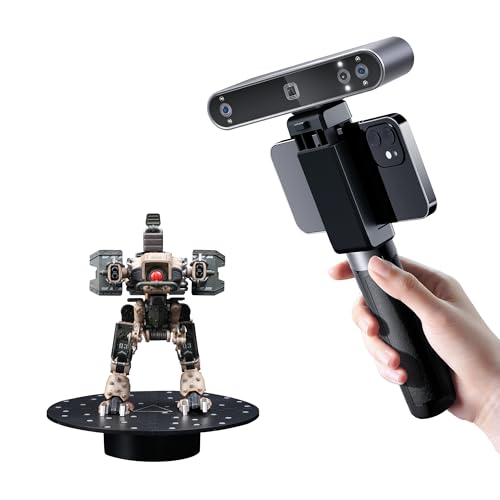
- 20-micron calibration accuracy with 0.05 mm fused point distance
- Scans objects up to 2 x 2 x 2 m for broader use cases
- Full-color capture with Wi‑Fi 6 and mobile/desktop support
Best For: Makers and designers who want a lightweight handheld scanner for medium-to-large objects and color scans.
Best for Large-Scale Precision
Revopoint POP 4 Handheld 3D Scanner
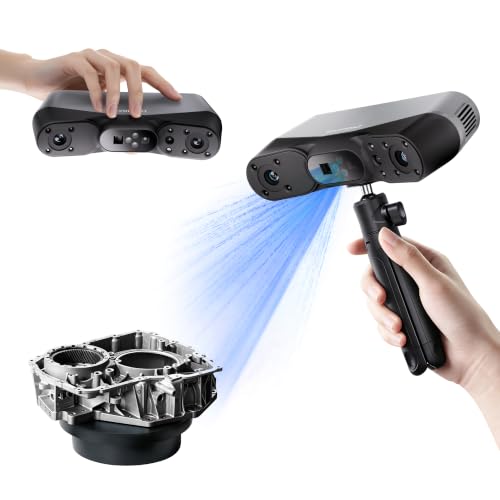
- 0.03 mm claimed accuracy for detailed capture
- Up to 105 fps for smoother large-object scanning
- Works with dark, reflective, and outdoor subjects
Best For: Users who want a versatile handheld scanner for large objects, precision parts, and field work.
Best All-in-One Portable Scan

- Wireless scanning and editing on the device
- Near/Far modes for small parts and large objects
- Up to 0.02 mm precision with 48MP color capture
Best For: Makers and professionals who need a portable scanner for both small details and large items.
Best for Large Objects
Creality CR-Scan Ferret 3D Scanner

- Wide-range mode suits larger objects and broad scan areas
- High-accuracy mode reaches up to 0.1 mm precision
- Full-color RGB capture adds realistic texture detail
Best For: Makers who want a portable handheld scanner for large objects and mixed-size 3D printing projects.
Best for Precision Large-Object Scans
Revopoint MetroY Pro 3D Scanner

- Up to 0.01 mm precision for measurement-focused work
- Multiple laser and full-field scan modes for flexibility
- No spray needed for shiny or dark surfaces
Best For: Users scanning large parts, industrial components, or detailed models who need high accuracy.
Best Simple Pick
Revopoint INSPIRE 2 3D Scanner

- Dual scan modes suit different object sizes and materials.
- Wireless WiFi 6 support improves mobility around large items.
- Handles dark or reflective surfaces without scanning spray in many cases.
Best For: People scanning large objects with mixed, reflective, or dark surfaces.
Best for Industrial-Scale Scans – Creality CR-Scan Raptor Pro
If you need a 3d scanner for large objects that can also handle fine detail, the Creality CR-Scan Raptor Pro is built for serious work. Its blue-laser plus NIR setup is designed to capture everything from small parts to full-size bodies, while keeping handheld scanning fast and stable.
Best For: Industrial designers, reverse engineers, and pros who need one scanner for medium-to-large parts, outdoor use, and full-color capture.
Pros:
- Up to 0.02mm accuracy with fast 60fps laser scanning for detailed results
- Scans large objects from 5mm to 4000mm, including bodies and faces
- Handles black, metallic, and some transparent surfaces without spray powder
- 24-bit color capture and broad compatibility with pro 3D software
Cons:
- Requires a strong Windows or modern Mac setup for best performance
- Priced for advanced users, not casual hobby scanning
The CR-Scan Raptor Pro is a strong fit if you want a 3d scanner for large objects that still preserves precision on tricky materials. It’s especially compelling for professional workflows where speed, portability, and texture capture matter as much as raw scan size.
Best for Large-Format Detail – Revopoint POP 4 3D Scanner
If you need a 3d scanner for large objects that still captures fine detail, the Revopoint POP 4 is a strong all-around pick. It combines blue laser, structured light, and VCSEL scanning modes with fast tracking and solid outdoor performance, so you can move from small parts to oversized subjects without changing tools.
Best For: Makers, reverse engineers, and 3D printing users who need accurate scans of both large objects and challenging surfaces like dark plastic or reflective metal.
Pros:
- Up to 2 x 2 x 2 m scan range handles large objects with ease
- 0.03 mm accuracy and multiple scan modes support detailed capture
- Blue laser mode helps with shiny, dark, and hard-to-scan surfaces
- WiFi 6 and AI segmentation can speed up the workflow
Cons:
- Best features may depend on NVIDIA GPU or Windows support
- Outdoor filter and battery grip are sold separately
- Advanced modes may take time to learn for first-time users
As a 3d scanner for large objects, the POP 4 stands out for its mix of portability, scan range, and surface versatility. It is a practical choice if you want one scanner that can cover big parts, detailed geometry, and mixed lighting conditions without feeling overly specialized.
Best for Photogrammetry – Revopoint MIRACO Plus 3D Scanner
If you need a 3d scanner for large objects that can still preserve fine detail, the Revopoint MIRACO Plus is built for that workflow. Its photogrammetric metrology kit, quad depth cameras, and full-color capture make it a strong fit for measuring everything from small parts to oversized equipment without losing accuracy.
Best For: Users who need one portable scanner for large-item capture, detailed measurements, and color 3D models.
Pros:
- Photogrammetric kit adds high-accuracy measurement support for large objects.
- Quad depth cameras and Near/Far modes handle both tiny details and big surfaces.
- 48MP RGB color capture helps produce more realistic 3D models.
- 32GB RAM, Wi-Fi 6, and multiple export formats support a smoother workflow.
Cons:
- Revo Design is sold separately for scan-to-CAD work.
- Advanced features may be more than casual users need.
- Software compatibility is limited to x86 systems.
This is a compelling 3d scanner for large objects if you want a portable all-in-one system that balances accuracy, size flexibility, and color capture. It is especially attractive for users who measure complex items and want fewer compromises between speed and detail.
Best for Mixed-Surface Large Scans – EINSTAR 2 Wireless 3D Scanner
If you need a 3d scanner for large objects that can also handle smaller parts, the EINSTAR 2 stands out with dual capture modes: a 17-line blue laser for detailed work and VCSEL infrared for faster, broader coverage. It is designed to stay usable on black, reflective, and even outdoor subjects, so you can move beyond controlled studio setups without spraying or extensive prep.
Best For: Makers, product teams, and hobbyists scanning larger items, mixed-material surfaces, and objects that need portable, cable-free capture.
Pros:
- VCSEL infrared mode helps cover large objects efficiently in fewer passes.
- Blue laser mode improves detail on reflective surfaces and tight geometry.
- Wireless operation with a swappable battery makes field scanning easier.
- Handles black surfaces and bright environments without spray in many cases.
Cons:
- Higher-end versatility likely means a steeper price than entry-level scanners.
- Best results may still require markers on some larger or low-detail objects.
- Wireless workflows can still fall back to cable use if interference appears.
As a 3d scanner for large objects, the EINSTAR 2 is a strong pick if you want portability, broad material compatibility, and the option to switch between speed and fine detail. It is especially appealing when you need one scanner that can tackle big items outdoors or in less-than-ideal lighting.
Best for Portable Full-Color Scans – Revopoint POP3 Plus 3D Scanner
If you want a compact 3d scanner for large objects that still handles detailed captures, the Revopoint POP3 Plus is a strong midrange pick. It combines handheld portability, full-color scanning, and Wi‑Fi 6/USB-C connectivity, making it practical for product design, creative work, and scanning medium-to-large items without a fixed studio setup.
Best For: Makers and designers who need a lightweight handheld scanner for medium-to-large objects, full-color captures, and flexible mobile or desktop use.
Pros:
- Up to 20-micron calibration accuracy and 0.05 mm fused point distance for detailed scans
- Captures objects from small parts up to 2 x 2 x 2 m, making it versatile for bigger subjects
- Full-color scanning with RGB camera and flash LED lighting adds realistic texture data
- Wi‑Fi 6, USB-C, and support for Android, iOS, Windows, and macOS improve workflow flexibility
Cons:
- Not the fastest option for users scanning very large objects regularly
- Revo Scan is limited to x86_64 systems, which may affect some setups
- Best results may require marker tracking or careful scan technique on complex surfaces
For buyers comparing a 3d scanner for large objects, the POP3 Plus stands out more for portability and color capture than sheer industrial scale. It is a smart choice if you need a capable handheld scanner that can grow with 3D printing, design, and reverse-engineering workflows.
Best for Large-Scale Precision – Revopoint POP 4 Handheld 3D Scanner
If you need a 3d scanner for large objects that still preserves fine detail, the Revopoint POP 4 is built to bridge that gap. Its fast multi-line laser and structured-light modes help you capture bigger items smoothly, while the 0.03 mm accuracy target makes it suitable for reverse engineering, 3D printing prep, and detail-heavy modeling.
Best For: Buyers who need a versatile scanner for large parts, mixed materials, and outdoor or on-site scanning.
Pros:
- High claimed accuracy and multiple scan modes for both fine detail and broader coverage
- Up to 105 fps scanning helps keep pace with large objects and complex scenes
- Handles dark and reflective surfaces better than many consumer scanners
- Wireless scanning and battery grip improve flexibility in the field
Cons:
- Top features like AI segmentation and 3DGS rely on specific software or NVIDIA GPU support
- Premium pricing may be hard to justify for casual hobby use
- Best results still depend on learning the workflow and choosing the right scan mode
For anyone shopping for a 3d scanner for large objects, the POP 4 stands out because it combines speed, outdoor usability, and multi-mode flexibility without giving up precision on smaller details. It is a strong pick when you need one scanner that can handle both industrial parts and larger field captures.
Best All-in-One Portable Scan – Revopoint MIRACO 3D Scanner
If you want a 3d scanner for large objects that can also handle smaller parts, the Revopoint MIRACO stands out for its all-in-one, wireless workflow. It scans, edits, and exports on the device itself, making it a practical pick for workshops, on-site captures, and users who do not want to stay tethered to a computer.
Best For: Makers, designers, and technicians who need a portable scanner for both detailed small objects and bigger items like furniture, vehicles, or machinery.
Pros:
- Wireless, computer-free operation with onboard scanning and editing
- Near and Far modes make it flexible for small details or large surfaces
- Up to 0.02 mm single-frame precision for detailed captures
- 48MP color capture adds realistic texture and color data
Cons:
- Higher-end feature set means it is not the cheapest option
- Revo Design CAD workflow requires separate paid software
- Battery runtime is limited to around 2 hours of scanning
Overall, the MIRACO is a strong choice if you want a 3d scanner for large objects without giving up portability or color capture. Its onboard controls and dual-range scanning make it especially useful when you need flexibility more than a desk-bound setup.
Best for Large Objects – Creality CR-Scan Ferret 3D Scanner
If you want a practical 3d scanner for large objects, the Creality CR-Scan Ferret is built around wide-range capture, decent speed, and portability. Its dual scanning modes let you switch from broad object coverage to finer detail work, while the ASIC chipset and full-color camera help keep scans smooth and realistic for 3D printing workflows.
Best For: Makers and hobbyists who need a handheld scanner that can handle larger models, furniture-sized parts, or mixed-size objects without a bulky setup.
Pros:
- Wide-range mode covers large objects efficiently, with up to 560 × 820 mm per scan
- High-accuracy mode reaches up to 0.1 mm precision for more detailed captures
- ASIC processing helps deliver faster, steadier scanning at up to 30 FPS point cloud capture
- RGB camera captures full-color textures for more realistic 3D models
Cons:
- Android-only mobile scanning may limit flexibility for iPhone users
- Requires compatible hardware and software versions to run well
- Not the simplest plug-and-play choice for complete beginners
As a 3d scanner for large objects, the CR-Scan Ferret stands out more for coverage and portability than for premium workstation-level polish. It makes the most sense if you want a compact handheld scanner that can move between bigger scans and finer detail jobs without a major investment in hardware.
Best for Precision Large-Object Scans – Revopoint MetroY Pro 3D Scanner
If you need a 3d scanner for large objects that can also handle fine detail, the Revopoint MetroY Pro is built for serious capture work. Its blue-laser modes, full-field structured light, and marker-free scanning give it the flexibility to move from bigger parts to complex surfaces without changing tools.
Best For: Reverse engineering, metrology, and 3D printing users who want high precision on larger objects and industrial-style scan workflows.
Pros:
- Up to 0.01 mm precision with strong volumetric accuracy for demanding measurement work
- Multiple scan modes, including 34-line, 15-line, single-line, and 62-line full-field options
- Handles shiny and dark surfaces without scanning spray in laser modes
- Built-in Wi‑Fi 6 and real-time preview improve mobility and monitoring
Cons:
- Requires a fairly powerful computer to run well
- Some advanced software tools and workflows are Windows-only or sold separately
- Higher-end feature set may be more than casual users need
For buyers prioritizing accuracy over simplicity, the MetroY Pro is a compelling 3d scanner for large objects when the job calls for both speed and measurement-grade detail. It is especially attractive if you want one scanner that can cover industrial parts, detailed scans, and turntable workflows in a single setup.
Best Simple Pick – Revopoint INSPIRE 2 3D Scanner
If you need a 3d scanner for large objects that can still handle tricky finishes, the Revopoint INSPIRE 2 is a strong mid-range pick. Its dual scanning modes, wireless workflow, and outdoor-ready design make it easier to capture bigger items without constantly fighting setup limits.
Best For: Users scanning large or awkward objects that include dark, reflective, or mixed-material surfaces.
Pros:
- Dual infrared structured light and multi-line laser modes improve flexibility across object sizes and materials.
- Wireless WiFi 6 scanning and mobile streaming make it easier to move around larger subjects.
- Can scan reflective or dark surfaces without spray in many cases.
- Lightweight 190g build and outdoor support add portability for field work.
Cons:
- Revo Design scan-to-CAD workflow requires separate paid software on Windows.
- Best performance depends on a capable device, especially for Windows and mobile use.
- Large-object scanning still benefits from markers and careful planning for alignment.
For buyers comparing a 3d scanner for large objects, the INSPIRE 2 stands out for versatility more than raw industrial throughput. It’s a practical choice when you want one scanner that can handle bigger parts, varied surfaces, and portable workflows without moving into a much higher price tier.
How We Picked the Best 3d Scanner for Large Objects
For a 3d Scanner for Large Objects, we looked for models that can maintain tracking over wide areas, offer enough working distance to scan comfortably, and provide a practical mix of speed and precision. We also favored scanners with flexible scan modes, wireless or handheld convenience, and support for both textured and low-detail surfaces.
Large-object scanning often benefits from a wider capture volume, stronger light projection, and software that helps align multiple passes. That is why the best choices here are not just accurate, but also efficient enough for real-world use on furniture, vehicles, sculpture, and other oversized subjects.
Quick Comparison
High-precision laser scanners are the best fit when surface detail matters most and the object is large but manageable in a controlled setup. Wireless all-in-one scanners are ideal if you want fewer cables and a smoother workflow around bigger items. Budget handhelds can still work well for casual or occasional projects, but they may require more patience with alignment and surface prep.
Key Buying Factors for a 3d Scanner for Large Objects
Tracking Stability and Working Distance
Large objects demand stable tracking over longer passes. Look for scanners with good anti-shake performance, robust alignment, and enough working distance to move around the subject without constantly losing data.
Speed Vs. Detail
Faster capture helps with big surfaces, but scan speed should not come at the expense of usable detail. If you need accurate geometry for reverse engineering or fit checks, prioritize precision and repeatability over raw frame rate.
Lighting and Surface Compatibility
Reflective, dark, or matte-heavy surfaces can be challenging. Blue laser, structured light, and hybrid systems each have strengths, so choose a scanner based on the materials you scan most often.
Portability and Workflow
If you scan on-site, battery power, wireless operation, and an all-in-one display can matter as much as resolution. For workshop use, tethered scanners may be fine if they deliver stronger performance and simpler file handling.
Who Should Buy Which 3d Scanner for Large Objects?
Choose a high-precision industrial-style model if your priority is metrology, detailed reverse engineering, or professional-grade CAD work. Pick a wireless all-in-one scanner if you want convenience and plan to scan large objects in varied locations. Go with a faster, more affordable handheld if you are a hobbyist, maker, or small business owner who needs dependable results without overinvesting.
In short, the best 3d Scanner for Large Objects is the one that matches your object size, accuracy needs, and scanning environment. Start with workflow, then compare precision, speed, and software support before deciding.