
Choosing a handheld 3D scanner is really about matching precision, speed, and scan workflow to the kind of objects you want to capture.
From hobby 3D printing to inspection and full-color capture, the best models in 2026 make it easier to get reliable results without a steep learning curve.
Best 10 Handheld 3d Scanner Picks for 2026
Best for Wireless Scanning
Revopoint INSPIRE 2 3D Scanner

- Wi‑Fi 6 wireless scanning with PC-to-mobile streaming
- Dual laser and structured-light modes for varied surfaces
- Lightweight 190 g design with full-color capture
Best For: Makers and small teams that need a portable scanner for flexible indoor and outdoor work.
Best for Precision Detail
Revopoint POP 4 Handheld 3D Scanner
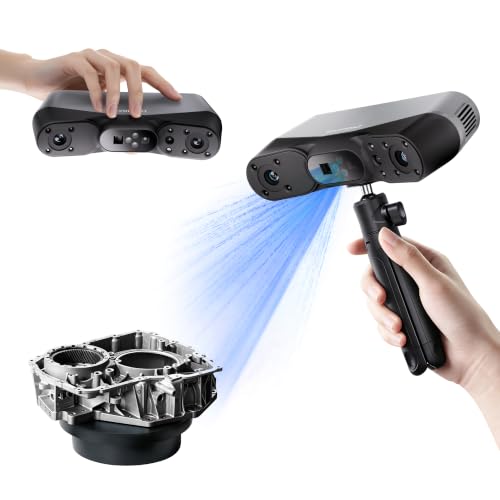
- 0.03 mm claimed accuracy for fine-detail scanning
- Five modes for dark, reflective, and deep-hole surfaces
- Wi‑Fi, battery grip, and outdoor support boost portability
Best For: Makers and engineers who want a compact scanner for detailed, versatile capture.
Best for Photogrammetric Accuracy
Revopoint MIRACO Plus 3D Scanner

- Photogrammetric metrology kit for larger-object measurement
- 0.04 mm single-point accuracy with near/far scanning modes
- 48MP color capture plus 32GB RAM for smoother workflows
Best For: Makers and professionals who need a portable scanner with measurement-focused accuracy and color capture.
Best for Small Spaces

- WiFi 6 wireless scanning with app support on multiple platforms
- 0.1mm accuracy with 24-bit full-color capture
- Lightweight 105g scanner with a helpful accessory kit
Best For: Beginners and creators who want a portable wireless scanner for general 3D printing work.
Best for Precision & Industrial Work
Revopoint MetroX Pro 3D Scanner

- Up to 0.01 mm claimed single-frame precision
- Handles shiny, dark, and detailed surfaces well
- Auto turntable and real-time streaming improve workflow
Best For: Engineers and designers who need high-detail scans for reverse engineering, inspection, and 3D printing prep.
Best Wireless Pick
Creality CR-Scan Ferret Pro 3D Scanner

- 0.1mm accuracy with 30FPS scanning
- WiFi 6 wireless support for mobile use
- Anti-shake tracking helps beginners
Best For: Makers who want a portable scanner for 3D printing and wireless mobile workflows.
Best for Outdoor & Wireless Scanning
Revopoint INSPIRE 2 3D Scanner

- WiFi 6 wireless scanning for untethered workflows
- 11 laser lines handle dark and reflective surfaces
- Full-color capture with dual scanning modes
Best For: Creators who need a portable scanner for outdoor capture, mixed materials, and detailed 3D models.
Best for Full-Color Scans
Creality CR-Scan Ferret 3D Scanner

- 0.1 mm accuracy in high-precision mode
- Full-color RGB capture for realistic textures
- Portable, lightweight handheld design
Best For: Makers who want a color-capable handheld scanner for 3D printing and mobile scanning.
Best for Precision Scanning
Creality Raptor Handheld 3D Scanner
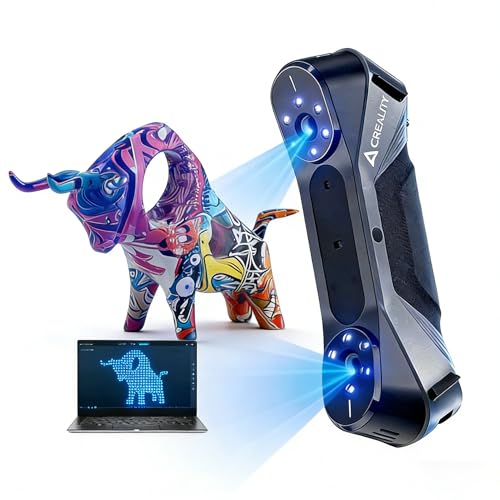
- 0.02mm precision for detailed parts and measurements
- 7-line blue laser and infrared modes for flexible scans
- 24-bit color capture with Windows and macOS support
Best For: Engineers, makers, and 3D printing users who need accurate scans of small to medium objects.
Best for High-Detail Scanning

- 0.02 mm accuracy with fast blue-laser and NIR scanning
- Works on black, metallic, and semi-transparent surfaces
- Captures color textures and supports pro 3D software
Best For: Makers and professionals scanning tricky materials, large parts, and detailed models.
Best for Wireless Scanning – Revopoint INSPIRE 2 3D Scanner
If you want a handheld 3d scanner that can move from desk to field work without much setup, the Revopoint INSPIRE 2 is built for that workflow. Its Wi‑Fi 6 wireless mode, dual scan modules, and color capture make it a strong fit for users who need flexible scanning across different object sizes, materials, and locations.
Best For: Makers, reverse engineers, and small studios that want portable scanning with wireless operation and good detail on varied surfaces.
Pros:
- Wi‑Fi 6 support enables wireless mobile scanning and PC-to-mobile streaming.
- Dual infrared structured light and 11-line laser modes help handle different objects and finishes.
- Up to 0.03 mm precision and 0.05 mm accuracy support detailed 3D printing and CAD work.
- Lightweight 190 g body and outdoor-capable scanning improve portability.
Cons:
- Revo Design CAD workflow is sold separately and only works on Windows.
- Maximum performance depends on compatible hardware and system requirements.
- Advanced features may be more than casual users need.
This is a compelling handheld 3d scanner if you care about flexibility more than a stripped-down entry-level price. The combination of wireless scanning, mixed-surface performance, and full-color capture gives it broader utility than many basic scanners in the same class.
Best for Precision Detail – Revopoint POP 4 Handheld 3D Scanner
If you need a handheld 3d scanner that balances fine-detail capture with flexible scanning modes, the Revopoint POP 4 is built for serious modeling work. Its 0.03 mm claimed accuracy, blue laser options, and strong outdoor performance make it a practical pick for 3D printing, reverse engineering, and mixed indoor/outdoor jobs.
Best For: Makers, engineers, and pros who want a compact scanner with high detail, multiple scan modes, and solid handling for difficult surfaces.
Pros:
- Up to 0.03 mm accuracy for detailed parts and clean geometry
- Five scan modes cover small objects, deep holes, dark surfaces, and reflective materials
- Up to 105 fps plus anti-shake tracking for smoother capture
- Wi‑Fi scanning and battery grip improve portability for field use
Cons:
- AI segmentation is Windows-only, so some features are platform-limited
- 3DGS output requires NVIDIA GPU support
- Premium capability comes at a higher price than entry-level scanners
Overall, the POP 4 stands out as a feature-rich handheld 3d scanner for users who care more about capture quality and versatility than keeping things basic. It is especially appealing if you need one device that can handle precision parts, awkward surfaces, and on-location scanning.
Best for Photogrammetric Accuracy – Revopoint MIRACO Plus 3D Scanner
If you need a handheld 3d scanner that can handle both detailed objects and larger jobs, the Revopoint MIRACO Plus stands out for its photogrammetric metrology kit, 0.04 mm single-point accuracy, and flexible near/far scanning modes. It is built for users who want a portable scanner that can do more than basic hobby capture.
Best For: Makers, reverse engineers, and small shops that want a versatile handheld scanner with strong measurement features and color capture.
Pros:
- Photogrammetric kit improves length accuracy for large-object measurement
- Quad depth cameras and near/far modes cover tiny parts to bigger surfaces
- 48MP RGB camera and flash LEDs help create fuller color scans
- 32GB RAM, onboard storage, and Wi‑Fi 6 support a smoother workflow
Cons:
- Photogrammetry features add setup and workflow complexity
- Revo Design is sold separately for scan-to-CAD work
- Software compatibility is limited to x86 systems
For buyers who value measurement-oriented scanning over simple plug-and-play convenience, this handheld 3d scanner offers a rare mix of portability, precision, and large-object flexibility.
Best for Small Spaces – Creality CR-Scan Ferret Pro
If you want a handheld 3d scanner that feels approachable but still covers serious hobby work, the Creality CR-Scan Ferret Pro is a practical pick. It combines wireless WiFi 6 scanning, full-color capture, and up to 0.1mm accuracy, making it a strong fit for general-purpose 3D printing projects and object digitizing.
Best For: Beginners, DIY creators, and 3D printing enthusiasts who want wireless scanning across Windows, Android, iOS, or Mac.
Pros:
- Wireless WiFi 6 scanning with broad cross-platform support
- 0.1mm accuracy and 24-bit full-color capture for detailed models
- Lightweight 105g design that is easy to carry and use on the go
- Includes useful accessories like a tripod, phone holder, power bank, and case
Cons:
- Not ideal for very small, intricate items like jewelry or precision parts
- Can struggle with reflective, transparent, or very dark surfaces
- Requires compatible system specs for stable performance
Overall, the Ferret Pro is a well-rounded handheld 3d scanner for users who value portability and wireless convenience over ultra-fine micro-object scanning. It fits best as a versatile starter-to-intermediate option for everyday 3D scanning tasks.
Best for Precision & Industrial Work – Revopoint MetroX Pro 3D Scanner
If you need a handheld 3d scanner that leans toward metrology-style accuracy rather than casual hobby capture, the Revopoint MetroX Pro is built for demanding jobs. Its blue-laser modes, up to 0.01 mm single-frame precision, and support for shiny or dark surfaces make it a strong fit for reverse engineering, inspection, and detailed 3D printing prep.
Best For: Engineers, makers, and designers who need high-detail scans for industrial measurement, reverse engineering, or automotive modeling.
Pros:
- Very high claimed precision for fine-detail scanning and dimensional work
- Multiple scan modes help handle dark, shiny, flat, and feature-rich objects
- Auto turntable and real-time streaming can speed up repeatable workflows
- Color scanning and software tools support design, inspection, and prototyping
Cons:
- More specialized than a casual plug-and-play consumer scanner
- Paid software options are sold separately for some workflows
- Heavier and more industrial in setup than simpler handheld models
For buyers who want a handheld 3d scanner with serious precision credentials, the MetroX Pro stands out more for capability than convenience. It’s a better choice when accuracy, surface handling, and workflow flexibility matter more than a lightweight beginner experience.
Best Wireless Pick – Creality CR-Scan Ferret Pro 3D Scanner
If you want a handheld 3d scanner that balances portability with strong core specs, the Creality CR-Scan Ferret Pro is a compelling option. It combines up to 0.1mm accuracy, 30FPS scanning, and WiFi 6 wireless transfer so you can capture objects more smoothly on PC, Android, or iPhone with the bridge accessory.
Best For: Makers and hobbyists who want a portable scanner for 3D printing, quick reverse engineering, and wireless scanning on mobile devices.
Pros:
- Up to 0.1mm accuracy and 0.16mm resolution for detailed scans
- WiFi 6 wireless support improves mobile scanning convenience and transfer speed
- Anti-shake tracking helps keep scans stable for beginners
- Works outdoors in ambient light up to 30,000 lux
Cons:
- Wireless use on iPhone and Android depends on the bridge and compatibility requirements
- Like most handheld scanners, reflective, transparent, and very dark surfaces are harder to capture
- Requires a capable device and current software for best results
Overall, this handheld 3d scanner stands out for users who want more mobility than a basic USB-only model without giving up useful scan quality. It is especially appealing if you plan to move between desktop and mobile workflows while keeping setup relatively simple.
Best for Outdoor & Wireless Scanning – Revopoint INSPIRE 2 3D Scanner
If you want a handheld 3d scanner that can work untethered and handle tricky surfaces, the Revopoint INSPIRE 2 is built for flexible capture. Its WiFi 6 wireless mode, dual scanning modules, and lightweight 190g body make it a practical choice for mobile scanning, outdoor use, and detailed 3D printing projects.
Best For: Users who need a portable scanner for outdoor capture, mixed materials, and full-color 3D models.
Pros:
- WiFi 6 wireless scanning and PC-to-mobile streaming add real mobility
- 11 infrared laser lines help scan dark or reflective surfaces without spray
- Dual modes plus optical zoom improve flexibility across object sizes and textures
- Full-color capture and Revo Metro software support detailed scan workflows
Cons:
- Revo Design scan-to-CAD software is sold separately and is Windows-only
- Best results depend on a fairly powerful computer for processing
- More advanced than a basic entry-level scanner, so setup may take practice
Overall, this handheld 3d scanner stands out for buyers who need flexibility more than a simple plug-and-play device. It combines mobility, outdoor usability, and strong detail capture, making it a smart pick for creators who scan in different environments.
Best for Full-Color Scans – Creality CR-Scan Ferret 3D Scanner
If you want a handheld 3d scanner that balances portability, full-color capture, and solid detail for everyday 3D printing workflows, the Creality CR-Scan Ferret is a practical pick. Its dual-mode setup lets you switch between wider object coverage and higher-accuracy scans, while the RGB camera helps preserve surface texture for more realistic models.
Best For: Makers and 3D printing users who want a lightweight scanner for color models, medium-size objects, and mobile scanning on compatible Android devices or a PC.
Pros:
- Up to 0.1 mm accuracy in high-accuracy mode for more detailed captures
- Full-color RGB scanning for realistic textures and better model presentation
- Fast processing with an ASIC chip and up to 30 FPS point cloud capture
- Portable design with flexible power options for on-the-go scanning
Cons:
- Requires compatible hardware and software, especially for smoother performance
- Android support is stronger than iOS support for mobile scanning
- Color results and tracking can still depend on object size, surface, and lighting
Overall, the CR-Scan Ferret stands out as a capable handheld 3d scanner for users who care about texture capture as much as geometry. It is a strong fit if you want a travel-friendly scanner that can handle both larger objects and finer-detail work without moving into a higher price tier.
Best for Precision Scanning – Creality Raptor Handheld 3D Scanner
If you want a handheld 3d scanner that prioritizes fine detail over casual convenience, the Creality Raptor is built for accurate part capture. Its blue laser and structured-light modes make it a strong fit for small mechanical items, larger objects, and color scanning workflows where clean geometry matters.
Best For: Makers, engineers, and 3D printing users who need high-accuracy scanning for small to medium objects and mixed-material surfaces.
Pros:
- Up to 0.02mm accuracy for detailed measurement work
- 7-line blue laser plus infrared structured light for versatile scanning
- 24-bit color capture and better performance on black/metal objects
- Windows and macOS support with guided software workflows
Cons:
- Requires a fairly capable computer to run smoothly
- Learning curve may be higher than simpler entry-level scanners
- Best results depend on using the right mode for the object
Overall, the Raptor stands out as a serious handheld 3d scanner for users who care about precision, surface detail, and scan flexibility. It’s a better fit for serious hobbyists and small-shop workflows than for plug-and-play casual scanning.
Best for High-Detail Scanning – Creality CR-Scan Raptor Pro
If you need a handheld 3d scanner that can handle demanding parts without sacrificing detail, the Creality CR-Scan Raptor Pro is built for serious work. Its mix of blue laser and NIR scanning, strong tracking, and wide material support makes it a solid fit for users who want precision on everything from small components to larger objects.
Best For: Makers, reverse engineers, and pros who need high accuracy on tricky surfaces, larger parts, and color texture capture.
Pros:
- Up to 0.02 mm accuracy with fast laser scanning for fine detail
- Handles black, metallic, and semi-transparent surfaces without spray powder
- Scans very small parts and large objects, including body and face scans
- 24-bit color capture and broad software compatibility for pro workflows
Cons:
- Higher-end pricing will be overkill for casual hobby use
- Best results depend on a capable PC or supported mobile setup
The CR-Scan Raptor Pro stands out as a feature-rich handheld 3d scanner for users who care more about precision and surface flexibility than simplicity alone. If your projects involve complex materials, large dimensions, or production-ready detail, it offers a strong balance of speed, accuracy, and versatility.
How We Picked the Best Handheld 3d Scanner Options
We focused on practical buying factors that matter most in real use: stated accuracy, scan speed, tracking stability, supported scan modes, color capture, and portability. We also gave extra weight to models that support both small-detail work and general-purpose scanning, since many buyers want one Handheld 3d Scanner that can do more than a single task.
Quick Comparison
If you want the highest precision, look at models built around blue laser scanning and tighter accuracy specs. If you want easier everyday scanning, prioritize wireless operation, anti-shake tracking, and broader object compatibility. For creators who need texture and presentation quality, full-color capture and photogrammetry support can be more valuable than raw speed alone.
Key Buying Factors for a Handheld 3d Scanner
Accuracy and Resolution
Higher stated accuracy helps when scanning small parts, mechanical components, or objects that need to fit a measured workflow. For 3D printing, lower noise and consistent detail usually matter more than marketing speed claims.
Scan Technology
Structured light, blue laser, and hybrid systems each have strengths. Laser systems tend to excel on finer detail and more challenging surfaces, while structured light can be easier for general object capture and broader use cases.
Tracking and Ease of Use
A good Handheld 3d Scanner should maintain alignment without constant rescans. Features like anti-shake stabilization, wireless operation, and clear software guidance can save time and reduce failed captures.
Object Size and Surface Type
Think about what you will scan most often. Small parts, medium consumer products, faces, and larger items all place different demands on working distance, field of view, and tracking. Dark, shiny, or textured surfaces may also require better lighting control or a stronger scanning system.
Color and Extra Features
If presentation matters, full-color scanning can be useful for digital archiving, content creation, and product visualization. Features like photogrammetry, AI segmentation, and multi-mode scanning add flexibility, but only pay off if you will actually use them.
Who Should Buy Which Handheld 3d Scanner?
Budget-minded beginners should choose a straightforward scanner with stable tracking and simple setup. Makers and 3D printing users should look for a balanced Handheld 3d Scanner with good accuracy and versatile object support. Buyers with inspection, reverse-engineering, or detail-heavy workflows should lean toward higher-precision blue laser models. If you want color-rich capture or broader creative use, consider a scanner with full-color output or photogrammetry tools.
In short, the best choice depends less on the biggest spec sheet and more on how often you scan, what you scan, and how much post-processing you are willing to do.